1. The long-term trend of the US dollar cycle and the real interest rate gap between the US and Europe
After the disintegration of the Bretton Woods system, the U.S. dollar left the gold standard, and global currencies entered the era of paper currency with free floating exchange rates. After the 1960s, due to the increasing proportion of non-US currencies in international economic and trade transactions, the composition of the US dollar index has become more and more diversified. In fact, the U.S. dollar index does not reflect the long-term actual purchasing power of the U.S. dollar, but reflects the relative purchasing power of the U.S. dollar against non-U.S. currencies among global currencies. Its long-term fluctuations only reflect the purchasing power of the U.S. dollar against non-U.S. currencies . In layman's terms, it refers to the strength of the US dollar against the currencies of other countries such as the euro, Japanese yen, and British pound. This not only reflects the relative difference in short-term economic growth rate, but also reflects the long-term competitiveness difference caused by the difference in the level of science and technology in the long term. One of the important viewing angles is the real interest rate differential between the dollar and the euro.
The data show that the real interest rate difference between the US and Europe can partly explain the long-term trend of the US dollar index. Currently, the euro accounts for 57.6% of the U.S. dollar index (Figure 1). Therefore, the trend of the U.S. dollar index and the real interest rate difference between the United States and Europe have a long-term probability of the same trend (Figure 2). When the U.S.-EU real interest rate difference rises, the U.S. capital return rate is higher, and international capital prefers to hold U.S. dollar assets, thereby promoting the appreciation of the U.S. dollar; conversely, when the U.S.-EU real interest rate difference decreases, the U.S. capital return rate decreases relatively. , capital tends to flow from the U.S. to non-U.S. markets in search of higher returns. Judging from the current composition of the U.S. dollar index, it is also generally possible to simply observe the economic volume and international economic and trade proportion of each major trading body in the world. At present, in the global monetary system, due to the non-free convertibility of RMB, the role of RMB in the world is underestimated.
It should be emphasized that the rise and fall of the U.S. dollar index does not reflect changes in actual purchasing power. For example, after the U.S. dollar left the gold standard in the 1970s, the real purchasing power of the U.S. dollar fell sharply in the context of high inflation in the following ten years, but the decline in the U.S. dollar index was relatively small, which could not explain the extent of the decline in real purchasing power. However, the fluctuation of the US index has better recorded the process of relative changes in the purchasing power of currencies among countries.
Figure 1: Composition of the U.S. Dollar Index
Figure 2: The difference between the U.S. dollar index and the real interest rates of the United States and Europe
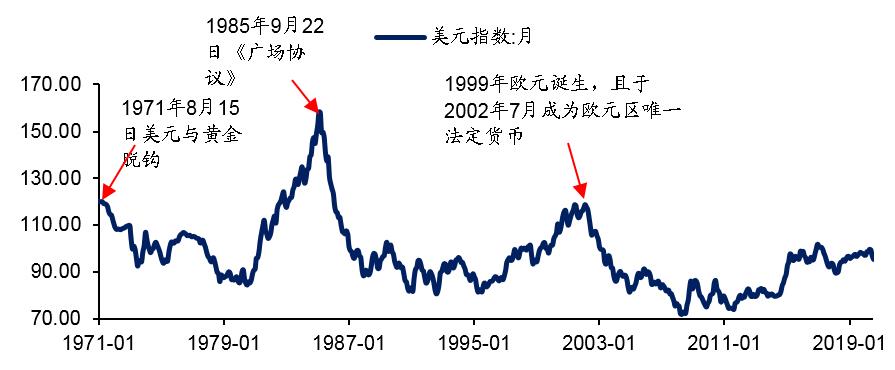
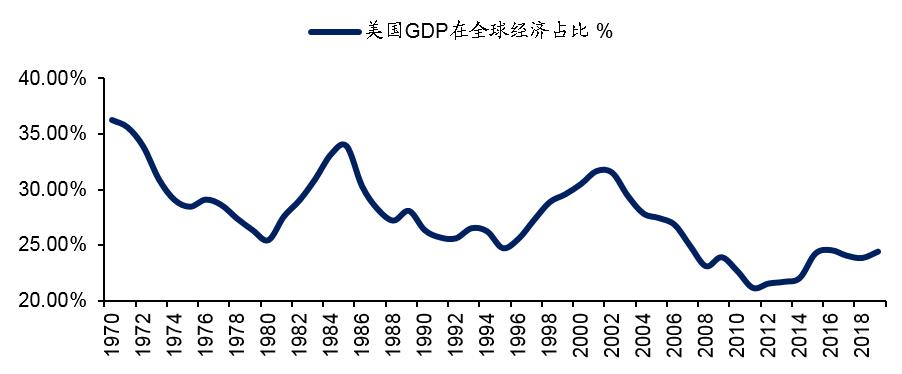
On the other hand, looking back at the cyclical ups and downs of the U.S. dollar index over the past fifty years, and analyzing the internal causes of these changes, the essence is the relative strength of the long-term economic and technological competitiveness of the United States relative to non-US economies. The U.S. dollar index has reached multiple highs in history, and milestone events of the U.S. dollar against non-U.S. currencies have occurred at corresponding time points (Figure 3). For example, the U.S. dollar left the gold standard in 1971 and the strong rise of Germany and France, the yen appreciated sharply after the "Plaza Agreement" in 1985, and the economic and trade integration of the euro zone around 2000 drove the euro to strengthen. The deeper reasons behind it are all The periodic weakening of the US dollar as a global trade and reserve currency. On the surface, these three relatively high points mean that the U.S. dollar system is forced to accept an emerging strong currency into the global monetary system. In fact, it corresponds to an important turning point in the changes in the national power of various countries and international rights and obligations. More than a decade after the financial crisis, due to the continued economic downturn in Europe and Japan and the technological revival of the United States, the US economy has increased its share of the world in the past decade, which has also promoted the relative strength of the US dollar.
Figure 3: U.S. Dollar Index Trend and Previous Depreciation Catalysts
2. The real interest rate reflects a country's long-term economic and technological competitiveness
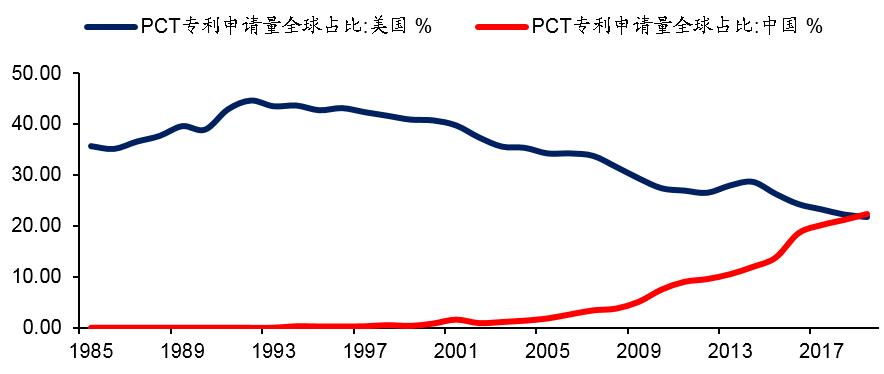
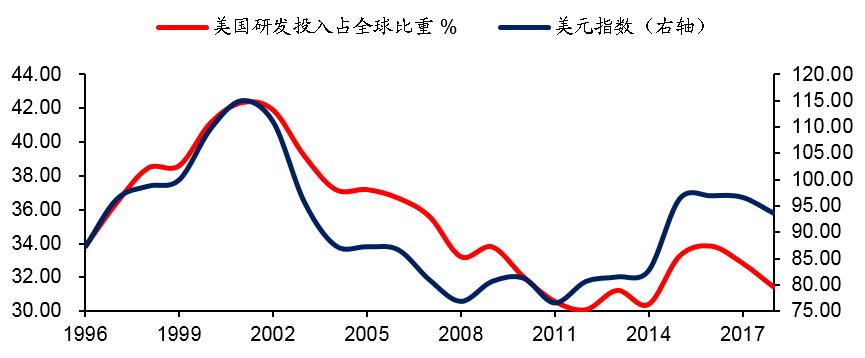
Broadly speaking, countries' long-term economic competitiveness can be attributed in part to their relative labor productivity. In short, an increase in a country's labor productivity often corresponds to an increase in its technological level and production efficiency, which will increase its division of labor and competitiveness in the global industry and easily promote currency appreciation. For quite a long time after the war, the United States has dominated the world in the number of PCT patent applications and R&D investment. The United States is undoubtedly still the world's largest innovator. In the 1990s, the US’s PCT patents once accounted for more than 40% of the world’s total (Figure 5), which also allowed it to basically monopolize the cutting-edge science and fruitful economic achievements of the global information revolution in the following two decades. The R&D investment of American companies accounts for more than 30% of the global proportion for a long time (Figure 6), far ahead of other countries. It is no exaggeration to say that the information technology revolution from the 1990s to the present, from Internet development to applications, wireless communication services, mobile phone communication equipment, and semiconductor manufacturing processes, has been basically monopolized by American companies in the form of brand, technology, or capital. , and dominate the global market.
To sum up, the U.S. dollar index has a long-term high positive correlation with the potential labor productivity of the United States and the proportion of U.S. R&D investment in the world. The fluctuation of the U.S. dollar index more reflects the strength of the national strength and technological competitiveness of the United States relative to non-U.S. economies Variety. U.S. labor productivity growth rate rises/U.S. technology R&D investment increases → U.S. economy’s long-term competitiveness rises → U.S. dollar index appreciates; U.S. labor productivity growth slows down/U.S. technology R&D investment growth slows down → U.S. economy’s long-term competitiveness declines → U.S. dollar index depreciates .
Figure 5: The number of PCT patents in China and the United States accounted for the global proportion (%)
Figure 6: U.S. R&D investment as a percentage of the world and the U.S. dollar index
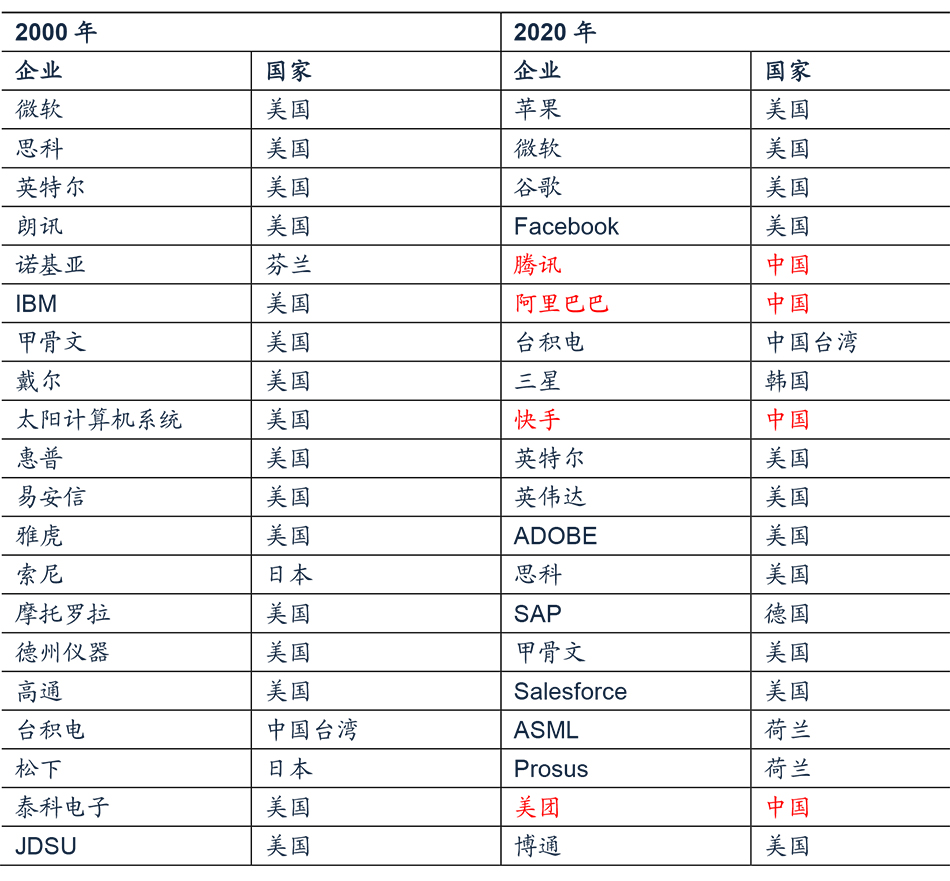
In the past ten years, with the rapid development of domestic communication equipment and Internet companies, a number of technology companies with global competitiveness have also been born in mainland China. With the rapid increase in the number of PCT patent applications and scientific research investment in mainland China, the technological level of my country's communications, electronics, and semiconductor industries has advanced by leaps and bounds. At the height of the dot-com bubble in 2000, most of the world's leading technology companies were from the United States. Today, non-European and American technology companies are mainly from China (Table 1), and Huawei's contribution to China's basic science and applied technology is undoubtedly the most significant. Of course, what must be objectively recognized is that although the gap between China and the United States is gradually narrowing in some key areas of science and technology, the gap still exists objectively, and many technology patents and technical standards have a long history, and Western countries have formed a strong Barriers to technological monopoly and property rights protection cannot be avoided in the short term.
Table 1: Changes in the world's top 20 technology companies by market capitalization in 2000 and 2020
3. Economic size + technological competitiveness is the core of long-term competitiveness among countries
The comprehensive national strength among countries mainly includes two aspects: the first is the economic volume, and the second is the level of science and technology. The two complement each other, and the level of science and technology leads the long-term competitiveness. Looking back at the history of the development of countries around the world after World War II, there are only a handful of countries that meet this requirement, and the United States undoubtedly has an advantage in both. In the past 40 years, through reform and opening up and the hard work of the people of the whole country, China is trying to narrow this gap. a gap.
Over the past few decades, fluctuations in the U.S. dollar index have actually better reflected changes in national strength and technological competitiveness between the U.S. and major non-U.S. economies. After the 1980s, with the rise of the Japanese economy, the US dollar’s global status once declined significantly; but after entering the 1990s, with the bursting of the Japanese financial bubble and the substantial improvement in the technological competitiveness of the United States in the information age, The U.S. dollar index and the status of the U.S. dollar have risen sharply again. After the financial crisis, with the decline of European and Japanese technology companies, American technology companies regained their dominance in this round of globalization, and the U.S. dollar index also bottomed out. Judging from the history of fluctuations in the U.S. dollar index, the strength of technological competitiveness among countries is well synchronized with the strength of currencies. Scientific and technological competition is the core of long-term competitiveness among countries. In the past ten years , with the continuous investment and rapid development of domestic enterprises in the fields of communication, electronics, semiconductors, new energy and other technologies, which has promoted the improvement of China's comprehensive national strength, the globalization of the RMB has also developed simultaneously and rapidly.
In recent years, as the proportion of emerging economies in the national economy continues to increase, whichever country masters more emerging science and technology, whichever country masters more enterprises with technological competitiveness and international pricing power, the development and application of 5G technology That's a good proof. In the era of the Internet and information technology, the United States has indeed incubated and created the vast majority of technology companies in the world, and these companies have absolute advantages in capital and technology, and their global competitiveness is actually crucial to maintaining the global hegemony of the United States and the status of the dollar. Provided the most favorable support. At present, with more emerging countries investing heavily in technology research and development and the global rise of non-US technology companies, the United States is also feeling unprecedented pressure. The rapid improvement of China's national strength and scientific and technological capabilities will have a huge long-term impact on the US dollar system and the US dollar index, just like Japan and the euro zone before, and the impact has just begun. The historical experience of the U.S. dollar index shows that whoever masters the ability to innovate in technology will master the password to unlock wealth.
(Extracted from the Internet)





 Add
Add


