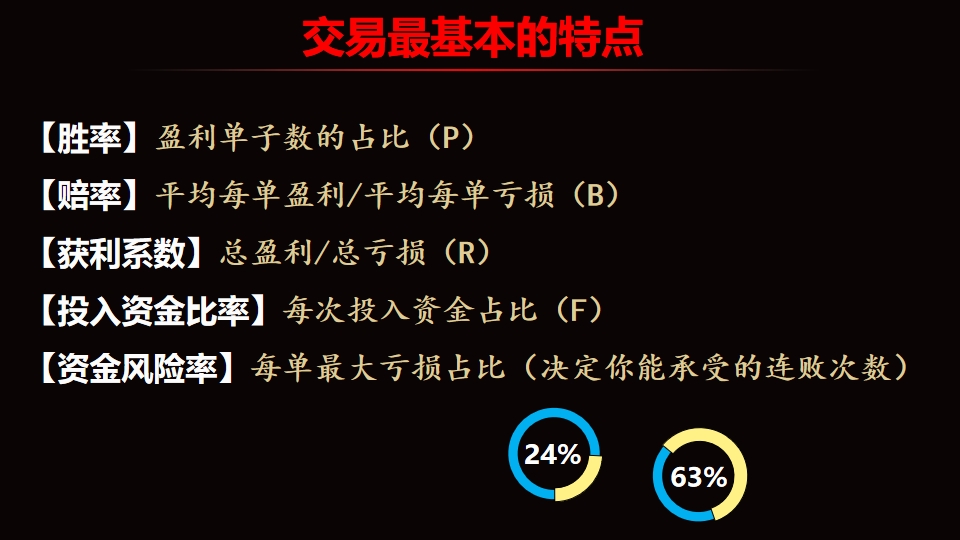
In a binary trading world that is either right or wrong, profit or loss, the results of long-term repeated trading operations will inevitably show various probabilistic and statistical characteristics. These precise and cold numbers profoundly reveal your trading Features that accurately reflect your trading performance.
These statistical characteristics are familiar to everyone, and it is commonplace to say them. They are:
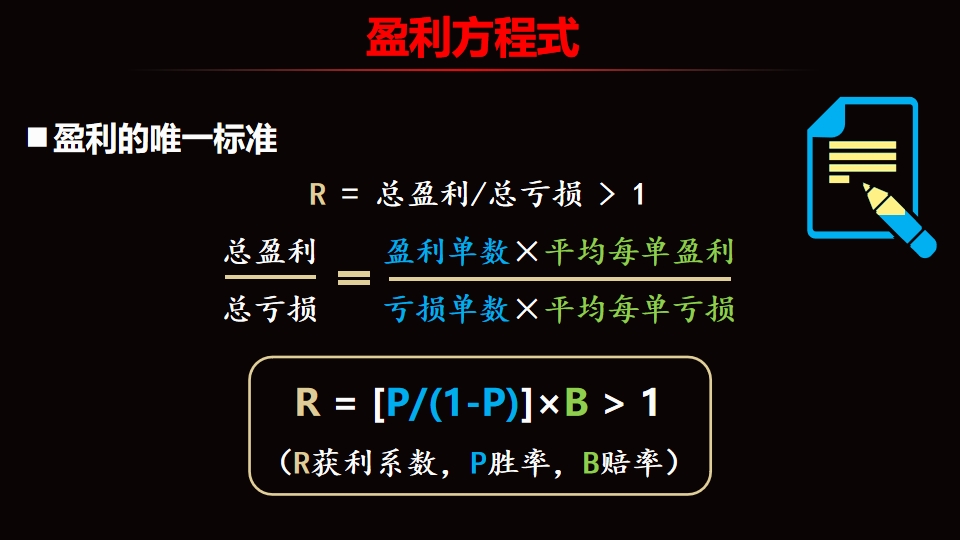
The only criterion for profit: total profit > total loss
That is: total profit/total loss > 1
In the above formula, the number of profit odds divided by the number of losses is the winning rate P divided by (1-winning rate P), the blue part; the average profit per order divided by the average loss per order is the odds B, the green part.
This is what we call a profit equation that is determined by your trading winning rate P and odds B.
Let's take a look at the theoretical calculation of the profit equation.
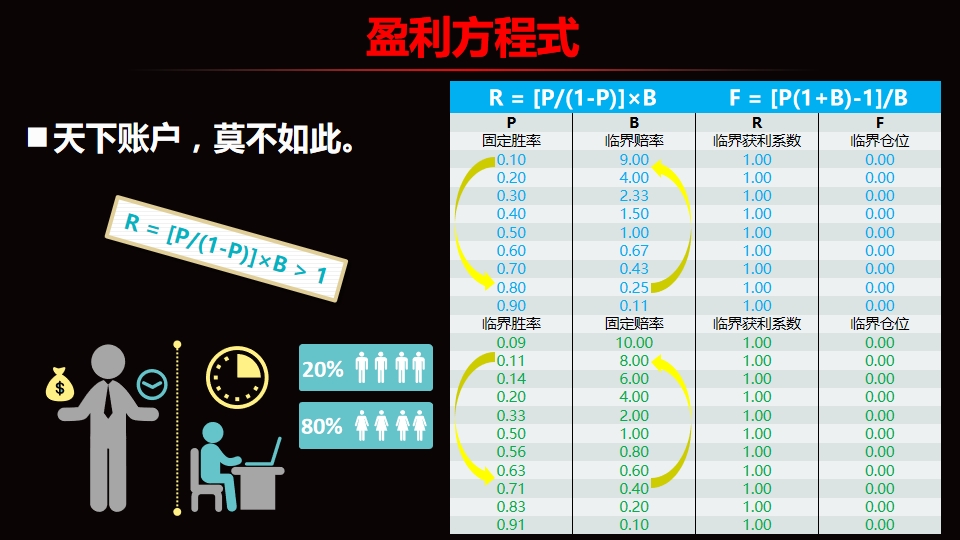
Let's fix the odds first:
① If you can only get 10 right out of every 100 orders on average (the winning rate is 0.10), then your average profit per order must be more than 9 times the loss to finally make a profit (odds 9.00). When the odds are 9.00, the profit factor is 1.00, so you don't lose. At this time, the proportion of investment funds is 0.00, which means that you should not invest a penny in a no-loss transaction;
② As the winning rate continues to increase, the odds requirements for your final profit will continue to decrease. If you can get 80 right out of every 100 orders on average (the winning rate is 0.80), then you can finally make a profit as long as your average profit per order reaches more than a quarter of the loss (odds 0.25).
Let's fix the odds again:
① If your average profit per order is 10 times your loss (odds 10.00), then congratulations, you only need to make more than 9 correct orders out of every 100 orders to make a profit (winning rate 0.09);
② As the odds continue to decrease, the winning percentage requirements for your final profit will continue to increase. If your average profit per order is one-tenth of the loss (odds 0.10), then unfortunately, on average, you get 90 right out of 100 orders and you still cannot make a profit (winning rate 0.91).
Whether you are a large institution or a small retail investor, no matter what trading ideas, concepts, methods, strategies, or tools you use, whether you are manually qualitative or mechanically quantitative, as long as it is a trading account with sufficient order samples, you are the ultimate investor. If it is profitable, then the combined operation of your trading winning rate P and odds B must be greater than 1, otherwise you must be losing money.
All accounts in the world are like this.
The profit equation contains two important statistical meanings:
[1] Only the trading system that satisfies the combination of P and B with R>1 is meaningful to execute: if
your winning rate is P, then your final profit must meet your odds B > (1-P)/P;
if Your odds are B, so you must satisfy your winning rate P > 1/(1+B) in order to make a final profit.
[2] Only the trading system that satisfies the P and B combination of R>1 has the significance of planning the ratio of investment funds: the
ratio of investment funds is also determined by the winning rate and odds of the transaction: F= [P(1+B)- 1]/B.
The profit equation has important guiding significance for our actual operation:
【1】Winning rate and odds are calculated based on long-term, large, sufficient and consistent single sample statistics
. Up and down, don't pursue the best of both worlds that doesn't exist;
[3] Your final trading performance is determined by your trading winning percentage and odds. They are like your left and right arms. Any split winning percentage and odds And the systems that only talk about one are one-sided and incomplete;
[4] In the long-term repeated trading operation process, you need to form a relatively fixed winning rate and odds combination that satisfies the profit equation, that is, you need to form a Relatively fixed trading methods.



 Add
Add


