1. The shape of a single candlestick:
It can be classified according to the four price points of highest price, lowest price, opening price and closing price. Among them, the opening price and closing price feel the range of the entity, the highest price and the lowest price determine the range of the amplitude, and they jointly determine the shape of the upper and lower shadow lines. It can be roughly divided into the following four types:
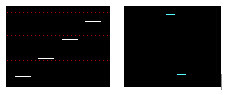
1. If the four digits are exactly the same, it is a flat board: divided into daily limit board and down limit board
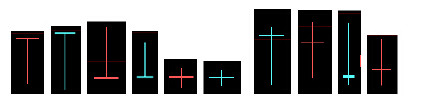
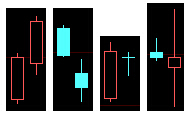
2. The opening price is almost the same as the closing price, but there are large fluctuations: it can be divided into three categories according to the position of the opening price, closing price and high and low prices: T-shaped, T-shaped, positive cross star, long upper shadow cross star, long shadow doji
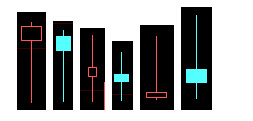
3. There is not much difference between the opening price and the closing price, but there is a large shock: it can be classified into hammer head, inverted hammer head, and medium hammer head
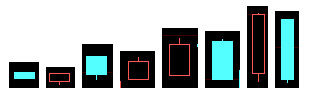
4. The body part accounts for the vast majority with little or almost no shadow line: according to the size of the body, it can be divided into extreme yang (yin), small yang (yin), middle yang (yin), and big yang (yin).
2. Two candlestick patterns
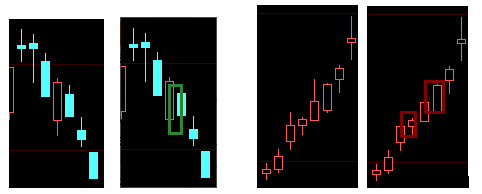
The two K-line patterns can be divided into rising, falling and containment, among which containment can be divided into the first two kinds of front containment and back containment.
Definition: The high and low points of the previous K line are H1 and L1; the high and low points of the next K line are H2 and L2
1) Up: H1 > H2 and L1 > L2 (the low point of the latter K-line is higher than the low point of the previous K-line, and the low point of the latter K-line is higher than the low point of the previous K-line)
2) Falling: H1 < H2 and L1 < L2 (the low point of the latter K-line is lower than the low point of the previous K-line, and the low point of the latter K-line is lower than the low point of the previous K-line)
3) The front includes: H1 >= H2 and L1 <= L2 (the high and low range of the previous K line includes the high and low point range of the next K line)
4) Afterwards include: H1 <= H2 and L1 >= L2 (the high and low range of the next K line includes the high and low point range of the previous K line)
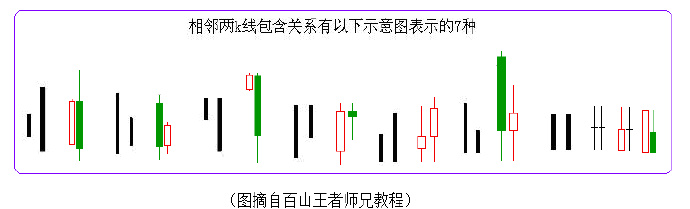
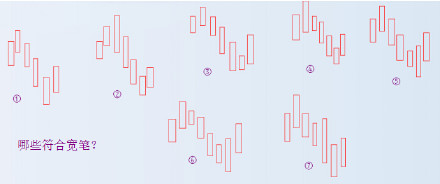
Two adjacent K-lines can have the 7 inclusion relationships shown in the figure, that is, the high and low points of one K-line are all within the range of the other K-line.
The inclusion relationship shows that the long and short parties are still entangled, and no substantial progress has been made. Adjacent K-lines with containment relationship can be merged and processed into one K-line. After processing, the two adjacent K-lines only have two forms: rising and falling.
K line contains processing methods:
K-line inclusion processing is divided into two ways: upward processing and downward processing, among which,
1) Up (high) processing: H=max(H1,H2) L=max(L1,L2)
2) Downward (low and low) processing: H=min(H1,H2) L=min(L1,L2)
Which processing method to adopt is determined according to the previous two included K-line forms:
If the first two are rising patterns, the upward (high high) processing method is adopted; the previous two are falling patterns, and the downward (low low) processing method is adopted.
Three, three candlestick combination form
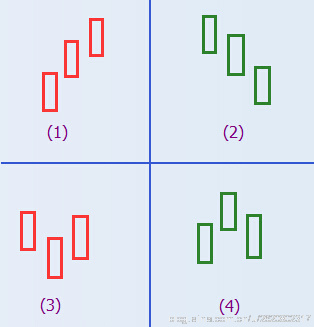
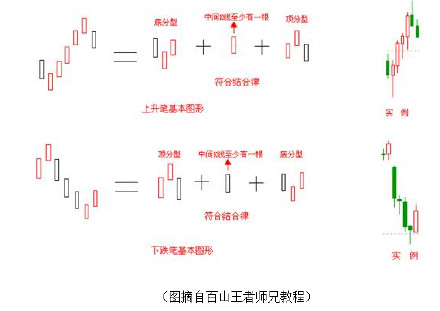
After including the three K-lines, the following four combinations can be obtained: 1) Up 2) Down 3) Bottom type 4) Top type
4. Pen (Multi-K-line combination form)
Intuitively, the pen is a K-line form composed of the top, bottom and the K-line between the top and bottom: the pen formed from the low point of the low point as the starting point to the high point of the top point as the end point is an upward pen; The high point of the fractal is the starting point and the low point of the fractal is the end point. The pen formed is an upward pen.
The precise definition of a pen is as follows:
1) Strict (old) pen definition:
Two adjacent tops and bottoms, and there is at least one candlestick between the tops and bottoms, constitutes a stroke. That is to say, after inclusion processing, there are at least 5 candlesticks in one transaction. The diagram is as follows:
2) Wide (new) pen definition:
Due to the different one-minute data processing methods between different software, the divided pens will be inconsistent. In order to facilitate learning and unify the division of pens, the teacher gives the following definition of wide pens. From the perspective of energy strength, the establishment conditions of pens can be defined A little looser, that is, a sum that meets the following two conditions:
1. After the top parting and bottom parting are included, no common K-line is allowed, that is, there cannot be one K-line belonging to the top parting and bottom parting respectively. This condition is not allowed to be relaxed, because only in this way can guarantee strength.
2. Under the premise of satisfying one, between the highest K line in the top type and the lowest K line in the bottom type (excluding these two K lines), regardless of the inclusion relationship, there are at least three K lines (including three) K-line, obviously, the second requirement is slightly looser than the original requirement that there must be an independent K-line between types.
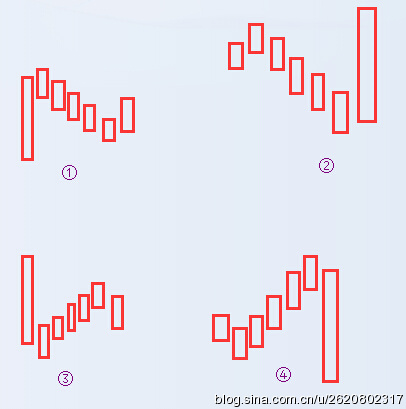
The wide pen is constrained by the two conditions 1 and 2 at the same time. From 1, it can be seen that after the inclusion process, there are at least 4 candlesticks in one stroke. It can be seen from 2 that a stroke of wide pen contains at least 5 K-lines that have not processed the inclusion relationship. It should be noted that the following four situations are not wide pens.
Points to note about pen division:
1. Strict inclusion processing, if the inclusion processing is wrong, it is likely to lead to incorrect stroke division.
2. Strictly distinguish strict pen and wide pen, strictly implement according to the definition, and maintain the unity of the division standard.
3. It is not allowed to appear that the top type is lower than the bottom type or the bottom type is higher than the top type.
4. Dynamic adjustment of the pen
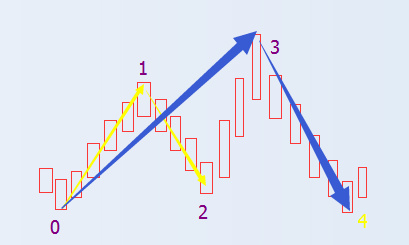
After a new high or new low appears, the bottom (top) corresponding to the new high (new low) does not form a pen, so it can be used to replace the previous top (bottom)
0~1 is an upward stroke, 1~2 is a downward stroke, but 2~3 is not satisfied with one stroke, but 3 is a new high, so the new high is merged with the previous one 0~1, and 0~3 is adjusted to 1 pen up, 3~4 is 1 pen down.
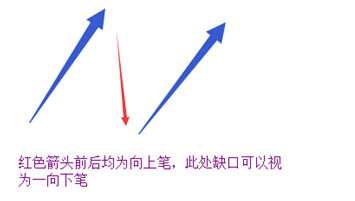
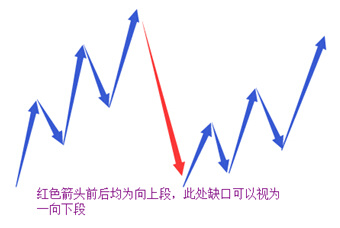
5. Dealing with gaps
The homeopathic gap is not processed, and the reverse gap can be written or segmented according to the specific context
1) If there are pens in the same direction before and after the reverse gap, the gap can be a reverse stroke
2) If there are segments in the same direction before and after the reverse gap, the gap can become a reverse segment
【About Entanglement】
Generally, everyone is familiar with two kinds of pens: old pen (strict pen) and new pen (wide pen). These two pens are familiar to everyone. They are mainly used to construct line segments at the bottom layer. It can be used, but if you use strict pen definitions on the large cycle diagram, you will often encounter awkward moments. In fact, the pens on the large cycle diagram do not need to be strictly defined. On the large cycle, the classification is mainly used to predict the turning point , so the requirements for writing can be relaxed. Because, the following two types of pens have been newly added to the Tangzhong Hunting Tanglun toolkit. For the convenience of explanation, they are called "simplified pens" and "essay pens" respectively.
What is Jianbi? Simple strokes are the simplest, that is, the high-low point connection line after the K-line is merged, which can also be understood as the direct connection line of the top-bottom parting, where the top-bottom parting can share the K-line. It is so convoluted, you can understand it directly from the above picture.
The advantage of this kind of simple pen is that it eliminates the future function of the pen. As long as the parting type is formed, it will become a pen, and it will not change in the future. On the large cycle diagram, it is sometimes clearer to look at the picture according to the simple pen, especially When the market is in shock, how to use it, you can slowly experience it yourself, and I will share my experience with you when I have time.
What is an essay? The essay is not a random pen, but on the basis of the new pen, the following two conditions have been released:
1. Let go of the restriction that the top and bottom cannot be written.
2. Let go of the restriction that you cannot complete a pen when it is less than 5K but has surpassed the previous one.
After letting go of these two restrictions, there will be no such awkward situation when drawing a pen on the large cycle diagram. Because we mainly use the type and the pen center as references in the big cycle, so letting go of these two conditions will not have a negative impact on our application, but it is more suitable for the structure of the pen center.
I would like to emphasize here that I do not quite agree with the pen center. The large-scale pen itself is a rough thing, and the pen center is even more rough. Therefore, for analysis, the precise and recursive one shall prevail. However, in terms of quick market reading and program stock selection, the pen center is still a good choice, which is a compromise in feasibility. Therefore, the compromise based on large-level pen center market reading and stock selection is elementary. ,Roughly. Can not be completely relied on, need further detailed analysis.
To sum up, there are four types of pens that can be switched independently in the Tangzhong Hunting Tanglun toolkit: 0 (old pen), 1 (new pen), 2 (simple pen), 3 (essay pen), by These four kinds of pens can also construct four kinds of pen centers. Therefore, when you choose stocks by form, you can choose a variety of stocks based on these four pen centers, which greatly increases the chances of stock selection by form. Flexibility and applicability.
Finally, I would like to share a relatively complete formula for writing and segmenting Tanglun:
[Download link of Tangling Hunting Toolkit] https://pan.baidu.com/s/1uzBXj5b-LNxDM91CaTVysg Extraction code: r6u8
[Special reminder] Because the pen type of the stock selection formula and the pen type of drawing are set separately, it is enough for everyone to keep the same when using it. If you use a strict pen to select stocks, but use a random pen when looking at pictures, this Time may not match the number.


 Add
Add


