Trendline
A trend line is a straight line that can correctly reflect the market trend.
The trend line made needs to meet two principles:
(1) Can correctly reflect market trends;
(2) This trend line can better serve the transaction.
There is no unified regulation in the industry for the drawing of trendlines, and the trendlines drawn by different traders may be different, but as long as they are drawn correctly, the overall difference will not be great—because the trend is established, Trendlines must correctly reflect the trend. Generally, we will use the connection of inflection points to draw trend lines.
But here are three important points:
(1) Not all inflection points and inflection point connections are trend lines, some are just inflection point lines, which will be introduced later.
(2) In order to serve the transaction, sometimes it is possible to draw a trend line through the entity of the K line without selecting an inflection point.
(3) The trend line needs to be adjusted according to the dynamics of the market. Only dynamic adjustments can better pay attention to trading opportunities.
rising trend line
An upward trend refers to a trend in which each round of rising highs continues to make new highs and each round of callbacks continues to raise lows within a given period of time. A straight line that correctly reflects the upward trend is the upward trend line.
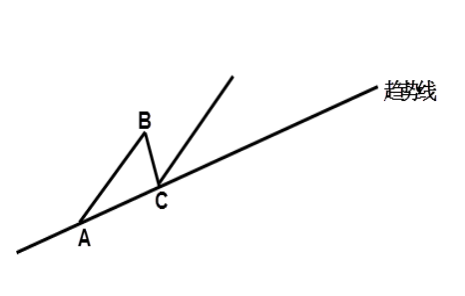
Figure 3.9 Uptrend Line
Figure 3.9 is a schematic diagram of an upward trend line, A, B, and C are all effective inflection points and A is a low point, C is a low point caused by a callback, and B is a high point caused by a rise.
Generally, when the market price successively produces three effective inflection points A, B, and C, if the price continues to run upwards to the vicinity of point B or exceeds point B, we can connect the two effective inflection points A and C to connect the two effective inflection points. The line formed by the dots is the uptrend line - the uptrend line forms a support.
With the development of the market, when the strength of the bulls is extremely strong and the price rises rapidly, the market may not run strictly according to the original upward trend line, that is, the low point of the callback has not been tested to the original trend, and it will be supported and resumed. Expand upward, at this time we need to correct the rising trend line.
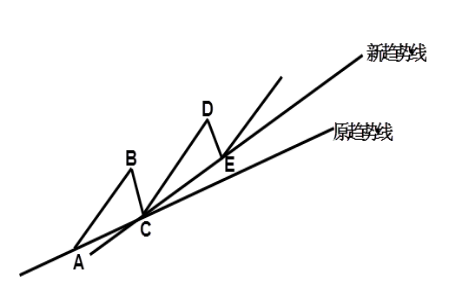
Figure 3.10 Correction of the Uptrend Line
As shown in Figure 3.10, with the development of the market, the price rose to point D and started a callback, but the low point E of the callback did not test the original trend line below and continued to rise.
When the price rises to a new high point near D or exceeds D, we can connect C and E to form a new upward trend line. This upward trend line is closer to the market. At this time, we should pay more attention to this trend The support function of the trend line and use it to serve the transaction, but it should be pointed out that the original trend line still has a support function. This trend line adjustment process is the correction of the upward trend line.
It should be noted that the correction of the trend line has prerequisites and cannot be carried out prematurely. When the price rises to a new high or exceeds a new high, we can adjust and correct. Correcting prematurely by mistake can distort the trend and lead to wrong trading, as shown in Figure 3.11.
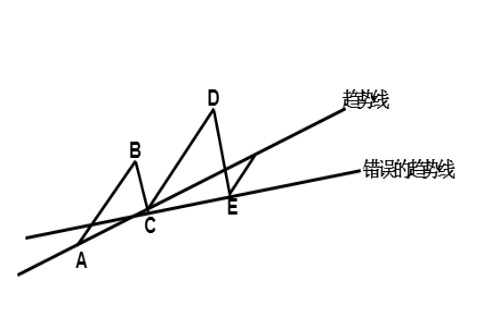
Figure 3.11 Wrong Trendline Correction
Figure 3.11 is a schematic diagram of the wrong trend line correction. From the figure, we can see that point D is another new high in the process of rising, and then the market starts to pull back. When the price pulls back to the vicinity of the rising trend line, we should pay attention to its performance.
In the figure above, the price directly fell below the upward trend line and stabilized at point E. Point E is an effective inflection point and its price is higher than the previous callback low point - point C.
But when the price stabilizes at point E and goes up again, because the price does not return to the original upward trend line and reaches near point D, we cannot prematurely correct the trend line.
In fact, since the upward trend line has been broken, although there is no clear reversal of the trend at this time, we should pay attention to the back pressure after the upward trend line is broken. If the price is under the back pressure of the trend line and goes down again If it falls below point E, the trend will change from long to short. If the trend line is corrected incorrectly, it will distort the trend and make it impossible to accurately judge the trend.
In the actual market, due to the fact that the gold currency market is a reflection of the trading behavior of global traders, the quotations of each platform may be different, and glitches, etc., the effective inflection point often cannot be accurately generated on the trend line, but is generated near the trend line. At this time, we need to be more flexible in drawing the trend line, and do not require too much precision, as shown in Figure 3.12.
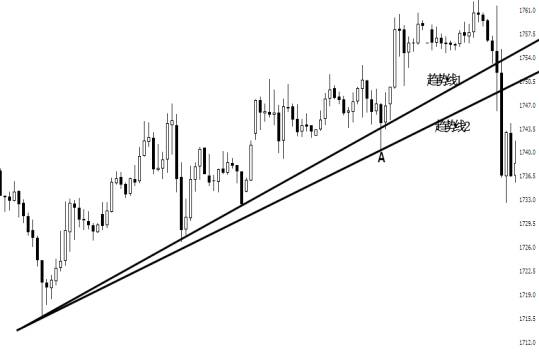
Figure 3.12 Golden hour trend line
Figure 3.12 shows the golden hour chart with two upward trend lines, both of which are correct. But in trading, trend line 1 provides us with greater help and value.
Because this trend line is closest to the market, it can reflect the market trend changes in the most timely manner. Trend line 2 is an upward trend line formed by strictly connecting effective inflection points, but it lags behind in reflecting trend changes.
Point A in the figure is an effective inflection point. The trend line 2 obtained through point A strictly according to the definition of the trend line is relatively lagging behind, while the trend line 1 that is regarded as a burr shape and drawn flexibly is closer to the market, which is helpful for our trading bigger.
As we said at the beginning, the trend line drawing method needs to meet two principles-the trend line must be able to correctly reflect the market trend and the trend line can better serve the transaction. Obviously, the trend line 1 is more in line with these two principles, But trend line 2 is more conservative than trend line 1. Once it falls below, the trend change will be more certain.
downtrend line
A downtrend refers to a trend in which, within a given period of time, when the lows of each round of decline continue to make new lows, the highs of each round of callbacks also continue to decrease. A straight line that correctly reflects a downtrend is the downtrend line.
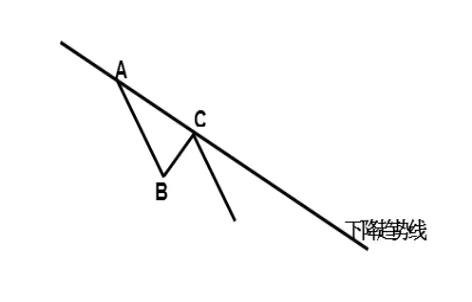
Figure 3.13 Downtrend line
Figure 3.13 is a schematic diagram of a downward trend line, A, B, and C are all effective inflection points and A is a high point, C is a high point generated by a callback, and B is a low point generated by a decline.
Generally, when the market price successively generates three effective inflection points A, B, and C, when the price continues to run down to the vicinity of point B or exceeds point B, we can connect the two effective inflection points A and C, and connect the two effective inflection points. The straight line formed by the dots is the downtrend line - the downtrend line forms a suppressive effect.
With the development of the market, when the bear power is extremely strong and the price falls sharply, the market may not strictly follow the original downward trend line, that is, the callback high point is not tested to the original trend line, and it will be suppressed and start to expand again. At this point we need to correct the downtrend line.
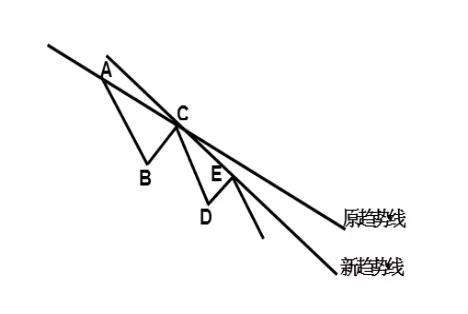
Figure 3.14 Revision of the downtrend line
As shown in Figure 3.14, with the development of the market, the price fell to point D and started a callback, but the callback high point E did not test the original trend line above and continued to fall.
When the price falls to a new low point near D or exceeds D, we can connect C and E to form a new downward trend line. This downward trend line is closer to the market. At this time, we should pay more attention to this trend line and use it to serve trading, but it should be pointed out that the original trend line still has a suppressing effect. This trend line adjustment process is the correction of the downward trend line.
In the part of the rising trend line, we also introduced the wrong trend line correction and the flexible drawing of the trend line.
The descending trend line also involves these two points, so I won’t go into too much detail here. Readers can combine the knowledge of the rising trend line to deduce its situation in the descending trend line.
Application of trendlines
The trend line has an important reference value, it intuitively reflects whether the trend is in a healthy state.
What we often say "follow the trend" must be inseparable from the trend line. A very important role of the trend line is to help us find support and resistance levels.
General technical indicators are calculated based on the price, and the biggest flaw is the hysteresis; and the trend line is often forward-looking, that is, according to the trend line, we can predict in advance the area where the market may have a chance to pull back.
Uptrend line support
Generally speaking, in an upward trend, we only pay attention to the long opportunities and give up the short opportunities during the pullback.
When the upward trend line remains intact, it has a good supporting effect, which provides us with an operable focus area for us to pay attention to long trading opportunities.
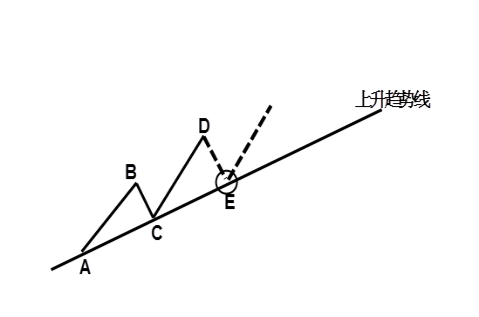
Figure 3.15 The support function of the rising trend line
As shown in Figure 3.15, the market maintains a good upward trend, connecting the effective inflection points A and C to form an upward trend line.
When the market reached a new high and reached point D, the market began to pull back. During the callback process, we give up short trading opportunities. Based on the support of the upward trend line, we can predict in advance that the market may pull back to area E and pay attention to possible long trading opportunities in this area.
If there is an obvious reversal candle pattern in area E (such as the cross star, hammer line, upward engulfing pattern or morning star we introduced in the previous chapter), we can properly intervene in the long position and set a stop loss.
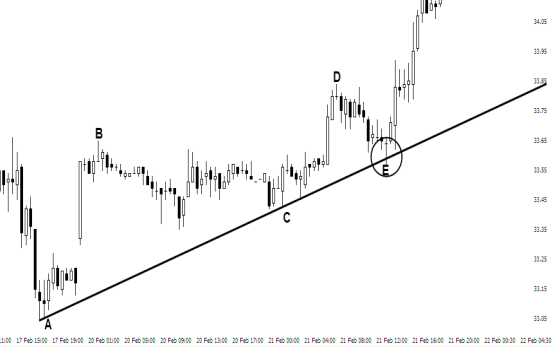
Figure 3.16 Silver 30-minute chart
Figure 3.16 is a 30-minute chart of silver. When the market stabilizes at point C and then rises to the high point B, we can connect points A and C to form an upward trend line.
When the market hits a new high point D and starts a downward correction, we can roughly estimate that the target of this wave of correction may be the E area according to the support of the upward trend line. When the price enters the E area and tests the upward trend, we should Highly concerned about its possible long opportunities.
The price in the figure is obviously supported after testing the rising trend line - first the cross star is closed, and then a resolute big Yang line forms an upward engulfing pattern with the previous cross star. At this time, we can rely on the support of the rising trend line and stabilize An up candle pattern enters the long position and places a stop loss.
Suppression of the downtrend line
Generally speaking, in a downtrend, we only pay attention to short opportunities and give up long opportunities during pullbacks. When the downtrend line remains intact, it has a better suppressing effect. This provides an actionable focus area for us to focus on short trading opportunities.
Figure 3.17 Suppression of the Downtrend Line
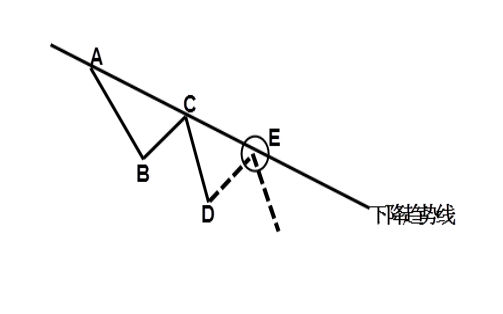
As shown in Figure 3.17, the market maintains a good downward trend, connecting the effective inflection points A and C to form a downward trend line.
When the market reached a new low and reached point D, the market began to pull back. During the callback process, we give up long trading opportunities. According to the suppressing effect of the downward trend line, we can predict in advance that the market may pull back to area E and pay attention to possible short-selling opportunities in this area.
If there is an obvious reversal candle pattern in area E (such as the doji, shooting star, downward engulfing pattern or evening star, etc. we introduced earlier), we can appropriately intervene in the short position and set a stop loss.
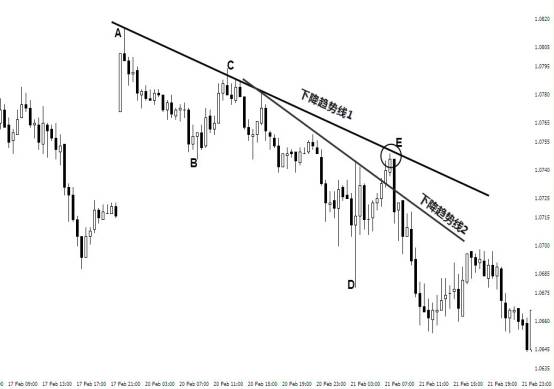
Figure 3.18 AUD/USD 30-minute chart
Figure 3.18 is the 30-minute chart of AUD/USD. When the market falls from point C to near the previous low point B, we can connect points A and C to form a downward trend line 1. When the market hits a new low point D and starts an upward correction At that time, although a downward trend line 2 that was more suitable for the market once appeared in the market and was broken upward, it cannot be concluded that the trend has reversed. Investors should retreat to the upper downward trend line 1 and pay attention to possible short trading opportunities.
The price was obviously suppressed after testing the pressure level - it closed a resolute big negative line and formed a downward engulfing pattern with the previous positive line, and at the same time returned to the bottom of the downtrend line 2. At this time, we can enter the short position and set up stop loss.



 Add
Add


