The Federal Reserve is familiar to everyone, but it is very strange. Because most people know very little about the Federal Reserve other than its name. This time I am going to write about the most basic things about the Federal Reserve. I try to simplify it so that everyone can understand it.
Since it is a basic thing, it is natural that the composition of the Federal Reserve cannot be avoided, that is, the organizational framework.
The three agencies of the Federal Reserve
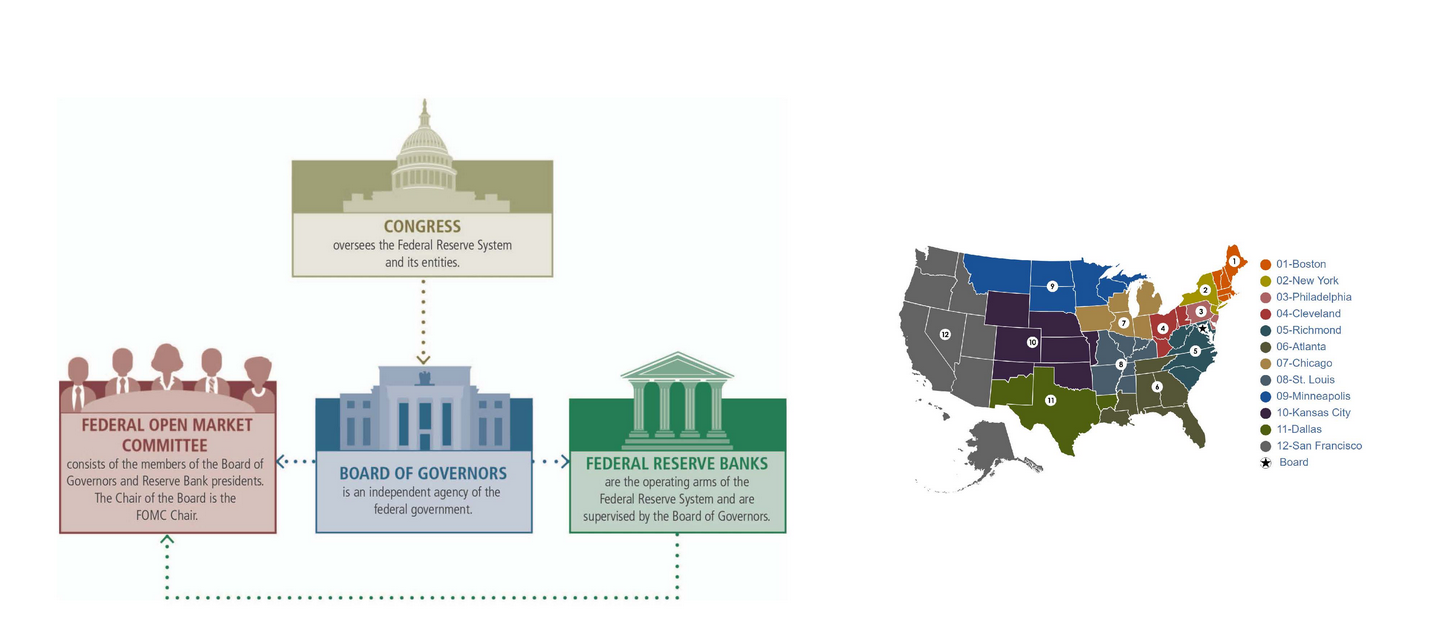
Looking at the picture below (left), you can clearly see that there are three key institutions under the Fed:
The first is the Board of Governors of the Federal Reserve
The second key institution is the 12 branches of the Federal Reserve. In history, the 12 branches were originally operated separately, and then the Federal Reserve Act of the Federal Reserve brought them together and belonged to the entire Federal Reserve system.
The third core institution is the Federal Open Market Committee (FOMC). The FOMC is an institution that those of us who do transactions are more concerned about. Because every Fed interest rate resolution and monetary policy meeting is held by the FOMC, rather than by the Board of Governors of the Federal Reserve and various branches of the Federal Reserve, the FOMC is the sub-agency of the Federal Reserve that we focus on.
The picture above (right) shows 12 branches, maybe the presence is relatively weak? Wrong. These 12 branches have their own research groups and their own statistics, such as the economic situation of the state where they are located, the status of industry, manufacturing industry, and so on. Therefore, the official websites of these 12 branches actually contain a lot of valuable data and research materials.
The Fed's Hierarchy of Power
After talking about the structure, we are looking at the power level of the Federal Reserve.
The first point is that the Federal Reserve is regulated by law, there is no doubt about it. Because the establishment of the Federal Reserve is based on the Federal Reserve Act, which means that the Federal Reserve needs to act according to the law. For example, the Federal Reserve Act stipulates that the Fed's influence on the interest rate market can only be indirectly affected by buying and selling government bonds.
As for the monetary policy goals that the Federal Reserve wants to achieve according to the law, there are two. The first is full employment, and the second is stable inflation. This goal is similar to the important central banks in the world.
The second point is that the president and Congress actually lead the Fed. Although many Fed officials always mention that they are not involved in politics when they speak, or that the Fed has policy independence, in fact they are still influenced by the president and Congress (Powell and Trump are good examples) ).
The third point is that the current market pays too much attention to the chairman of the Federal Reserve, but pays too little attention to the members of the Board of Governors of the Federal Reserve Board and other voting committees of the FOMC.
Why not pay too much attention to the chairman? Because in the FOMC, as long as you are a member of the FOMC, you have the right to vote to make decisions on monetary policy. You can vote for or against, and Powell actually only has one vote (the right to vote). For others, there is no too much power.
The Fed is only nominally independent
The so-called independence of the central bank is only nominally independent, not actually independent. Former Federal Reserve Chairman Bernanke once said:
When the independence of the central bank is guaranteed, if under the pressure of politicians, the monetary policy formulation is too expansionary, or the government's finances rely on monetary policy as a source of financing, this can prevent inflation from rising.
In other words, what kind of problems will a central bank without policy independence face? Easily pressured by the President or other superiors. They will force you to expand monetary policy, why? Because if interest rates are low, the economic growth numbers look better (déjà vu?)
In addition, why does government finance affect the independence of monetary policy?
Everyone knows that the currency of the Eurozone is managed by the European Central Bank. If other countries in the euro zone issue national debt and the government is unable to repay it, they have no right to repay their national debt through fiscal monetization, that is, printing money to repay debt.
From another perspective, these countries in Europe do not have monetary sovereignty, only fiscal sovereignty. But for the United States, if the Ministry of Finance wants to implement expansion or deficit financing, it can use the central bank to monetize to support such an expansionary policy.
Federal Reserve-Treasury Agreement
There is a very famous agreement in history - the "Federal Reserve-Treasury Agreement", which established the so-called modern independence of the Federal Reserve and liberated the Federal Reserve from the hands of the Treasury Department.
The background of this agreement is that after the outbreak of the Korean War in June 1950, the differences between the Federal Reserve and the Treasury Department on interest rate policy further deepened.
The Ministry of Finance advocates maintaining a low interest rate, because when the interest rate is low, the cost of paying interest is low when issuing treasury bonds.
But the Fed advocates raising interest rates, why? Because supplies were relatively scarce during the war, inflationary pressures were particularly high at that time. In anticipation of war, the public flocked to buy necessities. In the second half of 1950, the U.S. CPI rose by 7.7%, while in the first half of 1950 it rose by 17.2%, which was a terrifying level of inflation.
Fed hawks versus doves
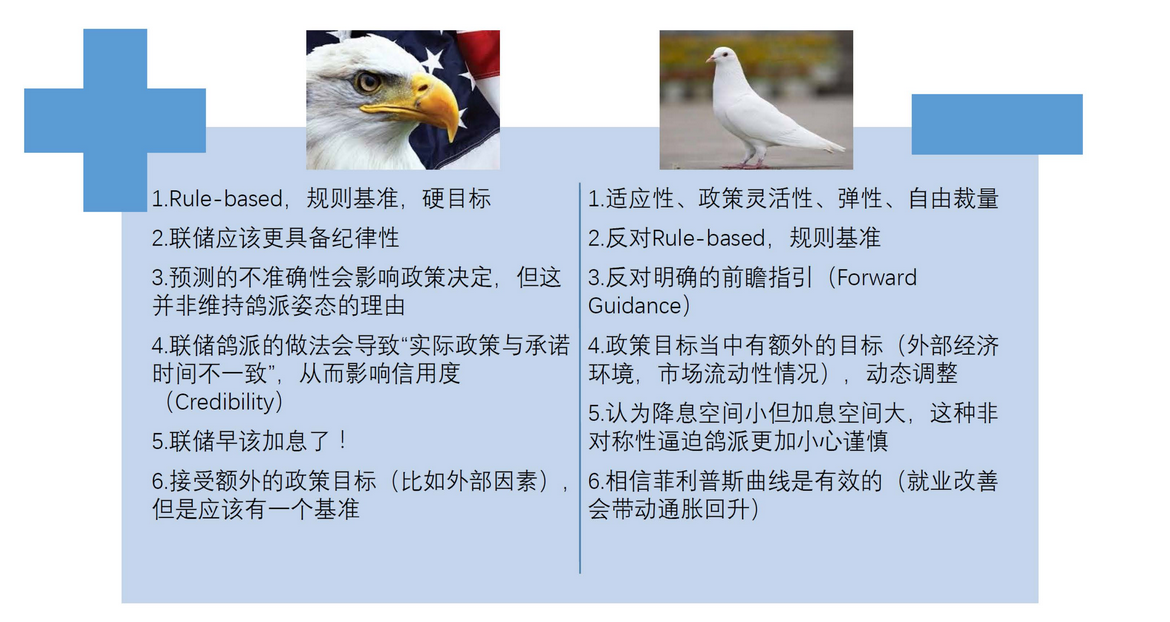
Everyone knows that there are hawks and doves among the officials of the Federal Reserve. What is the difference between these two factions? Or what impact does it have on monetary policy? The hawks are on the left and the doves are on the right.
1. Hawks
The hawks hold that once inflationary pressures arise, interest rates must be raised, so the plus sign is used on the left side of the figure. The hawks' claim is to implement monetary policy through some hard targets.
For example, the most common Taylor rule, once the central bank sees that the inflation indicator reaches a certain level, such as 2.5% or 3%, or the unemployment rate reaches the natural unemployment rate, such as 3% or 4%, then it must follow the rules to increase inflation. interest.
In addition, hawkish officials believe that the Fed should accept some additional policy goals, but these additional policy goals must also have a benchmark.
For example, now that the UK is leaving the European Union, our policies may need to take a break, right? We should not cut interest rates in such a hurry, lest it affect the global financial market. But the hawks are opposed to this, and believe that although Brexit is a risk point, the Fed should define what kind of benchmark situation it should relax, instead of taking these risk events as a reason for dovishness.
2. Doves
After talking about the hawks, let's talk about the doves. Doves are more flexible, emphasizing the adaptability, elasticity, and flexibility of monetary policy. There's a word called discretion, and that's what the doves are advocating.
Monetary policy should be discretionary, rather than hard-coded by rules. Doves are very opposed to rule benchmarks and clear forward guidance. It’s just that the words are too clear. For example, we will raise interest rates when we reach 2% inflation. The doves are more opposed to this statement.
The doves believe that there should be additional goals among the policy goals, such as the external economic environment, such as Brexit, the debt crisis in Europe, or the deterioration of market liquidity, so the Fed should make dynamic decisions based on these different situations. adjustment.
Dovish officials believe that the Phillips curve is effective, which means that when the employment situation is improving, inflation will definitely pick up; and when the Phillips curve is invalid, doves will be more cautious in policy.
Three other divergences at the Fed
In addition to the difference between doves and hawks, the Fed will also have differences on whether it is fast or slow, active or passive.
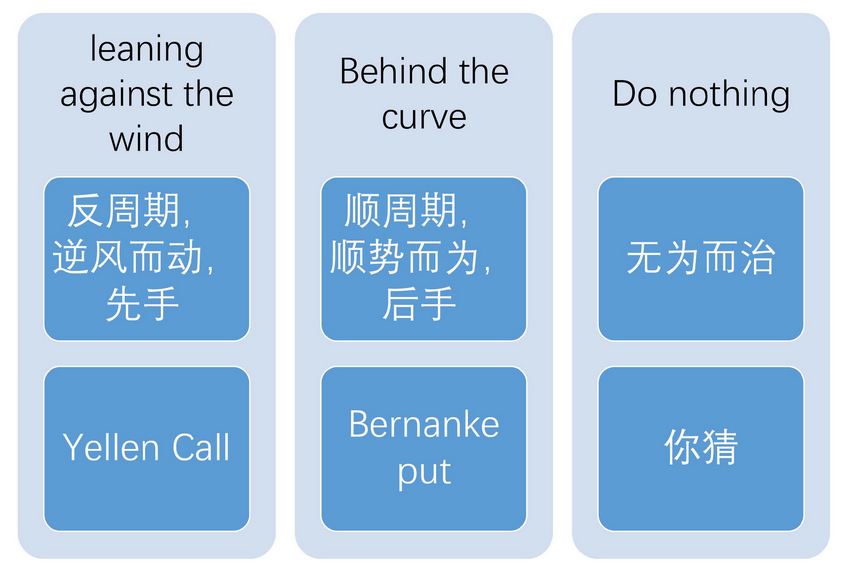
What is the point of disagreement? The first is liner against wind, that is, running against the wind, the second behind curve, is behind the curve, and the third is do nothing, which means doing nothing.
The first two statements are relatively common in the market, and the third almost never appears. How to understand these three situations?
How to explain the first one? That is to say, when the economy starts to recover, we cannot wait for it to really start to recover before starting to raise interest rates, but to raise interest rates first when we see signs of economic recovery. Representative: Yellen.
Then the second is a proposition made by former Federal Reserve Chairman Bernanke. He believes that it should follow the trend and play a backhand.
How to explain the second one? That is, in the process of raising interest rates, you must see some clear data, or the economy has turned for the better, and it is almost telling you: It is time to raise interest rates. If you only raise interest rates at this time, the market will think that it is behind the real interest rate curve. Because it's too dovish. Representative: Bernanke.
The first is seen as more hawkish and the second more dovish.
These disagreements of the Fed will eventually affect the market, and how?
To put it simply, the consistency of monetary policy becomes worse, and interest rates are raised for a while, and interest rates are lowered for a while. The market will be disturbed by these policy changes and become more chaotic.
In addition, in addition to the impact on the financial market, it will also impact the economy, because many corporate expenditures or plans are adjusted based on interest rates. And such changes will eventually affect the market's trust in the Fed.


 Add
Add


