The combination of candlesticks, support and resistance lines, and moving averages works very well to find support and resistance levels. When looking for support and resistance levels among the three, the most direct ones are support resistance lines and moving averages, but candlestick charts are also of great significance.
On the one hand, candle charts are the basis for making support resistance lines and moving averages; on the other hand, candle charts can verify the effectiveness of support and resistance levels found through support resistance lines and moving averages. The more technical methods point to the same area, the more worthy of attention this area is, and this area is the resonance area.
Finding Support and Resistance We also tend to look for areas of resonance, which are more reliable than areas indicated by a single technical indicator. It also needs to be pointed out here that among our moving averages 50SMA and 15EMA, generally only 15EMA is used to find support and resistance levels, and 50SMA is not used as a moving average to find support and resistance levels.
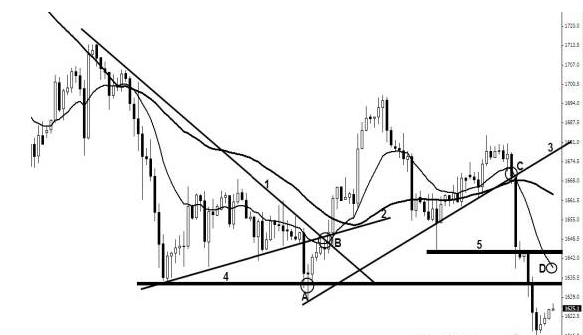
Below we will use the gold 4-hour chart to illustrate how the three combine to find support and resistance levels.
We will respectively explain how areas A, B, and C use candlestick charts, support-resistance lines, and averages to determine whether they have support or resistance.
In area A, we can make a horizontal straight line through the previous low point, which is the horizontal support line. When the market falls below the inflection point support line 2 with a resolute big negative line, it is necessary to pay attention to the horizontal support line 4 at this time. It can be seen that when the market moves to the vicinity of this position, although it once fell below the horizontal support line, the price recovers and rises again. The doji closed at the close, and then a positive line with a larger range verified the validity of the horizontal support band. Area A is a combination of support and resistance lines and candlestick charts.
In area B, when the price is supported and stabilized upward, we should focus on the pressure in area B at this time.
Why is the pressure effect of area B so important? This area is actually the resonance zone of three major pressures. These three major pressures are: the counterpressure effect after the inflection point support line 2 is broken, the suppression effect of the downward trend line 1, and the suppression effect of 15EMA.
It can be seen that the market has been somewhat suppressed here, but after a brief adjustment, the market resolutely breaks through upwards. Although this pressure zone is strong, it is not necessarily impossible to break through. Once a breakthrough shows that the bulls in the market are extremely strong and the suppressing effect becomes stronger. For support.
It can be seen that after the market broke through the B area, the strength of the bulls was fully released, and a rise of nearly 500 points was launched. Area B is the combined use of the support resistance line and the moving average.
In area C, when the market moves to the vicinity of area C, there is an upward trend line 3 support below. It can be seen that our treatment method for this trend line is to regard the lower lead of the middle K line as a glitch, and flexibly make a closer line The superiority of this method is fully reflected in this example - to determine the end of the original trend of the market in advance.
When the price is adjusting, we should first pay attention to the support function of 15EMA, because the support position it provides is closer to the price. When the market falls below the support function of 15EMA with a firm negative line and directly tests the upward trend line, we should not be overly bullish .
It can be seen that after the exhaustion pattern appeared at the high level, the resolute big Yin line and the previous small Yang line formed a downward engulfing pattern. At this time, more attention should be paid to the possible breakout of the market.
It can be seen that the support function of the upward trend line has also been broken. When it is broken, our primary target can be seen at the horizontal support band 5 below. Area C is used in conjunction with candlestick charts, support resistance lines and moving averages.
A, B, and C are all historical market prices. Now we analyze how to use candlestick charts, support resistance lines and moving averages to find support and resistance levels under the real-time market conditions in this figure.
Due to the large decline, the downward trend line has not yet formed, and the counterpressure effect formed by the break of the upward trend line is also far away, so we don't need to pay attention to both of them for the time being.
It can be analyzed that the short-term trend of the market is a downward trend, but after falling to 1611, it stabilizes and pulls back upwards. We can make a horizontal support zone 6 through the low point of 1611, which is likely to be a short target in the market outlook.
The market is undergoing an upward correction. We must first pay attention to the horizontal pressure zone 4 formed after the horizontal support level is broken. If there is a more obvious reversal pattern near the horizontal pressure zone 4, we can intervene in short-term short positions.
If the horizontal pressure zone 4 is broken upward, we should pay attention to the pressure zone D formed by the 15EMA; if the pressure zone D is broken, we should pay attention to the market performance near the horizontal pressure zone 5, if there is a more obvious reversal near this zone We can also consider intervening in short-term short positions. In this part, we use the support resistance line and the moving average to find the support resistance level.
Everyone must not only master the essentials of using individual analysis tools, but also must learn to use these analysis tools in combination to integrate them into one. Only in this way can we judge and analyze the market more accurately and grasp the trading rhythm.
Candle charts, support-resistance lines and moving averages are three of the "five sharp tools" of our analysis technology. Later, we will introduce the golden section line and multi-period analysis respectively. Integrating the five into one can maximize its effectiveness.



 Add
Add


