We all know that supply and demand affect the price of an item, and the same applies in trading.
If an indicator can show the impact of trading volume on market prices, I think it is a more objective indicator that can help us grasp trading opportunities more accurately.
MFI is such an indicator. Even in the trading market, it is considered to be one of the most important indicators after the moving average. It was once considered a technical indicator worth tens of millions by senior traders. In measuring the overbought and oversold phenomena in the market It has a higher weight than the RSI indicator.
Let's take a look at the application of this indicator together.
Simple understanding of MFI
MFI stands for Money Flow Index, which is a transaction volume indicator. The value is between 0-100 and can be used to identify overbought and oversold signals in the market. Different from RSI, MFI calculation involves trading volume parameters, which can effectively filter out false signals.
How is MFI calculated?
Similar to RSI, it is first necessary to calculate a "typical price (TP)", which is the average of the highest price, lowest price and closing price in a certain period of time.
TP=(highest price+lowest price+closing price)/3
MFI should take into account the transaction volume (V), so it is not a simple measure of price ratio, but a measure of capital flow (MF).
MF=TP*V
The next step is to calculate the positive and negative capital flows in N time periods. If the MF is higher than the previous time period, it is a positive capital flow, and if it is lower than the previous time period, it is a negative capital flow. And calculate the sum of positive and negative fund flows respectively, and calculate the currency ratio (MR).
MR=Positive Money Flow/Negative Money Flow
Finally, according to the range of values:
MFI=100-100/(1+MR)
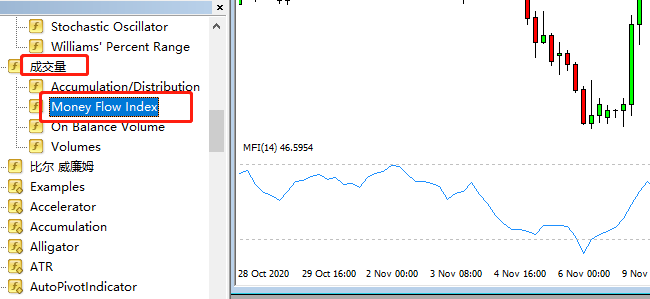
The calculation method is somewhat cumbersome, but we don’t need to calculate it ourselves. MT4 or MT5 generally has its own MFI indicator. Add technical indicators directly, and find Money Flow Index in the transaction volume indicator.
The default period is 14, do not change.
How to apply MFI in trading?
Identify overbought and oversold
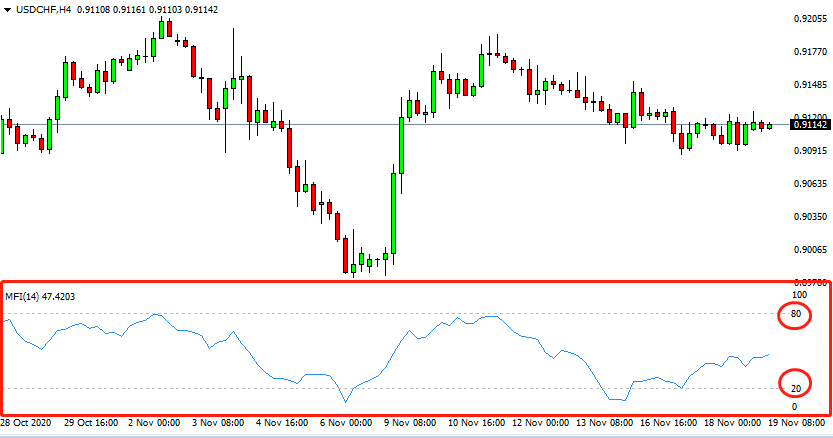
First of all, MFI can be used to identify overbought and oversold signals. When the MFI is higher than 80, it is considered an overbought signal, and when it is lower than 20, it is considered an oversold signal.
It is generally believed that if the market is oversold, it is better to wait for the signal of long orders, and if the market is overbought, it is better to wait for the signal of short orders. However, the signal of overbought and oversold is not necessarily a signal to enter the market, and it must be analyzed and confirmed in combination with the shape of the K-line.
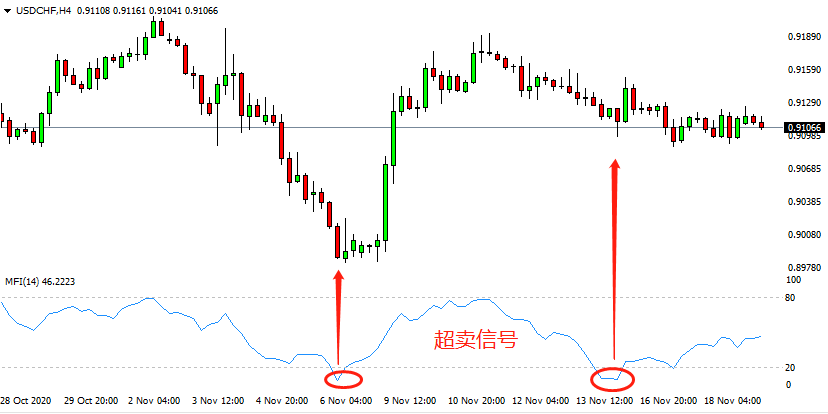
As shown in the figure below, in the USD/CHF trading chart, the position where the MFI is lower than the 20 level is marked, indicating that the market has reached a certain oversold level. In the first oversold position, the corresponding market price quickly reverses, and the downtrend turns into an uptrend. But in the second oversold position, the market price did not reverse immediately and entered a period of consolidation.
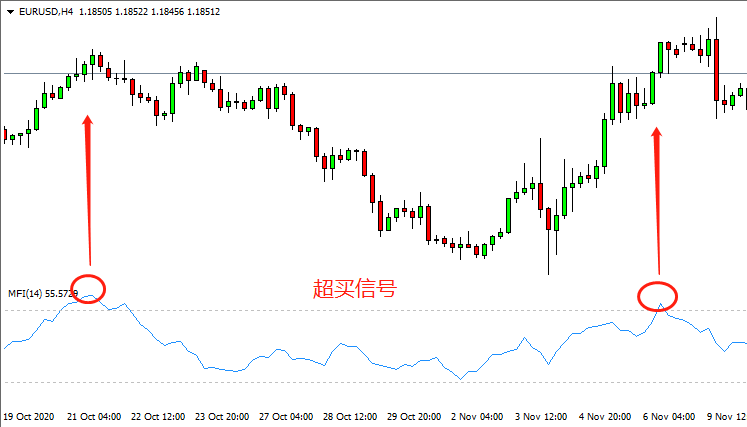
As shown in the figure below, in the EUR/USD trading chart, the position where the MFI is greater than the 80 horizontal line is marked. In the first position, the market price goes from an upward trend to a downward trend soon. In the second position, the market price did not fall immediately due to oversold, and entered a consolidation trend after continuing to rise.
Identify divergence signals
In addition to using MFI to identify overbought and oversold signals, it can also be used to judge divergence signals. Generally, divergence signals are easier to find with 4-hour or daily charts.
In a divergence signal, the market price will soon reverse.
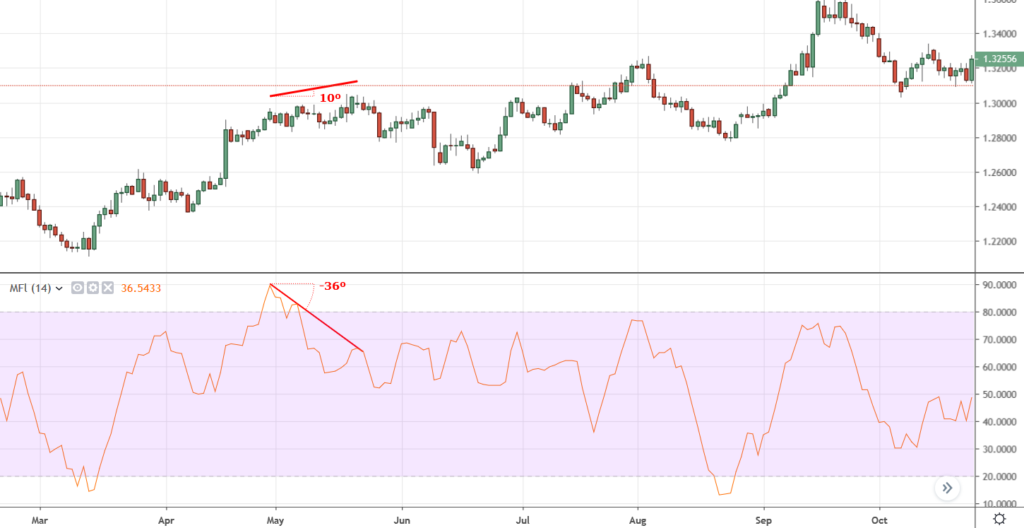
As shown in the figure below, in the marked position in the GBP/USD trading chart, the market price slopes upward, but the corresponding MFI value slopes downward, forming a bearish divergence signal. Soon the market price started to fall.
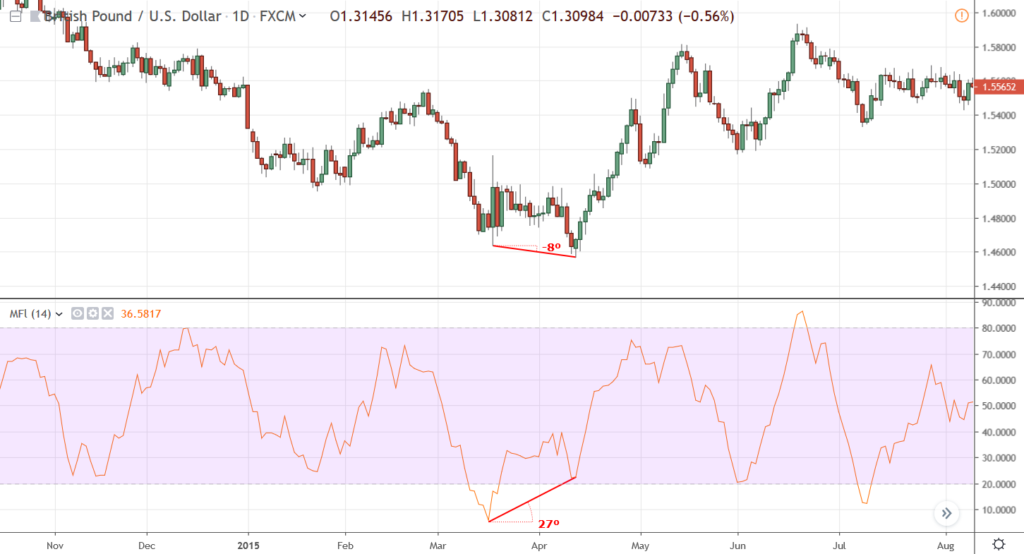
As shown in the figure below, in the marked position in the GBP/USD trading chart, the market price slopes downward, but the corresponding indicator slopes upward, forming a bullish divergence. The market price quickly reversed and showed an upward trend.
Generally, the divergence signal will occur when the market is overbought and oversold. We can focus on observing the position where the MFI is greater than 80 or less than 20.
Used in conjunction with moving averages
Another common usage is to combine the MFI with the 30 SMA. Use the crossover of MFI and SMA as a trading signal.
When the MFI crosses the MA upward, it is a long single signal, and when the MFI crosses the MA downward, it is a short single signal. And added the MFI middle line 50 horizontal line to filter the signal, only when the MFI is lower than the 50 horizontal line, you can go long, and if it is higher than the 50 horizontal line, you can go short.
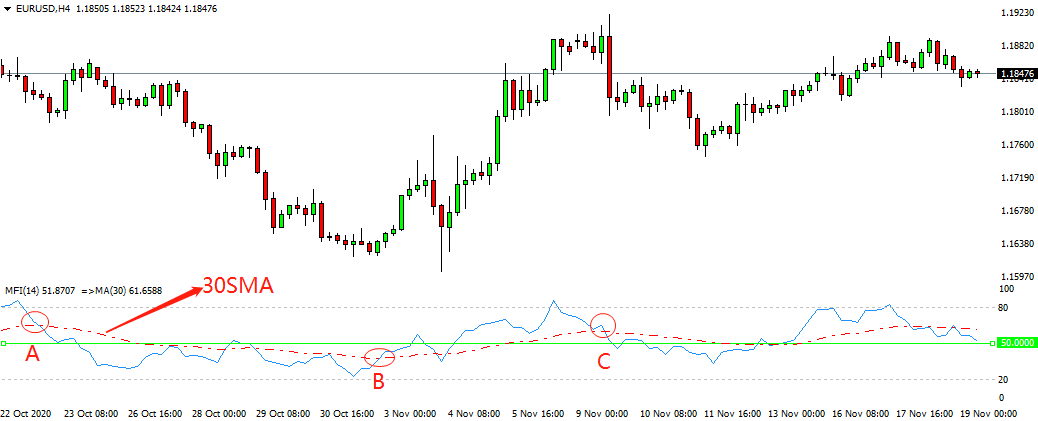
As shown in the figure below, the EUR/USD trading chart, the red dotted line in the figure is the 30 SMA line, at point A in the figure, the MFI line crosses the 30 SMA, and MFI>50 is a short-selling signal, and the corresponding market price also shows a downward trend . At point B in the figure, MFI crosses 30 SMA, and MFI<50, which is a long signal.
There are also several crossovers between MFI and 30 SMA between points AB, all of which are filtered out by the midline. Point C is a valid signal for short selling.
The above is today’s sharing. MFI can more accurately measure the impact of changes in trading volume on market prices, but when overbought and oversold signals are given, the price does not immediately reverse, and more auxiliary indicators are needed to verify .


 Add
Add


