Why are central banks taking different approaches now?
"This is the most significant divergence in major central bank policy we've seen since the pandemic recovery period," noted David Barrett, CEO of EBC Financial Group (UK) Ltd. "The Fed is holding firm, while the European Central Bank has already begun easing-and the Bank of England may follow. For traders, it's no longer just about the direction of rates, but why the paths are splitting and what that means for global positioning."
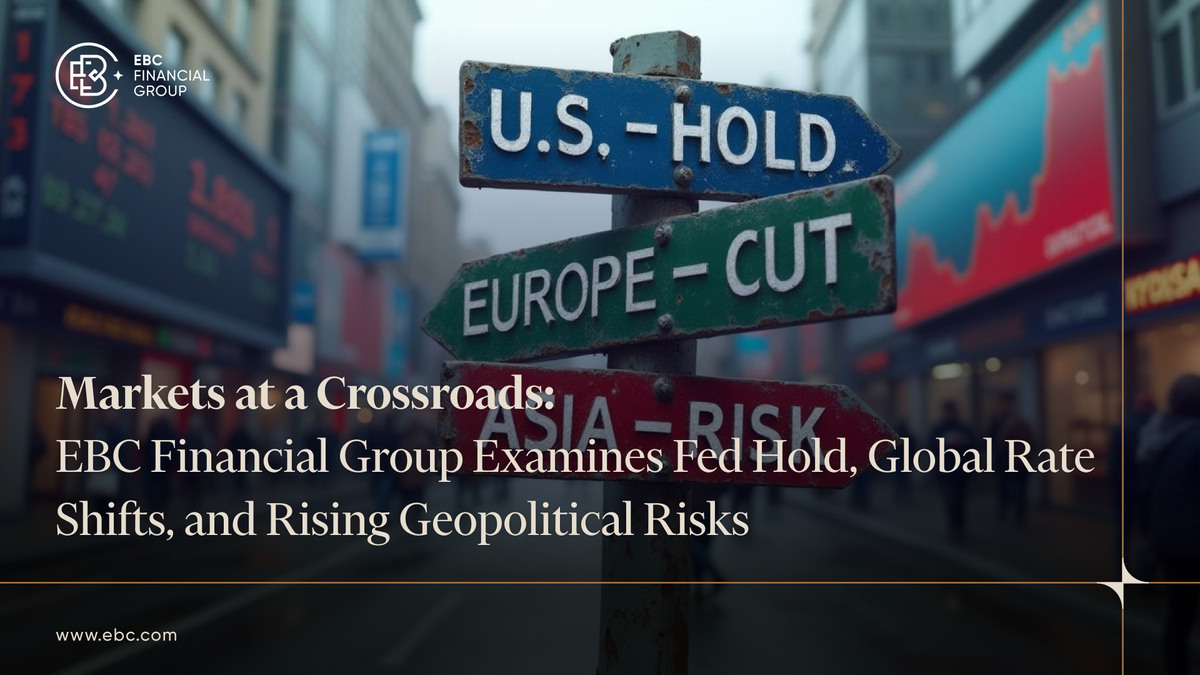
On May 7, the U.S. Federal Reserve chose to hold interest rates steady at 4.25% and 4.50%, citing ongoing inflation concerns and uncertainty over the economic effects of new tariffs introduced by President Donald Trump. In contrast, the European Central Bank cut its deposit rate by 25 basis points to 2.25% in April, marking its first rate cut since the pandemic-era normalisation began. Markets widely anticipate the Bank of England may follow suit. This divergence highlights a growing split in how major economies are responding to inflation dynamics, trade-related pressures, and weakening growth indicators.
How are geopolitical tensions influencing markets?
Further compounding uncertainty are heightened geopolitical tensions, particularly in Asia, where escalating conflict rhetoric between India and Pakistan has stoked concern over regional market instability, energy price volatility, and safe-haven flows.
"Geopolitical threats are re-emerging as a top-tier market risk," commented David Barrett, CEO of EBC Financial Group (UK) Ltd. "In the past, events like this may have been isolated, but in today's interconnected financial system, conflict-even perceived-can quickly ripple through currencies, commodities, and investor sentiment globally."
Gold and oil markets have already reflected these shifts. Gold prices have surged, reaching $3,397 per ounce, as investors seek safe-haven assets amid the escalating conflict and broader economic uncertainties. This uptick reflects a broader trend where geopolitical tensions drive investors toward assets perceived as more stable during periods of uncertainty.
What does this mean for traders and asset allocation?
Across asset classes, traders are adjusting not only to data but to the absence of clear global consensus. With some central banks signalling easing, others holding steady, and yet others still under inflationary pressure, the challenge lies in navigating a world where the usual indicators no longer apply universally.
"This is not a moment for passive observation," added David Barrett, CEO of EBC Financial Group (UK) Ltd. "It's a time when traders must actively interpret, adapt, and stay informed. At EBC, our role is to deliver real-time clarity and perspective-helping our clients make smart decisions even when the market narrative is fractured."
In times of global divergence, EBC remains committed to empowering traders through education, transparency, and world-class analysis. With regulated operations across key financial markets, EBC continues to offer institutional-grade platforms, multilingual insights, and expert-driven commentary tailored to evolving macro conditions.
Adapt to Changes
Whether it's rate cycles, regional flashpoints, or commodity volatility, EBC equips traders with the context they need to move with confidence-rather than react to confusion. In today’s fractured environment, adaptability, active interpretation, and staying informed are more critical than ever.
Disclaimer: This material is for general information purposes only and is not intended as (and should not be considered to be) financial, investment or other advice on which reliance should be placed. No opinion given in the material constitutes a recommendation by EBC or the author that any particular investment, security, transaction or investment strategy is suitable for any specific person.


 Add
Add


