Foreign exchange is referred to as Forex/FX, and foreign exchange refers to various means of payment expressed in foreign currencies that can be used for international settlement. In layman's terms, they are British pounds, US dollars, euros, Japanese yen, Canadian dollars, Australian dollars, Hong Kong dollars and other foreign currencies.
01What is foreign exchange investment
In layman's terms, opening a foreign exchange account is similar to stocks. In the account, it is the same as buying and selling stocks. Buying and selling foreign exchange rates is foreign exchange trading.
For example, today's exchange rate is 1 US dollar = 6.1000 RMB
Tomorrow the exchange rate is 1 US dollar = 6.1200 RMB
If you buy 1 lot of US dollars, you will earn = (6.1200-6.1000) * 100,000 US dollars = 2,000 US dollars
(1 lot transaction volume represents a transaction amount of 100,000 US dollars)
If you buy U.S. dollars and fall, you will lose money, so buying and selling foreign exchange is to predict the rise and fall of the exchange rate, and then make a transaction.
02Why choose foreign exchange
The foreign exchange market can be said to be the most "clean" speculative market in the world: investors don't have to worry about the performance of each stock, and they don't have to worry about insider trading between long and short futures. The huge daily trading volume makes no institution have the courage to sit on the bank. Up to now, the trading volume of the foreign exchange market has reached 6 trillion US dollars per day. The information that Soros and Buffett can understand can be understood by ordinary investors. Investors and speculators around the world are watching at the same time. With the same quotation and price graph, dozens of online trading platforms and thousands of market makers connect tens of millions of investors and speculators around the world. The most important thing is: whether you can make money is determined by your own ability.
1. The foreign exchange market is a 24-hour market
Unlike stocks, in the foreign exchange market, global traders trade the same financial product.
The development of information and communication technology has brought great convenience to the development of the financial market. On-site outcry trading is gradually giving way to 24-hour non-stop electronic trading. At present, almost all major financial assets can be traded at any place in the world. There is almost 24 hours of uninterrupted trading in one corner, but only the foreign exchange market has the nature of continuous trading, because traders around the world trade the same financial product.
Taking stocks as an example, most stocks are traded on local exchanges. The domestic Shanghai and Shenzhen A-shares, the Tokyo Stock Exchange in Japan, the Paris Stock Exchange in France, and the New York Stock Exchange in the United States are basically the most traded exchanges. Stock companies are all companies in their own country, and traders are also concentrated in the local area, which is basically the opening and closing time of the market.
At any time, there is always a dealer somewhere in the world that can provide a two-way quote.
But foreign exchange trading is different, it is a 24-hour uninterrupted market, at any time, there is always a dealer somewhere in the world that can provide two-way quotations, for example, Citibank is headquartered in New York, but nearly There are branches in 150 countries and regions, which continuously provide two-way quotations of foreign exchange. In addition to these large investment banks, in every time period, there will be foreign exchange trading activities in the local area, and local traders will also provide quotations.
2. Foreign exchange market transactions are more concentrated:
Foreign exchange trading is a global market transaction, so it is more affected by global information. Foreign exchange traders need to obtain information from all over the world 24 hours a day, and make trading strategies based on the latest information.
Therefore, each bank and market maker will set upper and lower limits for overnight positions in their trading rooms to control transaction risks, and the main players in the three major markets usually close their positions based on market judgments before the market closes. It makes the foreign exchange market transactions very concentrated, and the price changes sharply and in one step.
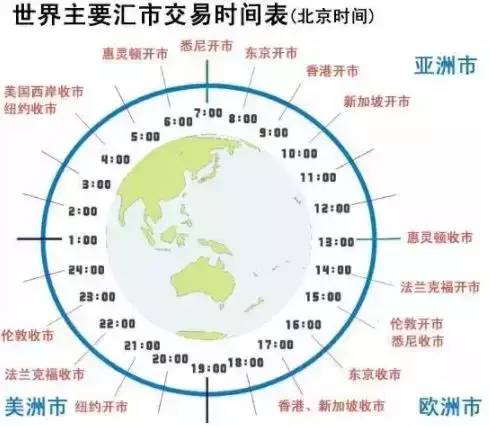
03 Opening and closing time of major foreign exchange markets (Beijing time)
New Zealand Wellington foreign exchange market: 04:00-12:00
Australian foreign exchange market: 6:00-14:00
Foreign exchange market in Tokyo, Japan: 08:00-14:30
Singapore foreign exchange market: 09:00-16:00
London foreign exchange market: 15:30-00:30
Forex market in Frankfurt, Germany: 15:30-00:30
New York foreign exchange market: 21:00-04:00
04 What are the "four elements" of the foreign exchange market
Time, Market, Active Currency, Event:
At present, the three major foreign exchange markets in the world are: New York (with Chicago), London, and Tokyo (with Singapore). These three markets influence each other. The third market; similarly, the first two market prices continued to fall, and the market may rebound in the third market.
If the big players in New York are seriously locked up, he may not settle the deal on the spot, which will further depress the exchange rate, and he will gradually unwind the set when the markets in New Zealand, Sydney and Tokyo open.
The foreign exchange trading in these three major markets has its own characteristics, mainly due to the trade situation and foreign exchange demand in the area where the market is located, and it is also the result of the three major market forces competing with each other and speculative trading.
05 What is a foreign exchange broker
A foreign exchange broker specializes in introducing transactions in foreign exchange transactions, acting as an intermediary between the supply and demand of foreign exchange and collecting commissions from them. There are many foreign exchange brokers in any active foreign exchange market), known as (Exchange Dealer) in the United States, just like the role of brokers in the stock market, foreign exchange brokers (Brokers) only act as intermediaries (Intermediaries) in the foreign exchange market The role of the company is to earn commissions, and its main task is to provide accurate and rapid transaction information to facilitate the smooth progress of foreign exchange transactions, and to negotiate exchange agreements for foreign exchange transactions on behalf of customers. It belongs to the relationship between buyers and sellers. Through the contact of foreign exchange brokers, directly or indirectly from the bank to buy and sell.
06 Supervision of foreign exchange trading platforms
Foreign exchange brokers in major international foreign exchange markets must accept strict supervision by local government agencies to ensure the stable operation of the foreign exchange retail market and protect the legitimate rights and interests of investors.
NFA (National Futures Association---NFA): A futures industry self-regulatory organization established in 1976. It is a non-profit membership organization and a non-commercial independent regulatory agency for futures and foreign exchange transactions in the United States. On October 1, 1982, NFA officially began to operate.
FSA (Financial Service Agency---FSA): The bureau was reorganized in October 1997 from the Securities and Investments Board (SIB organization) established in 1985, as an independent non- A government organization that intends to become a unified regulatory agency for the UK financial market, exercise statutory responsibilities, and be directly responsible to the UK Treasury.
New Zealand FSP, the full name is Financial Service Providers (financial service companies): Since August 16, 2010, the financial service business regulator FSPR has begun to accept applications from financial companies, and since December 1, 2010, almost all New Zealand financial services All service companies need to be registered with FSPR to provide corresponding financial services. The existence of FSP allows all financial service providers to appear in an electronically searchable form, and is mandatory to be regulated by the New Zealand government's Financial Service Providers Regulations 2008 to ensure that all financial service providers are compliant and legal without criminal records.
ASIC Australian Securities and Investment Commission (Australian Securities and Investment Commission---ASIC): The Australian Securities and Investments Commission is the regulator of Australia's banking, securities, and foreign exchange retail industries. With the promulgation of Australia's "Securities and Investment Commission Act" in 2001, ASIC has since brought the retail foreign exchange trading market into the scope of daily supervision, together with banking, securities, insurance and other financial industries, and has become an important part of Australia's national financial system.
07 Fund security guarantee of foreign exchange trading platform
The foreign exchange brokers in the world's mainstream foreign exchange trading market are strictly regulated by local government agencies. The client funds of all foreign exchange brokers with formal business licenses must be stored in strict independent isolation. Brokers cannot embezzle client funds, and Brokers must accept the financial inspection system, and brokers cannot intervene in customer transactions.
08 Development status of foreign exchange industry
Foreign exchange trading has great market opportunities and development potential in China. This is firstly because the Chinese economy has accumulated huge wealth after 30 years of rapid economic development, and the excess surplus value created by laborers must be transferred to reserves in large quantities; Everyone has experienced the reality of negative interest rates, stocks diving, and futures losing their money, and so on. Even real estate, as an investment hedging tool, also has a question mark.
09 Prospects of the foreign exchange industry
In mature overseas investment markets, 30% of each family's investment allocation belongs to foreign exchange investment. But it still accounts for less than 1% in our country. China's foreign exchange reserves account for one-third of the world's total foreign exchange reserves, which is more than three times that of Japan, the second largest. With the continuous acceleration of the internationalization of the RMB, China's foreign exchange market, whether it is retail or corporate foreign exchange demand, will increase With rapid development, the whole world will face the advent of China's foreign exchange era!



 Add
Add


