In July 1990 , a middle-aged man named Li Jingmou was working in the Provincial Grain Bureau to plan the task of grain storage. He did not know that he would be suddenly appointed as the person in charge of the Zhengzhou Grain Wholesale Market. This was the first time since the reform and opening up. A real futures exchange.
Going 900 kilometers south along Zhengzhou , we arrived in Shanghai. Guan Jinsheng, a boy from Jiangxi who is outstanding in foreign languages, is also forgetting to eat and sleep. Three months later, the Shanghai Stock Exchange, which he and his friend Wei Wenyuan will personally run, will also be established.
At this time , Liu Han in Sichuan was tossing a gambling game machine, Dai Zhikang had just left for the south, and Qing Ze, who was immersed in the dream of campus, was studying philosophy at Beijing Normal University. Philosophy was the favorite of Wenqing at that time.
It was also this year that Fu Haitang, a farmer in Shandong, was having disputes with his relatives and friends because he insisted on growing garlic. However, the garlic growers had lost money in the past two years. This peasant economist still needs to continue to "understand the Tao". Similarly, Boss Ge, who later became one of the Four Heavenly Kings, was studying economics at Sichuan University, while another big boss, Tang Savage, was studying in elementary school wearing a red scarf. Only Ye Qingjun from Ningbo wants to get involved in futures, and what awaits him is continuous liquidation.
For many futures bigwigs and leek specialists who followed suit in the future, 1990 was the origin of their destiny turning point.
Instead of racing at the sports meeting , they are going to wrestle in the capital market.
1. Gods fight with twists and turns
In September 1990 , Li Jingmou, who served as the deputy director of the Provincial Grain Bureau, was suddenly appointed as the director of Zhengzhou Grain Approval, which was under preparation.
The concept of futures was still imported to the Chinese at that time.
In short , futures are developed from forward spot transactions and are financial products that agree on future deliverable physical goods. They were originally used as a value-preservation tool for traders and manufacturers to prevent the risk of price fluctuations.
With the expansion of the scale of futures trading and the continuous introduction of speculative off-market capital, this financial tool has gradually grown.
China's futures market originated from the reform of the grain circulation system , in order to respond to policy adjustments for grain products, and guide enterprises to do a good job of stabilizing the risk of price fluctuations and preserving value.
Starting in 1990, the Zhengzhou Grain Approval Institute, the predecessor of the Zhengshang Institute, was launched, followed by exchanges from all over the country, which triggered the subsequent brilliant performances of many big speculators, and the electronic trading mechanism gradually established by Li Jingmou, The unilateral price limit mechanism provides a basic stage for these speculators, and the lights on the stage are not dark enough to give them more opportunities to squeeze positions.
Only five years later , the largest Tianwangshan battle broke out in China's futures market so far, namely the 327 national debt incident.
National debt futures are futures contracts launched by the country at that time in order to inject liquidity into national debt and move closer to developed countries.
At that time, it was rumored that the Ministry of Finance was about to increase the subsidy rate of government bonds by 7%-8%, so as to offset the losses caused by the rising inflation rate to holders of government bonds.
When the current price soared to around 147, Guan Jinsheng of Wanguo Securities began to sell.
Guan Jinsheng, one of the Three Musketeers in the Shanghai stock market, was a hot figure in the stock market at that time. Originally studying French literature, he switched to translation after graduation and joined Shanghai International Trust and Investment Corporation by mistake. Wanguo Securities, which he established, controlled 70% of the trading volume of A shares and all of B shares at its peak.
He believes that based on the maximum value-preserving discount rate of 8%, the highest price of 327 treasury bonds (three-year treasury bills issued in 1992 and due in June 1995) is 132 yuan, and it is impossible for the Ministry of Finance to provide additional subsidy costs.
Wanguo Securities, Gao Brothers Liaoning Guofa Big Shorts entered the market one after another, but they ignored the temple background of their opponent Jingkai (China Economic Development Trust and Investment Corporation), which had gradually built long positions on February 9.
The capital market is elusive , just like the invisible hand mentioned in Smith's book, ruling all kinds of dissatisfaction. Soon the value-preserving discount rate given by the Ministry of Finance was abruptly increased from 8% to 12.98%!
327 Treasury bond daily chart
Little ghosts quarrel, gods fight.
Mr. Guan believes that such a policy violates the laws of the market, but in the face of huge floating losses, he can only fight with his back and stud.
After the opening of the market on February 23, CEK, as the big brother of the bulls, pushed up the previous day's 148.21 yuan to 155.75 yuan in one fell swoop, directly rubbing the short side on the ground, and never stopped.
At the close of trading at noon , Guan Jinsheng urgently asked his friend Wei Wenyuan, the general manager of the Shanghai Stock Exchange, for help, but to no avail.
At the opening of the market in the afternoon, the "Italian" Gao brothers of the Axis countries took the lead in turning their guns. Liao Guo issued an empty order of 500,000 lots, and then backhandedly filled in more than 500,000 lots. The price rose by 2 yuan within 1 minute. This move pushed Wanguo Securities into the abyss of death.
A good story must have succession and transformation.
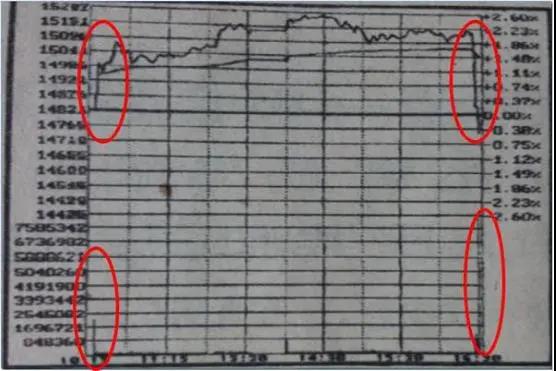
At 16:22, 8 minutes before the market closed, Guan Jinsheng had to make a final fight. In the absence of sufficient margin, Wanguo was dying of overdraft, broke through the institution's position limit of 500,000 lots, and placed an empty order of 20.7 million lots for self-operated seats, smashing the price from 151.30 to 148 in one go. The last huge sell order of 7.3 million equivalents in late trading directly pushed the price to 147.40 yuan. This face value has already approached 4.3% of the gross national product of the previous year.
Short raids become counterattacks.
The bulls who thought they were going to sit on the ground to divide the meat and push the cup for a cup were at a loss, and they burst out of the game one after another.
As of the close, the price was sealed to 147.40 yuan, and short Wanguo turned from a floating loss of 6 billion yuan to a floating profit of 4.2 billion yuan.
Time-sharing chart of 327 national debt on May 23
After many years , we revisited the long-short battle at that time. The bulls continued to squeeze shorts using the subsidy policy that seemed to violate economic principles. Under the mature mechanism of the market, perhaps this drama should end here, but CN's characteristic mechanism will always tell speculators who is the right hand: it is easy to shake the mountain, but it is difficult to regret it.
At 10:00 p.m. on the 23rd , the Shanghai Stock Exchange held an emergency meeting and issued an "imperial decree": Wanguo's short sellers violated the rules and canceled the last 8 minutes of trading, and the closing price was set at 151.30 yuan. The reason is insufficient margin.
The market is so weird. In a single thought, Guan Jinsheng stabbed himself with a sharp sword, resulting in a huge loss of 5.6 billion yuan in the book, and his wealth and debts were reversed in an instant.
And Dai Xuemin and Wei Dong, who were in charge of the Central Economics Kaibang, went to the Yamen, oh no, they made the right bet and became the final victor in this war of information asymmetry.
"The darkest day in the history of securities in mainland China (in the words of the Financial Times)" ended here.
Compared with other well-known long-air wars in the 1990s , the 327 national debt incident had a far-reaching impact. Speculators, exchanges, Treasury bondholders, and the visible hand behind it all put on a show. The large number of participants, the large amount of funds, the bad tactics, and the twists and turns of the plot make it an insurmountable Mount Everest in China's magnificent history of financial speculation.
A vicious fight, full of chicken feathers.
On the loser's side, Guan Jinsheng, the godfather of China's securities, went to jail, and the Gao brothers fled abroad and disappeared.
On the winning side, China Economic Development Co., Ltd. made a profit of 7.2 billion yuan, but since then it has driven high and low, and was involved in a major case of insider manipulation. In 2002, it was liquidated at a loss.
In this battle of gods, the speculators who follow the carnivores at the top of the food chain will become the rising stars in the future.
In the future, Director Chen, the stock god who was promoted to the deputy ministerial level, led Anhui's national debt to turn losses into profits.
The Hainan Fudao Fund, which was on the verge of bankruptcy, turned around in this battle, and Dai Zhikang, the helm, became famous;
Zhou Zhengyi, who runs the "Amao Stew" in Shanghai, finally found his first pot of gold after 17 years of hard work, and then officially embarked on the life path of cheating;
Huang Wei, a big accountant of China Economic Development Co., Ltd., took advantage of the trend and made a huge profit of 750 million yuan;
Qing Ze, who is about to become a trader's spiritual mentor, made a huge profit of more than 6.9 million yuan in this campaign;
In the future, Lin Jun, who founded the Xiangran Club, grabbed more than 1 million yuan just three years after graduation;
The 29-year-old Yuan Baojing and the 30-year-old Liu Han , who won this battle, tore up the sorghum futures the following year, tearing up endless grievances and vendettas.
Wei Wenyuan, general manager of the Shanghai Stock Exchange, who was walking at the referee's front desk, was like a mouse in a bellows. He hid in the VIP room on the second floor and sat there for more than an hour before issuing the notice of violation.
The treasury bond futures, which have been on the market for only 2 years, have been relegated to the sidelines , and it will be 18 years before it comes to power next time. As for the real profit flow under "327's profit to China Economic Development Co., Ltd. is not even 100 million yuan", whether Wei Wenyuan canceled the transaction in the last 8 minutes to protect Wanguo Securities has become an unspeakable secret.
Although the climax passed , it did not end. Instead, it is the group performance of the successors on the commodity futures.
2. The four must compete, each showing their special abilities
In the 1990s, many futures squeeze incidents caused the market to fall into a state of disorder , which deviated from the original intention of commodity hedging.
At the peak, more than 50 exchanges were left with 15, and then reduced to 3.
The structure of trading products, brokerage agency mechanism, and practice management methods have gradually come to the right track.
The crazy and violent atmosphere of the 1990s gradually calmed down, and the speculative control of the market was reduced. Speculators began to shift from gray arbitrage to research and judgment on fundamentals. Among them, the four who were dubbed the four wonders of the futures industry were particularly dazzling.
The legend of the rise of the Four Jue is essentially the story of how the losers of the Tianzihao broke out of their cocoons and became butterflies.
The first to take on the halo of the protagonists are Nandi Ye Dahu and Dongxie Boss Ge.
Ye Dahu was the first among the four to get involved in the futures industry . In the early years, he participated in most of the squeeze battles in the 1990s, and made a slight profit, but his later operations followed the path of the other three: making a lot of money and then losing money. He had a lot of gambling in the early days. In 2002, he almost went bankrupt and his wife and children were separated.
Not every speculator is called a special energy loser. In 2003, Ye Dahu finally took advantage of the soybean bull market. He used 100,000 yuan in real estate mortgages to build warehouses and increase positions all the way, earning 5 million yuan for his future business foundation.
In 2006, he made great strides in the bull market of rubber and copper, and his assets reached 60 million yuan.
At the time of 2007, in the futures and the stock market, his assets had accumulated to 400 million yuan.
Brother Ge, who was in the same age as Ye Dahu, gave up the oil business . After suffering from liquidation, he gradually grasped the core of speculative trading (N words are omitted here, because the author does not know), starting from 2000, the following In the past 4 years, I have made more than 5 billion yuan by opening and upgrading all the way.
Bei Gai, a peasant economist who is two years older , is still struggling through his ten-year long suffering period. Never looking at K-line charts, only doing fundamentals, has become his flaunted criterion in the future, but it will take a long time to get familiar with the pulse of this market in the early stage.
In 2007, he took a heavy position in soybeans, but was washed out back and forth.
In 2008, he turned into an "Empty Copper School" and ran away after eating 3 down limits.
Such a situation of being sure but not being able to hold it is the same as Boss Ge's repeated entry and exit for Sichuan Changhong and Shenzhen Development Development a few years ago. In the end, Boss Ge only took 3 times the original 10 times profit.
But what is different from retail investors is that after experiencing these lessons, the big guys who make trend orders can quickly correct themselves. I didn't make up my mind to cut the loss list until I clamored to pass on the shares of PetroChina to the next generation.
Livermore said that making big money depends on concentration, not brains.
This may be an important technical indicator to distinguish retail investors from big guys.
The start is 28,000, and the doubling depends on Stud . Xi Kuang, born in the 1980s, also caught up with the last train of Fengshen. The principal of 28,000 yuan reached 150,000 a month, and it doubled 40 times after half a year. After that, he joined the leaping cotton battle.
When Ge Dahu, the "Tojo of Wall Street", was frantically deploying overseas and cutting capitalist wool, the other three coincided with each other and joined hands in long cotton in 2010, starting a classic battle.
2010 Cotton, Cotton, Still Cotton
When the new cotton was launched in 2009, due to the expected reduction in production and the support of the auction price policy, the price previewed a small bull market.
By the first quarter of 2010, textile enterprises had experienced a large inventory of raw materials, resulting in insufficient spot circulation, which triggered a "good start" in cotton prices.
The big market came at the right time and place. The market predicts that the consumption of cotton by cotton spinning companies will be 13% higher that year. The main cotton-producing areas will be delayed by low temperature and rainy weather. In addition, South American cotton is scarce, and the auction of national reserves is almost exhausted. The cotton bull market is about to come.
Gambling is a man's addiction, and money is a man's guts.
Seeing the right time, Xikuang entered the market with 6 million. After enduring 60% of the floating loss, he finally ushered in the big bull. He increased his position all the way to the limit of 30,000 lots, and it snowballed to 1.3 billion in four months, "wiping out most of the long positions. Profits are no longer anyone's trader."
And Beigai, who had already caught the Mavericks last year, came back in the second half of 2010. When he was close to the high point, he closed all his positions at 29600, making a profit of 120 million yuan.
In this year's cotton plucking relay race, Xikuang's income reached an astonishing 220 times, Beibei's income was 20 times, and the assets of Nandi Ye's big family increased to more than one billion.
In the first round, everyone was happy.
2011-2012 Three lore
By 2011 , the West Wilders judged that the Cotton Cow was coming to an end, so they turned long and short.
This time, Nandi still sticks to the long camp, and the former allies have become enemies.
Maybe it was because of Xikuang’s continuous good luck, or maybe the cotton bulls were exhausted, and Nandi, who insisted on going long with 2 billion yuan, was finally defeated, with a loss of 60%, and he returned to the pre-liberation overnight.
What is young and frivolous? West Wilderness made the best demonstration: After nearly ten months, there were 20,000 tons of empty orders, with a profit of 700 million yuan.
In the second game, the post-80s won.
It is not too late for a gentleman to take revenge in half a year.
Nandi finally found a chance to fight back in 2012.
First of all, Xikuang has become so crazy that "one go long and one short, in just over a year, from 6 million to more than 2 billion, I feel omnipotent at once, and my confidence has swelled to the point that I want to assist the government to complete some ambitions. To the point of great achievements."
Xi Kuang's madness, Livermore will be internally injured when he sees it, and Soros will go crazy when he sees it.
The West Wilders began to idling and continued to blow their horns on the familiar cotton battlefield. He announced his positions, costs and trading ideas online. The bloody posting of the bill completely exposed himself and angered his opponents.
Furthermore, Dongxie, who was punished in the US cotton market, turned his perspective back to China and made an alliance with the Southern Emperor.
The first battle in 2012 came earlier than before.
After confirming the eyes, the Southern Emperor and Dongxie were living and dying with the wild people of the West at the beginning of the year.
It was a battle, and Xi Kuang retreated all the way, with a stop loss of 700 million and was out.
In the third game, Nan Di won.
This year , the beggars in the north did not stop. According to the way of heaven that he gradually explored, he made a heavy position in soybean meal and soybeans, making a profit of nearly 100 million yuan, and won the first prize in the Haitong Futures Competition that year.
After the Cotton War , Sijue gradually calmed down.
But the market can't bear the loneliness. It always wants to tease the nerves of institutions and retail investors, drag them in, and play with applause.
So how can we be the birthday star of the market?
Maybe, there is a solution, and there is no solution.
A saying that Du Yuesheng often hangs on his lips is: There are three bowls of noodles that are the most unpalatable in life, human face, scene, and human face.
For speculators, there are also three bowls of noodles that are unpalatable, namely fundamentals, technicals, and news.
Beijiao is obsessed with fundamentals . The core of his theory of the way of heaven is two viewpoints. The first is the law of supply and demand, which determines the general direction of commodity prices. The second is that things must be reversed when they are extreme. Beibei, who never looked at K-line charts, made small losses and big profits later. After several years of continuous bottom-hunting rebar losses, he finally waited for the supply-side reform, which directly doubled from 15 million to 1 billion in 2016.
This kind of long-term layout and the concept of enduring a large retracement will inevitably discourage most speculators.
Dongxie has two principles , one is the ratio of wind to reward, and the other is the resonance of fundamentals and technical aspects.
However, when the Shanghai Stock Exchange fell below 2200, he intervened in new energy and financial stocks, and increased his positions all the way to 1800 points.
However, Xiaoyao Liu Qiang of "Memoirs of a Big Futures Operator" with the same concept invented his own multi-point resonance system. Only when the technical and fundamental resonances can enter the market, but in the 2015 crash, he pinned his hopes on the government to rescue the market and continuously bought the stock index. Ultimately burst.
The regret of the text is that no matter how you choose words or sentences, it cannot carry its connotation and overall picture. After all, experience will be outdated, and sudden profits will also have luck. Stimulation on the news side, etc., these also happen to be a key part of uncertain trading.
So, where is the noodle unpalatable? Still undecided.
3. The destination of retail investors
The capital market is a battlefield where gunpowder is filled with smoke and blood is flying everywhere. The Lunar New Year script of family reunion is naturally insulated from the capital market.
The only ones who can survive are the generals who were disarmed and returned to the field and the soldiers who fled. As long as you are in it, protect yourself and accept the battle.
Although the bigwigs walking in the foreground have their own protagonist traffic, the fate of most speculators can only be reduced to cannon fodder.
From two data, we seem to be able to find evidence.
One is that for six consecutive years from 2012 to 2017, the number of accounts opened in the futures market has increased year by year, but the ratio of the number of retail accounts to the number of institutions has continued to decline in the past three years, from 34.74 to 31.14 and then to 29.7.
Institutional predators are criss-crossing the market, and leeks are urgently needed to enter the market.
Another data is the futures firm offer competition in 2019.
There were 43,799 participating accounts, with a total participation fund of nearly 16.8 billion, a net loss of -530 million, a profit of 1 billion for the fund group, and a loss of -1.64 billion for the light and heavy groups. Profitable accounts accounted for only 25.4%. The shelf life of the 28th law is still very long.
The number of profitable accounts in descending order is fund group, quant group, weight group, and light group. Retail investors are always destined to accompany them to run and carry sedan chairs, which is well known to passers-by.
The most profitable stage is the unilateral market of iron ore, Shanghai gold, and Shanghai silver. In the same trend market, some people cry, some laugh, some lose, some get old, and the ending is really different.
The handling fee has not been disclosed, but the data for the 2018 competition is 1 billion, accounting for 50% of the season's losses. If the champion of harvesting IQ tax is selected, it must be an exchange and a futures company.
If we blindly verify that this market is the clichéd conclusion that most people do A, B, and C, and only 20% or even less people reach the top of the pyramid, then this long article has reached this point, and it seems that there is no need to discuss it further. It is a hundred times more difficult for people to withdraw from the market than to persuade people to buy insurance.
Let us do a shallow analysis.
Among the profitable accounts in the 2018 real offer competition, 80% of the profits come from long-term profits within 5 orders, and most of them will fall into losses.
5 single characteristics: the holding period is basically about 2 months to grasp the unilateral trend market.
This feature is similar to the reason why the big guys discussed before seized the 327 national debt and doubled their assets in the 2010-2012 cotton market. If you catch the big unilateral market, you will be able to open for three years.
In 2011, rubber, cotton, and the Shanghai and Shenzhen 300 Index were short and unilateral;
In 2012, soybean meal rose by 50% in the middle of the year, and palm oil fell by 30%;
In 2013, gold and silver plummeted by 30%;
In 2014, the stock index rose 55% at the highest unilateral rate;
In 2015, the stock index fell by 50%, the black series fell by more than 50%, and corn started a unilateral 50% plunge in the past two years;
In 2016, the black line rose unilaterally, and the rubber skyrocketed by 100%. Black Swan double 11 suffocation;
In 2017, coke rose by 100% in the second half of the year, thermal coal plummeted after a sharp rise, and rubber plummeted by nearly 50%;
In 2018, Apple skyrocketed by 100%, PTA skyrocketed by 70% in the middle of the year, and then fell back to the original point;
In 2019, iron ore soared by 100%, and eggs soared by 40%.
These big market trends are encountered every year. If we can make trial and error, build positions, and increase positions on these market conditions, will we be able to stabilize huge profits?
I'm afraid it's not that simple.
The world has been suffering for a long time . Affected by unexpected news, sector linkage failure, frequent dishwashing, etc., 90% of the retail investors who entered the market at the beginning of the market will not get the final result.
From the early use of information asymmetry, to inciting public opinion to guide fundamentals, and now to high-frequency trading, dealers and retail investors have been performing a love-hate drama.
The futures market is still there, and the account has been red several times.
Well , the author will see you at the end of the article. After we make a long speech and point out the country, we may be able to get three pieces of news from the 30-year history of futures speculation.
1. Good news - the market is becoming more and more regulated.
The management of regulatory agencies is becoming more and more standardized, and gray policy arbitrage is slowly disappearing. Various rules and regulations and technical means will make the market operate in a more formal direction.
2. Bad news - dealers are getting trickier.
The "powder kegs of the Balkans" Yong'an and Huatai, COFCO Futures, which are short-sellers of agricultural products, and foreign-funded giants at their doorsteps, these bookmakers have different methods.
In the eyes of retail investors, cunning bookmakers are the poison of short-term investors and the nightmare of long-term investors.
3. Not bad news - the speculative market may be an "opium" for speculators to deal with risks and pursue freedom.
Many articles and suggestions from bigwigs call on retail investors to leave the market as soon as possible. Beibei once said: In line with the principle of being responsible to future generations, I must make a will before I "go", and my children and grandchildren would rather be beggars than enter the stock and futures markets.
But in the speculative market of the past thirty years , so many passers-by have come and gone, there are low-key bosses with deep fame, late heroes pacing on the roof, His Highness Qiao Biluo who pretends to be a ghost, and more are The melon-eaters who were looking for the Holy Grail in the audience, a very small number of them rushed to the sea of stars and wealth, and most of them climbed to the top of the building to line up to shake their numbers.
What is the difference between being a retail investor and a salted fish if you don’t have a dream?
A sage thinks about cultivation, a fool thinks about it.
Although people all want to get rid of the worldly troubles and concentrate on learning from the speculative market, but where is the paradise? This speculative market has almost all the elements of the mundane world, such as rivers and lakes and temples, ups and downs, heroes' twilight, old people in mountains and rivers, simple and complicated, big plans and small plans, and of course, one will succeed and die.
In essence , people who speculate and people who play video games go the same way.
Between illusion and reality, speculators seek a balance between the two in pursuit of wealth and inner freedom.
There are all kinds of things in the world, click to become gold , this may be the fundamental reason why the sages are obsessed with it.




 Add
Add


