"Don't keep thinking about profits, but think about how to protect the profits you have already obtained."
——Paul Tudor Jones (Paul Tudor Jones)
A sentence from Tudor Jones accurately interprets what risk management is. Risk management is finding ways to limit losses. You have to know how much risk you are taking and how much you can bear.
Successful traders have a very high risk awareness. More than 80% of top traders believe that risk management is the first necessary trading quality for traders. The advice that many top traders give to novices in foreign exchange trading is to improve their risk management capabilities.
Why is risk management important when trading?
Many traders see trading as an opportunity to make money, but they tend to overlook the potential risks. When the market goes against the direction of the trade, traders can minimize the loss of the trade through risk management.
Traders who always incorporate risk management into their trading strategies can gain profits when trading with the trend and minimize losses when trading against the trend. The main risk management methods include stop loss, price limit and investment portfolio.
The risk for traders who do not use limits on their trades is that the trader may hope for a reversal in market direction and hold a position for too long in a countertrend. This is the first mistake most traders make, and we have summarized many other mistakes that many traders make in our guide to trading for winners.
How to manage risk while trading
Here are five tips for risk management when trading:
Predetermine risk/exposure
Choose optimal stop loss level
Diversify portfolio: the less correlated the better
Secure risk Consistent with emotion management
Setting a positive risk reward ratio
1) Pre-determined risk/exposure
Risk is inherent in every trade, which is why it is important to first determine the degree of risk you can take before entering the market. Generally speaking, the risk of a single transaction cannot exceed 1% of the net value of the account, and the risk of all positions cannot exceed 5% of the net value of the account. Assuming that your total account is 10,000 US dollars, the maximum loss in a single transaction cannot exceed 100 US dollars. Traders need to judge their position size according to the distance between the stop loss point and the entry point to ensure that the maximum risk does not exceed 100 US dollars.
The advantage of this method is that it can help investors maximize the net value of the guaranteed account after several failed transactions. In addition, determining risk/risk exposure through presets allows investors to take advantage of new opportunities emerging in the market to obtain free margin, This also avoids the situation of having to give up new opportunities because the margin of existing transactions is locked up.
2) Optimal stop loss level
There are many ways for investors to set stop loss. The author introduces three common methods here:
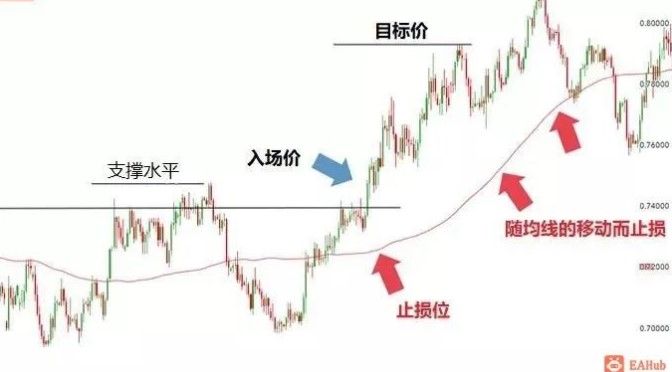
moving average: you can set the long/short stop loss point above/below the moving average, The figure below shows how to use moving averages for dynamic stop loss.
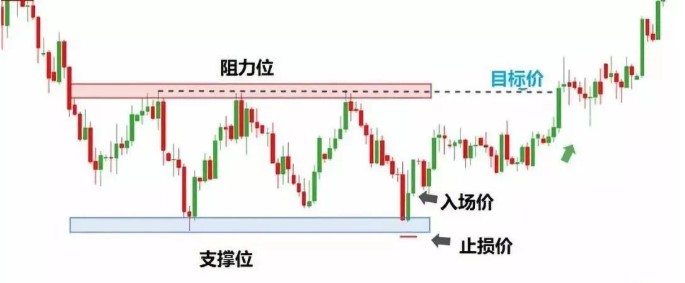
Support and resistance: Set a long position stop loss slightly below the support level, or set a short position stop loss slightly above the resistance level, as shown in the figure below.
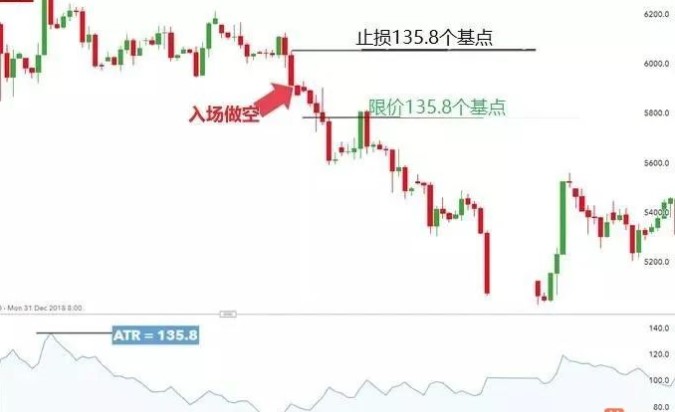
Use ATR to set stop loss: The ATR indicator can be used to move the stop loss of the position. As shown in the figure below, the ATR value within a certain period of time is 135.8, then the stop loss can be set above the entry price of 135.8 points. If the direction of the market is consistent with the direction of the investor's position, the investor can use the trailing stop loss to lock in the vested profit, and at the same time maintain the same stop loss distance.
3) Diversified investment portfolios, and the smaller the portfolio correlation, the better.
Investors always adhere to the above 1% principle in transactions (the risk of a single transaction cannot exceed 1% of the net value of the account). It is far from enough. It is also necessary to ensure the correlation of the investment portfolio when trading. The lower the correlation, the less risk the account bears. When the market direction is consistent with the position direction, a highly correlated investor portfolio will undoubtedly double the profits, but if the direction is opposite, the losses investors have to bear will also multiply.
4) Ensure that risk and emotional management are consistent.
One of the traps that investors often encounter in trading is that when certain transactions are profitable, the nature of human greed will induce investors to further increase the size of their positions, followed by There will be a risk of liquidation. A mature trader can indeed increase the position of the existing position when the position is profitable, but at the same time, the risk management should be more strict and prudent.
5) Setting a positive risk-reward ratio
Setting a positive risk-reward ratio when trading is very important for risk management. Setting a positive risk-reward ratio while ensuring that the risk of a single transaction does not exceed 1% of the net value of the account can help investors feel more at ease when trading.
The risk-reward ratio refers to the ratio of the number of points investors are willing to bear in a single transaction to the number of points they hope to obtain in return. A risk-reward ratio of 1:2 means that once the transaction is triggered, investors are willing to risk one point to obtain two points. return.
The magic of the risk-reward ratio lies in its repeated applicability. We also researched in Winner's Guide to Trading that traders who use positive risk reward ratios tend to be more profitable than negative risk reward ratios. As long as a positive risk-reward ratio is maintained at all times in the transaction, even if only 50% of the transactions are profitable, the investor's entire transaction is still successful.
Remarks: When the trading direction is right, but the price turns its head down before reaching the target point and triggers the stop loss point, investors are often very frustrated. The way to avoid this situation is when the price moves closer to the target price When trading, first close half of the position to lock in the profit, and then set the stop loss price at the breakeven point. In this way, the remaining position is a risk-free transaction.


 Add
Add


