Since the outbreak of the epidemic, the Federal Reserve has released a large amount of liquidity to the market to save the U.S. economy, and the surge in liquidity in the market has triggered high inflation in the United States. In order to control inflation, the Fed’s monetary policy stance has gradually turned hawkish. Policy normalization is on.
Recently, market expectations for the Fed to raise interest rates and shrink its balance sheet have continued to heat up, so how does the Fed achieve its interest rate target?
Before the global financial crisis, the Fed used a system of scarce reserves and fine-tuned the supply of reserves to maintain control over interest rates. Since then, however, the Fed has been operating in a floor system, meaning that the Fed no longer actively manages the supply of reserves, but rather affects the federal funds rate through adjustments to administered rates.
Before the 2008 Financial Crisis: The Fed Achieved Its Objectives Primarily Through a System of Scarce Reserves
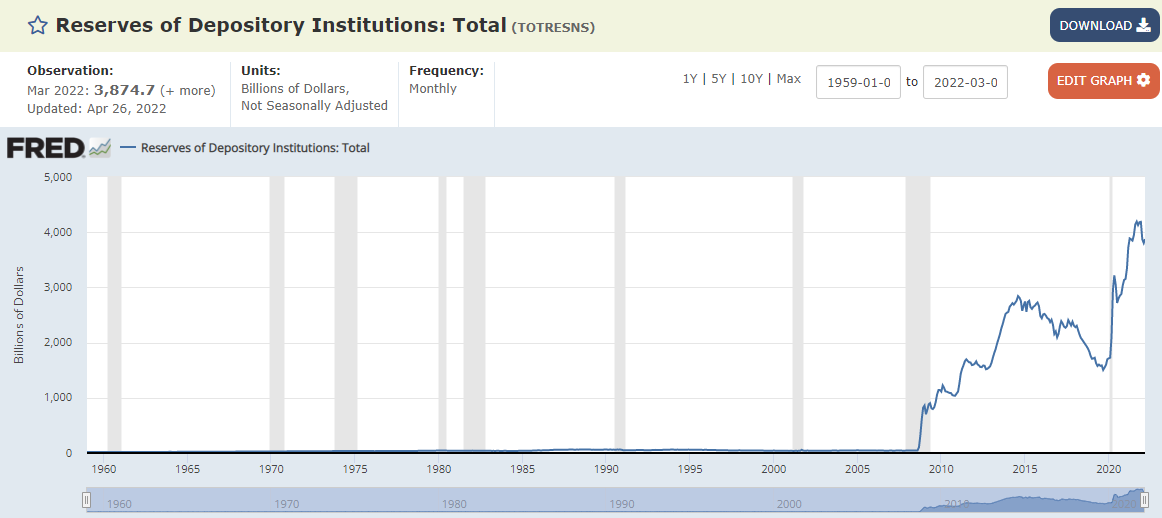
Before the 2008 financial crisis, the banking system usually kept reserve balances at a low level, which was partly related to the fact that reserve balances had no income at that time. If a bank has insufficient reserve balances, it can borrow overnight in the fed funds market at a cost known as the effective federal funds rate (EFFR). According to data released by the Federal Reserve, from January 1980 to September 2008, the balance of reserves in the banking system averaged only about US$48 billion.
Under a system of scarce reserves, the Fed achieves the federal funds target rate through open market operations. To put it simply, if the market's effective federal funds rate is higher than the Fed's target rate, the Fed can buy securities in the open market and inject liquidity into the market, thereby lowering the effective federal funds rate; and vice versa.
So why did this approach fail after the financial crisis?
After the outbreak of the financial crisis, in order to improve financial market conditions and stimulate the economy, the Federal Reserve launched a quantitative easing policy (QE, that is, a large-scale asset purchase plan), injecting a large amount of liquidity into the market. According to data released by the Federal Reserve, the size of the reserve balance of the banking system has risen sharply since September 2008, and was close to 3 trillion US dollars before the end of QE in 2014. Facing a market with such ample reserves, it will be difficult for the Fed to achieve its target interest rate through open market operations.
After the 2008 financial crisis: the Fed mainly through the interest rate corridor system to achieve the goal
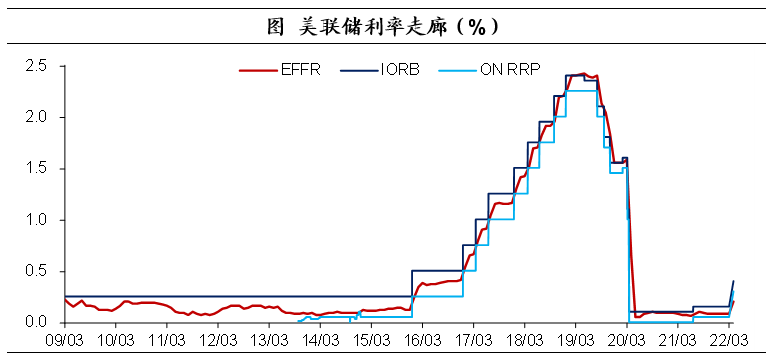
The so-called interest rate corridor is to set the upper and lower limits of the interest rate, and to achieve the target interest rate by adjusting the upper and lower limits of the interest rate. The current upper limit of the interest rate set by the Federal Reserve is the interest rate on reserve balances (IORB), which is the reserve interest paid by the Federal Reserve to the banking system; The mortgage reverse repurchase interest paid.
So, how did the interest rate corridor come into being?
First of all, in October 2008, the Federal Reserve announced the payment of interest on the reserve balance and excess reserve balance of the banking system, namely IORR and IOER (set to a unified interest rate level from November 2008, and unified revision of IORR and IOER from June 2021 is the interest rate on reserve balances (IORB). The Federal Reserve initially planned to set the IORB as the lower limit of the interest rate, that is, once the federal funds rate is lower than the IORB, financial institutions tend to put funds in the Federal Reserve to earn higher interest rather than lending them out.
However, contrary to expectations, the federal funds rate is often lower than the IORB. The main reason is that the large amount of liquidity injected by the Federal Reserve is not only flooding the banking system, but also flooding non-bank financial institutions such as money market funds, government-backed enterprises GSEs (such as Freddie Mac, Fannie Mae, and Federal Home Loan Banks FHLBs), and hedge funds. These institutions cannot earn interest on reserve balances from the Fed, making them willing to lend reserves at any interest rate higher than 0, and the banking system has an incentive to borrow reserves at rates lower than IORB to achieve arbitrage. Eventually the IORB gradually evolved into a cap on interest rates.
Secondly, in September 2013, the Federal Reserve announced the start of overnight reverse repurchase operations, that is, authorized participants can obtain overnight repurchase interest (ON RRP) from the Federal Reserve through reverse repurchase operations. Due to the wider scope of participation, in addition to the banking system, non-bank financial institutions can also participate. Once the federal funds rate is lower than ON RRP, non-bank financial institutions tend to earn higher interest from the Federal Reserve through overnight repo operations instead of lending go out. Eventually ON RRP gradually evolved into a lower bound on interest rates. On the one hand, the setting of ON RRP helps the Fed to better manage short-term interest rates, and on the other hand, it also lays the foundation for the Fed to raise interest rates.
Finally, to achieve its target interest rate, the Fed only needs to adjust the IORB and ON RRP simultaneously.
Overall, the Federal Reserve's monetary policy implementation framework has changed from a framework that controls interest rates based on the scarcity of reserves to a framework that mainly relies on managed interest rates. However, the U.S. financial system is complex, and banks are only part of the financial market. Thus, the Fed uses additional tools to support interest rate control in situations where non-bank institutions also influence the transmission of monetary policy.
PS: Code words are not easy, like and follow to unlock more knowledge about the Federal Reserve


 Add
Add


