double needle shape
According to the previous trend, the double-needle pattern can be divided into the double-needle pattern in the upward trend and the double-needle pattern in the downward trend, which belong to the commonly used reversal K-line combination pattern.
A twin-needle pattern in an uptrend is called a twin-needle top, and it has the following characteristics:
(1) The previous trend was an upward trend;
(2) It is composed of two candle lines. The absolute range of the leading lines of the two candle lines and the relative range relative to the entity of this candle line are both long enough, and the entity can be either Yin or Yang;
(3) It is best if two candle lines appear consecutively, but it is also allowed to have 1 or 2 negligible small yin or small yang lines in the middle.
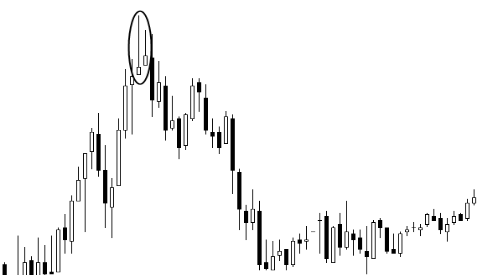
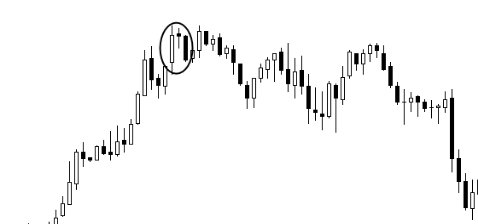
Figure 2.29 Double needle probe top
The appearance of a double-needle top pattern in an upward trend indicates that the strength of the bulls is gradually exhausted at this time. The first candle line with a long enough upper lead indicates that there is obvious pressure on the top, and the bulls encounter resistance and cannot push the price to a higher level.
And the second candle line with a long enough upper lead went up again and then fell back, verifying the pressure above. This pattern indicates that the bullish market is likely to come to an end temporarily and enter a volatile market or reverse.
If you have long positions, you should consider possible profit-making after this pattern appears; if this pattern appears in the callback of the downtrend, it indicates that the callback may have been basically in place, and we should pay attention to possible short-term intervention opportunities at this time.
As shown in Figure 2.29, it was a relatively strong upward trend before. However, it was suppressed and quickly fell back after rushing high. The first candle line with a long upper lead line - the shooting star line was closed. After the K line is closed, we must pay attention to the bullish market Possibility of coming to an end.
Later, due to the last fight of the bulls, the price pulled up again. However, it was still suppressed by the top and continued to close the shooting star line that rose and fell back. It formed a double-needle probe pattern with the previous shooting star line. The probability of a reversal in the market outlook is very high. As can be seen from the above chart, the market started a rapid and sharp decline just after this pattern.
A double-needle pattern in a downtrend is called a double-needle bottom, and it has the following characteristics:
(1) The previous trend was a downtrend;
(2) It is composed of two K-lines. The absolute range of the lower lead of the two candle lines and the relative range relative to the entity of this candle line are both long enough, and the entity can be either Yin or Yang;
(3) It is best if two candle lines appear consecutively, but it is also allowed to have 1 or 2 negligible small yin or small yang lines in the middle.
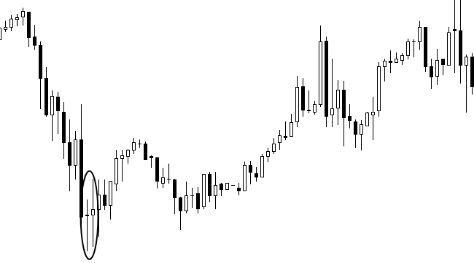
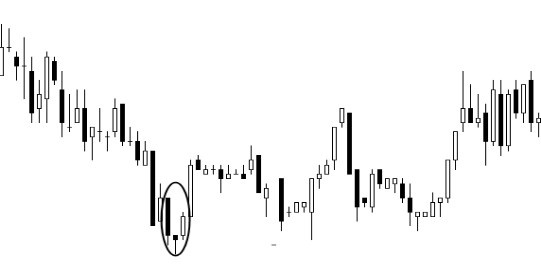
Figure 2.30 Double-needle bottoming
The appearance of a double-needle bottoming pattern in a downtrend indicates that the power of the bears is gradually exhausted at this time. The first candle line with a long enough lower lead indicates that there is a relatively obvious support below, and the bears encounter a large support and cannot suppress the price to a lower level. .
And the second candle line with a long enough lower lead went down again and stabilized to verify the support below. This pattern indicates that the short market is likely to come to an end temporarily and enter a volatile market or reverse.
If there is a short position, you should consider possible profit closing after the appearance of this pattern; if this pattern appears in the callback of the upward trend, it indicates that the callback may be basically in place. At this time, we should pay attention to the possible opportunities for bulls to intervene.
As shown in Figure 2.30, it was an obvious downward trend before, but after a resolute big negative line, the first candle line with a long lower lead line - cross star was closed, indicating that there is a relatively obvious support below, and the short position is already very strong at this time It is difficult to suppress the price to a lower level.
Then the market went down again to test and closed the doji with a longer lead line again, and the two dojis formed a double-needle bottoming pattern. At this time, the short power is basically exhausted, the market chooses to go up after the horizontal adjustment, and the previous downward trend is reversed.
morning star and evening star
The morning star appears in a downtrend. This form is composed of three K-lines, and it belongs to the classic reversal candle line form-a bottom signal.
(1) The previous trend was a downward trend;
(2) It is composed of three K-lines, the first one is a large negative line that continues the downward trend, the second K-line is a cross star, and the third one is a positive line, and the entity has a large range and goes deep into the first line A Yinxian body even engulfs the first Yinxian inside.
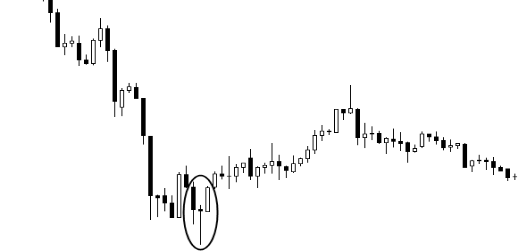
Figure 2.31 Morning Star
The morning star in the downtrend indicates that the short sellers are gradually running out of power at this time, and the short sellers encounter a large support and cannot suppress the price to a lower level.
The first negative line shows that the previous downward trend is still healthy, and the bear force is dominating the market; the second K line, when the cross star closes, shows that there is a relatively obvious support below, and the bears have been unable to suppress the price to a lower level ; The third K-line verifies the support function and shows that bulls are beginning to gradually gain market dominance. The larger the range of the third K-line entity, the higher the probability of reversal.
This pattern indicates that the short market is very likely to come to an end temporarily and enter a volatile market or reverse, and the probability is relatively high (because the last candle line has verified that the lower support is effective).
If there is a short position, you should consider possible profit closing after the appearance of this pattern; if this pattern appears in the callback of the upward trend, it indicates that the callback may be basically in place. At this time, we should pay attention to the possible opportunities for bulls to intervene.
As shown in Figure 2.31, it was a relatively obvious downward trend before, and a group of upward engulfing patterns appeared at the bottom, indicating that there was a certain support below; then the market went down again and closed the morning star pattern. After the pattern was closed, it was the same as the previous group The upward engulfing pattern established a relatively solid bottom pattern, and the bears gradually lost power. It can be seen that the market has launched a relatively large upward correction.
The above is a relatively standard morning star. However, it is often difficult to encounter such a standard morning star pattern in the market. We call the pattern that is not completely standard but has the essence and meaning of the morning star as the morning star. variant form.
It has exactly the same technical significance as the morning star, and we should also pay high attention to it in transactions and make it serve our transactions. The following is a brief example of several variations of Morning Star.
Figure 2.32 Variation Form 1 of Morning Star
Figure 2.33 Morning Star variation form 2
In Figure 2.32, the difference between variant form 1 and the standard form is that there are two dojis, while the standard form is one doji.
But this pattern has all the essence of the standard morning star, which is equally instructive. In Figure 2.33, the difference between variant pattern 2 and the standard pattern is the difference in the second K-line - the standard pattern requires that the candle line be a doji and this pattern is a hammer line.
The hammer line also shows that there is a relatively obvious support below, which has the same meaning as the cross star, so this form also fully has the guiding role of the standard morning star.
The evening star is the corresponding form of the morning star, the difference between the two is that the previous trend is different. The evening star appears in an uptrend and is a classic peak signal, which has the following characteristics:
(1) The previous trend is an upward trend;
(2) It is composed of three candle lines, the first is a large positive line that continues the upward trend, the second candle line is a cross star, and the third is a negative line, and the entity has a large range and goes deep down to The inside of the first positive line entity even engulfed the first positive line.
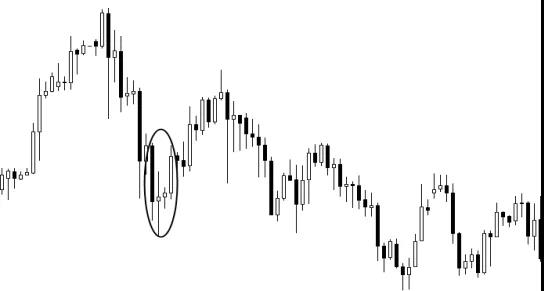
Figure 2.34 Evening Star
The evening star in an uptrend indicates that the strength of the bulls is gradually exhausted at this time, and the bulls are under greater pressure and cannot push the price higher.
The first positive line shows that the previous upward trend is still healthy, and the bulls are dominating the market; the second K-line, when the cross star closes, shows that there is more obvious pressure on the top, and the bulls have been unable to push the price to a higher level. High price; the third candle line verifies the pressure effect and shows that the bear force is gradually taking over the dominance of the market. The larger the range of the third K-line entity, the higher the probability of reversal.
This form indicates that the bullish market is likely to come to an end temporarily and enter a volatile market or reverse, and the probability is relatively high (because the last candle line has verified that the upper pressure is effective).
If you have long positions, you should consider possible profit-making after this pattern appears; if this pattern appears in the callback of the downtrend, it indicates that the callback may have been basically in place, and we should pay attention to possible short-term intervention opportunities at this time.
As shown in Figure 2.34, it was a relatively obvious upward trend before, and a cross star appeared after a positive line in the rapid rise—indicating that the bulls were weak and lacked momentum.
A resolute big Yin line behind the doji verifies the upper pressure. The entity range of the Yin line basically recovered the increase of the first Yang line, and the bears gradually took the lead. It can be seen from the figure that after the bull market ended, the market began to fluctuate downward.
As the corresponding form of the morning star, the evening star also has corresponding variant forms, and these variant forms have the same guiding significance as the evening star. Readers can find the mutated form of the Evening Star based on the mutated form of the Morning Star, so I won't go into too much detail here.
The above is the introduction of some classic candle lines and their combination forms. Fully grasping these candle lines and their combination forms is of great help to our trading. Of course, the knowledge of candlestick charts is extensive and profound, and there are many contents. Investors need to constantly comprehend and learn during trading to enrich the knowledge of candlestick charts.



 Add
Add


