Economic interconnectedness generally increased after World War II through international trade and cross-border financial flows
Global trade in goods and services has grown to (25%) the total global output of the past few decades. The U.S. experience mirrors this pattern, with its total imports and exports trending upward relative to GDP. The increase in trade reflects technological advances and government policies. For example, containerization has made sea and land transportation cheaper and more convenient, while the Internet has provided various extensions of trade in services and trade in goods. At the same time, the establishment of the General Agreement on Tariffs and Trade (GATT) in 1947 and successive rounds of trade negotiations of its successor (the World Trade Organization) resulted in less trade restrictions. While measuring the extent of financial flows is more challenging than measuring trade flows, there is evidence that international borrowing also increased during this period. Cross-border bank lending accounts for about 40% of global GDP, according to BIS estimates.
There are greater trade interests and financial interconnections
Increased international trade in goods and services increases production efficiency by allowing production specialization and access to larger markets. It also increases the variety and choice of products available to consumers. Compared with other advanced economies, the location and size of the United States make it relatively "closed" from the rest of the world. Still, about 20 percent of U.S. consumer spending goes to foreign producers, and U.S. manufacturing companies export about half of their output. U.S. banks and financial institutions have global reach, and U.S. borrowers, especially the government Benefit (by selling treasury bills and bonds) from world capital markets that lend to the US at better rates than the US. This would prevail if borrowers had to rely solely on domestic savings in the United States. Similar benefits are more pronounced for other countries with greater foreign presence in trade and finance.
However, increasing international trade and financial flows make countries vulnerable to economic shocks originating abroad. For example, the surge in oil prices in 1973 meant that the U.S. and other oil-importing countries effectively paid a "tax" to OPEC countries, causing recession and fueling the high inflation of the 1970s.
The second example is the financial crisis that broke out in Thailand in July 1997 and spread to other countries. Problems in the country's domestic banking sector have led to the withdrawal of foreign investors, triggering a vicious cycle of depreciation, recession and banking weakness.
Contagion occurs when foreign creditors start pulling out from other countries in the region that are seen as having similar vulnerabilities. The crisis spread first to East Asian economies and then to Russia, Brazil and elsewhere. In the United States, the initial impact has been both negative and positive. The reduction in exports led to immediate trade-related disruptions as affected countries reduced their purchases of U.S. products. But the U.S. also benefits from lower inflationary pressures from lower import prices and lower commodity prices, as well as lower borrowing costs, due to higher demand for safe U.S. government bonds. The U.S. Treasury Department and the New York Federal Reserve Bank struggled to contain potential financial contagion.
The third example, the Great Recession that began in 2008, differs from the other two in that it originated in the United States, whose financial markets have collapsed. The crisis spread to other countries through financial and trade channels. European and Asian banks found the assets on their books plummeted overnight, jeopardizing solvency and limiting lending. Due to the decline in US income and limited access to trade financing; the demand for imports by US consumers and businesses has fallen, triggering a global "trade collapse". The recent economic recession is related to the pandemic and the global crisis. The outbreak of the epidemic has reshaped the global industrial chain.
Economic events in the U.S. have varying degrees of impact on the rest of the world due to U.S. dominance in global trade and financial markets, and the use of the U.S. dollar as a global currency
The deflationary policy in the United States in the late 1970s is an example. At that time, the unemployment rate in the United States was more than 7.5%, and the inflation rate was close to 15%. The Fed raised U.S. interest rates to nearly 20% over a decade, a policy that ultimately worked, ushering in a new era of low inflation. But it also contributed to a U.S. and global recession as the effects of tight U.S. monetary policy spread to other countries through trade and financial markets.
On the trade side, U.S. exporting businesses actually benefit from a stronger dollar because goods from other countries are relatively cheap for U.S. consumers. But with the US recession, import demand decreased; 1980, 1981, and 1982 were each lower than in 1979. On the financial front, a rising dollar poses problems for any investor in dollar-denominated debt, including many emerging markets. High interest rates in the United States have also triggered capital outflows from highly indebted developing countries. These last two factors contributed to the Latin American debt crisis of 1982.
The U.S. is also in a unique position to help during a crisis
The debt crisis in Latin America in the 1980s was finally resolved through the implementation of the Brady Plan. The program converts defaulted debt into U.S. guaranteed bonds. It restored countries' ability to borrow abroad and created a buoyant global sovereign bond trade. Likewise, after the Mexican crisis of 1994 and the Asian financial crisis of 1997, efforts by Federal Reserve Chairman Alan Greenspan, Treasury Secretary Rubin, and Treasury Under Secretary for International Affairs Larry Summers to prevent a global economic collapse prompted the 1999 The cover of Time magazine announced three for the "Save the World Committee."
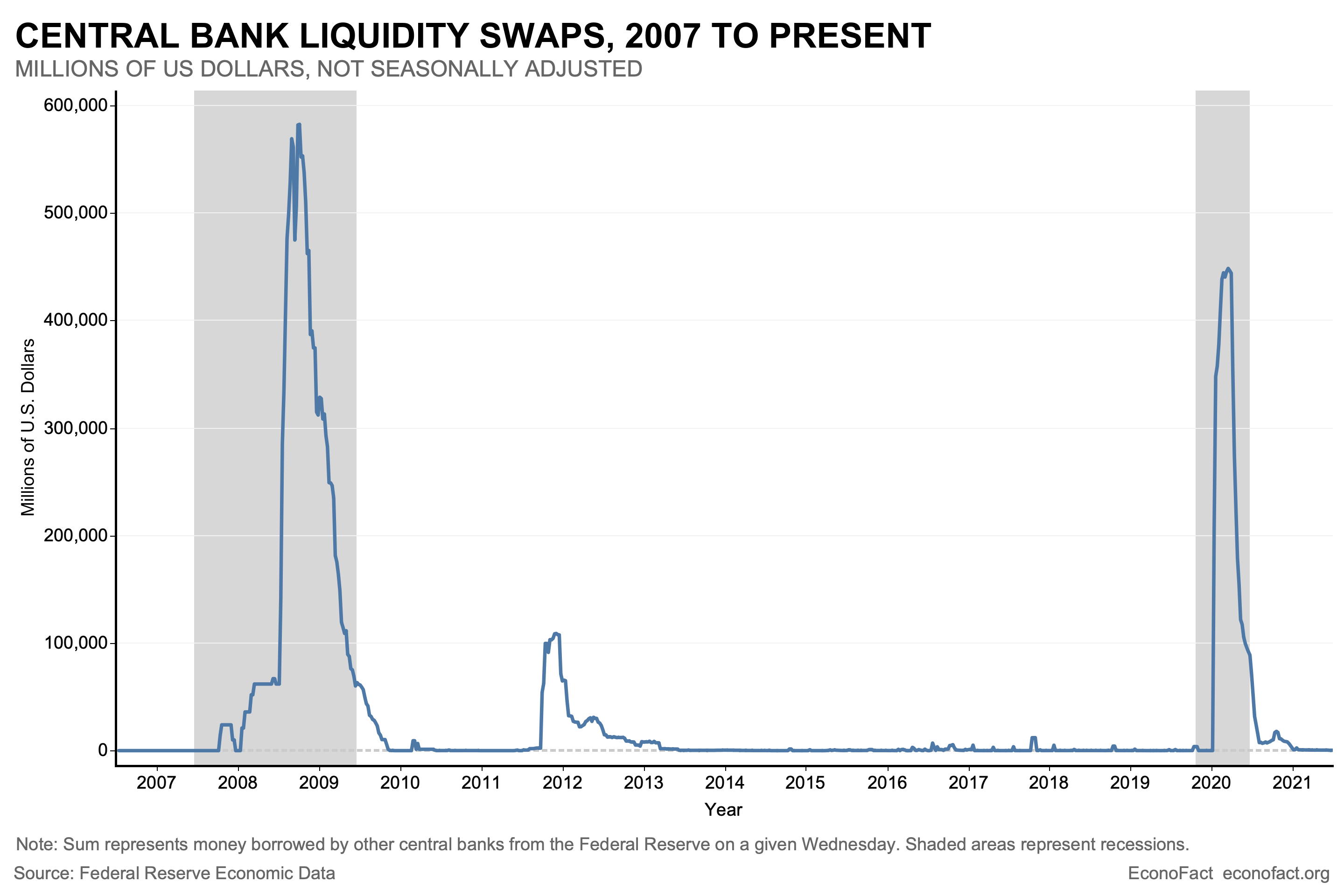
During the 2008-09 global financial crisis, the Fed provided "swap lines" to many foreign central banks. That is, dollar loans that these foreign central banks can use to lend dollars to domestic commercial banks to cushion the depreciation of the dollar. This is important because widespread losses in dollar-denominated assets mean that foreign financial institutions need to buy dollars at a time when markets experience dollar shortages and foreign central banks do not have enough dollar reserves to help their banks.
How to understand all prosperity and all losses
As the chart below shows, nearly $600 billion was provided to foreign central banks in early 2009. Likewise, in March, April, and May 2020, when the pandemic caused a global lockdown that spread to panic in financial markets, the Federal Reserve provided more than $400 billion a week in swaps to foreign central banks.
Economists usually use the term "one prospers, one loses all" to describe the interconnected world economy. How the economic fortunes of countries are affected by adverse events originating from a single major country or region deserves special attention. Economic events outside the United States can affect the country, and the size of the U.S. economy and the central role of the dollar in international transactions means that economic crises in the country have huge global ramifications. The United States can also help other countries in times of crisis through direct action and participation in a coordinated response. Ultimately, the best way for an individual country, including the United States, to respond to economic disruption originating beyond its borders is to maintain stable inflation and manageable government debt, strong economic growth, and reliable banks from a strength standpoint and financial institutions. Countries that start out in better economic shape tend to be better able to withstand crises brought on by foreign sources, just as initially healthy people are better able to survive disease than those with underlying health conditions.




 Add
Add


