Without expanding and improving the production structure, it will be difficult to increase the supply of goods and services in line with the increase in aggregate demand. Infrastructure expansion and enhancements depend on ever-expanding pools of savings. We believe that the currently observed massive shortages of various factors of production, such as labor and raw materials, are a response to the huge monetary injections by the Federal Reserve and the massive increase in government spending.
The market generally believes that the main driver of economic growth is the increase in aggregate demand for goods and services. It is also believed that the increase in aggregate output is a multiple of increases in government, consumer and business spending.
Along these lines, it's no surprise that most commentators believe that fiscal and monetary stimulus can prevent the U.S. economy from slipping into recession. For example, through increased government spending and monetary injections from central banks, it is believed that this will strengthen the production of goods and services, the overall supply.
It follows that, through increased government spending and monetary injections from the central bank, authorities can boost economic growth. This means that demand creates supply. However, is it so?
Falling Savings Threat to U.S. Economy
We believe that it will be difficult to increase the supply of goods and services in line with an increase in aggregate demand without expanding and upgrading the production structure.
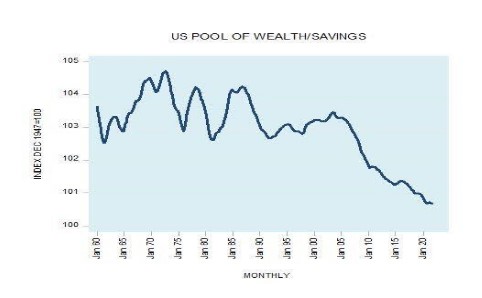
Infrastructure expansion and enhancements depend on ever-expanding pools of savings. (This pool includes final consumer goods). Savings pools are needed to support the various individuals employed in enhancing and expanding the infrastructure. Given all the reckless fiscal and monetary policies past and present, we estimate that the U.S. savings pool is currently most likely to be under severe downward pressure.
Furthermore, neither government activity nor monetary pumping generates wealth. Therefore, all other things being equal, it is impossible to increase saving due to an increase in government spending and an increase in the money supply in the absence of an increase in wealth.
Why supply precedes demand
Now in a free and unhindered market economy, the creators of wealth don't produce everything for their own consumption. Part of their production is exchanged for the products of other producers. Thus, in a free and unhindered market economy, production precedes consumption. This means that something can be exchanged for something else. It also means that an increase in the production of goods and services leads to an increase in the demand for those goods and services.
Increases in government spending disrupt the wealth creation process by causing savings to shift from the wealth-creating private sector to the government. Likewise, monetary pumping initiates the transfer of wealth from wealth creators to wealth consumers by setting up barterless exchange. Now, since government activities do not generate wealth, these activities are equivalent to consumption without prior wealth production. Likewise, an increase in the money supply initiates consumption without prior production, i.e. nothing in exchange for something. Thus, an increase in government spending and an increase in money injections lead to consumption without the support of production.
Therefore, an increase in aggregate demand due to government spending and central bank money pumping is bad news for growth. Note that unsupported consumption of production leads to a decline in saving flows. This in turn weakens the capital formation process, thereby undermining prospects for economic growth.
Shortages and Currency Pumping
The currently observed massive shortages of various factors of production such as labor and raw materials are a response to the huge monetary injections by the Federal Reserve and the massive increase in government spending.
Again, the purpose of these measures is to stimulate overall demand and thus overall output. In a free-flowing market, the occurrence of a shortage means that the market is not cleared. Once liquidation occurs, the so-called shortage disappears.
In our view, huge government spending and massive money injections lead to a massive increase in demand for goods and services. This increase has not been supported by a corresponding increase in supply. As a result, this led to a sharp increase in the prices of goods and services.
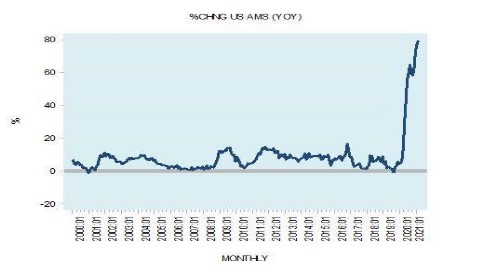
The price increase was further exacerbated by the supply shock caused by the lockdown. What we have here is more money per good and service. Note that the price of an item is the amount paid per unit of the item. Note that in February this year, the annual growth rate of the US monetary indicator AMS jumped to 79%, compared to 6.5% in February 2020. The average increase over this period was 43%.
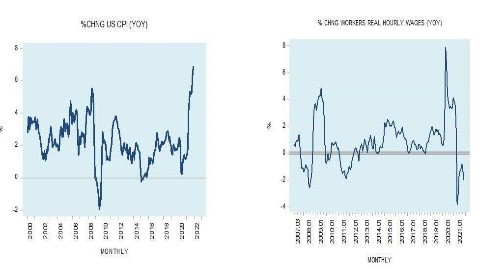
As a result, annual CPI growth climbed from 1.2% in November 2020 to 6.8% in November this year).
Annual growth in wages for private sector workers, adjusted for the annual increase in the Consumer Price Index (CPI), was negative 2% in November, compared with negative 1.4% in October and negative 3.3% in November 2020.
Now, the labor market is variously regulated and controlled, i.e. unable to quickly adapt to various external changes, such as a large increase in aggregate demand due to large monetary injections and large increases in government spending.
Thus, at a given real wage, far more workers are currently needed than are willing to be employed. Thus, the shortage of workers is at a given real wage.
This means that once workers' real wages rise, the labor shortage will decrease. In addition, government largesse during the lockdown further stifled the labor market. Many workers find it more beneficial to have more leisure time than to work, especially as real wage growth rates have fallen significantly.
The supply shortage we are currently observing is not a supply shortage caused by the pandemic, but a supply shortage caused by the response of governments and central banks to the epidemic and the lack of a free market.
Most market watchers believe that the U.S. economy has been kept strong by massive government spending and massive monetary injections by the Federal Reserve. In our view, this so-called strength is measured in terms of real gross domestic product (GDP). The metric's annual growth rate was 4.9 percent in the third quarter of this year, compared to 2.3 percent in the third quarter of 2020. The increase in this indicator is due to the aggressive measures taken by the government and the Federal Reserve. Therefore, the increase in the growth rate of real GDP reflects the consumption of savings.
If the savings pool is still expanding, then aggressive policies by the government and the Federal Reserve will lead to strong real GDP growth. However, if the savings pool is shrinking, so-called real economic activity will follow suit, and the savings pool is currently under strong downward pressure.
in conclusion
Increases in government spending and money injections from the central bank boost overall demand in the economy. In turn, this is thought to lead to an increase in the production of goods and services, i.e. an increase in the overall supply. What we call "demand creates supply" here.
This argument is problematic if individuals do not allocate enough savings to support increased production of goods and services. Also, in order to be able to exchange something for goods and services, an individual must own the thing. This means that, in order to demand goods and services, individuals must first produce something useful. So supply drives demand, not the other way around.
We also believe that the currently observed shortages of workers and materials, as well as the sharp rise in the prices of goods and services, are due to aggressive monetary injections by the Federal Reserve and large government spending. These enormous increases coupled with various obstacles, especially in the labor market, prevented individuals from responding quickly to these surges.




 Add
Add


