First of all, we need to know what KDJ indicators and RSI indicators are.
KDJ indicator: KDJ indicator, also known as stochastic indicator, is a fairly novel and practical technical analysis indicator. It was first used in the analysis of the futures market, and later widely used in the short-term trend analysis of the stock market. The most commonly used technical analysis tool on the Internet. Generally, it is a statistical system used for stock analysis. According to statistical principles, the highest price, the lowest price, the closing price of the last calculation cycle and the three times occurred in a specific period (usually 9 days, 9 weeks, etc.) Calculate the immature random value RSV in the last calculation period based on the proportional relationship between them, and then calculate the K value, D value and J value according to the smooth moving average method, and draw a curve to judge the stock trend.
RSI Indicator: Relative Strength Index RSI is a technical curve made based on the ratio of the sum of rising points and falling points within a certain period of time. It can reflect the prosperity of the market in a certain period of time. It was first applied to futures trading by Welles Wilder. Later, people found that in many technical analysis of charts, the theory and practice of strength indicators are extremely suitable for short-term investment in the stock market, so they are used in stock trading. In the measurement and analysis of ups and downs. The design of this analysis indicator is to use three lines to reflect the strength of the price trend. This graph can provide investors with an operational basis and is very suitable for short-term spread operations.
So what are the skills of using KDJ indicators and RSI indicators?
The most commonly used is the judgment of overbought and oversold. Overbought and oversold, as the name suggests, means that there are too many people buying or selling, and the market is in an extremely irrational state and is about to pull back. Generally speaking, 20 and 80 are used as the dividing line between overbought and oversold.
After knowing how to judge overbought and oversold, it is not difficult to apply it to trading. Generally speaking, when the RSI value exceeds 80, it is bearish, and when it falls below 20, it is bullish. Steady traders can also wait for the RSI to break through 80 before making a judgment. The latter often has a higher winning rate, but a lower profit-loss ratio.
In the same way, the application of KDJ is similar to RSI. When the K value and D value are above 80, it is bearish, and when it is below 20, it is bullish (the D value is calculated based on the K value, which can be regarded as D is the movement of K. moving average, D will lag behind K)
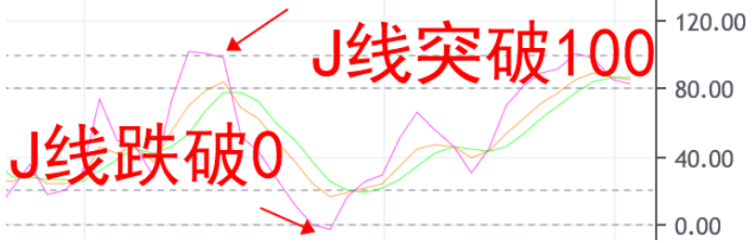
The J line, which is most sensitive to price changes, may break through 100 and fall below 0. Generally speaking, the overbought zone of the J line is above 100, and the oversold zone is below 0. 0 and 100 can be used as the dividing line of the J line.
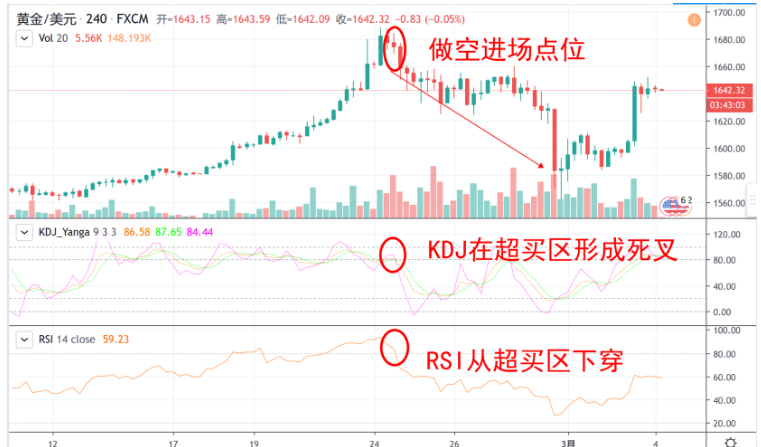
In addition to the separate use of the three KDJ lines, the intersection of the three lines can also be used as a judgment: short when there is a KDJ dead cross near 80, and long when there is a KDJ golden cross near 20.
As shown in the figure, RSI fell back after breaking through 80, and KDJ formed a dead fork in the overbought zone, shorting.
The fastest moving line is the J line. 0 and 100 can be used as the overbought and oversold judgment space of the J line. The picture shows a typical KDJ overbought signal: the J line breaks through 100 and then falls back, forming a dead fork at a high level, shorting.
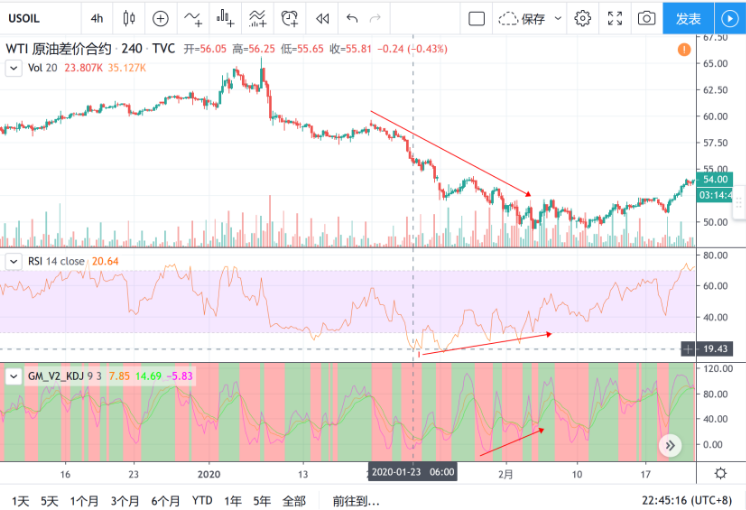
Deviate from judgment. KDJ and RSI can also be used as a reference for deviation. When the price keeps hitting new highs or new lows, the inflection point of the indicator does not follow the bottom of the new high. At this time, it can be judged that the momentum of the trend is exhausted and the price is about to reverse.
Taking the crude oil trend chart as an example, the price keeps falling, but the bottom of RSI and KDJ keeps rising, reflecting that the downward momentum is gradually exhausted, and the market outlook is bullish.
And what we need to know is that from the point of view of the indicator calculation principle, KDJ's response is more sensitive, so KDJ can identify the market that RSI cannot identify, but at the same time KDJ will appear more false signals. Using KDJ and RSI as the trading basis alone is difficult to make money in the long run, because there will be many false signals when trading with a single indicator, so we need to learn to filter out inappropriate signals combined with other technical indicators.
The last thing to say is that KDJ and RSI are more effective in large cycles. It is recommended to use them above the daily line in 4 hours. Less effective below the 1-hour chart. In the general trend market, KDJ and RSI will fail, and other indicators should be used as the basis for entry and exit.



 Add
Add


