Inflection Points and Trends
Trend line is a trading technique often used in trading, and it is the core content of our trend trading method. To draw a trendline accurately, you first need to understand what a trend is.
Market movement generally has three directions-uptrend, downtrend and sideways oscillation, and sideways oscillation is also called "no trend". In trading, we have a strict definition of trend, and the definition involves an important concept-turning point.
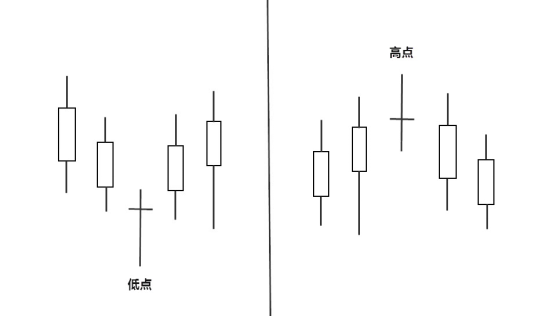
An inflection point is the point where the low (high) point of a candle pattern is lower (higher) than the low (high) points of the two K-lines on the left and right sides of the candlestick pattern.
The definition of inflection point may seem like a mouthful, but we can understand it simply and clearly through graphics.
Figure 3.1 Composition of Inflection Points
As shown in Figure 3.1, we can intuitively understand the composition of the inflection point. First of all, the standard inflection point must be found by five candlestick charts; secondly, there is no need to pay attention to whether a specific single K line is positive or negative, but only the relative positions of the leading lines of each K line.
Let's use the low inflection point on the left side of the graph as an example: as long as the lowest point of the middle K-line is lower than the lowest points of the two left and right K-lines, it is a "low inflection point" in our standard sense.
Similarly, the high inflection point on the right side of the chart: as long as the highest point of the middle K line is higher than the highest points of the two left and right K lines, it is the "high inflection point" in our standard sense.
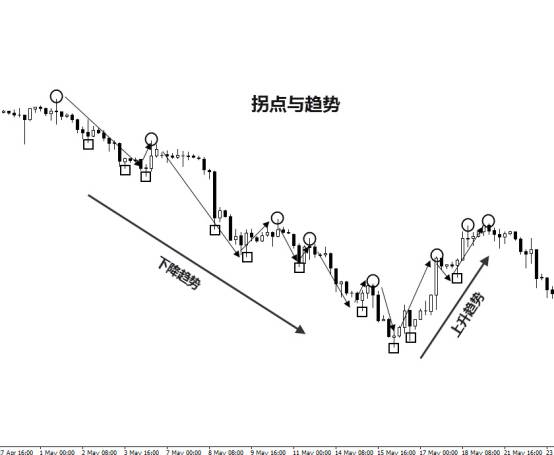
Figure 3.2 Inflection point and trend
As shown in Figure 3.2, through an example, let's find the high point of inflection point and the low point of inflection point, which we will refer to as high point and low point in the following. The high points are marked with circles and the low points are marked with squares. It can be seen that the high point of the K-line marked by the circle is higher than the high point of the two K-lines on the left and right sides, and the low point of the K-line marked by the square is lower than the low point of the two K-lines on the left and right sides.
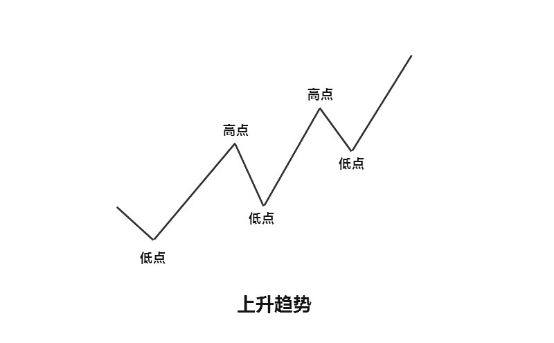
Inflection points are closely related to trends. In a given period of time, when the high point of each round of rising continues to make new highs and the low point of each round of callbacks also continues to rise, we call it an upward trend, as shown in Figure 3.3.
Figure 3.3 Uptrend
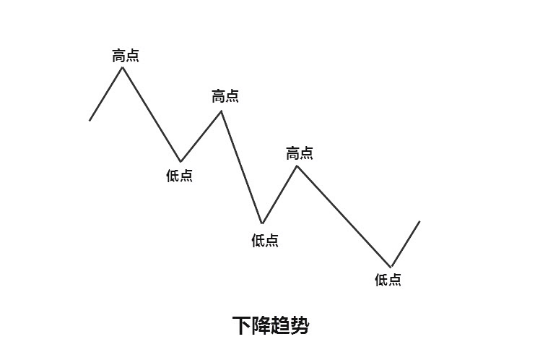
In the time period, when the low point of each round of decline continues to make new lows, and the high point of each round of callback continues to decrease, we call it a downward trend, as shown in Figure 3.4.
Figure 3.4 Downtrend
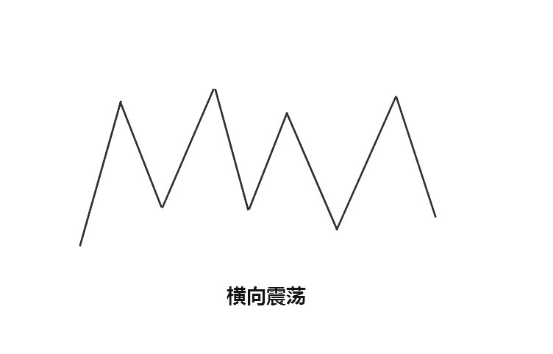
In a given period of time, the market is neither in the above-mentioned upward trend nor in a downward trend, but in a horizontal movement arrangement, which we call sideways oscillation, also known as no trend, as shown in Figure 3.5.
Figure 3.5 Lateral Oscillations
Trends include the above three types - uptrend, downtrend and sideways shocks. According to the size and cycle of the trend, we can divide it into long-term trend, medium-term trend and short-term trend.
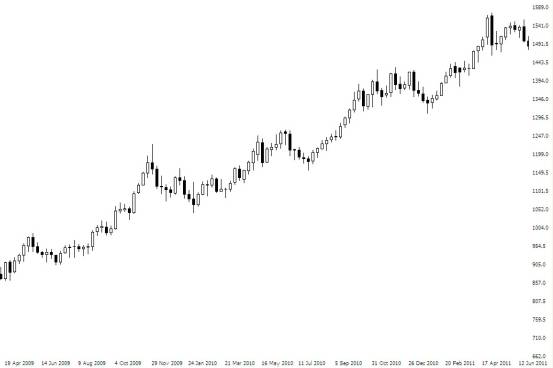
The long-term trend is the main trend in a long period of time, and the time period is generally 1-2 years or even longer. Figure 3.6 is the weekly chart of gold from 2009 to June 2011. It can be seen that its long-term trend is a good upward trend.
Figure 3.6 Long-term trend of the Golden Week chart
The long-term trend is composed of main waves and correction waves, and these relatively independent main waves and correction waves are regarded as medium-term trends, and their time period is generally 2 to 10 weeks.
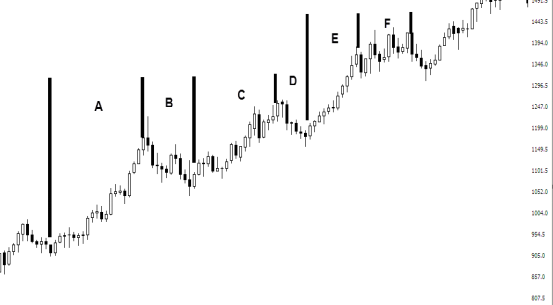
As shown in Figure 3.7, this chart is still a golden week chart. We divide it into 6 areas, and each individual area is the main trend in this period, which we call the medium-term trend.
It can be seen that the long-term trend of gold is an upward trend, but its mid-term trend will show a downward trend (areas B and D in the figure) and horizontal shocks (area F in the figure).
Figure 3.7 Medium-term trend of the golden week chart
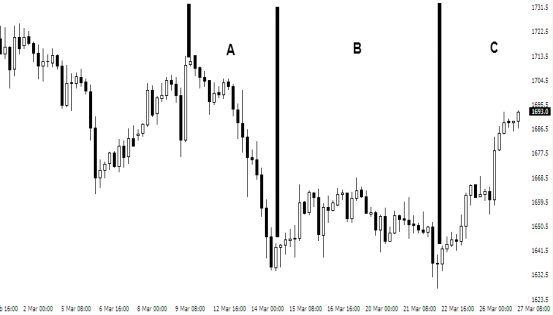
Similarly, the medium-term trend is also composed of main waves and correction waves, and these relatively independent main waves and correction waves can be regarded as short-term trends, and their time period is generally several days to two weeks. As shown in Figure 3.8, the picture is a gold 4-hour chart.
The three areas we marked are three short-term trends, the A area is a downward trend, the B area is a sideways shock, and the C area is an upward trend.
Figure 3.8 The short-term trend of the gold 4-hour chart
The trend we focus on is the market volatility within a specific time frame , which is something investors must attach great importance to. "Following the trend" requires investors to be clear about whether their transactions are long-term, mid-term or short-term. Only by knowing the cycle of their "following the trend" can it be possible to truly follow the trend.



 Add
Add


