First of all, let's clarify a concept, that is, what is a trailing stop loss
In trading, any indicator, data, or trading method is a double-edged sword. We should not only see their good points, but also their shortcomings. With the development of electronic networks, currently more than 80% of transactions are executed automatically, and the "moving stop loss" on the MT4 platform is one of the tools used to automatically manage account risks.
"Moving stop loss" is also called "trailing stop loss" or "trailing stop loss". It follows the latest foreign exchange currency pair price to set a certain number of points of stop loss, and it is only triggered when the exchange rate changes in a favorable direction for the position. The main function of the trailing stop loss is to automatically maintain the position held in the foreign exchange transaction, and automatically change the stop loss level according to the price change.
Moving stop loss setting on MT4
Taking the trend of EUR/USD as an example, if a trader enters the market at 1.1100 to do long, and sets the trailing stop loss 50 points below the entry price, that is 1.1050. If the exchange rate continues to rise, then the trailing stop will automatically follow and maintain a gap of 50 pips from the current price. That is to say, if the price touches 1.2200, the trailing stop price will be automatically set at the 1.2150 level.
Conversely, if an empty order is opened, the behavior of the trailing stop loss is completely opposite. Traders set it a few pips above the entry level. A price drop causes the trailing stop to move by the set number of pips. The price goes up, the trailing stop does not move.
If the market is good and the trend is strong, traders will regret it because they took profits too early. At this time, trailing stop loss is a very useful tool, which can maximize the profit of traders.
Trailing Stop: Two-Day High/Low Strategy
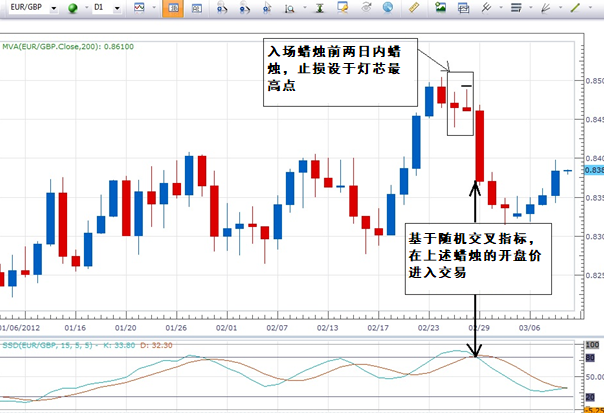
Short EUR/GBP on the daily chart, assuming stochastics are crossing slowly to the downside. The two candles in the box represent the selected stop loss area. When shorting, a stop can be placed above either of the two "wicks" as that represents the high of the two-day period. In this case, the stop loss would be placed at the upper wick, which is seen as the black line.
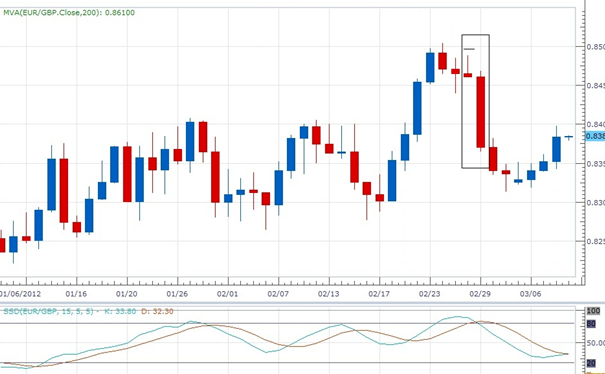
As time moves to the next trading day, the candles in the box will move with it. As you can see in the chart below, the two-day high remained the same, so the stop loss did not move either.
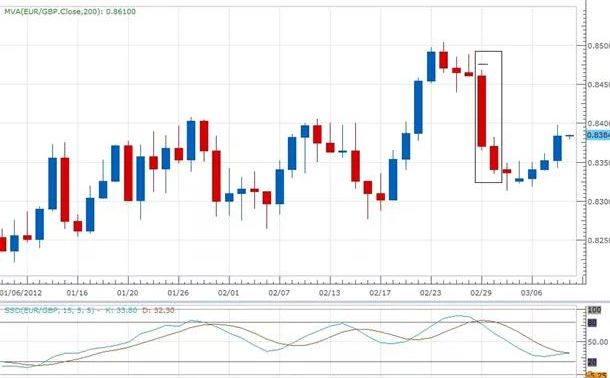
On the next chart, when entering the next trading day, the candles in the box will also continue to move forward by one.
Trend trading is used by traders, but it is impossible to track price movements consistently. Day trading should also use trailing stops when a quick reaction to price movements is required.
In the end, one thing must be remembered: no matter what the automated trading tool or "gut feeling" may be, the financial markets are still a game of few possibilities, which cannot provide exact formulas for success.



 Add
Add


