Guide:
The most powerful weapon in the world is not the atomic bomb, but "time + compound interest".
Since you have spare money in your hands, what are you most afraid of? Fear of being stolen or robbed, and even more afraid of the depreciation of your hard-earned money. As a value investor, most people should understand the concept of "compound interest effect". Compound interest corresponds to "time leverage", and time has become the most important element in investment.
Investing is like a long-distance race. What matters is not your speed at a certain stage, but whether you can reach the end at an appropriate speed. However, unlike a long-distance race, investment is a long-distance race without an end. The farther you run, the richer the "gift" you will get. So outperforming inflation has become our only way to keep money.
More than three hundred and ninety years ago (September 11, 1626), Dutchman Peter Minuit, one of the first generation of white immigrants, arrived in America and bought Manhattan, New York from the native Indians with trinkets equivalent to $24. Island, up to now, the value of New York's land can be estimated at more than 100 billion based on tax revenue.
From this point of view, it seemed to be an extremely unfair deal for the Indians back then. In this "deed", the Indians obviously suffered a lot from their immediate interests. For many years, the Indians seemed to have become the object of ridicule and a case of negative education.
However, there is a calculation method that will produce unexpected results: If the Indians at that time had invested the $24 for more than 390 years, how much wealth would they have today?
Buffett compares investment to snowballing. He said that what investors need to do is to find a piece of relatively wet snow (to find investment products that can obtain higher compound interest) and a long enough slope (to obtain compound interest for a long time), and then they can roll Make huge snowballs (for huge investment returns). His usual method is to use low-cost insurance capital to invest in a certain product for a long time, and through the compound interest of time, he will finally obtain a huge return.
90% of Buffett's wealth is obtained after he is 60 years old. Investment guru Buffett’s Berkshire investment company’s annual geometric average rate of return is 20.8%. It took him 52 years to turn 1 dollar into 19,727 yuan; On par. The 10-year output multiple of the geometric mean rate of return is astonishing.
We don't have to ask Indians to be able to achieve Buffett's level of investment income, but we can also look at the power of compound interest.
Someone with good intentions has calculated an account. If the annual income of 24 US dollars 390 years ago was 8%, it will now become an astonishing income of about 121 trillion US dollars. I don’t know how many New Yorks can be bought. That's the beauty of time compounding.
The stock god Buffett's preference for long-term fixed investment value investment is also the long-term compound interest effect of time. Principal, time, and interest rate are the three major elements of compound interest. The first two items can be provided by investors on a fixed basis, and the job of asset managers is to achieve a long-term high and stable rate of return for everyone.
Many people succeed in financial management not because they choose high-profit investment tools, but because they use some stable investment channels and follow the steps step by step, but the important thing is that they start a few steps earlier than others.
From an investment point of view, the effect of compound interest on investment returns is quite astonishing. Many people know the formula for compound interest: sum of principal and interest = principal x (1 + interest rate) number of periods. As for the concept of compound interest, it is easiest to understand if it is explained by the so-called "rolling interest". That is to say, add the interest or profit earned from the use of money to the principal and continue to earn remuneration.
for example:
Assuming that a certain investment has a 10% annual profit, if calculated by simple interest, if you invest 1 million yuan, you can earn 100,000 yuan a year, and you can earn 1 million yuan in ten years, which is twice as much.
However, if calculated by compound interest, although the annual profit rate is also 10%, the actual "amount" earned every year will continue to increase. Taking the aforementioned 1 million yuan investment as an example, the first year earns 100,000 yuan, but the second year The profit is 10% of 1.1 million yuan, which is 110,000 yuan. In the third year, it is 121,000 yuan. By the tenth year, the total investment income is nearly 1.6 million yuan, an increase of 1.6 times.
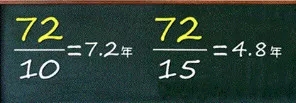
In addition, there is a "rule of seventy-two" that can help us easily calculate the time required to double the principal.
As shown in the picture above, for example, you have a principal of 100,000 yuan in your hand. If you invest in a product with an annualized return of 10%, then after 7.2 years, you will have 200,000 in your hand. Similarly, if you invest in a product with an annualized return of 15%, it only takes 4.8 years, and 100,000 will become 200,000.
Looking at it the other way around, for example, if we have a sum of money in our hands, we hope that the principal will double in 5 or 10 years. Then divide 72 by the time period, and we can calculate that we need to invest in financial products with an annualized return.
For every ordinary person, we live in a "three-dimensional world". From two-dimensional to three-dimensional, it is a huge perspective opening. The two-dimensional ants are always crawling on the plane, and they don't know the outside world they are in. What restricts human beings from passing through the "three-dimensional world" to a higher dimension is time. This is also mentioned in "Interstellar Crossing". Once human beings solve the time function, they can enter a wider world.
Being a friend of time can help a value investor realize the maximum growth of his assets. The time function is far more important than the speed function. We have seen that the greatest investors in history, whether it is Buffett, Burke, or the Rockefeller and Morgan families, have enjoyed long-term compound interest. And the greatest speculator in history, Livermore, who was once the richest man in the world, committed suicide because he could not enjoy the compound interest of time. The "Memoirs of a Stock Maker" has been left behind forever.
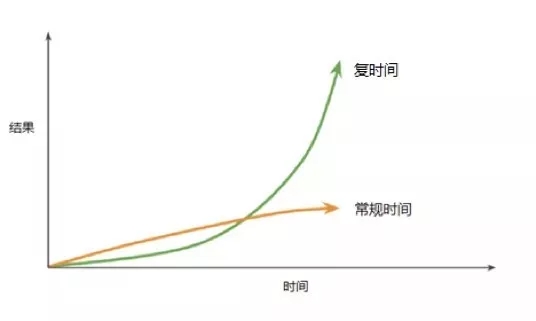
There is an article recently: Even more powerful than "compound interest" is "compound time"! The core point of this article is to enjoy the compound interest of time. Do things that have time to compound interest. You will find that the longer the time, the more value you get. Whether it is a great investor, an entrepreneur, or even a scientist, they all spend their time on things that have a compound interest effect, rather than trivial work every day. The more excellent a person is, the less "busy".
But the worst enemy of temporal compounding is mean reversion! How many people still remember the first generation of self-employed in China, the "fool melon seeds" Nian Guangjiu? As the earliest Chinese millionaire, he has long been submerged by the tide of the times. In the Chinese stock market in 1994, there was a man nicknamed "Green Preserved Egg" whose worth reached 30 million. This person's real name is Yang Weiguo, and he quickly made a fortune by entering the stock market to buy and sell stocks.
The 30 million in 1994 is about 3 billion today. However, he quickly lost all 30 million in treasury bond futures. Even "Yang Wanwan", who was still active in the past, did not achieve much after that. Some entrepreneurs even gradually withdrew from everyone's vision after the tide receded.
Here's the problem: mean reversion. If a person cannot evolve, it is impossible for him to maintain a non-linear growth rate. His level of wealth will eventually return to where it should be. This is the difficulty behind "time compound interest". It seems not difficult, but in fact, maintaining a growth that exceeds the average level of society for a long time means that you must continue to evolve yourself.
Dalio said that evolution is the homework of each of us. I gradually understood that behind compound interest is the theory of time evolution. If you want to be a friend of time, you must let yourself evolve continuously. This evolution includes the evolution of knowledge, the evolution of thinking, and the evolution of personality. In "The Selfish Gene", each of us is born to be "misled" by our own genes.
Why do you say "misleading"? Because, from a genetic point of view, he has only one purpose: to survive and reproduce. However, today's society and the primitive society 10,000 years ago have undergone earth-shaking changes. Many of the "genetic" patterns we have left behind, have aged. This is what we need to do to live in this world today, correct our inner genes, and then get real happiness.
Evolution means looking at yourself and the world objectively, long-term self-motivation, and overcoming weaknesses in your genes. Evolution is difficult, but only when you evolve can you truly stand on the side of time. Otherwise, we would not be friends with time and we would be mean reverted in the long run. That's why, investing in this world, there are many meteors and few stars. It is too difficult to maintain evolution for a long time.
Therefore, many people think that compound interest is just sitting there, but it is not.
① To invest. If the rate of return is too low, it will greatly affect the effect of compound interest, so maintaining a relatively high rate of return is the key. How to do it? To invest. Only by investing can there be a relatively high rate of return.
②Invest as early as possible. The longer the time period, the greater the effect of compounding. If we want to take advantage of this effect, we should invest as early as possible, and the earlier the better. The correct approach is that, if conditions permit, there should be a plan for investment and financial management after earning wage income.
③ To maintain a sustained and stable rate of return. The principle of compound interest tells us that if you maintain a moderate annual rate of return, you will be able to invest and become rich over time. How much rate of return is appropriate? Generally speaking, a goal of 15% is ideal. According to market conditions, this target can be adjusted accordingly. Individual investors can achieve this goal through hard work.
④ Avoid big losses. Only continuous calculation of the income of compound interest has a magical effect. During this period, it doesn't matter if the income is mediocre for one or two years, I am afraid of serious losses. If there is a serious loss, not only will all previous efforts be wasted, but the effect of compound interest will stop abruptly, and everything will have to start from scratch. If you want to use the principle of compound interest to get rich, you must keep in mind that you must not have a big loss.
Compound interest is to keep evolving and improve yourself. From our goal, people who want to get compound interest still hope to get more things. Then Munger said "If you want to get something, you'd better make yourself worthy of him!" Only by constantly improving yourself can you get more. Even if many people look back and say, look at stocks such as Moutai, Tencent, and Amazon, which have brought huge returns to holders for a long time, can I enjoy the compound interest of investment if I keep holding them?
However, in fact, these companies can go through the cycle for a long time because they themselves are also evolving, and investors who can really hold for a long time have their own cognition also evolving, so that they can match the speed of enterprise evolution. Otherwise, after breaking through your cognition, you will still be "safe in your pocket" at a certain stage.
Lifelong learning, keeping evolving, and matching our evolution with time, will bring compound interest returns to our own investment, and even life!


 Add
Add


