Fundamental and technical aspects play a pivotal role as the two pillars in transaction analysis. Whether it is the stock market, futures market, foreign exchange market or bond market, fundamental and technical analysis supports the reasons for investors to go long and short. Today Let's focus on technical analysis. I don't need to repeat the application and history of technical analysis here, but for investors who use technical analysis, does technical analysis only analyze charts?
In technical analysis, we can always hear that the market will continue to fall if it breaks through a certain key position, an important support, or open up a downward space, but why breaks through a support, the market will continue to go down, why break through the downward trend line, and fall The trend is coming to an end, why the market will continue to run upwards when it steps on the upward trend line, why are the moving average, macd and other indicators so popular with investors, what is the logic behind technical analysis, why is technical analysis useful, this is our In-depth research is required.
First of all, in terms of the composition of the market and the flow of funds, a mature market has thousands of investors participating, and the participation of thousands of investors means that there is a matching amount of funds deposited in this market Among them, the rise or fall of the market means that the inflow and outflow of funds have changed. What is the inflow or outflow of funds? Simply put, the total amount of long and short funds has changed. Under normal circumstances, when there are more long-term funds than short-term funds, the market will rise, and vice versa, it will fall. The essence of market ups and downs is that long and short funds are constantly competing with each other. The process of the long and short power game is constantly changing. The trajectory of the game changes is reflected on our disk, which is what we call the trend. Charts, k-lines and technical forms. Taking a fixed time period as the research object, if the long-term funds game wins in this period of time, then the market must show an upward trend during this period of time. If the outcome of long-short funds is not obvious during this period of time, the market must fluctuate in a range. If the short money game wins, the market will definitely fall.
We can go deeper into research, since it is the long-short game of funds that leads to the rise and fall of the market, then what guides the long-short game of investors' funds, which is obviously the individual views of investors participating in the market.
Because we are human beings, each of us has different interpretations of basic and technical aspects, different personality preferences, different education received, different people we come into contact with, three views, and even philosophical views. Opinions are different, so it is not difficult to explain why some people are bullish and others are bearish on the same disk. Different long-short views have led to a long-short capital game, but the so-called long-term must be united, long-term must be divided, when most people agree, one side wins after the game, and a direction is created, which is what we call The trend, follow Most people think that they can make money by doing it, which is what it means to follow the trend and follow the trend.
To use technical analysis, we must know what it is and why it is so that we can better understand the market. What technical analysis analyzes is not charts, but the flow of market funds and the psychology of the public.
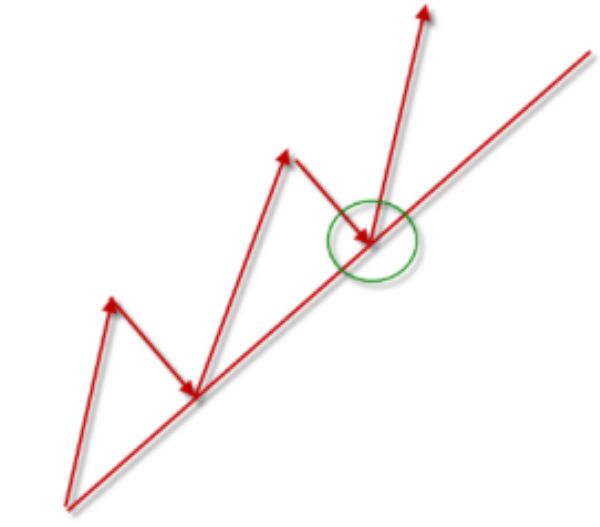
Take the picture above as an example. This is an obvious upward trend. There are many technical analysis mentioned that the position where the rising market touches the upward trend line is a buying point, such as the green circle in this picture. The principle is that in an upward trend, if the trend remains intact, stepping back on the trend line many times and rising firmly, it shows that the market capital flow and the public's investment psychology are relatively stable, and they are still in a bullish market sentiment. The rising trend line has a high probability of continuing to rise.
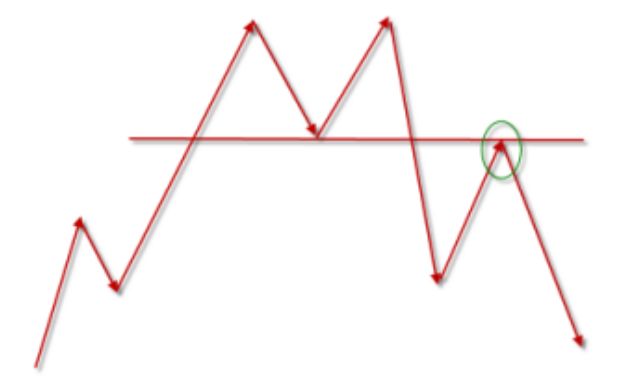
The picture above is a classic M-top. When the market forms an M-top, there is an empty order at the green circle on the neckline, which is the important pressure to sell short in our traditional technology. Conversely, if the W bottom is also formed at the same neckline position, then what is the principle of this model is quite critical. How can we explain this form with the nature of public psychology and capital games?
In a wave of rising or falling, a large number of investors will think that the market can continue the previous trend to go long on dips or short on rallies, but the market reverses unexpectedly, forming an M head or W bottom. The funds of long-short and long-short investors who previously believed that the trend will continue are deeply embedded in them. These locked-in funds may be looking at the mid-to-long-term trend. They may not want to admit defeat and are unwilling to leave the market. When the market returns to the neckline At that time, there is a strong demand for unwinding the locked-up market and the position is closed (imagine how you feel when the market has finally returned to your cost price after you have been locked in for three years). In the form, the exit of the long position is equivalent to the entry of the short position, so the position of the neckline can play a role of counter pressure, and this is the principle.


 Add
Add


