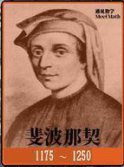
Fibonacci, an Italian mathematician of the medieval European Republic of Pisa, was considered "the most talented Western mathematician" of his time. But we're calling him that now, perhaps to the dismay of the man himself, Leonardo Pisano. What also surprised him was that the Fibonacci sequence named by him the most talked about by the world: 0, 1, 1, 2, 3, 5, 8, 13..., not his greater Mathematical achievement - introduction of the place value notation system for Arabic numerals and multipliers to Europe.
Leonardo Bonacci, Leonardo Fibonacci
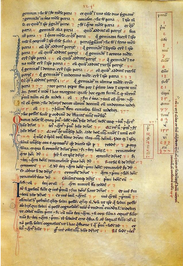
The Holy Roman Empire left Europe with the Roman numeral system, and we can still see the expression "2013 is MMXIII" in the copyright notices of many movies today. Roman numerals were not replaced by Arabic numerals until the middle of the 13th century AD. Leonardo Pisano's book Liber Abaci was one of the first Western books to recommend the replacement of Roman numerals with Arabic numerals.
Leonardo Pisano was born in Pisa, Italy at the end of the 12th century, so people also called him Leonardo of Pisa. Pisano, in Italian means he is from Pisa, just as Manchester means from Manchester. Leonardo's father was named Guglielmo Bonaccio. Centuries later, when scholars were studying the manuscript copy of the Book of Calculation (because it was published before the invention of printing), they misunderstood part of the title - "filius Bonacci" (meaning Son of Bonaccio) The abbreviation Fibonacci was interpreted as his surname, so the great mathematician we call "Fibonacci" is passed down from this error to this day.
Fibonacci (let's call him that anyway) spent his childhood in North Africa, was educated by the Moors, in Barbary (Algeria), traveled extensively, and was later sent to Egypt, Syria, Greece, Sicily Travel to Provence. On his return to Pisa in 1200 AD, he used what he had learned on his travels to write the Book of Calculations (published in 1202). It was in this book that he introduced the Indo-Arabic numeral system into the then Latin-speaking world. At the beginning of the first chapter of the first part of the book it is written:
"Here are the nine numbers in India: 9 8 7 6 5 4 3 2 1. Using these nine numbers, plus the symbol 0 (called zephiroum in Arabic), we can convert any number like Write it down like this."
Italy at the time was made up of small independent city-states and regions, which led to the use of multiple measurement and currency systems. When merchants traded between different systems, they were forced to convert from one system to another, and the backward Roman numeral calculation method seriously inhibited business behavior. Fibonacci wrote the "Book of Calculations" for these merchants, which dealt with a large number of practical issues and showed how simple and efficient business could be conducted with this new number system compared with the clumsy Roman numerals and mathematical calculations. Spreading the influence of decimal numbers through Fibonacci's book is his greatest mathematical achievement. However, I am well-known to the world because of the Fibonacci sequence listed in the "Book of Calculation".
Fibonacci's rabbit problem
One of the mathematical problems that Fibonacci studied in his "Book of Calculations" concerned the rate at which rabbits reproduce under ideal circumstances. Suppose a pair of newborn rabbits, a male and a female, are released into a field to be raised. Rabbits can mate when they are one month old, so that by the end of the second month, the female can produce another pair. Assuming the rabbit never dies, the female rabbit will give birth to a new pair of rabbits (one male, one female) every month starting in the second month. The question raised by Fibonacci is. How many pairs of rabbits will there be in total after one year?
· At the end of the first month, they mate, but there is still only one pair.
· At the end of the second month, the female rabbit gave birth to a new pair of babies, so there are now 2 pairs of rabbits.
· At the end of the third month, the original female produces a second pair, for a total of 3 pairs.
· At the end of the fourth month, the original female produced a new pair, and the second generation female, born two months earlier, also produced her first pair, for a total of five pairs now.
Now suppose there are x_n pairs of rabbits after n months. Then the number of rabbits that will be in n+1 months is x_n pairs of rabbits, (rabbits will never die) plus a pair of newly born ones. But new pairs are only born when they are at least one month old, so there will be x_(n-1) pairs of new rabbits. so we have
That's just the rule for generating the Fibonacci sequence: add the last two terms to get the next term. Next, you find that after 12 months, there will be 233 pairs of rabbits.
In fact, it is better to use bees as an example.
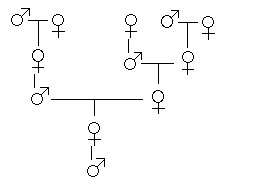
The rabbit problem is obviously artificial, but the Fibonacci sequence does occur in actual populations in nature, and bees are one example. In a bee colony, there is a special type of female called the queen bee. All other females are worker bees, and worker bees do not lay eggs. Additional male bees do not work and are called drones.
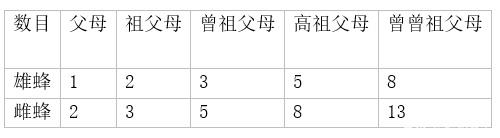
The drone is produced from the unfertilized eggs of the queen bee, so it has only a mother and no father. And all females are produced when the queen bee mates with a male. So female bees have parents, a male and a female, while male bees have only one mother, a female.
Now let's look at the family tree of the drone above from the bottom up and see the Fibonacci sequence again.
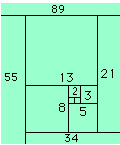
Spirals and ShellsBee populations aren't the only place in nature where Fibonacci numbers appear, they also appear in the beautiful spiral shape of seashells. We can see the animation below, starting with two small squares of size 1. Draw a square of size 2 (=1+1) above these two small squares. We can now draw a new square - one that clings to both one unit square and the sides of the second new square, so the sides are 3 units long; then another that clings to both 2 squares and 3 squares (it has 5 unit sides). We can keep adding squares around the picture, each new square having a side whose length is equal to the sum of the sides of the nearest two squares. The side lengths of this set of rectangles are two adjacent Fibonacci numbers, which we call golden rectangles.
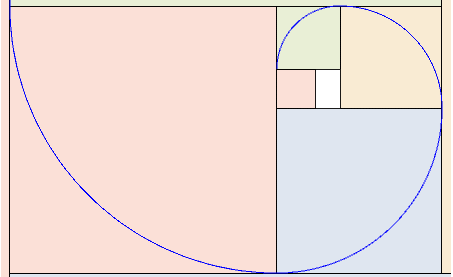
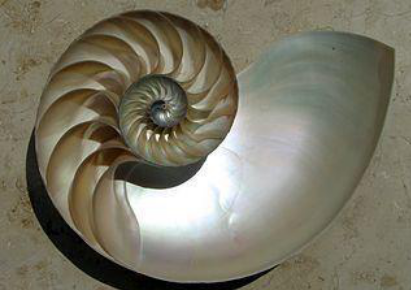
If we now draw a quarter circle on each square, we can draw a spiral. To be precise, this spiral is not a real mathematical spiral (because it is composed of circular arc segments, and the radius will not become smaller and smaller), but it can be very good approximation to the spiral shape that often appears in nature , such as snails and shells. In the image below, a cross-section of a marine shell shows the shell's helical curve.
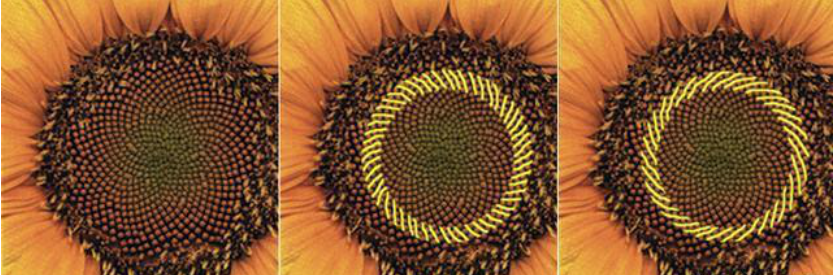
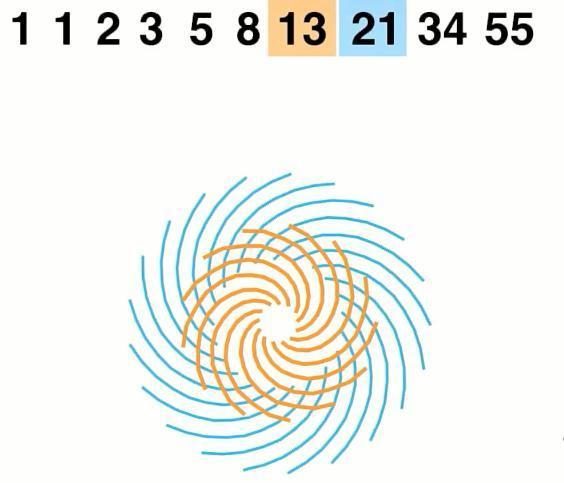
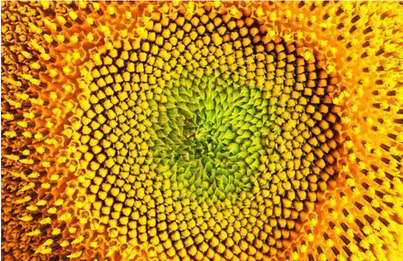
The Fibonacci sequence also appears in the petals and sepals of plants. Some plants also grow in this way, such as daisies can have 34, 55, and even as many as 89 petals! Also, a particularly magical and beautiful arrangement is the helix in the bud. The next time you see a sunflower, look closely at the arrangement of seeds in the flowerpot and you will notice that two sets of spirals, one going clockwise to the right and one counterclockwise to the left, are embedded in each other, growing in this arrangement.
Look at the edges of the sunflower picture above, if you count the curves of the seeds spiraling to the left as you go outward, there are 55 spirals. At the same point, there are 34 helix seeds spiraling rightward. A little further in the middle, you can count 34 spirals to the left and 21 to the right. In the Fibonacci sequence, pairs of numbers (left-curving and right-curving spiral numbers) are always adjacent (as shown in the diagram below).
The same is true of many seeds and flower buds in nature. The reason seems to be that this structure forms an optimal arrangement of the seeds, so that no matter how large the seeds are, they are evenly distributed at any stage, all seeds are the same size, the center is not crowded, the edges are not too sparse, and the disk is the strongest.
Nature seems to use the same pattern to wrap the petals around the edge of the flower and distribute the leaves around the stem. What's more, this structure is maintained throughout the plant's continued growth! So how do plants optimally maintain this?
Gold growth by natural selection
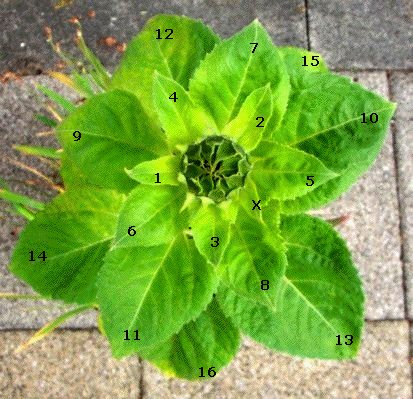
Botanists have shown that plants grow by dividing cells at the top called meristems. At the end of each branch or twig there is a separate meristem where new cells form. Once formed, they grow in size, but new cells only break out at such growth points. The cells are wrapping around the stem, struggling to grow outward. And, the cells grow in a spiral, like the meristem that turns at an angle to produce a new cell, turns again at the same angle to produce a new cell, and so on. These cells may be new seeds, new petals, new shoots.
Here the leaves are numbered sequentially, each being 0.618 clockwise rotations (222.5°) of the previous one.
Amazingly, such a fixed rotation angle produces an optimal layout design no matter how large the plants are. As early as the last century, some people speculated that according to this angle, a uniformly filled plane space can always be produced, but it was not proved mathematically by two French mathematicians until 1993. Doing this for 0.618 rotations would yield the optimal seed layout before new seeds (or leaves, petals, etc.) burst through the wall, but where does that magic number 0.618 come from?
Golden ratio φ
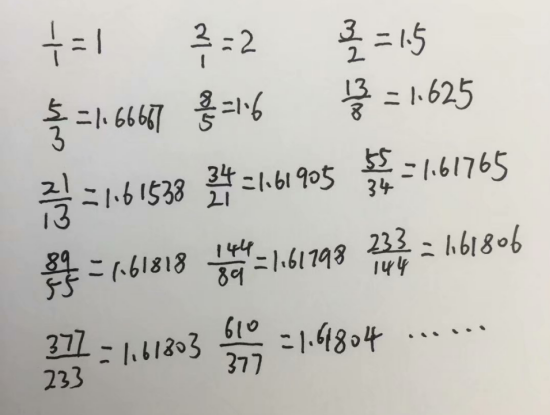
If we take the ratio of two consecutive numbers in the Fibonacci sequence and divide by the preceding number, we get the following sequence:
If you graph these values, you'll see that they seem to go to a limit, which we call the golden ratio (also known as the golden number and the golden section).
The exact value of the ratio of the continuous Fibonacci term is (√5 + 1)/2 (approximately 1.618034), usually represented by the Greek letter Phi (uppercase Greek letter Φ). The fractional part of Phi is represented by lowercase phi (Greek letter: φ), and the exact value is (√5 - 1)/2, which is approximately equal to 0.618034. This φ is more closely related to the number of helices and the arrangement of phyllotaxy in many plant seeds, so we will also see φ in many kinds of plants.
The value Phi is irrational, and so is phi, which means they cannot be written in a simple fraction form. Let's see what happens if a plant's meristem is rotated by some simpler number, say 1/2. After two rotations, we are back in the direction of the first seed. As time goes by, as new seeds continue to grow in the center, each half-turn will push the previous seeds to radiate in two growth directions, leaving space for the upper and lower planes.
Rotate between seeds by 0.5=1/2 turn: the seeds alternately grow in a line. Rotating between seeds by 0.48=12/25 turns: the seeds form two helical paths. Pressing 0.6=3/5 will rotate between the seeds: the seeds form 5 helical paths. Rotate between seeds by π circles: The seeds generate seven helical paths. A similar pattern occurs with rotations at other values: if the seed keeps splitting and growing along the path of the upper few spirals, there will be a lot of space between them (the number of spirals is the denominator of this ratio) . Therefore, the optimal value for the number of spirals will be an irrational number. But not any irrational number will do. For example, there seem to be seven spirals growing by the value of π, since 22/7 is a good rational approximation to π.
In order to use the space as much as possible, what is needed is an irrational number that cannot be approximated by rational numbers as much as possible. This result is Phi or phi, because they are the "most irrational" of all irrational numbers. That's why the variation of Phi value gives the best layout of seeds and leaves of the plant. This also explains why the Fibonacci sequence appears on the upper spiral growth line of the phyllotaxy and the flower disc - the ratio of adjacent Fibonacci numbers eventually approaches the golden ratio infinitely.
So how did plants discover this beautiful and useful number φ? Obviously not by solving mathematical calculations like Fibonacci. Instead, plants have gradually evolved and stayed at the number most suitable for their own survival during the evolution of hundreds of millions of years. Fibonacci's legacy shines not only on the bud of every plant, but also in one of the most dazzling and charming lights that the mathematical world has ever bloomed.




 Add
Add


