I said before that I would take you to read a few trading books. Everyone left me a message and recommended books that are very interesting, and I will arrange them one by one. I will share a reading article every Sunday, and I will add more when I have time in the middle of the week.
The first book I want to take everyone to read is not a famous trading book, but a book that I promised my friends to talk about before, but I have never filled in the holes. This book overturned my perception of "average". The author is Daryl Guppy and the title of the book is Master Trend Trading: Tools, Methods and Strategies.
At the beginning of this book, Guppy raised a very pointed question: If the trend is confirmed, where should the trend be added?
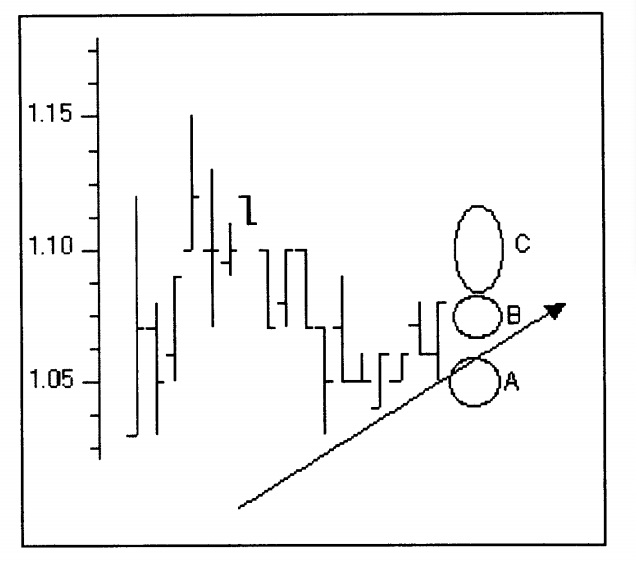
In the chart above, the price found support after touching the trendline and bouncing upwards. Guppy identified 3 positions of ABC, trying to discuss which area it is most reasonable for traders to enter and do long.
Guppy's decision-making is based on "respect for your analysis."
This decision-making basis cleverly avoids a thorny problem. It is not necessary to worry about whether the price is really supported by the trend line, but assuming that you agree with this analysis, how should you enter the market.
A is the price area below the trendline. Guppy believes that the trading behavior of traders who intend to buy at A is inconsistent with the analysis.
Point B is an area below the closing price of the K-line that was supported by the trend line and formed a strong rebound. Guppy believes that this strategy is still a variation of A strategy. After the price is supported by the trend line, it will trigger a larger rebound. If you plan to buy at B, the transaction may not be guaranteed.
Guppy believes that traders who respect their own analysis should set the buy order at C. Expect the continuation of the price rally to be consistent with your own trading behavior.
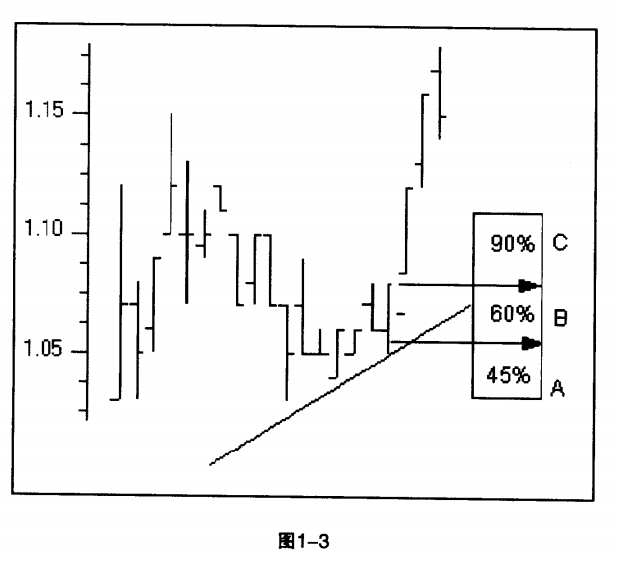
Guppy showed the possible transaction opportunities in ABC3 areas: 45% at A, 60% at B, and 90% at C.
Guppy did not explain how he came to this conclusion, nor did he show the difference in trading results after buying in different regions. Therefore, this set of figures can only be used as a reference.
Most technical analysis articles just vaguely tell readers to buy near the trend line, but do not discuss in depth where to buy near the trend line. Guppy brings up a really good discussion here.
Although I don't draw trendlines or trade trendlines, I use moving averages and horizontal lines. The only difference between these two tools and the hypotenuse trend line is that the angle is different, which can be regarded as a "variation" trend line.
A common strategy I have is to open a position betting on the continuation of the trend when the price falls back to the inside of the moving average band. Friends often ask me, where does the price fall back to the inside of the moving average before opening a position? Do you open a position as soon as it falls inside the moving average band, or wait until the price touches the boundary of the moving average band to open a position, or open a position after a confirmation signal appears? These questions are similar to Guppy's discussion.
The trading decision-making basis given by Guppy is to respect the analysis conclusion, that is, the trading behavior should be consistent with the analysis conclusion.
However, there is a rather extreme logical basis hidden in Guppy's analysis and decision-making, that is, "the trend is greater than everything else". He fully believes in the driving force of trends on prices, and will do whatever it takes to ride the trend.
Traders who agree with this point should undoubtedly buy in area C, because the probability of getting in the car is the greatest here. Moreover, believers in trend power should not require price adjustments and deep adjustments after the trend starts, so they must chase up and buy.
However, this is exactly what I want to question: Guppy made a bet that the trend would exhibit extremely strong characteristics based on the analysis that the trend was confirmed.
Guppy may have been unintentional, and his trading behavior and analysis conclusions are actually not equivalent.
We have classified price fluctuations in previous articles, and the main categories are shocks and trends. Shocks are divided into narrow range shocks and wide range shocks. Trends are also divided into strong and weak trends.
The characteristic of a strong trend is that one side does not look back. Whether you can get on the car depends on your guts. If you jump off the car halfway, you will have no chance to get on the car. If the weak trend does not stop profit in time, holding positions along the trend will also be tortured.
Based on the price performance of "the price hit the trend line and then gained support and rebounded", Guppy's analysis concluded that the trend will continue (or the trend will be confirmed), but according to his unconfirmed buying Odds can prove that even when a trend is confirmed, there is strength and weakness. What is difficult to buy is a very strong trend that is imminent. It is not that it is difficult to buy once the trend is confirmed.
Guppy assumes that every time a trend is confirmed, the trend will show extremely strong characteristics, and makes a bet.
Traders should be clear about their trading behavior, whether they are betting that the trend will continue or betting that the trend will exhibit strong characteristics.
Clearly, the two bets have different countermeasures.
Only when the two bets are conflated does the option debate over which area of ABC to step in arise. Once it is distinguished that the two bets are based on different logic, the conflict of choice disappears.
When you want to bet that the trend will show extremely strong characteristics, you must choose to buy in an area not lower than point C. Because point C is the only way that the trend will show a strong trend.
But if you just want to bet on the continuation of the trend, when the price is close to the tipping point where the trend may be broken, that is the most cost-effective area for you to bet on. This position is actually the forward moving area of A in the chart.
The premise of a trend showing extreme strength is that the trend will continue. So there are fewer opportunities to bet on an extremely strong trend than to bet on a continuation of the trend. Pulling the trigger requires tougher conditions. But betting that the trend will continue, it is possible to enjoy the favor of a strong trend performance.
According to my experience, the stock market, especially small-cap stocks, tends to exhibit extremely strong characteristics after forming a trend. In a sense, Bitcoin also conforms to this characteristic.
What is traded in the stock market is equity. The total amount of equity is stable and limited, and some equity is locked. Funds can only compete for the limited stock of circulating shares, and the supply and demand are easily unbalanced, leading to unlimited rises, which is a very strong feature.
Futures markets trade contracts. The contract can theoretically have unlimited supply. If the bulls want to push the price up, they must eat all the short contracts at that price. And if the short sellers holding the spot feel that the price is right, they can sell a large number of short contracts to lock in profits. The unlimited supply and unlimited circulation of the contract will balance the buying and selling forces, reduce the explosive power of the price trend movement to a certain extent, and cause more false breakthroughs.
After realizing this, read the description of River Moore's operation in "Memoirs of a Stock Operator", and you will find that he is not a trend trader, but a trader who bets on extremely strong trends. He will not enter the market when the trend is confirmed, nor will he wait until the trend confirmation is over before exiting. Liver Moore usually opens a position when the price hits a record high and the trend is unstoppable. Once the strong trend momentum shows the characteristics of decay, he closes the position. Some of his most successful trades came after a long wait of extreme patience.
This method, in essence, makes the price fluctuate extremely strongly under the condition of extreme imbalance of buying and selling power, which is driven by the power of trend. With the stability of the trend, bet on the extreme volatility that is fleeting.
In all markets, the common feature of extreme price strength is breaking through the ultimate barrier of the big cycle. When the trend force pushes the price to hit a record high or new low, the buying and selling power is extremely unbalanced, and the price movement shows a very strong state. For example, who would have thought that U.S. oil would go straight to negative value after falling below $20 this year.
Guppy aggressively bets that the price will fluctuate extremely based on the confirmation of the price's rebound against the trend line. I personally think it is a bit sloppy.
Some friends complained to me that they couldn't get rid of the cost quickly after making the list, and felt very uncomfortable. When I felt uncomfortable, I couldn't hold the order. As a result, after hindsight, I didn't make a good deal, and I regretted it very much.
This contradiction stems from not thinking clearly whether you are betting on an extremely strong feature or a continuation of the trend. To bet on the continuation of the trend, enter the market during the trend adjustment period, reduce the capital cost of betting, and give more patience to the position. If you want to bet on the strong performance of the price trend, you must be patient with short positions, and wait for the price to run to the critical point where the buying and selling forces are extremely unbalanced, so as to reduce the opportunity cost of betting.
When we review strategies or read trading books, we have a utilitarian need to learn "trading strategies". We are attracted to those strategies that provide excellent trading opportunities. Perhaps it is our subjective tendency, or the author's deliberate guidance. We will selectively "blind" those "abolished" opportunities.
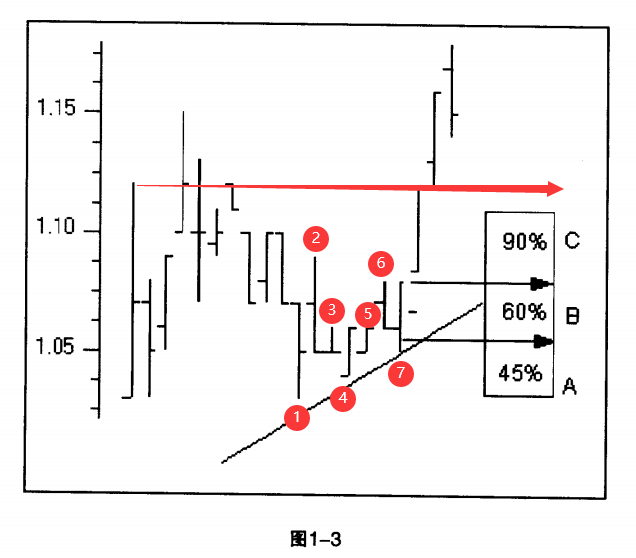
It’s still the picture given by Gu Bi. I marked the first few K-lines that Gu Bi made trading decisions with serial numbers, and let’s review it together.
It can be deduced that this trend line is not drawn based on the limited price information on the chart, but should be the rising trend line formed by the previous round of rising market.
K1 is the first K-line to approach the trendline. The trendline provided support, but without closing at the high of the day, Guppy may question the strength of the rally. I'm curious, when the price rises above the highest point of K1 the next day, will Guppy make a judgment of "strengthening" or "continuing the rebound" and open a position accordingly?
K2 closed at the lowest price of the day. If there is a purchase, will Guppy, who worships the power of the trend, decisively stop the loss above the trend line due to insufficient rebound strength?
Or he will wait for a break below the K2 low to stop, and K4 will trigger the stop.
If he chooses to stop loss at the low point of K1, or stop loss at the trend line, the stop loss will not be triggered. But do these two stop loss methods respect his analysis logic?
K4 fell below the low point of K2, but did not fall below the trend line, and closed at the highest price of the day. Can K4 be considered a confirmation of the trendline and prompt Guppy to try chasing up buys again the next day?
K5 opened low and moved high, but did not break through the high point of K4. Guppy probably won't buy.
K6 gapped and opened high, will Guppy let go of this long opportunity that implies a strong rebound?
As a result, K6 opened high and moved low that day, but closed near the high point of K5. Assuming Guppy buys for the second time, how should he set a stop loss.
Why did Guppy choose such a dramatic trend chart as a case illustration?
K7 opened flat and dropped to test the trend line, Gu Bi must be very entangled in whether to stop the loss.
The low point of K7 is closer to the trend line than K1 and K4, will Guppy panic?
In case, after adhering to a strong thinking, he decisively stopped the loss, and watched the day's closing at the highest price again, and the torture that touched the soul finally came:
After two stop losses, does he still dare to respect his own analysis and buy in the C area?
If he hesitates, he misses it.
In fact, each of our transactions cannot stand such strict scrutiny. Transactions are full of "not daring to do" and "not seeing".
I use this case just to show that when you see a perfect strategy display, you must ask, although "this time" is good, why only "this time"? At K2 and K5, what should be done according to Guppy's strategy?
Tried to enter the market repeatedly, but triggered the stop loss. As soon as I fell into self-doubt, the market ran away. We've been through this situation too many times. Many strategy presentations only tell us how perfect this time is, but hide the cost of grasping "this time".
In addition to regret and distress, you must clarify your trading tendency: whether you are pursuing extremely strong volatility, or just want to get on the trend car.
If you just get on the car, buy when K1 is close to the trend line, set the stop loss below the trend line, and just hold it patiently.
If K1 hesitates, you still have a chance to get in the car with K4 and K7. But your mind cannot analyze whether the price is strong or not, because you are betting that the trend will continue, not that the price will explode in the direction of the trend.
You can't place extreme demands on trends. If the trend is extremely strong, why give you a chance to get in the car. Why wait for you to get in the car before showing extreme strength. Only when the buying and selling power is extremely unbalanced can the performance be extremely strong. Why can you buy it?
If you are after extremely strong volatility, then it is definitely not your chance near the trend line, because short-term selling orders are greater than buying orders to push the price back to the upward trend line. Only when the price breaks away from the upper edge of the range constructed by the K-line on the left side of the chart, will the buying and selling power transform, and it is possible to show extremely strong characteristics.
Extremely strong traits don't last long. To bet on extreme volatility, you must be prepared to take profits quickly. The trend will continue by inertia. To bet on the continuation of the trend, you must plan to hold long-term positions.
The two betting strategies are neither good nor bad, each has its own advantages and disadvantages. You can pay off by choosing the one that suits your own personality and sticking to it. The pain often comes from a bet, but you want it all.



 Add
Add


