I could not have achieved such success if I only traded for the long term. I always take what I see.
—Michael Steinhardt
Michael SteinhardtMichael Steinhardt
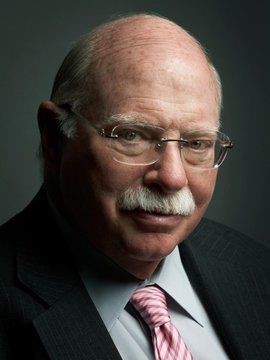
Michael Steinhardt, world-class short-term expert, godfather of hedge funds, investment genius, one of the most successful fund managers in Wall Street history. He has galloped on Wall Street for 30 years, from an unknown investor to a financial giant, from a stock analyst to "the godfather of global hedge funds" and "world-class short-term king". If you had put $10,000 into his fund in 1967, by 1995 you would have had $4.8 million.
01 The beginning of a genius
Michael Steinhardt was born into a family of jewelers.
When he was 1 year old, his parents divorced. Instead of cash, his father gave him 100 shares of Dixie Cement in Philadelphia and 100 shares of Columbia Natural Gas as compensation.
At the age of 13, in Brooklyn, Stenhardt started researching trading reports and tracking the prices of those stocks that were carried on the World Telegraph.
He said, "I didn't know anything about stocks at the time. No one I knew knew about the stock market." He began to enter the Merrill Lynch office frequently, "watching the screen with these old people smoking cigars. I was fascinated by it." Live." Soon, he started buying and selling stocks.
At the age of 16, he was admitted to the Wharton School of Finance at the University of Pennsylvania with his outstanding IQ.
Graduated early at the age of 19. In 1960, he found a job in securities research at Calvin Baroque Mutual Fund, thus starting his legendary investment career on Wall Street.
After that, Steinhardt worked as a reporter for the "Financial World" magazine, and later as the chief analyst of Lieb Rhodes Securities Company. During this period, the stock price of Gulf Occidental Petroleum, which he recommended, tripled.
02 At the age of 27, he started the legendary investment road
In 1967, Steinhardt really made his fortune. At that time, he worked as the chief analyst of Lieb Rhodes Securities Company, and then met Fein and Bekosz. The three hit it off and jointly raised 7.7 million yuan to establish a new company, which made a profit in the first year 30%, and a profit of 84% in the following year, while the S&P index rose only 6.5% and 9.3% in the same period.
If an investor purchased Steinhardt's fund in 1967, he would have gained 100 times his wealth 20 years later, with an average annual growth rate of 27%.
In 1969, all three partners became millionaires. Later, Fein and Bekosz left to start new funds one after another. Steinhardt managed the arbitrage fund alone and still achieved remarkable results. From 1967 to 1995, his fund had an average annual return of 24.5% (net of 20% management fees and bonuses). In other words, if you had put $10,000 into his fund in 1967, by 1995 you would have received $4.8 million ($190,000 in the S&P index).
In 1993, he topped the Forbes 400 richest list, worth more than 300 million US dollars.
03The most powerful "short-term killer"
The reason why Steinhardt can make a lot of money is mainly due to his extremely good short-term investment, and he is therefore known as the most powerful "short-term killer" in the world. He once said that for him, participating in the market is just to obtain the satisfaction of making the right decision. The shorter the time from investment to success, the stronger the satisfaction. Steinhardt is very passionate about short-term investment. Short-term operation not only brings him a sense of accomplishment, but also creates a huge return on investment for him.
His judgment on directionality was exceptionally accurate, and when he learned that interest rates might be lowered, he bought bonds without hesitation. In 1981, Steinhardt was convinced that the Federal Reserve would cut interest rates, and the medium-term treasury bonds would have a big rise. So he used the $50 million in cash held by the fund as the premium to buy five-year U.S. Treasury bonds worth $250 million to wait for interest rates to drop. In the end, a $250 million bond investment made $40 million. In this sale, the fund actually made $40 million out of $50 million in cash. In late 1984, he bought $400 million in medium-term government bonds, most of which was still borrowed on leverage, this time anticipating lower interest rates, earning $25 million.
"I wouldn't have been able to achieve this level of success if I had only been in the long-term, and I've always quit when I'm good," Steinhardt said.
Mex Group Collates Six Principles of Steinhardt Investing
1. Make mistakes early.
Make a decision and implement it immediately, and constantly correct the decision.
2. Always do what you love to make a living.
By following this path, your persistence can ensure the happiness of long-term success, rather than the emptiness after short-term speculation.
3. Stay relatively alert.
Research all areas that may bring wealth at any time, and perceive changes in the general trend earlier than others.
4. Try to make an informed decision even with insufficient information.
A lot of information is useless, the key is how to grasp the existing information and focus on the most important issues.
5. Always trust your instincts.
Experience is a kind of wealth. It has to be admitted that intuition is also the accumulation of experience. The key is how to strike a balance between intuition and experience.
6. Do not make small investments.
Human time and energy are limited. When investing in risky investments, make sure that the returns are sufficient to cover the expenses.
04 Disarmed and returned to the fields
Maybe it was tired of buying short and selling short in the market, or maybe something else, whatever the reason, Steinhardt left Wall Street in 1995 and left the market he loved.
After staying away from Wall Street, his life can be said to be "picking chrysanthemums under the eastern fence and seeing Nanshan leisurely". He bought the land north of West Chester and also owned a number of properties on the Croton Reservoir. There is a tree-lined road around there, through which you can overlook the reservoir. The house is on the right side of the river bank, and there is a large swimming pool in front of the house. The house was once the home of Theodore Dreiser, the 20th-century novelist who wrote "An American Tragedy." Steinhardt bought many animals and simply opened a wildlife park. He and his wife have also cultivated a camellia garden with apple and pear trees and a variety of berries.
I have to admit that I dare to retreat bravely, leave the market I love during the heyday of the hedge fund industry, and resolutely return to my hometown. Such a decision is admirable. Someone once asked Steinhardt what is the secret of success? He replied: Courage is more important than knowledge, and timing is more important than direction.


 Add
Add


