Bonds and interest rates are indicative and conductive. When bond prices fall, interest rates will rise. Creditors can obtain their own interests through the sale and purchase of bonds. The central bank has no right to order the market to adopt any interest rate, but it can adjust the market interest rate through open market operations. What is called open market operation, what is the real interest rate and the nominal interest rate, have to be interpreted one by one.
The Relationship Between Bonds and Interest Rates
To understand the relationship between bonds and interest rates and how the central bank affects interest rates, you first need to understand the characteristics of interest rates. The interest rate has reference and conduction, and the level of the interest rate is related to the risk of the borrower; the lower the risk of the borrower, the lower the interest rate obtained. If you lend money to the safest borrower in the world, you will receive the lowest interest rate. At this time, if other people also ask you to borrow money, the interest you charge will gradually increase on the basis of this lowest interest rate. This is the so-called reference and conduction.
This conductivity can actually be more complicated. For example, if your money is borrowed, the interest is your cost; at this time, if someone asks you to borrow money, the interest you charge him will definitely be higher than your cost rate, and the interest rate will be passed on at this time. However, in essence, the interest rate of the entire market is transmitted based on the change in the interest rate of the safest loan. So, if you can control the interest rates of the safest borrowers, you can influence the interest rates of the entire market.
So what is the safest loan? It is what we often call national debt. Because, we all acquiesce that the country's borrowing is the safest, and the risk of default is the lowest. The central bank can manipulate the national debt in some way to affect the interest rate of the whole market.
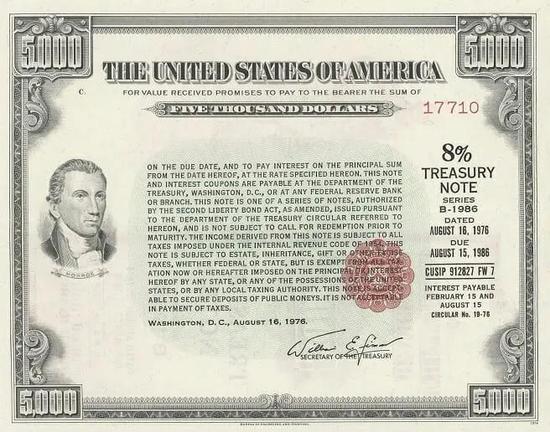
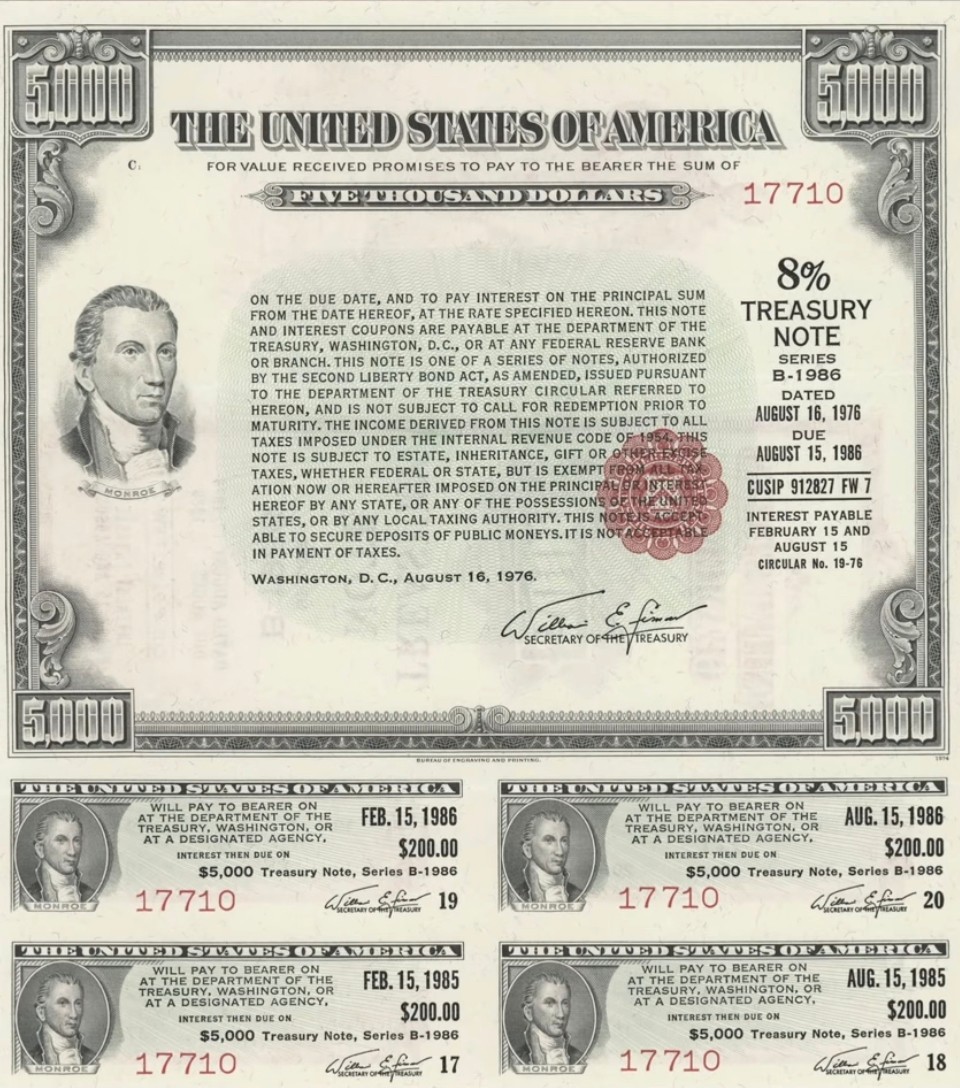
Now that national debt is mentioned, we can now explain what national debt is and the relationship between interest rates and bond prices, and then explain how the central bank manipulates interest rates through national debt, which will be easier to understand. The picture below is a former US ten-year treasury bond, and the bond is paper. Although paper bonds no longer exist, it is very simple and intuitive to explain the concept of bonds with it.
A bond is actually a loan certificate, or an IOU. Different from ordinary IOUs, bonds can often be bought and sold multiple times, and the behavior of buying and selling determines its complexity. There are many kinds of bonds. To facilitate understanding, let’s take the ten-year U.S. national bond as an example.
We assume that Smith wants to invest to make some money. In 1976, she bought a 10-year U.S. Treasury bond worth $5,000. It can be seen from the picture that it is divided into two parts. There are several places on the upper part marked with 5,000 US dollars, which means that the government borrowed 5,000 US dollars from Smith. It is marked with an annual interest rate of 8%, the issue date is 1976, and the maturity date is 1986, a total of ten years. In other words, in 1986, Smith took this bond to the government, and the government would return him $5,000. So what about the interest? This involves the second half of the bond.
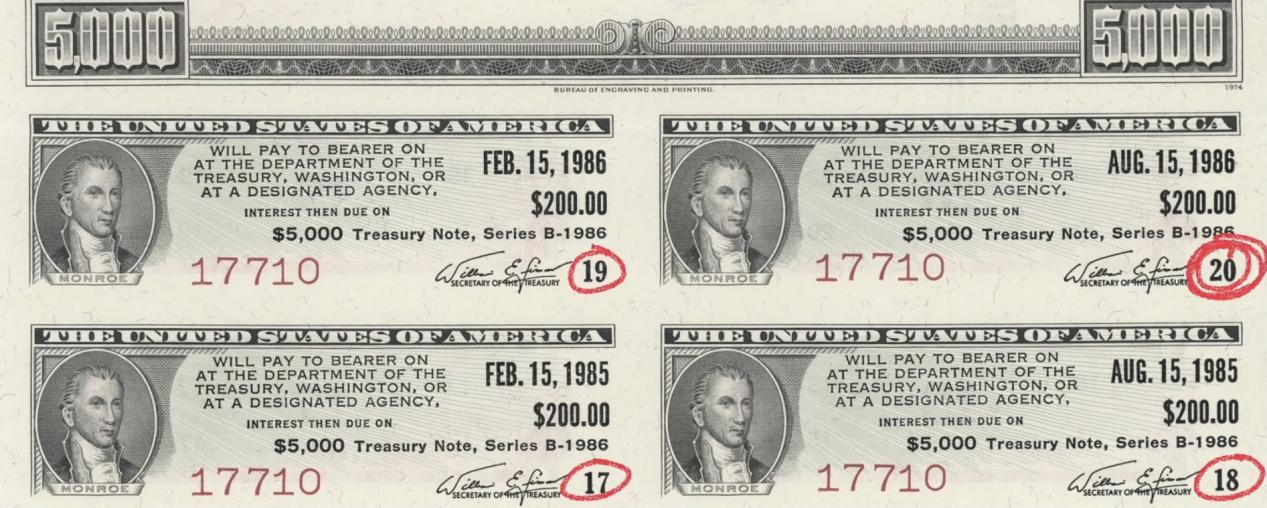
These small notes like money, they are called Coupon (interest), the number on it represents a total of 20 Coupons for each bond, and each Coupon has the amount of interest to be paid at a specific time. The 10-year treasury bond issues interest twice, that is, once every six months; the interest rate of a US$5,000 bond is US$400 a year, and US$200 every six months, so Smith cuts a Coupon from the top according to the date every six months. Just go to the bank and get $200. It is for this reason that the bond's interest rate is also called Coupon rate (coupon rate).
Bonds are actually born for convenience. It not only simply and clearly stipulates the maturity date of principal and interest; its convenience is more reflected in the fact that it can turn a loan contract into something similar to a commodity, thereby realizing secondary transaction. And this kind of transaction can cause price changes due to the relationship between supply and demand, which also changes the real yield of bondholders.
How Bond Prices Affect Interest Rates
First, when the government sold $5,000 of bonds to Smith, it did not necessarily sell them for $5,000. This is easy to understand. If the U.S. government issues bonds with an interest rate of 8%, the bonds can be traded for a second time after issuance. This is the so-called secondary market. Suppose Smith bought it at the face price of $5,000. In the first year, she had used two Coupons to get back $400, but Smith wanted to sell the treasury bond as soon as possible. At this time, Jonathan next door knew the situation of the Smith family and said, if you are in a hurry to use money, sell your national debt to me for 4,000 US dollars, and I will not care about the interest you have received for a year, and this year The interest rate of the newly issued treasury bonds is higher than your original 8%. Smith was not good at math and was in a hurry to spend money, so he sold this $5,000 denomination bond plus the remaining 18 Coupons to Jonathan for $4,000.
Although 8% interest was written on the bond, Smith did not earn back the 8% interest and lost $600; Jonathan earned more than the 8% because it cost less. Jonathan’s cost is 4,000 US dollars. Assuming that he keeps getting the 1986 national debt due, he will finally get the face value of 5,000 US dollars, plus the remaining 18 Coupons with a denomination of 200 US dollars each, or the actual profit is divided by 4,600 US dollars. Divide the principal of 4,000 US dollars by ten years, and the actual annual interest rate is 11.5%. The 8% interest rate marked on this bond is called the nominal interest rate, or the coupon rate. The 11.5% annual rate of return earned by Jonathan is its Effective rate (real interest rate). The interest rate we often talk about actually refers to the actual interest rate.
Many people are confused about bonds because they confuse these two interest rates. Jonathan bought a bond with a face value of US$5,000 for US$4,000, but the actual interest rate is 11.5%, which is higher than the 8% coupon rate. Doesn’t this mean that the bond price has become lower, but the actual interest rate has become higher? This is the so-called negative correlation between bond prices and interest rates. Note that the interest rate here refers to the actual interest rate, and the price mentioned here is the market transaction price, not the face price. This is the most fundamental reason why many people do not understand.
The above example is a very simplified mathematical model. In reality, bond trading is much more complicated than this, and the participants are mainly institutions. But no matter how complicated the reality is, the final conclusion is consistent, that is, bond trading prices and real interest rates are in negative phase. Another way to understand it is that the price of buying bonds is your investment cost; if your cost is high, the actual rate of return will decrease. If the price of the bond you buy is low, your investment cost is low, you earn more, and the real interest rate becomes higher. So, if you can control the price at which bonds are traded, then you can control the real interest rate.
U.S. Treasury bonds are the safest form of borrowing. The actual rate of return of U.S. Treasury bonds is a reference standard and a benchmark for all lending markets; and the probability and number of times that ten-year Treasury bonds are always traded due to the maturity time will be relatively high, and its interest rate will fluctuate more frequently. Therefore, the real yield of ten-year government bonds has become a benchmark and a wind vane for changes in interest rates in the entire market.
If the central bank can affect the price of government bonds, wouldn't it indirectly affect the market interest rate?
There are many factors that determine the price of a bond, mainly supply and demand, the maturity date of the bond, and the credit of the bond issuer. So how do central banks influence prices or interest rates? The answer lies in supply and demand. Central banks can go to these markets to influence interest rates by buying and selling bonds that change supply and demand. This mechanism is called open market operation (open market operation).
In other words, the central bank has no right to order the market to adopt what interest rate, it can only participate in market transactions to influence the interest rate. But unlike Smith and Jonathan, the central bank is not short of money. The central bank can print money, buy as much as it wants, and sell as much as it wants after buying. Therefore, when the central bank wants to lower market interest rates, they will go to the bond market to buy a large amount of government bonds, or even corporate bonds; Prices will naturally go up. According to this law, the real interest rate of bonds will fall, which will then be passed on to the entire market.
Similarly, if the central bank wants to raise market interest rates, it will sell a large number of bonds; or stop/reduce bond purchases. There will be relatively more people selling, which will naturally lead to a decline in bond prices and an increase in yields, which will be passed on to the entire market. This means that bond prices and interest rates are negatively correlated, and the central bank influences market interest rates in this way.
Another very important point is that the central bank affects market interest rates, not only through open market operations, but also through other policy methods; for example, changing the bank reserve ratio and so on. But the main way is open market operation (open market operation). Of course, you will also hear the federal funds rate (federal funds rate), overnight rate (overnight interest rate) bank lending rate and so on. But the essential principle is actually open market operations.



 Add
Add


