Despite the negative sentiment, gold still outperformed the market. In fact, there is short-term risk for gold if real interest rates rise; however, the relationship between the two is not set in stone. Even in the face of rising interest rates, the financialization of the economy and the risks of the existing monetary system make gold attractive.
Gold has become a highly controversial asset class in recent years. Precious metals are often viewed as an obsolete asset in the so-called new "index age" and often overlooked during the period when it performed well as a hedge against risk and uncertainty within the financial system.
In reality, however, gold and the SPDR Gold Trust ETF are doing what they're supposed to for investors willing to look beyond quarterly results and simplistic narratives. Despite the criticism and talk about rising interest rates, gold and ETFs are still outperforming the market.
Myth - Gold falls when real interest rates rise
To a certain extent, the price of gold is indeed inversely related to the level of real interest rates. But to understand how significant real interest rate rises are to the risk to gold prices, we have to answer some questions:
Are real interest rates bound to rise?
Is it reasonable to expect that this inverse relationship will remain constant over time, or will it change and actually become positive?
Are there other gold price drivers we need to be aware of?
The answer to the first question is almost always speculative. It is futile to predict real interest rates 5 or 10 years from now. The level of interest rates needs to be normalized to reduce certain systemic risks that are now too large to ignore. However, the magnitude of public debt relative to GDP and the twin deficits (fiscal and current account) do not allow for a significant increase in interest rates.
Debt to GDP and Fiscal Deficit
In short, real interest rates do not appear to be able to increase significantly, however, investment decisions based on such forecasts will be largely speculative and not prudent. More importantly, we should answer the second question about the inverse relationship between gold prices and real interest rates.
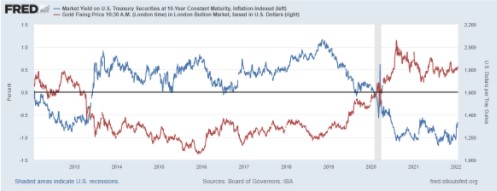
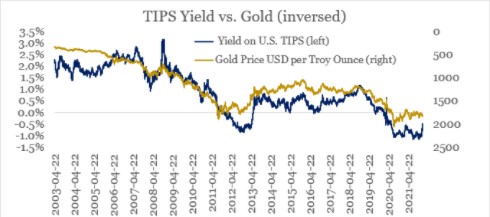
First, we should broaden our time horizon to avoid problems associated with data mining. Unfortunately, TIPS yield data from Federal Reserve Economic Data (FRED) only goes back to 2003. In the graph below is the yield on TIPS versus the inverse gold price on the right.
TIPS is currently yielding negative 0.63%, while the spot price of gold is around $1,836 an ounce. Back in September 2012, the yield was again negative 0.63%, while gold was at $1709. This is a very large difference and can be seen over time in the gap between real yields and the price of gold in the chart above.
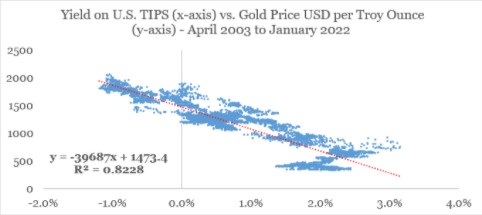
Another way to use the above data is to plot the TIPS yield on the x-axis and the gold price on the y-axis. At first, the relationship between these two variables seemed very strong. However, in the lower right corner of the chart, we see that the inverse relationship can actually become positive. So if we isolate the period between April 2003 (when the data started) and December 2007 (before the crisis and subsequent unconventional monetary policy), we find that the relationship is actually positive.
TIPS yield and gold
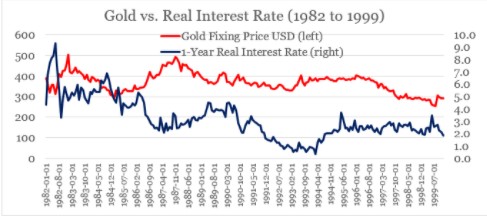
If we use the real interest rate data provided by the World Bank and take a longer-run view (still within the current monetary regime), we find that the relationship between these two variables is far less stable in the long run. For example, between 1982 and 1999, both the price of gold and real interest rates fell significantly.
It is true that over the next 20 years, as interest rates fell, the price of gold rose, but it is difficult to prove a consistent and strong negative relationship between the two. All of this clearly shows that the relationship between gold and real interest rates changes over time, and the trends of the past decade are unlikely to have any predictive power for the future.
Financialization of the economy
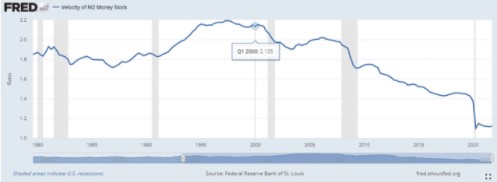
As we saw above, between 1980 and 2000, both the gold price and real interest rates fell. This can be explained by the rate at which the M2 money stock grew during one of its highest levels around the 2000s.
If we take the decade of the 1990s as an example, the growth rate of M2 is combined with the very low growth of M2. Inflation was also kept under control during this decade, suggesting that the real economy was strong and growing during this period, without any extreme financialization.
This setup results in very low demand for gold, even though both real and nominal interest rates are falling. This clearly illustrates how gold and interest rates move in tandem, given the right monetary conditions.
However, contrary to the 1990s, velocity has been declining over the past 20 years and reached one of the lowest levels in recent years due to the dramatic increase in the monetary base following the pandemic. Ample liquidity and the speed of the decline have been one of the reasons financial assets have performed so well over the past 20 years, while real assets have suffered. If this trend reverses, we could see both real interest rates and precious metals rising.
In addition, the relationship between gold and interest rates changes over time, and there is another very important factor driving the price of precious metals. More specifically, gold performs exceptionally well during times of change, risk and uncertainty in the existing monetary system. This is why gold did well when the gold standard was abandoned in the 1930s. Prices of precious metals also rose sharply in the years following the end of Bretton Woods. As we may be approaching a new monetary regime shift, gold's risk-reward profile looks attractive again.
in conclusion
Gold is hardly the most attractive asset these days. With so many exciting opportunities in the tech space, and all the hype surrounding cryptocurrencies, it's hard to see a shift in people's perception of gold. However, this is largely the result of decades of easy monetary and fiscal policies that provided all the incentives needed for the risk-seeking behavior and proliferation of unprofitable businesses we are seeing today measure. This financialization of the economy is a major headwind for gold, even as real interest rates have fallen into negative territory. As we reach the highest levels of financialization and the pressure to reset the current monetary regime mounts, gold's long-term setup appears attractive, just as market sentiment is at its lowest.




 Add
Add


