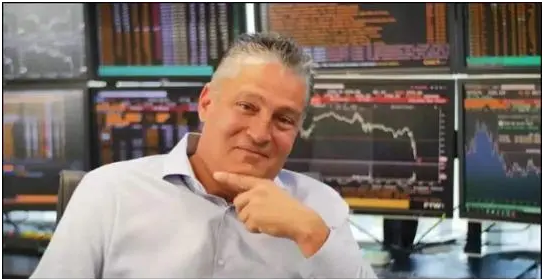
There is no shortage of legends in the trading world. Today let us meet a real consistently profitable super trader, Larry Benedict (Larry Benedict). In his 20 years of investing, Larry has never lost money in any one year. An independent third-party firm in San Francisco called Rothstein, Kass & Company legally audited the performance of Benedict's fund, Banyan Capital, from 2004 to 2012. They confirmed that Benedict and his team generated a total of $274,572,167 in revenue. Today he is the CEO of The Opportunistic Trader.
1. The Chicago Stock Exchange was fired on the first day of work
The reason why Benedict became a trader was because of his girlfriend. His girlfriend's father was a soybean trader on the New York Stock Exchange, and her house was the biggest house he had ever seen in his life. This made him determined to become a trader and want to make a lot of money.
But his career was not smooth. In 1984, he graduated and entered the Chicago Board Options Exchange as a floor trader. However, due to lack of experience, on the first day of work, he failed because he could not accurately record the trading order and deliver it in time. Get fired by the boss.
But his tenacious will and desire to be a professional trader made Benedict cheeky to continue to work on the exchange the next day, where he eventually learned his first trading philosophy: "from Profit from small profits until you have a large pile of cash".
2. Brilliant performance, unrivaled
In 1989, Benedict was employed by SLK as a trader of its XML index options (20 blue-chip stocks on the American Stock Exchange), officially starting his career as a professional trader.
In his first 13 years of trading career, his worst trading record was a one-month loss of 3.5%; as of 2011, he had achieved profitability for 20 consecutive years, with only a 0.6% loss in 2011. Since 2004, the average annual net return rate of the funds he manages is 11.5% (total return rate is 19.3%), the annual volatility is 5.8%, and the maximum withdrawal rate is less than 5%.
Benedict's Sharpe ratio of 1.5 (which measures the average rate of return per unit of risk) is surprisingly high. Benedict does not allow family or friends to invest in his fund. His family lost a lot of money during the global financial turmoil in 2008, while the fund managed by Benedict rose by 14% against the trend that year, but this did not change his idea of not letting his family participate in his investment, because he Thought it would be a distraction.
3. The essence of winning
Benedict's trading method is easy to describe. He exploited correlations between markets to profit from hundreds of trades that would have been nearly impossible for private investors. He relied on personal experience, accumulated over decades of failure. Everything is random, not formulaic.
The essence of Benedict's trading method is that when he observes the price changes in one market, he will pay attention to the price changes in other markets at the same time, instead of looking at them separately. Markets are correlated, but these correlations can sometimes change dramatically over time. Sometimes the S&P and bond prices move in the same direction, and sometimes they move in the opposite direction. Sometimes the S&P moves with crude oil prices, and sometimes the stock market has nothing to do with crude oil prices.
Benedict is keen to observe this kind of interrelationship within the market. He observes not only the relationship between the daily charts, but also the relationship between the minute lines. At any point in time, price fluctuations in the market may greatly affect (forward or reverse) the price fluctuations of one or several other markets.
Understanding the interrelationships between current markets is only the beginning. There is no trading manual telling you how to trade when the price of a market relative to it moves. Sometimes the effect is a lagged effect, and other times, the failure of the market to react as expected can mean a strengthening or weakening of relationships within the market. Usually refers to trading in two markets that interact with each other. If there is a positive correlation between the two markets, Larry Benedict might short the market product that already looks overpriced and hedge by going long in the correlated market. The timing of such paired long and short positions may not necessarily occur simultaneously, depending on the position between the current price and the expected price of each market product.
In short, Benedict's consideration of market correlation as a key factor is just the beginning. The selection and implementation of real deals is flexible and depends on multiple considerations and past experience. The whole process is artificial and not rule-based.



 Add
Add


