We know that in addition to the three cores, the wave theory also has three principles, which refer to the golden section principle, the correction wave depth principle and the alternation principle. We have introduced the golden section principle in detail before, now, let's introduce the remaining alternating principle and corrective wave depth principle .
Alternative principle
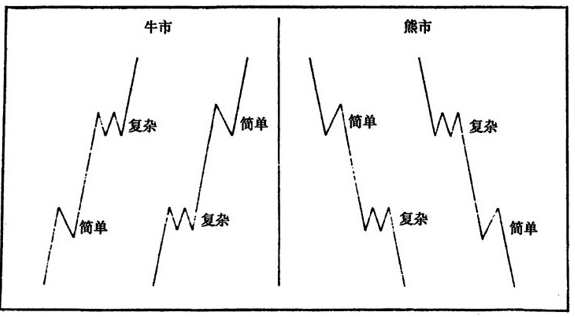
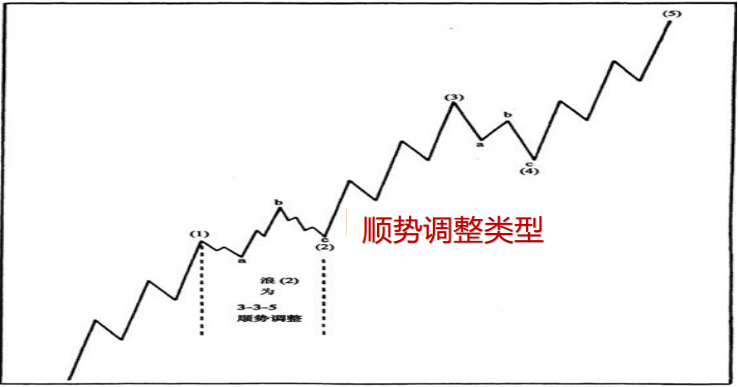
The so-called alternation principle, that is, simple and complex rotation, rising and falling rotation, promotion and adjustment rotation, regular and irregular rotation, etc.; because the wave concept believes that the market usually does not evolve in the same way one after another. The alternation principle of the wave theory we discussed is more reflected in the alternation of correction waves, that is, the rotation of simple adjustment modes and complex adjustment modes. If wave 2 is a simple adjustment, then wave 4 is likely to be a complex adjustment. Refer to figure 1. Here, we must first understand what is simple adjustment and what is complex adjustment.
Figure 1: Alternation Principles of Corrective Waves
simple adjustment
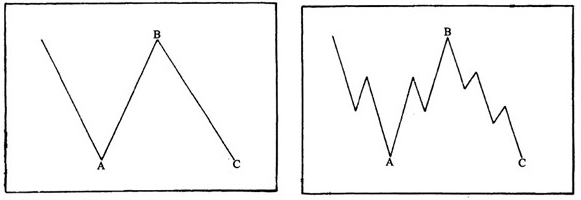
There is only one mode that is a simple adjustment pattern, and that is what we often refer to as a "zigzag adjustment".
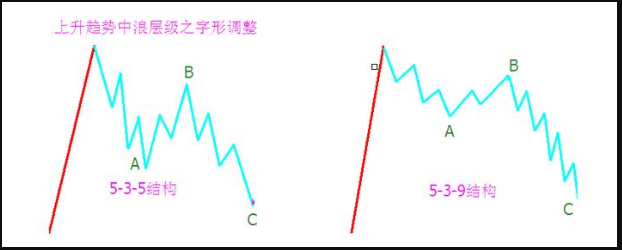
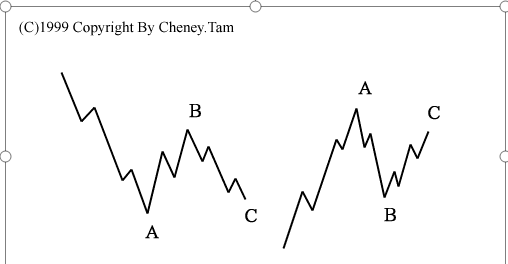
Zigzag adjustment is also called zigzag adjustment. It is named because the adjustment shape is similar to zigzag. Most of them are 5-3-5 structure, and zigzag adjustment is the most common adjustment wave shape in the stock market wave theory.
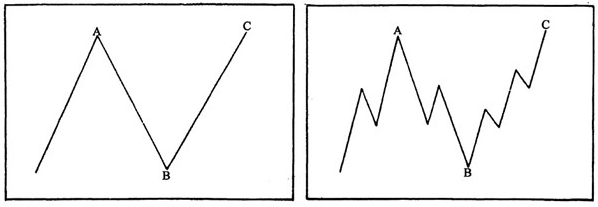
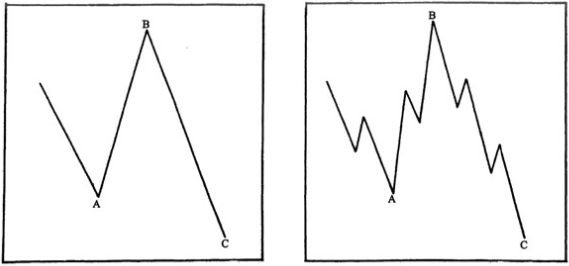
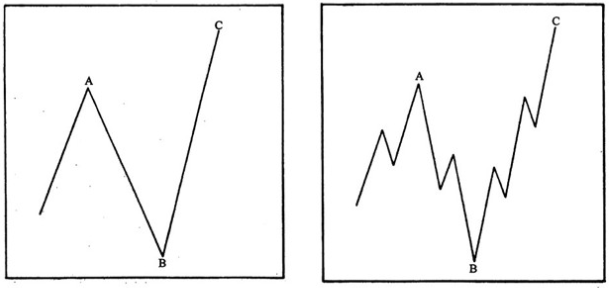
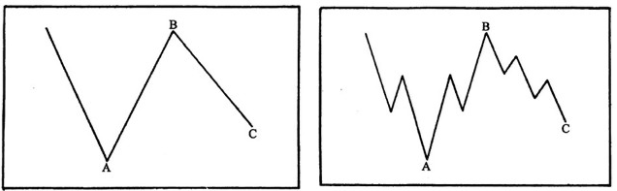
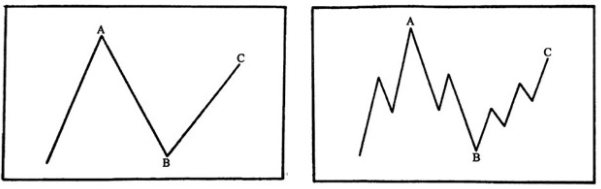
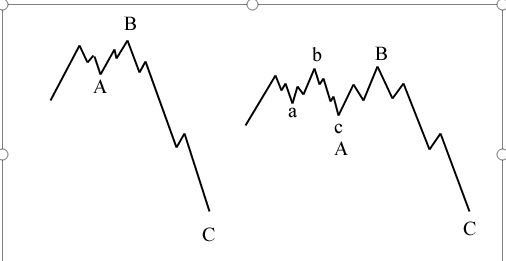
A zigzag adjustment is a three-wave pattern in which wave B cannot pull back above 75% of wave A, and wave C will form a new low below wave A. The biggest feature of zigzag adjustments is that wave A often has five waves, while in complex adjustments, wave A usually only has three waves. Thus, if you can identify an A wave consisting of five waves, you can conclude that the correction is a simple zigzag.
Figure 2: 5-3-5 Structure vs. 5-3-9 Structure
It is worth noting that although the zigzag adjustment is generally a 5-3-5 structure, occasionally there will be a C wave extension trend, that is, the C wave will have nine waves of ups or nine waves of downs, or a 5-3-9 structure.
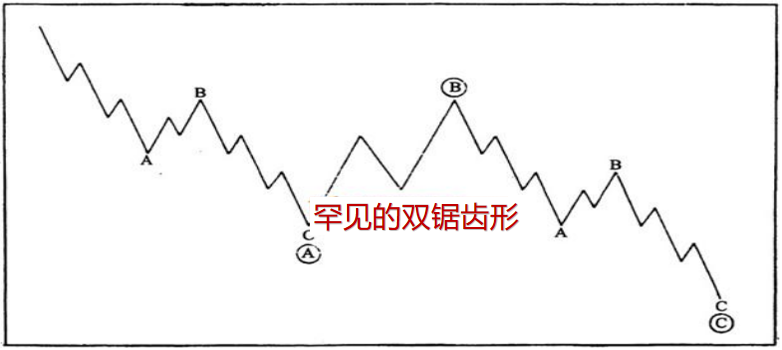
In addition, there is a less common variant of the zigzag, as shown in Figure 3, which we call the double zigzag. This variant sometimes appears in larger adjustment patterns. In fact, it is formed by connecting two zigzags of 5-3-5 sequences through the middle a-b-c form.
Figure 3: Double Zigzag
complex adjustments
Complex adjustments generally consist of three types: flat, triangular, and irregular.
1. Adjustment of flat shape
Flat correction waves are also called flat correction waves. As the name implies, the appearance of the correction waves is similar to building a platform. Most of them are 3-3-5 structures, and occasionally there are 5-3-5 structure platform corrections. Although the probability of the 5-3-5 platform adjustment wave appearing in the actual trend is extremely low, it is worth noting because this form is similar to the aforementioned zigzag; the biggest difference between them is: In the font adjustment, the B wave cannot be called back to more than 75% of the A wave; while the flat shape often reaches near the starting point of the A wave or exceeds the starting point of the A wave, showing strong market strength.
From Fig. 4 to Fig. 5, all are the example of conventional platform shape. For example, in a bull market, wave B has been rushing up to the highest point of wave A, which shows that the market is strong. The final C wave ends at or just below the bottom of the A wave, as opposed to a zigzag where the C wave ends much lower.
Figure 4: Bullish Platform (3-3-5)
Figure 5: Bearish Platform (3-3-5)
There are also two "irregular" variants of the regular platform shape. From Figures 6 to 7 a first type of variant is shown. Note the example of a bull market (Figure 6), where the top of wave B surpassed the high of wave A, while wave C fell below the bottom of wave A.
Figure 6: Bullish Platform (3-3-5)
Figure 7: Bearish Platform (3-3-5)
In addition to the above-mentioned variants, there is another variant, that is, wave B reaches the high point of wave A, but wave C is unable to reach the bottom of wave A. Naturally, this latter variant indicates a stronger bull market. Examples of this variant in bullish and bearish markets are shown in Figs. 8 to 9, respectively.
Figure 8:
Figure 9:
There is also the last variant of the flat adjustment, which we generally call the adjustment with the trend, which reflects a stronger market momentum. Figure 10 shows a trend adjustment in a bull market. Note that wave b is significantly higher than the top of wave a, and wave c is also higher than the high point of wave 1 of the main wave. This correction pattern is relatively rare, and it indicates that the market is too strong to form a correction pattern normally.
Figure 10: Platform (3-3-5) Adjustment Form
2. Triangle adjustment
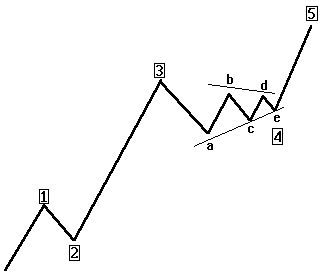
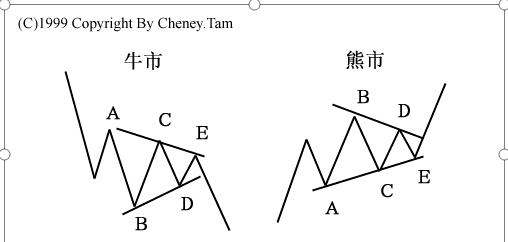
In addition to the flat shape, there is another complex adjustment pattern that often appears, and this pattern is called the triangle pattern. It is worth noting that the Elliott wave triangle method is very different from other triangle studies. The Elliott triangle is a pattern of five waves interspersed with each other. The five sub-waves of a triangle present waves A, B, C, D and E sequences, see Figure 11.
Figure 11:
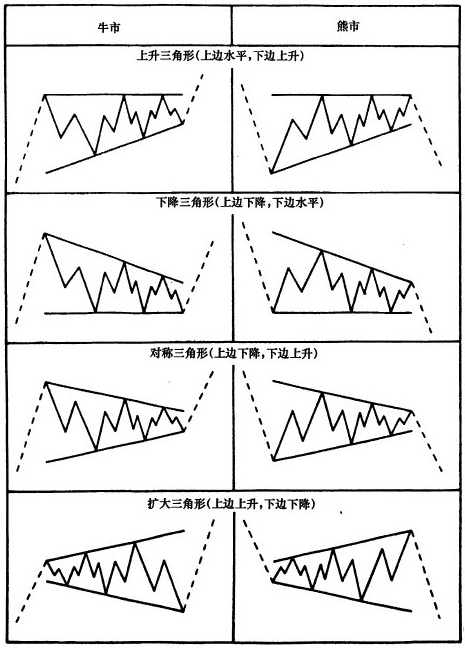
Triangles usually appear in wave 4, prior to the last move in the main trend (it can also appear in wave b of an abc sequence correction). Therefore, in an uptrend, we can say that a triangle can be both bullish and bearish. It is bullish in the sense that it means the trend will resume. And it's bearish because it suggests that the market may have reached its top after completing the remaining one up wave. In Figure 12, we have listed 8 situations of ascending triangle, descending triangle, symmetrical triangle and expanding triangle in bull market and bear market, for your reference.
Figure 12:
3. Adjustment of irregular shape (deformation)
People usually have 10 fingers and 10 toes. But sometimes, we have also seen people with 12 fingers. We can't say that he is not human, we can only say that he is a little weird. Corrective waves sometimes have this kind of situation, and these mutated forms are like mutated chromosomes, which are annoying. However, without the existence of these variant forms, the wave theory will lose its solid foundation.
In history, many followers of the wave theory have put forward what they believe to be a variation of corrective waves. Even in China, some people have listed many strange and strange shapes in an attempt to plan their statements or wave shapes. provide sufficient evidence. This is actually reasonable to follow. After all, as time goes by, any theory needs to be continuously improved in order to be successful.
Next, let's take a look at several variant forms:
(1) Double three wave structure and three three wave structure.
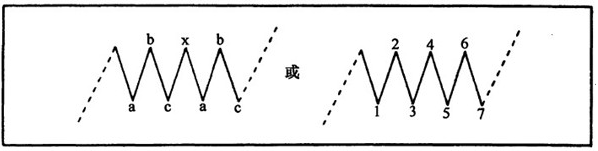
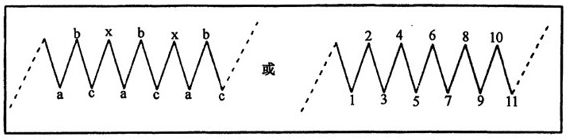
The so-called double-three-wave structure and three-three-wave structure are combinations of two or three simple patterns, which are less common complex patterns. Figures 13 and 14 are two examples. In Figure 13, the two sets of abc patterns merge to form seven waves. In Exhibit 14, the three a-b-c patterns merged to form the eleventh wave. Please note that these patterns are very similar to the finishing patterns in the K-line combination pattern.
Figure 13:
Figure 14:
strong triangle
Usually, each sub-wave in a triangle pattern decreases (increases) in turn, but at some point, especially in a contracting triangle, wave b breaks through the starting point of wave a, thus forming a strong triangle pattern (as shown in Figure 15 ). The emergence of this situation shows that the market is extremely strong, but it also makes analysts helpless. Is it a new round of uptrend or a b-wave rebound? It is indeed a headache.
Figure 15: Strong Triangle
variant zigzag
Elliott once pointed out that there is a kind of abnormal correction wave, the b wave will be like the zigzag, it will not climb to the starting point level of a wave, it will end, and the subsequent c wave will not fall below the end of a wave .
If this pattern actually exists, it is indeed a "failed C wave". In fact, Elliott proposed this pattern is incorrect, it fundamentally shakes the foundation of the entire wave theory. At least in my experience, I have yet to find an example of this in any price action above the hourly chart. Taking the Shenzhen and Shanghai stock markets as an example, similar patterns are often seen on the 5-minute chart. But if they are carefully divided, nine out of ten can be classified into other forms. I hope that readers will not make such a division unless it is absolutely necessary (as shown in Figure 3).
Figure 16: Variant ZigZag
abnormal top
This is an extremely rare variant that appears in a specific environment. In his writings, Eliot used more pen and ink to explain this concept. He pointed out that if the 5th wave is extended, occurs and ends within a larger (5th) wave, and a fairly large short market is about to come, then this upcoming short market (correction wave), If it were not preceded by a rather unusual small extended flat pattern (a wave), then the c wave would appear very long compared to the a wave (Figure 17).
For this statement, later generations disagree. It has been argued that this is as much a conceptual error as the variant forms listed in (3). However, as far as my personal experience is concerned, this has indeed occurred on some small tops. While it is possible to make other forms of division, it is not as natural as this one. Everyone, please remember that since the wave theory is a natural law, there are always many explanations for the division. If your eyes are not pleasing to the eye, then the probability of error will increase.
Figure 17: Abnormal top
Summary of the Principle of Alternation
Viewed more broadly, the alternation rule (or principle) holds that markets do not usually evolve in the same way one after another. If the last top or bottom was one way, the next one is likely to be another. The alternation rule doesn't say exactly what comes next, but it does say what might not.
In its more specific application, it tells us what type of correction pattern to expect in most cases. Adjustment patterns appear alternately. In other words, if corrective wave 2 is a simple a-b-c structure, then wave 4 is likely to be a complex shape, such as a triangle. Conversely, if wave 2 is complex, then wave 4 may be simple. In Figure 1, we listed a few examples. You can take a look. Basically, the corrective waves appear in alternating forms and are not the same.
In general, I can summarize the principle of alternation as follows:
1. If wave 2 was a simple correction, expect wave 4 to be a complex correction.
2. If wave 2 was a complex correction, expect wave 4 to be a simple correction.
Modified Wave Depth Principle
The so-called correction wave depth principle is used to measure the correction wave retracement range.
The principle of correction wave depth holds that a correction wave, especially the fourth correction wave, tends to complete its maximum range within the fluctuation range of the previous smaller fourth correction wave. However, if the first wave is an extended wave, then the limit of the corrective wave after the fifth wave should be the low point of the second lower wave.
Generally speaking, the corrective wave will usually reach the low point of wave 4 which is one level smaller. In a strong market, only new highs are not new lows. At this time, the 4th wave low of one level will be a good resistance level.
There are two exceptions to the principle of depth: the first is that when the impulsive wave is an extended wave and the correction wave is flat or triangular, the depth of the correction wave often cannot reach the interval of the fourth wave of the previous secondary wave; When the wave is a corrective zig-zag, the corrective wave tends to cut deep into the second wave of the secondary wave.
This principle is of great significance in predicting the duration and decline of a bear market.



 Add
Add


