


Stay in touch!
Subscribe to our newsletter to get the latest updates on live market analysis, trading strategies and more. You can unsubscribe anytime.
By subscribing, you agree to Trading.live Privacy Policy.


Thanks to Stop Loss Queen for the invitation. In fact, all different trading styles, as long as they are logically positive expected returns, can be profitable, but the difficulty of each trading style is different.
The subject talked about short-term trading. Short-term trading is indeed very popular now, because it can be seen from the one-minute chart that it fluctuates violently. Prosperous, but this type of short-term has some irresistible shortcomings.
First, the question of the trading frequency mentioned by the subject, in fact, there is nothing wrong with high-frequency trading itself. If the trading system is high-quality, high-frequency can also bring the benefits of rapid feedback. However, it is extremely difficult to make profits in general high-frequency trading because of the spread And the existence of handling fees, let’s look at this problem objectively. First of all, regardless of the high or low frequency of trading, even if it is profitable, the funds will go up in a twists and turns. I haven’t heard of anyone who can maintain a 45-degree slope without retracement. , so even if it is a good trading system, it relies on time to accumulate wealth, and what are the spread fees and handling fees? It is a fund curve with no retracement slope downward. The frequency is not high, maybe the slope is not big, only ten degrees or twenty degrees, but if the frequency is high, the problem arises, and the slope of this non-retracement stable downward curve will start to increase, especially in some days. Several times, dozens of times, this cost will be quite high. In the end, even if the trading system is profitable, but it cannot cover these costs, it may be a loss in the last day, and sometimes if you do not adapt to your own system during the day, The transaction itself loses money, and the fee must be spent, because you only need to open a position to have this fee, and you may lose a lot on this day, so it is too difficult to make profits in high-frequency trading. Day traders still need to control the trading frequency .
Second, the slippage problem that short-term traders cannot avoid. Many short-term traders look at the cycle is very short, such as one point, three points, five points, etc. The stop loss of this kind of short cycle trading is generally very small, maybe ten or twenty points, and the operation style is also small losses and small losses Earn, and then rely on the winning rate to win and accumulate profits, but the liquidity of the market is a very unstable thing, and sometimes the liquidity will be relatively poor, such as the impact of major events, sudden news, large capital intervention, etc., stop loss Sometimes there may be unavoidable slippage, and it may not be so obvious to slip three points at a time, but if there are three slippages out of ten times, it will be very hurt and affect the profit.
The third point is the stability issue. Short-term trading techniques are relatively rich, you can rely on fundamentals to fast in and fast out, you can rely on indicators, you can scalp, and even short-term trading can also be trend trading. But in fact, the stability of these methods is worse than that of the medium and long-term, which is determined by the time cycle. There are many glitches in the small cycle, and the relative trend of the large cycle will be less irritable and easier to control.
In fact, to put it bluntly, the short-term means fast feedback, and quick profit and loss results. It is a high choice for traders who are not so willing to take orders. The medium-term means that the feedback is not so fast, but it looks relatively stable, and the transaction does not need so much energy. It would be good if some major trends can be held. It is possible to make a profit, the premise is to have a positive expectation trading system, trade according to the rules, and choose the cycle according to personal preference.
Are you satisfied with this answer?
Copyright reserved to the author
Last updated: 08/07/2023 06:19
 Add
Add


The train of thought of the topic represents the aspirations of most trading leeks. Traders enter the market not only to make a profit, but also to win huge profits. Everyone wants to make a lot of money, make quick money, and then rush into the market enthusiastically to give their hard-earned money to others. The trading market is just taking advantage of traders' greed for speed and greed, and uses an illusory expectation to attract countless martyrs to actively spend their youth and blood and sweat on the inevitable road of loss.
The first thing I want to say is that even with the most conservative trading methods, speculative trading can bring profits that can be regarded as huge profits relative to any other industry. If your method is correct, you can get money through the market in three to five years that you could never make in your entire life. This kind of income can't be said to be a sudden profit, or it can't be said to be quick money. However, the vast majority of people are not even satisfied with this, wishing to earn a year's worth of money in one day and be financially free in half a month. Little do they know that the real meaning of "the risk is as great as the return" is "the risk is as great as the expected return". The status of the warehouse is up. It is extremely wrong to always think of quick profits, and it is the source of all losses.
The second thing I want to say is that whether it is short-term, long-term, frequent trading, or quantitative trading, it is a real trading method in itself, and its existence is reasonable, and it has its own theoretical basis. Short-term does not mean loss, long-term means profit, frequent trading means liquidation, and quantitative trading means liquidation. Every trading method has some people who use it very well, and some people who use it badly. Some short-term intraday traders often lose their positions, and some continue to make profits. The rest of the time is spent traveling and vacationing. It is stupid to say that a certain method is good and a certain method is not good without contact, understanding, and practice.
Then I want to emphasize that frequent trading must be short-term trading, but short-term trading does not necessarily require frequent trading. I found that many people have a deep misunderstanding of the trading hours, thinking that the long-term is trading on the daily and weekly lines, and the short-term is trading on the five-minute and one-hour lines. In the words of Buddhists, this is "to hold on to falsehood as truth". There is no long-term or short-term in the market itself, and the past and future are meaningless in the market, as long as the current transaction price is the only truth in the market. So you imagine that the market will have a short-term market that lasts for five minutes, and a mid-line market that will last for three days, all of which are "true delusions" and wishful thinking. Traders want to "trade in the present", and everything should start from themselves. I do short-term, which means that I hold the order for a short time and only hold it for a while. This does not prevent me from finding an opportunity on the daily line and only holding the order for five minutes. To be long-term means that I hold the order for a long time, and I need to hold it for two or three days to keep track of the market development, but it does not prevent me from looking for entry opportunities from the hourly line. Doing business doesn’t care what you look at, only what you do, everything you see is false, only what you do is the cause and effect, and the retribution is not good!
In the end, I want to say that trading philosophy is everything. Frequent trading and short-term trading each have their own theoretical support. Frequent trading is based on the principle that the market in the volatile market is always oscillating disorderly. If the take-profit space is small, then the profit order will always be closed. Through a large number of two-way orders and small stop-profits, the quantity is exchanged for quality, and the analysis of trading technology The requirements are relatively low, and you will die miserably when encountering a unilateral market after a breakthrough. The principle of short-term trading is to use the characteristics of high accuracy of technical analysis indicators in a short period of time, to obtain reasonable profits through relatively heavy positions and relatively high winning rates, and to avoid sudden risks through short-term positions. Here I want to emphasize that the accuracy of technical indicators on the short-term is higher than that on the long-term. Regarding the reverse K-line, I would like to remind one point that accuracy is not effectiveness, which does not prevent the saying that long-term technical indicators are more effective. The truth in this needs to be understood by traders themselves. There is a difference between frequent trading and short-term trading. Frequent trading places a large amount of orders, and the position of a single position is relatively low. It depends on the probability of shocks, and the stop loss is larger than the stop profit; because short-term trading requires a high degree of attention, generally only one order, the position It is too large, relying on the winning rate for food, and has higher requirements for technical analysis, and the stop loss is generally smaller than the stop profit; the only thing in common between the two is that the holding time of the order is very short.
There are many combinations in the trading system, and successful traders are good at combining different methods with their own strengths. But the combination of the short-term method of relying on technical analysis and the frequent placing of orders based on probability is the most stupid combination I can think of. This is the operation method of most leek traders, and it is also the reason why most leek traders lose money. Under the guidance of this method, you can only complete one order and open another order, and make a complete and good market in pieces, otherwise you will have to jump frequently among different trading varieties and successfully put a piece of stock into the market. The originally high-quality work has become heavy physical labor, which greatly consumes the energy and patience of the trader, and also greatly increases the possibility of making mistakes. In the last order. Regardless of whether you are a full-time trader or an amateur trader, if you are determined to do short-term trading, you really shouldn't turn it into short-term trading like manual labor. You should wait patiently like a sniper for the market to give you the best trading opportunity. Fight back, regardless of whether you are hit or not, you must quickly withdraw from the market, let alone turn short-term into long-term, and long-term into liquidation. The most important point is that traders should not be greedy for more and quicker. Just imagine, even if you can only catch one trading opportunity every day, you win three times and lose two times a week, leaving only one net winning order. In less than a year, your position can still be Doubled, the only result of trying to make a lot of money every day is to lose money quickly and get out.
Copyright reserved to the author
Last updated: 08/21/2023 15:06
Add

Short-term foreign exchange trading refers to transactions within 5 minutes. Compared with long-term transactions, short-term transactions have unique advantages in reducing transaction risks, increasing transaction opportunities, improving capital utilization efficiency, and improving transaction accuracy.
1. Reduce transaction risk
The advantages of short-term foreign exchange operations are that the trading cycle is short, and the position is settled on the day of opening the position, and the position will not be held overnight, so that you will not worry about sudden changes in the market the next day, and avoid falling into a passive situation in case of emergencies. Moreover, the funds are always in a flexible state, and the investment is more stable. flexible. In addition, short-term foreign exchange trading pays attention to low investment and high frequency trading, and will not invest too much money in a single transaction to avoid huge losses in a single transaction.
2. Increase trading opportunities
What are the benefits of short-term foreign exchange operations? The daily fluctuations in the foreign exchange market may be extremely narrow, but the bands are very rich, and the trend fluctuates repeatedly. Long-term trading investors cannot take advantage of the volatile market to place orders, but short-term trading players can immediately grasp the opportunity to enter the market, which is increasing significantly. Gain higher returns based on trading opportunities.
3. Improve the efficiency of capital operation
The benefits of short-term foreign exchange operations. Compared with long-term, short-term foreign exchange operations can significantly improve the efficiency of capital use. To give a simple example, if the market fluctuates continuously in a certain price range, long-term traders can only earn the basic volatility, while short-term traders can theoretically earn three times the volatility. Although the funds used have not increased, the efficiency of capital operation has improved significantly. promote.
4. Improve the accuracy of transactions
What are the benefits of short-term foreign exchange operations? Generally speaking, the longer the trading cycle, the worse the prediction accuracy, so short-term investors tend to have higher trading accuracy. A successful short-term investor can be both qualitative and quantitative about the current trend. If you want to increase your trading winning rate, you must do more short-term trading.
Of course, nothing is absolute. Although there are many benefits of short-term foreign exchange operations, short-term trading also has its risks, that is, the trend movement is irregular, and market analysis is more difficult. How to choose depends on the individual investor.
Copyright reserved to the author
Last updated: 08/08/2023 01:51
Add

If it is executed by humans, it will definitely not work, but if it is executed by machines, it is still possible. This also varies with different trading systems.
If it is done by a human being, the energy and spirit cannot bear such a high load, and it will definitely lose money.
Let's do the math. For example, the total profit is 1000 points. If you trade 10 times and make an average profit of 100 points each time, if the spread is calculated as 2 points, you need to pay a cost of 20 points.
If you trade 100 times, then you need to pay a cost of 200 pips. These two examples are compared and judged.
Remember, costs are also part of revenue.
One exception is high frequency trading. Because its trading system can only be profitable by doing high-frequency trading, it cannot be profitable by doing swings.
So if you increase your operating frequency, do you want to increase your income by increasing the turnover rate of funds, or does the trading system really want to do this. If it is the former, you can only lose more, if it is the latter, then do it boldly and with confidence.
Copyright reserved to the author
Last updated: 08/08/2023 13:48
Add

Many novices scoff at short-term trading, including me before. The reason is that the cost of short-term trading is much higher than that of long-term holding!
Regarding this point, it is undeniable that since each transaction requires a certain handling fee, the superficial cost of short-term trading is indeed much higher than that of long-term holders. Note, this is only a surface cost! But if you use ultra-short skills to sell high and buy low, your cost is actually much lower than that of long-term holders.
Let's take U.S. crude oil as an example. If the short-term and long-term both break through 35 US dollars on May 29, intervene. As of today, the price of U.S. crude oil is 42 US dollars, and the yield of long-term investors is 20%. Short-term investors have gone through three consecutive rounds of selling high and buying low, as shown in Figure 1: the first round of selling high at $40, and then buying at $35; Sell high at $42, enter at $39. As a result, the rate of return on short-term investment is as high as 51% today! It is much higher than long-term holding; in other words, after short-term investors sell high and buy low, their holding cost is 11 dollars lower than that of long-term holders!
figure 1:
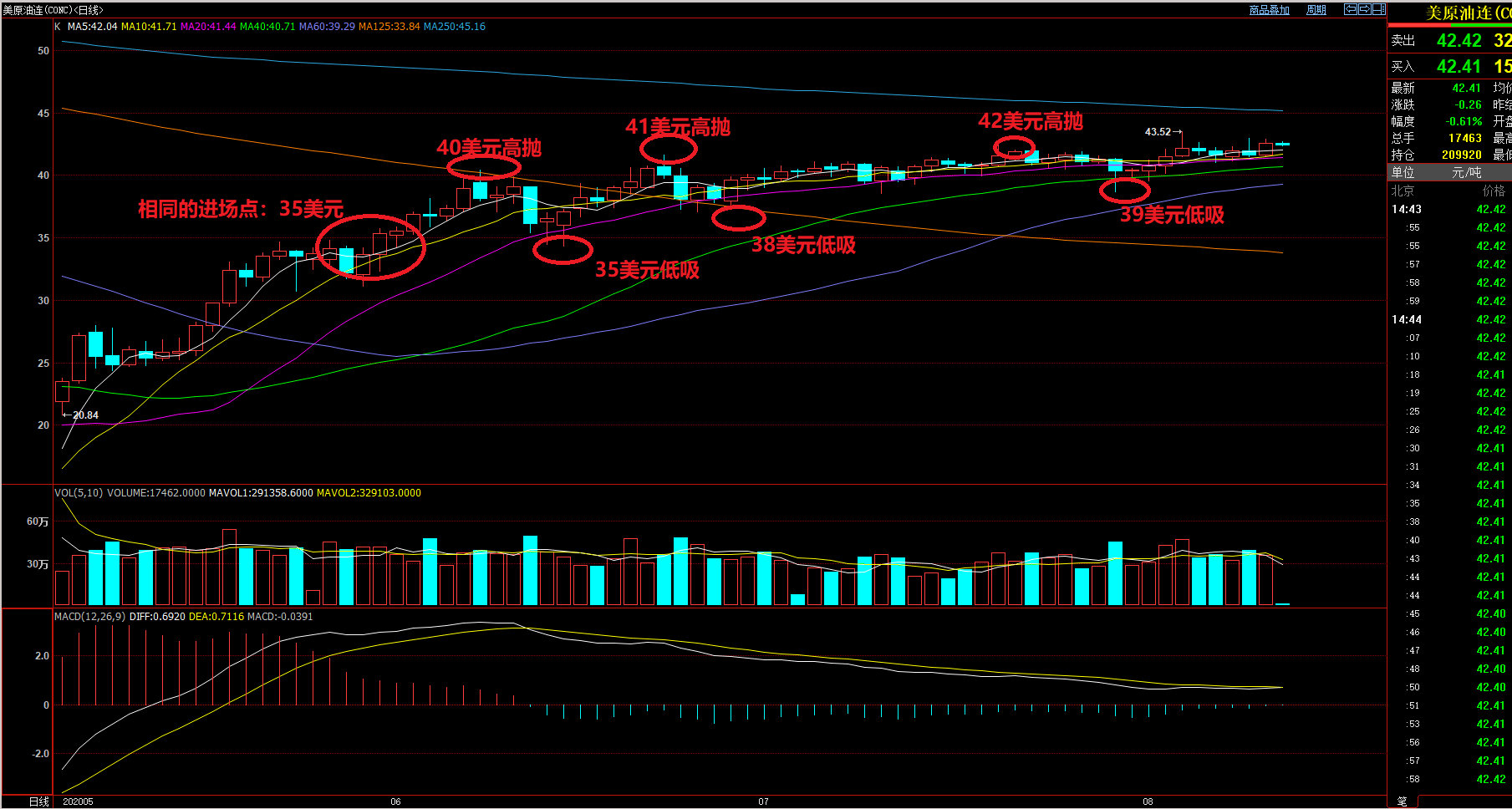
Therefore, short-term investment can increase the total return with a high probability; of course, the premise is that you have a mature set of ultra-short-term skills!
Copyright reserved to the author
Last updated: 08/13/2023 06:24
Add

Short-term trading has a rhythm, what does it mean? Is there no rhythm in doing long-term?
Short-term trading and frequent operations are not equal to quick profits, although they seem to be able to make quick profits on the surface.
Short-term trading requires you to have the ability to grasp the instantaneous changes in the market, or immediately change the decision made a few seconds ago when the situation changes.
Therefore, to a certain extent, short-term trading is quite difficult.
Larry Williams, a talented American futures trader, is a well-known short-term player. He once turned $10,000 into $1.1 million in less than twelve months. His "Short-term Trading Secrets" also has many fans in China.
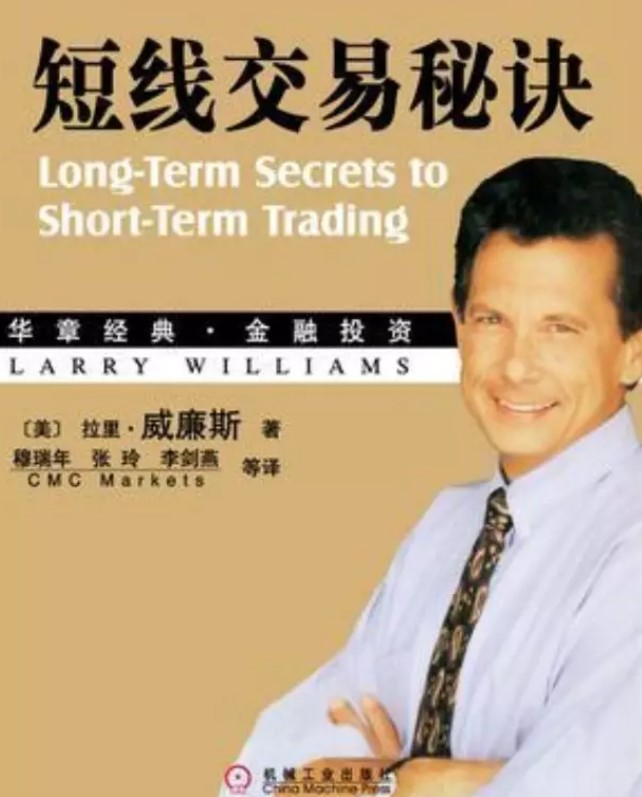
Williams told us that short-term trading is not about buying today and selling tomorrow. You must also be patient when doing short-term trading, and you can only make money by grasping a large range.
Actual statistics show that for short-term holdings, the average return for one week is twice as high as the average return for one day.
At the end of the book, Williams repeatedly emphasized two words: stop loss, stop loss. To do short-term, you must set up a stop loss point. However, the book does not say how much stop loss is a more appropriate stop loss point.
Copyright reserved to the author
Last updated: 08/13/2023 20:14
Add

There is no necessary connection between frequent operations and ultra-short skills to improve total income. This is like my article has more words and does not hold the central idea of the test question, but the score is higher than other students' high-quality articles. Can you understand?
Profit must be the result that investors most want to obtain in trading. In order to achieve the goal of profit, there are generally two directions of effort: to continuously increase the transaction winning rate, or to continuously expand the profit-loss ratio. Theoretically speaking, the profit-loss ratio and the winning rate check and balance each other. The higher the profit-loss ratio, the lower the corresponding winning rate, and vice versa. So in trading, should investors pursue the winning rate, or the profit-loss ratio?
Profit-loss ratio vs winning rate: A high winning rate does not mean a sure profit
Winning rate, as the name implies, is the probability of winning. If you make 10 transactions and make money 6 times, the winning rate is 60%. The profit-loss ratio is the ratio obtained by dividing the average profit point of profit by the average loss point of stop loss after multiple transactions. If the profit of each transaction is 15%, but the stop loss range is 5%, then the profit-loss ratio is 3 . In other words, an average profit of 3 yuan requires a stop loss of 1 yuan, which reflects the risk of investing in profitable transactions.
In theory, 80% of the time the market is in a volatile market, and 20% of the time is in a unilateral market. Taking international gold as an example, when the market is in a volatile trend, when the price of gold rises near the high-intensity resistance area before shorting, the stop loss is 3 yuan, the profit is 9 yuan, or the stop loss is 5 yuan, and the profit is 15 yuan (choose according to market fluctuations) plan); or go long in the low-intensity support area before the gold price falls, and use the above plan for stop profit and stop loss. But no matter which plan (the profit-loss ratio is 3:1), as long as you succeed in 3 out of 10 transactions (30% winning rate), you can make a profit (excluding transaction costs).
Stop loss 3 yuan x 7 times = 21 yuan Take profit 9 yuan x 3 times = 27 yuan profit 27-21 = 6 yuan
Stop loss 5 yuan x 7 times = 35 yuan Take profit 15 yuan x 3 times = 45 yuan profit 45-35 = 10 yuan
But what about the other way around? The winning rate is 70%, and the profit-loss ratio is 1:3. The result of long-term trading is still a loss. This example fully demonstrates that investors tend to ignore the importance of the profit-loss ratio.
Copyright reserved to the author
Last updated: 08/03/2023 02:02
Add

In my opinion, regardless of high-frequency trading or long-term trend trading, based on the fact that the principal cannot be infinitely large, the number of trading lots will not be particularly small, so liquidation is always inevitable.
Therefore, on the premise that the trend judgment is correct, earn as much as possible, and pursue the victory. The principal should always have a backup to start over.
You must admit that you cannot always have a correct judgment on the market, so the profitable part should be pocketed in time instead of overweight.
At the end of September, my friend and I jointly invested 300U out of a joke as a lunch fund. We only do minute-level transactions every day, do not hold overnight positions, and withdraw part of the day's profits for consumption and as backup funds. Today is the 9th day, and the overall profit is about 1300U, basically reaching the expected goal. At present, the initial plan is to stick to 100 trading days. I will also announce the profit and loss situation on the platform every day, hoping to find a way for sustainable development.
Copyright reserved to the author
Last updated: 08/31/2023 12:31
Add

The purpose of short-term trading should be mainly to earn rebates, and don't be too demanding on short-term profits. If there is no profit in the eyes of rebates, the income will be very stable. Work hard every day, watch the market and make more orders, and it is very clear whether you earn more or less.
Stability is also required in the short-term, and seeking an increase in total income is a demon and vain.
Copyright reserved to the author
Last updated: 08/03/2023 03:23
Add

Thank you Fengqing Yueming for your invitation.
The most important thing in trading is to do the right thing, not for profit!
Saying this may confuse novices, but anyone who has traded for a few years will understand.
I think you should understand what I mean. Since you know that frequent operations are not good, and you go back, isn't the tuition you paid before in vain?
Who doesn't want to make a quick profit? It is because everyone wants to make a quick profit, so there are so few people who make money!
Only those who can control this desire can slowly survive.
There are still people who are successful in short-term trading, but we all know that there are very few people who make stable profits in the foreign exchange market, and among the very few people, most of them are doing trend, and only a very small number of people are doing short-term.
So, I want to give you a sentence: Since you want to fish, why don't you go fishing where there are many fish?
Copyright reserved to the author
Last updated: 07/31/2023 20:36
Add

There are short lines for short lines, and medium and long lines for medium and long lines! At present, the short-term losses I see account for most of the losses. In fact, no matter how big each order is, you are the beginning of risk. I personally think that reducing risk is always a very important part of trading. Personally, I like to be a mid-term, because it is not so tiring, and I don’t need to watch the market all the time. I have more time to do other things or to check information and read books, so that people will not be highly stressed every day, and their emotions will not be chaotic. This Trading still depends on personal character! A friend said to me before: You should never catch every band, you are not that smart, and you have a chance only if you stay in the market. Short-term making money, but it really requires experience and technology, which requires a lot of mistakes
Copyright reserved to the author
Last updated: 07/31/2023 20:11
Add

This has something to do with the size of the capital and the mentality. If the capital is small, you may not be able to withstand the callback if you do it for a long time. Moreover, the capital is small, the number of hands you place is small, and the profit is also small. People who are eager to make a profit look down on that little profit, so many times , It is obvious that the floating profit has become a floating loss, and finally had to stop the loss.
From a technical point of view, they are all in the medium and long term. In this way, it is better to maintain the profit-loss ratio, and short-term trading needs to keep an eye on the k-line. If the capital is large, it is suitable for long-term investment.
Copyright reserved to the author
Last updated: 08/14/2023 16:59
Add

Ultra-short-term trading, generally the time is controlled within 5 minutes, such a transaction cannot be measured by the profit-loss ratio. But no matter what kind of trading mode, its ultimate goal is to make money in the foreign exchange market.
In recent years, short-term operations have become more and more popular among investors, because short-term operations have a short cycle, quick profits, high flexibility and high profitability. But not every investor who takes short-term operations can make a profit, because the risks in the foreign exchange market are inevitable, and not every short-term investor is really familiar with short-term investment strategies.
At the same time, transactions in the foreign exchange market also have costs. The existence of spreads and handling fees is often a stumbling block for ultra-short-term transactions, especially in the period of time when the market volatility is not high or on trading varieties, it is most likely to cause, although the number of operations There are many, but the income is not necessarily very ideal.
Therefore, for ultra-short-term trading, first of all, traders are required to have excellent market sense and trading skills. Only in this way can the accuracy of trading be improved and the odds of winning in trading can be improved. Secondly, it is necessary to choose varieties and time periods with relatively high volatility, so that ultra-short-term trading can have sufficient profit margins.
If these two points cannot be achieved, then ultra-short-term trading may not be the best trading method.
Copyright reserved to the author
Last updated: 08/14/2023 11:16
Add
Absolutely, there is a profession in the trading industry, which is known as Chaoshou, which means fast in and fast out. Sometimes the order will be flat within a few seconds after entering. I know a few friends who do this, and can earn tens of thousands a month very steadily, but it’s just a matter of talking. This requires a good sense of the market and a trading strategy.
Copyright reserved to the author
Last updated: 08/07/2023 10:12
Add

It's totally fine if you're in a good mood.
Quantity wins. In short-term trading, although the profit earned by each transaction is very limited, which may be only a few percent or even less of the trading funds used, but because it can run several times in a day, the accumulated profit is very large. considerable. Some "short gunners" use hundreds of thousands of yuan to speculate back and forth, and they can speculate thousands of lots in a day, although the average profit of each lot is pitifully small after deducting the handling fee, which may be less than 100 yuan. This is negligible compared to the thousands or even tens of thousands of yuan that long-term operators have to float on a single-handed order. Tens of thousands of yuan, but it is also a real achievement. Accumulating a lot, accumulating a lot, making a fortune, based on monthly statistics, those long-term traders who earn tens of thousands of yuan per lot often lose to short-term traders who earn tens of yuan per lot. The same is true for yearly and quarterly statistics. The reason is not difficult to understand. It is rare to have one or two opportunities for a unilateral big market with thousands of points in a row in a year, and it is even rarer to be able to make money from the beginning to the end of the market; However, small market fluctuations of more than ten points and tens of points within a day can be found everywhere. It is not too difficult to seek a small profit without being greedy or impetuous.
Every day the sun is new. The transactions on the same day are closed on the same day, the accounts on the same day are settled on the same day, whether it is profit or loss, it is clear and clear. If the operation is successful, continue the next day; if the operation fails, stop and summarize carefully. Anyway, there is no big loss, and it is easy to start all over again. No floating orders, no tails, no need to worry about the main force of the trader changing his mind, no need to worry about the impact of the external market, and no need to worry about any unexpected things happening. Every day when you wake up, the sun is new every day. No worries in my heart, no burden on my shoulders, clean and agile, easy to deal with, with a sense of inspiration, chic and unrestrained.
Copyright reserved to the author
Last updated: 08/14/2023 14:35
Add

The frequency of short-term is high, and the transaction risk is also high. It needs to be stable for more than 1 hour, in order to filter out sudden market trends, especially for foreign exchange. You must know that there is another kind of foreign exchange trader called event-driven trader. , not to mention Trump who likes to tweet... When you really make money, you will think the one-hour chart is too small... Also, the probability of continuous short-term mistakes is extremely high, how many people can calm down ... At that time, it will be another torture to my intelligence and psychology... Why bother.
Copyright reserved to the author
Last updated: 08/12/2023 13:12
Add

The charm of ultra-short-term trading is that it can maximize the utilization rate of funds, and at the same time, it can well reflect the effect of compound interest.
But after all, the risks of short-term trading are also very large, and it is not just the risks of the traders themselves, such as insufficient market sense, inadequate technology, improper grasp of savings, capital management and risk control, etc. At the same time, the requirements for the platform are relatively high, and there must be no delay, slippage, chucking, etc.
Therefore, to do a good job in ultra-short-term trading, we need to start from two aspects
First, in terms of self, improve your own ultra-short-term trading system, especially the rules of entering, exiting and risk control on a time period of about five minutes. Trading methods and trading skills also need to be improved accordingly. Otherwise, it is easy to make the short line into the middle line, and it will be very passive.
Second, for platform selection, we must look for a formal platform, preferably with relatively low spreads and handling fees (the platform selection can be screened on FX110). After all, it is related to the issue of transaction costs, and ultra-short-term trading also has quite high requirements for the trading environment of the platform. At the same time, it is necessary to communicate with the platform whether scalping short-term transactions are allowed. Many platforms also have corresponding restrictions on ultra-short-term transactions in order to prevent and control risks.
Whether ultra-short-term trading can be stable and profitable can not be judged by indicators such as the profit-loss ratio. The most important thing is to judge the accuracy of the operation. Since success depends on quantity, the success rate is the key to success.
In short, trading styles vary from person to person, and not everyone is suitable for ultra-short-term trading. It is recommended to make timely adjustments according to your actual situation.
Copyright reserved to the author
Last updated: 07/31/2023 19:04
Add

Seeing that everyone is discussing so enthusiastically, I will briefly talk about my opinion and personal experience, which can be regarded as a reference for everyone.
People always want to get quick money, which is determined by human nature. I used to play stocks, because the T+1 system made me impatient, so I switched to foreign exchange later. It is indeed more stimulating. Compared with buying stocks and staying still, foreign exchange is simply a paradise for impatient people like me. At the peak, I probably manually made nearly 700 orders a day until I saw stars.
I was also obsessed with this trading method for a time, as if it was like picking up money. Although I didn’t pick up much each time, as the subject said, it would add up to a lot. I also often study short-term trading systems, such as 5-minute momentum trading, 1-minute ultra-short killer system, and so on. But doing this kind of short-term trading requires an environment, that is, there must be enough time and freedom, and a high winning rate is also required.
This kind of ultra-short-term trading is especially easy to do in volatile markets, but it is not applicable to trends, even if they are relatively small trends. We also have no way to completely abandon the analysis of larger periods and only conduct ultra-short transactions in small periods. Therefore, when the winning rate of ultra-short trading drops, it is easy for people to fall into conflicts and always want to find a way to get close to 100% winning rate. The fastest way to increase your winning rate is actually to reduce the frequency of transactions. Doing 2 orders a day and 200 orders a day must have a higher winning rate for 2 orders.
In addition, to be honest, ultra-short trading is really only suitable for young people. . .
Copyright reserved to the author
Last updated: 08/03/2023 15:50
Add

There is a very important saying in trading, slow is fast, as you said, if you want to make money quickly, you may lose money faster in the end, short-term trading is much more difficult than long-term, and it is rare to make money by making short-term real stable profits. Many people look at short-term 5 minutes, 10 minutes... What I want to say is that this time level is not called a trend, it is purely irregular fluctuations within the day, full of great uncertainty, to make money or to look at the trend, the trend has a relative Stability, it must be reasonable for many bigwigs to say so.
Copyright reserved to the author
Last updated: 08/03/2023 20:54
Add

Improving the profit-loss ratio is the key to increasing the total profit
From the calculation formula (profit/loss) of the profit-loss ratio, we can find a way to increase the profit-loss ratio-increase the average profit margin, that is, increase the numerator; or reduce the average loss margin, that is, reduce the denominator. The first way to achieve these two points is to increase the profit of each transaction and reduce the loss of each transaction. To use the famous Wall Street saying, it is "cut off the loss and let the profit run".
In this method, it is difficult for investors to control how far profits can "run", but they can control the maximum loss range of each transaction, which is often called stop loss. Set the maximum loss range for each transaction, or set the exit conditions. Once the conditions are met, you will sell even if you lose money, so as to control the loss range, so as not to be deeply locked in by large losses. This is one of the reasons why stop loss is important.
However, although the profit margin is difficult to control, the position size at the time of profit and loss is controllable. This involves the second method to increase the profit-loss ratio - position management. Reducing loss-making positions and increasing profitable positions can also increase the profit-loss ratio.
However, the profit-loss ratio is a lagging indicator, and it needs to be counted after doing a lot of transactions. It is difficult to guide by the profit-loss ratio when entering the market, and the mandatory setting of the profit-loss ratio may turn profits into losses, or it may be empty. Therefore, investors should make a plan in the transaction. After making a profit according to the plan, the cost line can be set as a forced exit point, so that at least no loss can be guaranteed. On the premise of ensuring the floating profit space, the profit can be moderately used to win a bigger market to expand the profit-loss ratio. In the long run, the profit space will also increase day by day.
Copyright reserved to the author
Last updated: 08/01/2023 15:34
Add

0
work
0
subscriber