


Stay in touch!
Subscribe to our newsletter to get the latest updates on live market analysis, trading strategies and more. You can unsubscribe anytime.
By subscribing, you agree to Trading.live Privacy Policy.


I have been trading for five years. All candle patterns, I am best at doing divergence, which can be divided into two types: trend divergence and inflection point divergence.
Among them, the trading strategy of inflection point divergence must use a technical indicator, which is chosen by almost all traders. It combines the advantages of trend indicators and oscillator indicators, which is MACD.
My love for the MACD indicator is beyond words, especially after I made slight parameter adjustments, the accuracy and sensitivity of the MACD signal have been qualitatively improved, and the improved MACD indicator has become my must-have killer for trading.
If there is anything that is the most important technical tool for me, MACD is like no other.
Some friends will ask me that the original default parameters of MACD often have duplication and lag. Will the MACD after the improved parameters really effectively avoid these two disadvantages? It sounds like a fantasy, but I want to tell you that the accuracy of the improved MACD indicator is really amazing.
MACD is a dual-feature indicator, which has both the characteristics of an oscillator and the characteristics of a trend indicator. If we want the MACD indicator to avoid the two major characteristics of dunhua and lag, we must first analyze which of the two weaknesses of dunhua and lag has the least impact on the trend market and the timing of entry.
l The trend is focused on the direction and the point is weakened.
l The timing of entry focuses on key positions and weakens the trend.
l The common and unavoidable drawback of indicators - lagging.
Combining the above three items, we have clarified our thinking. The improved MACD indicator focuses on the trend and weakens the point and timing.
In this way, the thinking is clear at once, and the MACD is improved into a trend indicator.
In this way, the accuracy of signals that deviate from the market is greatly improved.
Copyright reserved to the author
Last updated: 08/24/2023 06:51
 Add
Add

In the derivatives trading market, I personally think that no technical tool is the most important, because I have always believed that the trend shown on the chart has always followed a law, that is, history will repeat itself, but it is definitely not simple. This has also caused, in many cases, all technical tools fail. However, technical analysis is still the main basis for traders to interpret the disk, which must be affirmed first.

The technical analysis method is a scientific summary of market experience. After several generations of research, innovation and development in the modern market, the technical analysis method system has become more mature and perfect. However, technical analysis methods also have their limitations. For example, a technical analysis method is not a panacea. It may only be suitable for a certain market environment, but ineffective for another market environment, and may even lead to errors. Therefore, it is the key to effectively apply technical analysis methods to correctly understand and deeply understand the characteristics of technical analysis methods and to grasp the market environment to which each technical analysis method is applicable.
Practice has proved that the key to the application of technical analysis methods is the correct understanding and understanding of technical analysis methods. I personally think that technical analysis methods should be correctly understood from the following aspects:
(1) The technical analysis method is a mirror, and history will repeat itself, but it is by no means a simple repetition.
The emergence of technical analysis methods enables people to infer and predict future market changes with the help of historical market information. The pioneers of technical analysis methods believe that "history will repeat itself", but this repetition is by no means a simple repetition. For example, the Shanghai Composite Index has experienced a 7-year bull market, showing a complete pattern of 5 rising waves, of which the three impulsive waves 1, 3, and 5 all have 5 sub-wave structures, but their internal structure, running time, and wave length All are different.
(2) Technical analysis mostly uses statistical analysis as a means, and the analysis result is a probability event, not an absolute event.
This understanding is very crucial, it can make you treat the results of each technical analysis objectively and dialectically, and will not make some mistakes mentioned above. For example, after the market closes on a certain day, analysts A and B analyze the soybean futures trend of the next day based on the internal information of the Dalian soybean futures market. A predicts that the price will rise, and B predicts that the price will fall. Is it right or wrong? It can only be determined by the price trend of the soybean futures on the next day, and before that, no one can rule. This example shows that the result of market analysis is only a forecast, which may be right or wrong. This forecast result should be used as the basis for making investment plans, but preparations must be made to deal with wrong forecast results in the plan. The stop loss item in the investment plan is a necessary measure to prevent errors in the analysis results.
(3) Each technical analysis method has advantages and disadvantages, and they are applicable to certain market environments, but not to all markets.
For example, trend indicators (moving average method, etc.) are suitable for use in a trending market, but generally speaking, their application value will be reduced in a consolidating market. Oscillating indicators (strength index, stochastic index, etc.) are suitable for consolidating the market, and their application value decreases in trending market conditions. Therefore, there is no distinction between good and bad technical analysis methods, only the difference between being applicable to a specific market and not being applicable. Don't give up a certain method easily, and don't apply a certain method at will. Investors must master the application characteristics of technical analysis methods, and choose different analysis methods for different market environments.

All, I personally think that technical tools are just tools, and the focus is not on which is the most important, but the understanding and cognition of technical analysis methods or tools.
Copyright reserved to the author
Last updated: 08/11/2023 13:13
Add

For traders or traders, they should know a formula, a successful trader = 90% mentality + 10% technology. It can be seen that the trading mentality occupies a very important position on the road to successful trading, so returning to the main question, the tool that can help traders overcome their demons is the most important tool, and this tool is the trading log.

For new traders, no matter what kind of commodity investment failures and setbacks you originally caused, or you followed friends’ introductions or even rumors, you will eventually rely on the high leverage characteristics of the foreign exchange market and the practical convenience of trading software. After all, you still come to the foreign exchange market, a grand view garden surrounded by mountains and seas.
Going back 10,000 steps, have all your personal shortcomings in the original investment been eliminated? Your boss has replaced the latest software, hardware and ideological equipment, enough to cope with the unreasonable ups and downs of the market? And paranoidly, you still think that you can definitely rely on the luck of a novice; to encounter the incredible profits of foreign exchange commodities, and even dream of writing an urban legend of getting rich overnight. Naively, you may really think that you can break through the market with one trick In the end, you just want to experience or add some imprints of life, and stubbornly write down the investment stories among all living beings. The most ordinary is the traditional ending of investment failure.
In the early morning of Saturday, in the illusion of continuing to lead the students, as always, I checked my statement for the week first; then I checked whether there were any deviations in the transaction log that needed special attention for research or correction. The account statement, trying to use the clues on the entry and exit points to guide the students' technical shortcomings. I think that perhaps the most perfect technology does not necessarily exist, and it is impossible to require a complete copy of the trading method, but the ability to adapt to the talent. In the end, we will cultivate our own stability on the foundation laid by the leader (us). Profit model, but these are all good. Poor skills can gradually strengthen the judgment, but the cultivation of peace of mind and calmness is solid, and you can only rely on yourself.
The training and improvement of trading technology has always been a false topic. For you who have not yet reached the other side of stable monthly income; just make good use of the knowledge hidden in books during the visit, or use the Internet to search and improve this matter It will happen as planned. If there is an obstacle, it may be necessary to seek guidance from a teacher. If you don’t understand fund management and position control at the beginning, you can only use real money to pay the market for tuition. If you don’t make good use of small units If you use the number of foreign exchange positions to practice and arbitrarily enlarge the position, I am afraid that you will only learn fear and frustration, because the execution of trading technology, whether it depends on the talent of the market to fight in and out, or follow the SOP defined by the technical indicators, is still indispensable to the market. beat. Because the gap between ideal and practice will be your first task after seriously entering the market, and the hidden potential key trick lies in how to grow linearly, so that the simultaneous progress of trading skills and psychology is no longer just a castle in the air . The focus should be on how to improve trading techniques, trading psychology, follow-up market trends, margin status, etc...
The following provides a format reference for the transaction log:
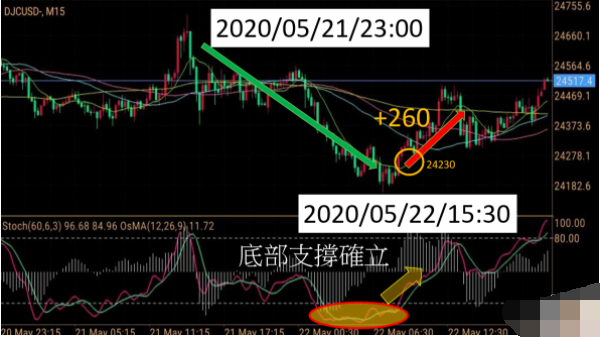
Example one
l Buy Commodities: Dow Jones Index
l Buying time: 2020/05/22 15:30
l Buying price: 24230 long
l Set loss price: 24106 – 50 = 24056
l Part: 2 hands
l Reasons for buying: Clear support and turning signals (KD, MA, VOL) and execute band operations
l Selling time: 2020/5/22 21:30
l Reasons for selling: Predict that the main force of the Dow Jones market will sell half of the market for arbitrage
l Selling price: 24490 (+260)
l Part: 1 hand
l Reasons for success/loss: successful price difference orders first come out and close
l How to improve: Continue to maintain the current strategy of judging the bottom turning point
l Follow-up of the market situation: the prediction is correct and there is 1 lot of long orders to continue to hold
l Margin control status: Earn 15% confidence increase
Example two
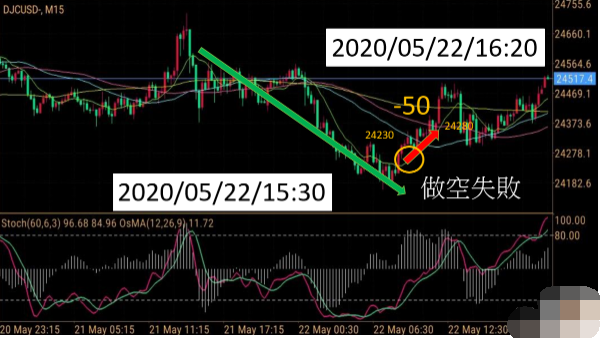
l Buy Commodities: Dow Jones Index
l Buying time: 2020/05/22 15:30
l Buying price: 24230 short
l Set loss price: 24230+50=24280
l Part: 2 hands
l Reasons for buying: Predict the opportunity to fall below the bottom support 25106 range
l Selling time: 2020/5/22 16:20
l Reason for selling: Sweep to the stop loss point
l Selling price: 24280
l Part: 2 hands (-50X2=-100)
l Reason for success/loss: Failed to sweep to the stop loss point
l How to improve: Predict the reason for the failure of the failure to be included in the follow-up research
l Follow-up of the market situation: it is correct to turn more and execute stop loss
l Margin control status: The reasonable range of loss of 5% will not affect the follow-up operation psychology for the time being
Example three
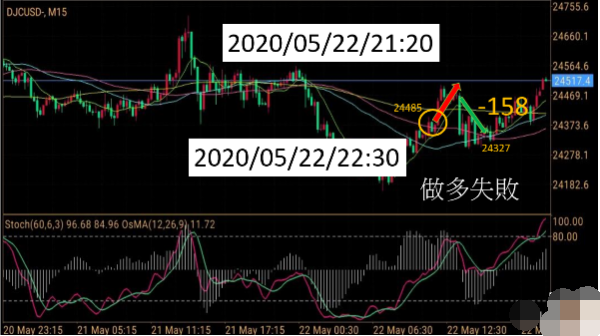
l Buy Commodities: Dow Jones Index
l Buying time: 2020/05/22 21:20
l Buying price: 24485 long
l Loss price: no loss
l Part: 1 lot
l Reasons for buying: Predict the subsequent continuous multi-party offensive
l Selling time: 22:30 on 5/22/2020
l Reason for selling: Excessive loss
l Selling price: 24327
l Part: 1 hand (-158X2=-316)
l Reasons for success/loss: The paranoia in the heart of failure, thinking that it is only the main force to wash orders, even though I know it, but the pressure in my heart is too great to bear
l How to improve: Entering the market too early and not strictly implementing the set stop loss point needs to understand the proportion of the wash order interval in the night market
l The follow-up of the market situation: it is still the multi-party that was originally predicted
l Margin control status: a loss of 13% seriously affects the follow-up operation psychology
The above three examples are to provide simple execution for novices. It does not take too much time to write, but it is best to re-examine your own improvement every week to achieve continuous improvement. Personal experience, in the case of qualified trading techniques and strategies, Writing a trading journal can indeed gradually improve the psychological quality of traders. Many people think that trading techniques must be excellent to beat the market. In fact, most of them are mainly influenced by psychological factors.
Copyright reserved to the author
Last updated: 08/08/2023 13:14
Add

The different analytical tools in the trading toolkit can help you find buy and sell signals, identify and predict market trends, and help you understand which positions you should take. But to create a consistent and effective strategy, you need to understand how the chosen indicator is used as a check and balance within a more comprehensive trading strategy.
The most successful traders are able to manage risk and reward and understand the big picture of their trading decisions by filling their toolkit with four tools: trend following, trend confirmation, overbought and oversold, and profit taking. We've outlined why these four roles are essential, and how they complement each other to make you a more savvy trader.

Trend Following Tool - Riding the Trend
While Wall Street movies love to glorify characters who make it their mission to predict the future, in reality, trading with current trends is often more profitable and less risky, especially in the currency markets. You don't need a crystal ball, or even Michael Bree-esque statistics, to be a solid trader. If you can identify trending markets and accurately determine trend direction and strength, then you have established the cornerstone of a profitable trading strategy.
Trend following tools are usually lagging indicators, which follow price action rather than leading it. The most common trend-following tool is the moving average, which analyzes current price action versus the average closing price over a set lookback period. The direction of the moving average trendline and the amount of time it tracks in that direction can tell you whether the market is in an uptrend, experiencing an uptrend, or a downtrend. The slope of the line can also indicate the strength of the trend, with steeper slopes indicating a stronger trend.
Using a trend-following tool such as a simple moving average will ultimately provide a clearer and more comprehensive market context than looking at a small window on a price action chart. Likewise, drawing a trendline on a price action chart is another simple trend-following tool that can be used to show trend direction, as shown.
By plotting a line of all price action peaks and declines over a given time period, you can use the slope and direction of the trendline to get an idea of the current trend direction and strength. Trendlines can also be used as support and resistance levels to help identify breakouts and reversals.

Trend Confirmation Tool - Trend
Once you understand how the market is performing, your next step should be to confirm trend strength, direction and momentum using another indicator in your toolkit. This reduces your vulnerability to false signals and helps inform your entry and exit points. One of the most commonly used trend confirmation tools in trading is the Moving Average Convergence Divergence (MACD). MACD draws an exponential (weighted) moving average, showing a simple moving average on the chart near the price action. The resulting interplay of the two lines helps traders confirm trend momentum and strength. Since price momentum often changes before price itself, any change in momentum is interpreted as an early signal of an underlying trend change. By identifying trend momentum as well as direction and strength, you can more accurately determine the risk and reward of entering positions at different points. When trend strength and momentum are strong, it is generally considered less risky to enter a trend following position to take advantage of the current movement. When trend strength and momentum begin to increase or decrease, traders look for ideal exit and entry points with maximum profit potential and minimum risk.

Overbought and Oversold Tools - Entry
To determine ideal entry and exit points, most traders refer to overbought and oversold momentum indicators. Based on the concept of support and resistance, when the price of a currency pair reaches an overbought or oversold threshold, it will reverse in the opposite direction. As a result, trending markets fluctuate between ongoing uptrends and downtrends, oscillating between overbought and oversold levels in a predictable manner.
Ideally, a trader's goal is to get out of uptrends and downtrends for the longest period of time, switching positions at key market turning points, which represent the greatest opportunity for profit. Indicators that define overbought and oversold conditions help traders predict when a trend may reach a breaking point, informing positioning and signaling ideal exit and entry points. Typically, an overbought reading is considered a bearish (sell) signal, while an oversold reading is considered a bullish (buy) signal, anticipating a trend reversal to the other side.
The most popular overbought and oversold tools are the RSI (Relative Strength Index) and the Stochastic Oscillator. Since both instruments are range-bound (banded) momentum oscillators, they clearly define support and resistance levels for the market in question. That said, markets can remain in overbought and oversold regions at different times, so overbought and oversold readings are not an instant invitation to enter a position. Many traders will use the RSI, Stochastic Oscillator and MACD in tandem to confirm buy and sell signals and wait for confirmation of reversals (consult their price action charts, trend following indicators and trend confirming indicators) before trading.

Profit Tool - Exit
Profit tools are best used to identify exit points that balance risk and reward. To determine when to exit a position and take a profit, you must be able to identify when the current trend may reverse or stall. Many overbought and oversold momentum indicators can also be used as profit taking tools - the key is to have a separate tool for each function so as not to rely too heavily on the signals of one indicator.
Bollinger Bands are another common profit taking tool. Unlike RSI and Stochastic Oscillators, Bollinger Bands are three lines drawn directly on your price action chart. A simple moving average (SMA) is used as the center line (or center band) and a given standard deviation is calculated above and below this SMA to account for changes in closing prices. The upper Bollinger band represents an overbought condition and the lower band represents an oversold condition. Because these overbought and oversold levels are calculated using standard deviations, they often provide a more accurate representation of current market volatility than averages alone. Therefore, they are ideal for confirming signals generated by other indicators in volatile markets and for identifying precise profit points.

Putting It All Together - Trading Systems
Many indicators fall into more than one of these four basic categories. The key to a successful trading strategy is understanding the different underlying functions of each indicator and making sure you provide each of these fundamental roles in your trading toolkit. As you understand how different indicators work and their unique advantages and pitfalls in different market conditions, you will better determine which indicator to use to guide your trading strategy.
Therefore, in summary and in line with the topic, there is no technical tool that is the most important, but the tools that can form a complete trading system are the most important and indispensable.
Copyright reserved to the author
Last updated: 08/24/2023 22:11
Add


The technical indicator I value most is the MACD indicator, which is an important tool for me to analyze the trend market and judge the entry position. In the field of trend tracking, there is an important idea called "market behavior". In my eyes, the market has a statement. The so-called turning point, breakthrough, continuation, shock, etc. are all "behavioral actions" of the market. Biological activities require energy, and market behavior still requires energy. As a simple example, why do many breakouts reverse quickly while others continue? Just because the energy of the breakthrough action is different. The MACD indicator is used to indicate market energy. To put it simply, the longer the column, the greater the energy, the longer the column, the greater the energy, and the shorter the column, the energy will begin to decline. The MACD column is directional, and the trading energy it represents also has directionality. I call this directional energy "momentum".
To put it simply, the bar of MACD represents the degree to which the short-term average price deviates from the long-term average price (at the same time, this price deviation process is also a kind of market behavior). . It takes energy for the price to maintain this behavior, which means that there is a new inflow of funds, and the greater the deviation, the greater the inflow of funds. Conversely, if money continues to flow in, prices can maintain this behavior. Although instantaneous price changes can also achieve this kind of deviation, in most cases, it is difficult to cause obvious changes on the MACD column line without the continuous cooperation of huge funds. . In a trend that continues for a long time, we can use the changes in the MACD column to judge the changing state of the market momentum during the trend development process. If the peak of the MACD column continues to expand, forming a continuous peak that is higher than the other, it means bulls The momentum is abundant. If there is a reverse valley, but the valley is not large and the duration is not long, it means that the short momentum is weak enough to pose a threat to the bull trend. If a MACD valley with a long duration and a valley value greater than the previous peak suddenly appears in a bull trend, it means that the momentum of the bears has surpassed that of the bulls. The top divergence state in the MACD indicator indicates that the bullish trend is coming to an end.
The MACD indicator has a zero line, which is the watershed between bulls and bears. When the MACD column crosses near the zero axis, it also represents the transformation of the absolute strength of the current long and short sides (note that this only represents the current state, and whether it affects the current trend needs to be compared with the previous MACD peak and valley values). The long-short conversion gives us a more accurate entry opportunity. If the long-short conversion of the MACD column coincides with the crossing of a certain moving average by the price, basically the choice of the current long-short direction can be judged, that is, the emergence of new momentum, which is an excellent opportunity to enter the market. The change in the size of the MACD bar and the period of the moving average crossed by the price can determine the size of the new momentum. The more intense the change in the bar and the longer the period of the moving average crossed by the price, the stronger the momentum and the greater the follow-up market. Generally, I use the 20-period moving average when doing short-term, and the 60 and 120-period moving average when doing medium and long-term, and the results are good.
Copyright reserved to the author
Last updated: 08/11/2023 15:06
Add

The Ichimoku balance should be one of the most useful technical indicators, and it is also an indicator that predicts the future price equilibrium. Only using the Ichimoku balance can also do a very good transaction.
As for the trend, everyone wants to find the trend and want to control the trend. To put it bluntly, it is to find the best trend and hold it for a long time. I always feel that things like trends are inseparable from long-term big profits. I personally think that the trend is actually a form of trading compared to a rebound or a fall. It just means what state the market is currently in, that's all. Some people say that trends make money, some people say rebounds make money, and some people say shocks make money. But only from the perspective of technical analysis or technical trading, as long as you can make money, it is the same. There is no difference between good and bad. The so-called black cat and white cat catch mice are good cats.
For the trend of Ichimoku, I use four steps. Just like plowing in spring, planting in summer, harvesting in autumn and storing in winter, we have walked out of a cycle. Taking a downtrend as an example, the initial stage begins with a break below the cloud. It is confirmed that the delay line fell below the rising cloud layer in the previous period, and in the weakening stage, the delay line touched the price. The eventual end is when the price rises above the descending cloud again. form a cycle. During this period, there are many repetitions, and not every stage is so clear. For example, after the price weakens, it sometimes struggles for a long time, and it will fall again, but it is still a grasshopper after autumn, bouncing around. And at the same time, will the next spring begin after the end? Not necessarily, it will still be a cold spring, the price is still in winter, and there is no shadow of spring. Therefore, it is more troublesome to judge the trend than to rebound or fall.
In addition to trends, shocks can also be reflected in the Ichimoku balance table. The shocks in the Ichimoku balance have their own characteristics.
Shocks are divided into two categories in the Ichimoku balance table. I divided it myself. Knowing an indicator or system, I personally think that at least several important forms of transactions can be expressed or described. It is very important to realize the division of forms on the basis of understanding its principles. Everyone's understanding of trading is different, so the emphasis is also different. For example, the gold fork or dead fork that is emphasized in the original book is based on the reality of trading. I personally don't pay much attention to it, so I won't say too much. Hope to understand.
I divide the types of shocks into two types. The first type is defined as shocks when the price moves in the clouds with a relatively large space. And the space of this cloud layer is called the shock interval. The second type, the trend of the delay line in the space with large clouds, is also defined as not oscillating, and the corresponding K-line trend is oscillating.
As for other market conditions, I personally believe that he is disorderly. Of course, you also have your own name. You can see profits that I can't see, so don't force it. It will not force all the market trends to be defined, which is unrealistic. Look for those with a high success rate, strong operability, and stable forms, which are the basis for profit
Copyright reserved to the author
Last updated: 08/09/2023 09:03
Add

The importance of the golden section tool in financial markets
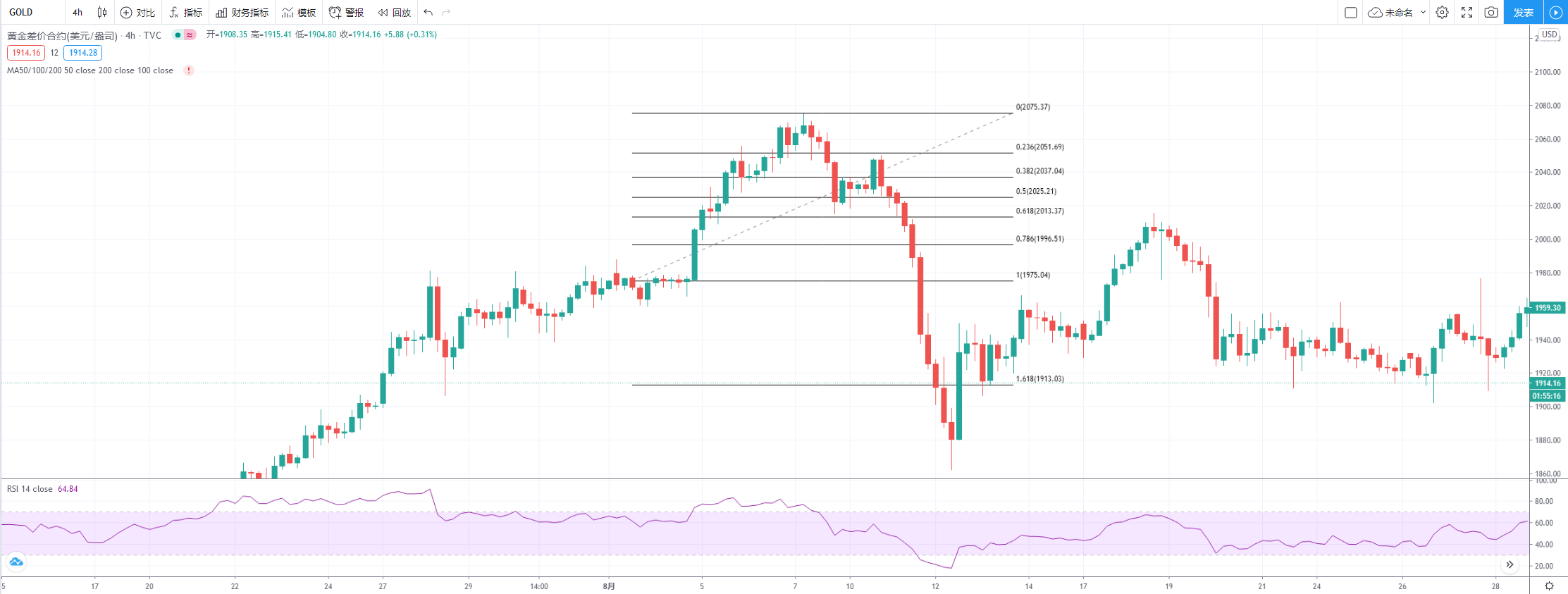
The golden section is inseparable from the Elliott Wave Theory. Elliot himself was the first to use the Fibonacci ratio in the price. He found that there is a golden ratio relationship between the number of waves. For example, a market that represents Elliott waves is driven by five waves and adjusted by three waves. Therefore, 3/5=0.600. The number of internal sub-waves of three waves is 13 waves, and the number of internal sub-waves of five waves is 21 waves. Therefore, 13÷21=0.619. After continuing to divide the 13th wave and the 21st wave, and so on, it will be further found that the proportional relationship of the number of sub-waves is very close to the golden ratio of 0.618. This is where the golden ratio in the Elliott Wave Theory comes in. Elliott further extended the application of the golden ratio to the proportional relationship between the impulsive waves and the proportional relationship between the correction wave and the impulsive wave, so that the application of the golden ratio is more extensive. What is the true meaning of the golden section? Starting from the basic concept of zero-value function theory, I found that the golden ratio actually represents the proportional relationship between long and short positions.
Copyright reserved to the author
Last updated: 08/06/2023 19:56
Add

I think the most important technical tool is the RSI indicator.
The RSI indicator, also known as the relative strength index, is a technical indicator created by Wells Wider to calculate the market buying and selling power comparison through the stock price changes in a specific period of time, to judge the internal nature of the stock price, and to speculate on the future direction of price changes. .
The principle of using RSI indicator:
1. If the strength index remains above 50, it means a strong market, otherwise it is lower than 50, which means a weak market;
2. Restricted by the calculation formula, no matter how the price changes, the value of the strength index is between 0 and 100;
3. When the six-day strength and weakness index drops to 20, it means that the stock market is oversold. Once it continues to drop below 10, it means that it has reached a serious oversold area, and the stock price may have a chance to stop falling and rebound;
4. The strength index mostly fluctuates between 70 and 30. When the six-day index rises to 80, it means that the stock market is overbought. If 3. Once it continues to rise and exceeds 90, it means that it is seriously overbought The warning zone, the stock price has formed a head, and it is very likely to reverse in the short term.
Simple usage of RSI
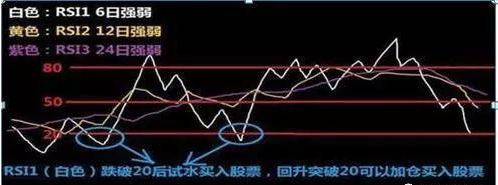
1. RSI1 (white line) falls below 20 and then breaks through 20, which is a buy signal.
When the RSI white line falls below 20, it means that the stock market has entered the oversold area. Generally, at this time, there is not much room for the stock price to continue to fall. Choose to increase your position when it breaks through 20. But after all, it is an oversold rebound, and you have to enter and leave the market quickly.
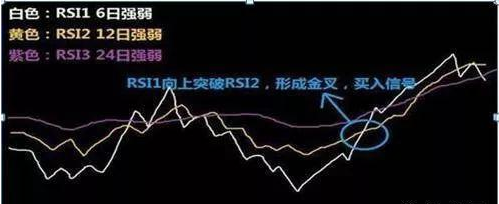
2. RSI1 (white) and RSI2 (yellow) low golden cross, buy signal.
When the RSI white line and yellow line are below 50 at the same time, they suddenly go up together, and the white line breaks through gold upwards. At this time, it is a strong buying signal for ultra-short-term, but this is only a signal. The operation should be combined with the change of trading volume to decide whether to buy or sell.
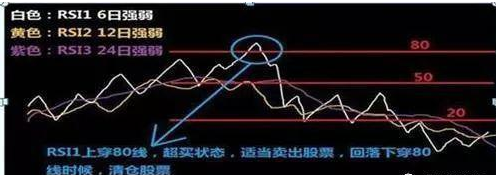
3. RSI1 (white line) fell below 80 from the high level, which is a sell signal.
When the RSI white line breaks through 80, it means that the market has entered an overbought state. At this time, the room for the stock price to continue to rise is very small. You can sell stocks appropriately and choose to wait and see with light positions. If the RSI white line peaks and falls below 80, you can clear your position and get out, and the top of the stock price has been formed.
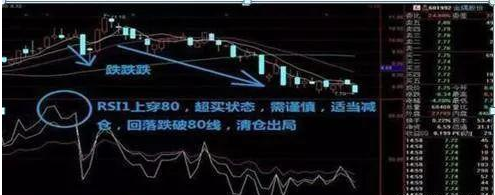
4. RSI1 and RSI2 cross high, a sell signal.
The RSI white line and the yellow line run downward together, and at the same time the white line breaks through the yellow line from top to bottom, forming a dead cross, indicating that the short side in the market has gained the upper hand. At this time, you should sell your position as soon as possible. .
Copyright reserved to the author
Last updated: 08/11/2023 18:42
Add

Before answering this question, let's look back at the market. Please think about answering the two questions. What is the final decision on the profit or loss of any transaction? spread.
What exactly does the price difference refer to? Enter the entry price and exit price, extract a keyword "price".
To make a transaction is to add and subtract prices between buying and selling.
Next, we take the keyword "price", look back at the market, and then think about answering the third question, which technical tools are most closely related to price fluctuations? "Naked K".
So, to answer the author's question, what are the important technical tools? "Naked K".
The shape of the previous K-line in each cycle chart will most likely give traders information about the shape of the next K-line or the range of price fluctuations. Interpreting the K-line is the fastest and most streamlined skill for interpreting the future market.
Go through all the books on naked K decomposition, and the interpretation of K line is all around these three points. I summarize these three techniques as follows:
1), the length of the shadow line - the length of the shadow line represents the temporary end of the original trend
2) Entity size - a large entity represents a strong reversal momentum
3) The number of combined K-lines - a large number represents a stable momentum
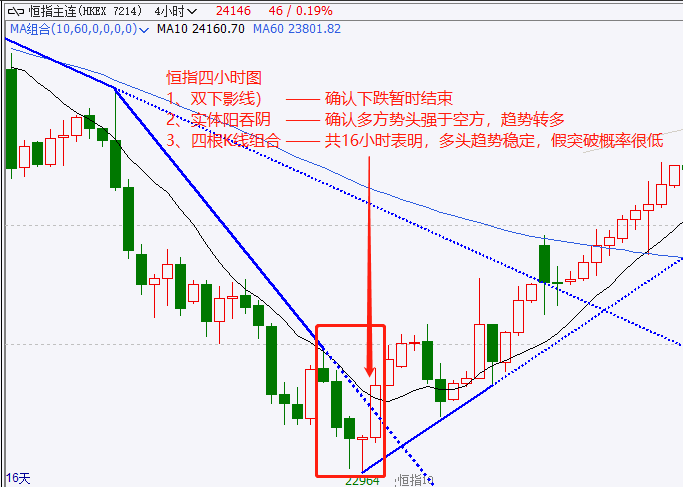
The picture above is the four-hour price chart of the Hang Seng Index from September 24, 2020 to September 29, 2020.
(1) Double lower shadow lines - the short bottom has been confirmed twice in a row. Indicating that the bearish trend has a high probability of ending.
(2) Entity yang swallowing yin - the physical ratio of yang K and yin K line is 1:1. Indicates that the trend has turned multi-directional and is gaining momentum.
(3) Combination of four K-lines - a total of 16 hours, indicating that the bullish trend is relatively stable, and the probability of a real breakout is relatively high.
Based on the above three points, combined with the actual disk, I think most people will learn and use them flexibly and can draw inferences from one example to form their own unique naked K technology system.
Copyright reserved to the author
Last updated: 08/10/2023 18:04
Add

When doing transactions, we are all used to drawing lines, so today we will talk about drawing lines. I believe that those who have done transactions are no strangers to cross-line trading. Cross-line trading is one of the earliest subjective analysis methods we have come into contact with and is also considered the simplest by novices. The so-called line trading, the most familiar ones are parallel line support and resistance, trend line, trend channel, these three common line trading.
Two points determine a straight line. This is the law. How to apply line drawing to trading. The transaction itself requires entry and exit conditions. Any line in trading has support and resistance. Support and resistance are the most fundamental conditions for our trading prices. To put it simply, it is to buy at the price callback support level, and sell at the resistance level when the price rises.
The first line: the horizontal line.
Horizontal line - draw a line with the previous low point to form a support for another fall, or the previous low point rises again after breaking through the previous low point
(breaking the previous low point) to form a resistance effect; on the contrary, use the previous high point to draw a line to form
a rebound The resistance effect, or the previous high point will fall again after breaking the position in the later period (the previous high point breaking the position) will form a supporting role.
Horizontal line --- constitutes resistance and support, and can also be continuously switched. If you break the position, you can follow up, that is,
break the resistance to go long, and break the support to sell short. (It is also the most common way to draw support and resistance)
The second: trend line
Since the trend line is a subjective indicator, if the trend line is drawn incorrectly, it is easy to cause your misjudgment of the trend, so we draw the trend line At this time, it is best to follow the following steps:
Select a major interval to find the highest point and lowest point of this interval.
If it is a downward trend line, connect [the highest point] and [the highest point before the latest low point], Then extend this line;
if it is an upward trend line, connect [lowest point] and [lowest previous high]], and then extend this line;
to find an effective trend line, we must be more cautious in identifying:
1 . A valid trendline must be peak to peak or trough to trough.
2. An effective trend line must be established if there are more than three points connected.
3. The more points connected by the trend line, the greater the meaning of support or pressure it represents.
4. The temporary breakthrough of the effective trend line by the shadow line does not mean an effective breakthrough. The significance of an effective breakthrough is relatively clear when the closing price breaks through.
5. The longer a valid trend line has been formed, the more meaningful it represents. That is to say, the significance of the trend line formed over several years is definitely greater than the trend line formed within only a few weeks.
6. After the trend line is effectively broken, the roles of the original support and pressure are often reversed, the original support becomes pressure, and the original pressure becomes support.
Third: Parallel channel line (trend channel line)
Parallel line definition: Parallel lines as channels: can be divided into ascending channels and descending channels.
In the upward trend, connect the two low points, and then click the high point between the two low points to draw a line parallel to the previous one to complete the upward channel. In the same way, the descending channel is completed.
The next thing I want to talk about is a few points that need to be paid attention to in multi-year cross-line trading:
1: Support and resistance are all used to be broken, and it is only a matter of time. And what you need is to find the most effective one in a short period of time.
2: In the actual market, try not to use a straight line to fix the support resistance level, and try to use a range to divide it.
3: In trading, drawing a trend line may need to constantly adjust the trend line according to the actual price changes and the emergence of new high and low points, and the most effective one must be the one with the most touch points.
4: Trend channel, the probability of being broken is higher the further you go. The trend channel with a larger slope has a higher probability of being broken.
5: The price is close to the point where the line is drawn, and does not have directionality. The touch point is just a game point.
Trendlines and channels are very useful in operations, but their importance and accuracy are easily exaggerated by misinterpretation. Since the trend line often needs to be continuously revised during the market operation, and the final confirmation is made based on the experience afterwards, its reliability is easily overestimated. For example, if a certain upward trend line is broken downwards, this is originally a sell signal, but the market outlook finds that the trend line has not been broken after being revised, and the previous sell signal is negated.
Copyright reserved to the author
Last updated: 08/10/2023 19:09
Add

Trendlines are one of the indicators I use the most. Therefore, the trend line is the most important tool for me personally.
It can help me get the desired result simply and roughly in a wave of trends.
The basic function of a trendline is to mark support and resistance levels. In a market with constant ups and downs, prices tend to follow linear levels, also known as trendlines.
The trend line drawn by myself requires at least 3 clearly formed points. These 3 points are also high or low points of price fluctuations, and can be connected to form an obvious line.
Trendlines imply strong support or resistance lines, so if this market structure is broken, then an important breakout is possible.
To catch trendline breakouts, I use the close price determination method myself. That is, don't just look for a candlestick breakout, but look for a candlestick close that breaks a trendline.
Because the price often pierces the trend line, but the closing price actually follows the trend line, this is also a common false breakout. I was fooled by accident, and many people also fell in this place.
Additionally, trendlines can also be used to identify consolidation structures, which I also refer to as "price squeezes". Because in this structure, the market keeps making lower highs and higher lows, and these highs and lows keep moving closer to each other, creating a squeeze scenario.
There is actually another usage of the trend line, which is the channel. Prices are constantly fluctuating within this channel, making it easy to find reversal signals. There are many usages, so I won't say more. Here I mainly talk about the basis of my own personal trend line. I guess this is also a doubt that many people have.
Personally, I think that the trend line drawn based on the highest (low) price of the shadow line defined in many books has misled many people. The reason is that the lowest price/highest price with the shadow line is the price point glitch that occurs instantaneously in the intraday. The randomness is relatively strong, and the closing price is the result of incentive competition between the long and short sides within a given period of time, which is more valuable because it shows the result of the battle between the long and the short, and the calculation of many other indicators is based on the closing price. Accurate, such as moving average indicators.
Of course, if there are multiple K-line minimum price tests at the position of the long shadow line, it means that this point has valuable reference significance. The large trading volume or dense transaction area is also a strong support and resistance level, which has a strong reference value. Drawing trend lines at these points has a meaningful value.
Personal summary: drawing a trend line is mainly based on the closing price as a reference, but the trend line cannot be used as a basis for individual trading, because the trend line is more for you to judge the direction of the trend, not a good indicator for entering the market, let’s talk about the trend The randomness of the line is still very large, and the trend line combined with other indicators to enter and exit the market is of value.Copyright reserved to the author
Last updated: 08/10/2023 22:03
Add

For myself, I would choose ADX, which is DMI. Personally, I think this indicator is very useful.
ADX is used almost exclusively as a trend indicator, and its most valuable aspect is that it can identify the strength of the trend. Generally speaking, the higher the value of ADX, the stronger the dynamic direction of the market, and the lower the ADX, the weaker the dynamic direction of the market. Note that the directionality mentioned here can be both rising and falling. ADX is not an indicator that distinguishes whether the market is bullish or bearish, it measures the extent of the trend. This is important to understand because it is not uncommon for the ADX to rise significantly when the price is falling.
When the ADX line crosses the 25 horizontal line upwards, it continues to run upwards, which indicates that there is a trend in the market, and trend traders should choose an opportunity to join the trend. Two points need to be emphasized here:
1. The ADX line only measures the strength of the trend, not the direction of the trend. In other words, when the ADX line continues to rise, the market may have an upward trend or a downward trend.
2. The reading of the ADX line itself is not important, what is important is the rising movement of the ADX line itself, because it tells us that the trend is beginning to appear. Therefore, the setting of the horizontal line parameter itself is not so important, and the horizontal line parameters in different markets will also be different, so you don't have to stick to the form.
However, there is a problem with the ADX line, which is relatively lagging. This should be the commonality of many indicators, so in fact it is not a big problem, just figure out how to use it yourself.
This indicator can very well judge the strength of a wave of momentum, which in turn can help me trade better. For example, it is currently rising/falling, has this wave of momentum come to an end? Then you can plan whether the follow-up operation is to reverse or continue to hold.
In identifying trending markets, the direction of ADX is much more important than its absolute value. Rising ADX values (such as from 18 to 20) show a stronger trend than declining ADX values (such as changes from 30 to 28). Therefore, when actually using the ADX indicator to screen a trending market, it is only necessary to determine whether the value of ADX has risen.
Following this line of thought, when I used ADX before, I always used it as a trend identification indicator and used it as a filter. But this will face two problems:
One is to wait for the ADX to rise continuously and enter the market after meeting the conditions. However, the cost of opening a position will often be relatively high, and it is extremely easy to face a strong callback trend.
The second is that ADX is used as a filtering indicator. After ADX meets the conditions, do not enter the market in a hurry, and wait for other breakthrough indicators to send an entry signal again before entering the market. Although this effectively solves the problem of entry costs, once there is a strong trend that will never turn back, there will be no chance to enter the market at all, and you can only look at the ocean and sigh.
So, I had to think in the opposite direction. Since the continuous rise of ADX can be used to identify the trend of the market, then when ADX does not rise continuously, or even falls, the market is likely to be in a turbulent pattern. Then, I can combine ADX and swing indicators (such as RSI) to make shock strategies.
Such an oscillating system, used in conjunction with the trend system, can play a very good role in smoothing the capital curve.
Copyright reserved to the author
Last updated: 08/14/2023 04:54
Add

I don't know what the landlord refers to specifically, is it an indicator or other small tools? Or draw lines or something? These should be different for everyone. Personally, I use the golden section line more often.
Although it may not be the most important technical tool, I think it is very useful and can point us to very good points for our reference. Remember, indicators and tools are for our reference, and the final decision is still made by ourselves.
The golden section line is also called the Fibonacci retracement line, which is a tool to indicate the extent of market correction. Generally, we pay more attention to the three gears of 38.2%, 50%, and 61.8%. The market is very likely to encounter support or resistance at these positions, thereby continuing the previous trend.
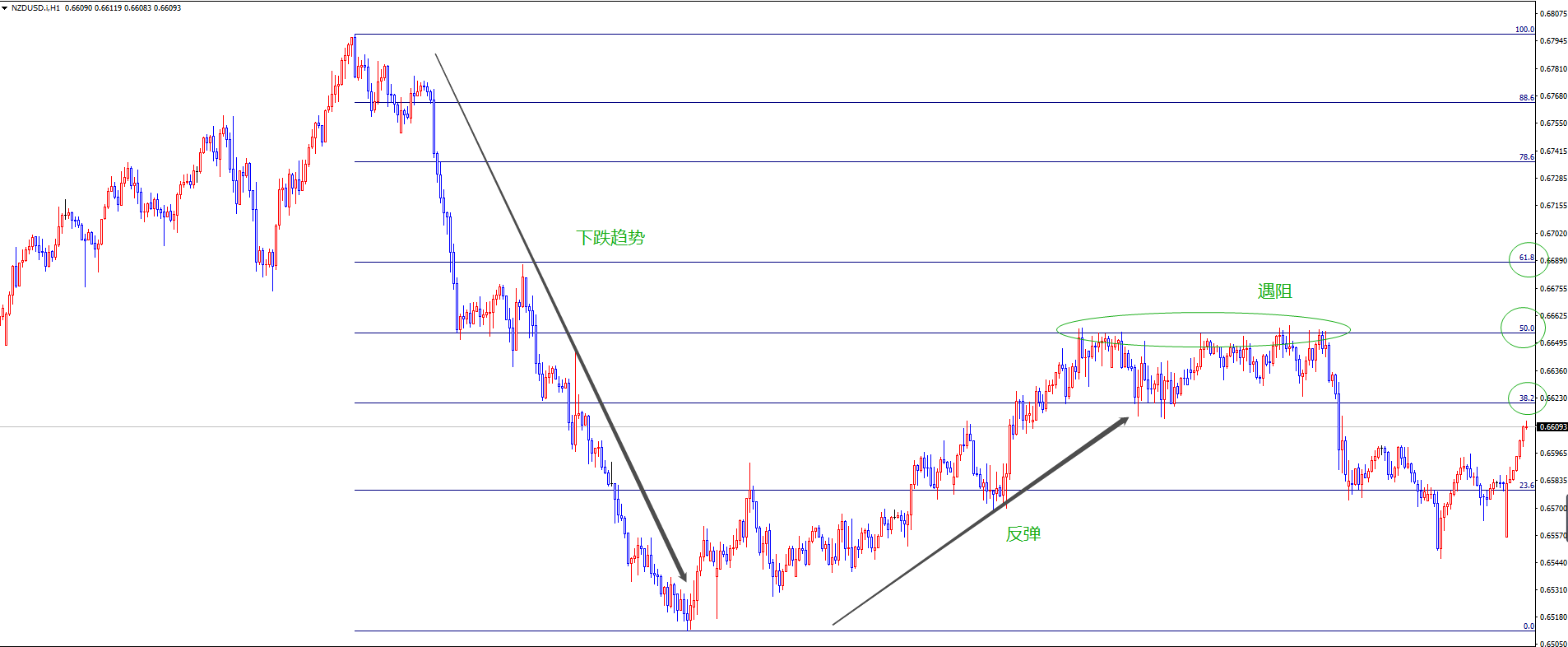
For example, NZD/USD has started a rebound trend after the recent decline, and we draw the golden section line by taking this downtrend as the main trend. We see that the exchange rate has encountered resistance to a certain extent when it rebounded to 23.6%, 38.2%, and 50%. The greatest resistance was encountered at 50%, and then the exchange rate fell again. Therefore, we can short again at the 50% position to obtain a better profit margin.
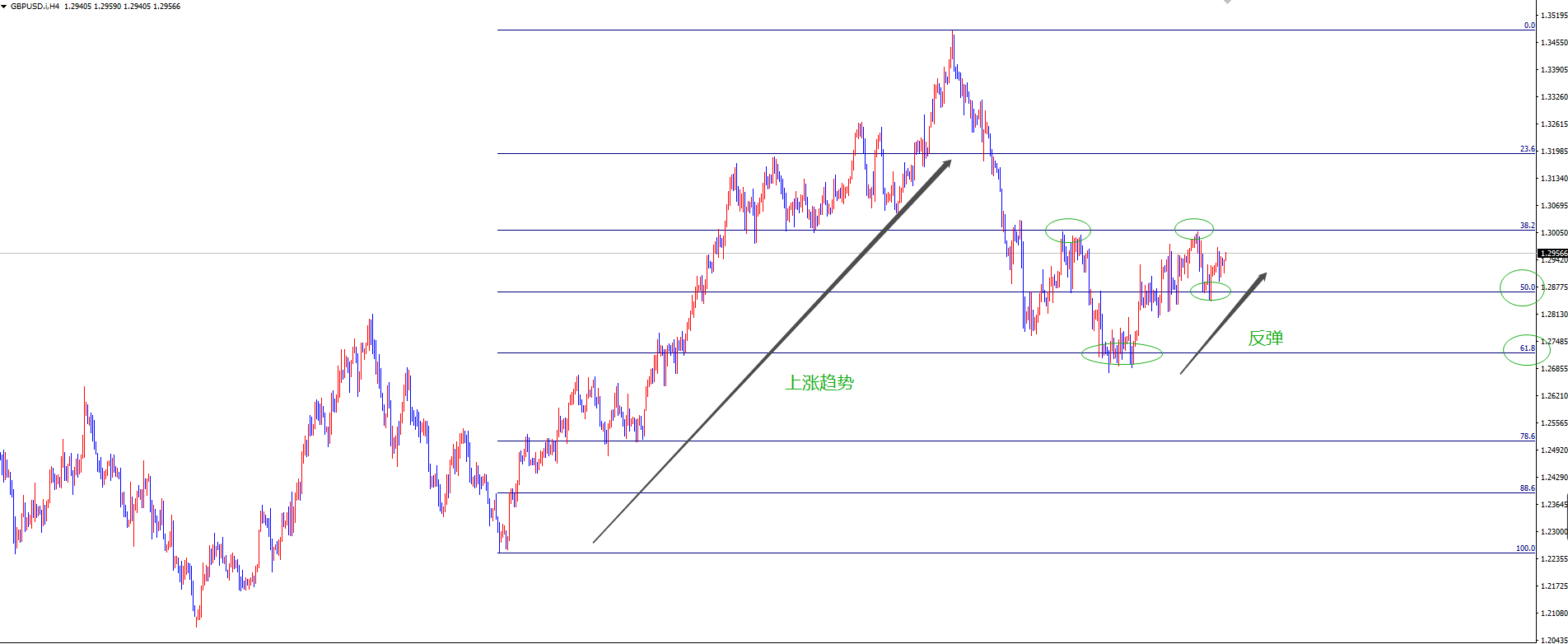
The same is true for the upward trend. We look at the overall upward trend of GBP/USD. After the exchange rate falls, we draw the golden section line. We see that the exchange rate has obvious support around 38.2%, 50% and 61.8%. The 61.8% level is the most critical. Once the exchange rate falls below this level, it implies that the previous trend may end. Therefore, if we try to catch the rebound at the 50% or 61.8% level, we will have a good winning rate and profit-loss ratio.
I have been using this tool all the time. Combined with other indicators, it can give me a very good entry position, and I recommend it to everyone.
Copyright reserved to the author
Last updated: 08/14/2023 11:10
Add

What is the most important criterion? You have to know that debates in the field of technical analysis are normal. The big guys only agree on a few universal theoretical concepts. index.
The theoretical basis of technical analysis is based on three major assumptions: 1. Market behavior is inclusive and digests everything. 2. The price evolves in a trend manner. 3. History repeats itself. It is difficult for investors in different markets to agree on these assumptions. These are doomed to be multivariate and subjective in the field of technical analysis, and the best or most important things simply do not exist.
To talk about the indispensable technical tools, it is also related to the preferences of specific users, let's talk about MACD.
MACD is the moving average of similarity and difference, which is developed from the double exponential moving average. The fast exponential moving average (EMA12) is subtracted from the slow exponential moving average (EMA26) to obtain the fast line DIF, and then 2×( Fast line DIF-DIF 9-day weighted moving average DEA) to get the MACD bar. The change of MACD represents the change of market trend, and the MACD of different K-line levels represents the buying and selling trend in the current level cycle.
Among them, the zero axis is the long-short dividing line of MACD, DIF and DEA above the zero axis are long markets, and below the zero axis are short markets. The zero line rule came out.
Let’s look at the golden cross first. The golden cross means that the DIF line crosses the DEA from bottom to top, and the MACD changes from a green column to a red column. The golden cross means that the price of the target has changed from falling to rising, which means the beginning of a bull market. According to the relationship between the position of the golden cross and the zero axis, it can be divided into a golden cross above zero and a golden cross below zero.
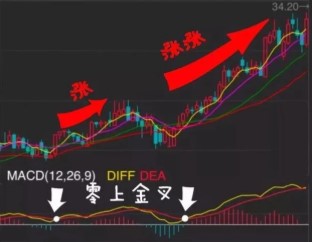
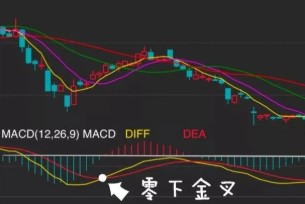
When both DIF and DEA are above the zero axis, it is a golden cross on zero, and the market as a whole is in a bull market, and the golden cross is the icing on the cake. When both DIF and DEA are below the zero axis, it is a golden cross below zero, and it is often only a short-term rebound in the short market, so its stability and reliability are low, and its strength is not strong.
Besides the dead cross, DIF crosses the DEA from top to bottom, and the MACD column changes from a red column to a green column, which means that the stock price has changed from rising to falling, which means the beginning of a short market. The dead cross is also divided into zero dead cross and zero dead cross. DIF and DEA are both above the zero axis and zero dead cross. It is often just a callback in the bull market, the reliability is not high, and the adjustment range will not be too large.
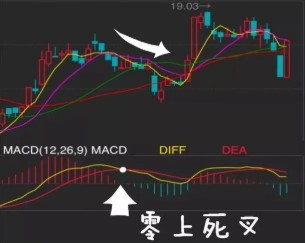
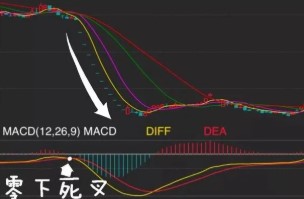
When both DIF and DEA are below the zero axis, it is a dead cross below zero, which often means the beginning of a new wave of decline.
In addition to the zero-line rule, MACD also has certain guiding significance when it comes to bottom hunting and top escape.
Copyright reserved to the author
Last updated: 08/07/2023 02:41
Add

In fact, there are many trading tools, and there is no most important one. If I had to choose one, it would be MACD
Today let us analyze the mystery of the existence of the two-line MACD, and explore how we should use the two-line MACD to achieve profitability.
abstract:
The composition, usage and defects of the double-line MACD indicator; the difference, comparison and other usages of the double-line and single-line MACD
01. The composition of two-line MACD
The MACD indicator is also formed based on the principle of the moving average, which is mainly composed of two parts: the difference between positive and negative (DIF), and the average of similarity and difference (DEA). Among them, the DIF index is the core data, and the DEA is the auxiliary data.
DIF: The difference between the short-term and long-term exponentially smoothed moving averages of closing prices. This data is usually used to reflect the difference in product price perception between short-term investors and long-term investors.
This value indicates that the 12-day EMA is above the 26-day EMA, and the market is in an upward trend. The larger the difference, the stronger the short-term rally.
Conversely, in a downtrend, the difference is negative, and the larger the absolute value, the stronger the market's downward momentum in the short term.
DEA: It is the exponentially smoothed moving average of the M-day average of DIF, and the commonly referred to as M is 9.
BAR: The longest histogram used in the MACD indicator, the BAR chart is obtained by subtracting DEA from DIF.
When it is below the 0 axis, it indicates that the trend of the market is down;
When the MACD is above the 0 axis, it indicates that the trend is up.
02. Usage of MACD
When DIF and DEA are above the 0 axis, it is a long market. When DIF breaks through DEA from bottom to top, it is a buy signal.
When DIF and DEA are below the 0 axis, it is a short market. When DIF breaks through DEA downward, it is a sell signal.
As far as the operation is concerned, it should be bought with a golden cross in a long market and sold with a dead cross in a short market. And when there is a divergence at the top, sell short, and when there is a divergence at the bottom, buy long.
Fork and dead fork indicate the so-called divergence: that is, the K line continues to make new highs, while macd does not have a new high. The picture below is the current sky map of the U.S. dollar index. It can be seen that the U.S. dollar index has shown signs of divergence from the top of the macd, and short positions may be staged.
The bottom divergence can be viewed in reverse, that is, the K-line continues to make new lows, while the MACD does not have a new low, so you can see more in the later stage.
03. Flaws of MACD
1. Since MACD is a medium- and long-term indicator, the buying point, selling point, and the price difference between the highest price and the lowest price are relatively large, and the signal may be confused when the market fluctuates violently.
The time interval between the buy signal and the sell signal is very short. If you enter the market according to this indicator signal, not only will you not make a profit, you may even lose the spread and handling fees.
2. When the rise and fall are particularly large within one or two days, the MACD has no time to respond.
This is also a common problem of all technical indicators. Since the MACD indicator cannot change immediately, the effect of the MACD at this time is relatively weak.
Let's talk about the difference, comparison and respective advantages of the two-line MACD and the single-line MACD.
04. The difference between two-line MACD and single-line MACD
One-line MACD
The single-line MACD on MT4 is composed of MACD line, bar line and zero line. And 12, 26, 9 are the default parameters of the system and the most commonly used set of parameters in the market, so there is no need to change them.
The principle is the same as the two-line MACD introduced earlier.
Histogram: represents the difference between EMA (12) and EMA (26);
MACD line: Another red line is DIF (DIF=EMA(12)-EMA(26)) which is brought into the exponential moving average calculation formula with a parameter of 9.
The two-line MACD corresponds to it. The MACD line in the two-line MACD indicator is the blue line in the figure below, which is an exponential moving average with a parameter of 9.
Another line linked by the vertices of the histogram is the signal line, which has the same effect as the histogram.
05. Comparison of two-line MACD and single-line MACD
Compared with the single-line MACD indicator, the signal given by the two-line MACD indicator is obviously more.
As far as the income of a single signal is concerned, it is obvious that the income effect of the signal given by the double-line MACD is not as obvious as that of the single-line MACD.
Especially among the first few signals given by the two-line MACD, the profit effect of trading according to the signals seems to be more general.
However, compared with the single-line MACD, the two-line MACD sends out signals faster and can quickly respond to market changes, thereby maximizing returns.
6. Some other uses of the two-line MACD
We all know that any technical indicator has its limitations, and there is no perfect technical indicator. Therefore, multiple technical indicators need to be combined to avoid trading losses due to the limitations of a single indicator. However, due to the limited processing power of humans, the simultaneous existence of too many indicators may lead to confusion.
Therefore, we can convert the two-line MACD indicator into the following index system, so as to avoid some unnecessary troubles.
When there are 3 columns in a row, and one is higher than the other, it is regarded as a buying signal, and this wave of buying can be held until another column is lower than the previous one.
When there are 3 columns in a row, and one is shorter than the other, it is regarded as a sell signal, and this wave of selling can be held until another column that is higher than the previous one appears.
Using this method can avoid confusion when the two-line MACD is used in combination with other indicators, and can also judge trading signals more accurately.
Copyright reserved to the author
Last updated: 08/07/2023 03:32
Add

I basically make orders on the 1-hour chart. Forex trading is basically 22 hours a day, and the 1-hour chart can capture the overall fluctuations of the day well.
In my cycle, one indicator is essential, and that is the rsi indicator. I set the parameter of this indicator to 22, which captures the overall volatility of the day. Because I do 1-hour swing trading, I also pay attention to the current overall trend. But the existence of rsi allows me to better grasp the point and obtain better profit margins to a greater extent. Let's use graphics as an example.
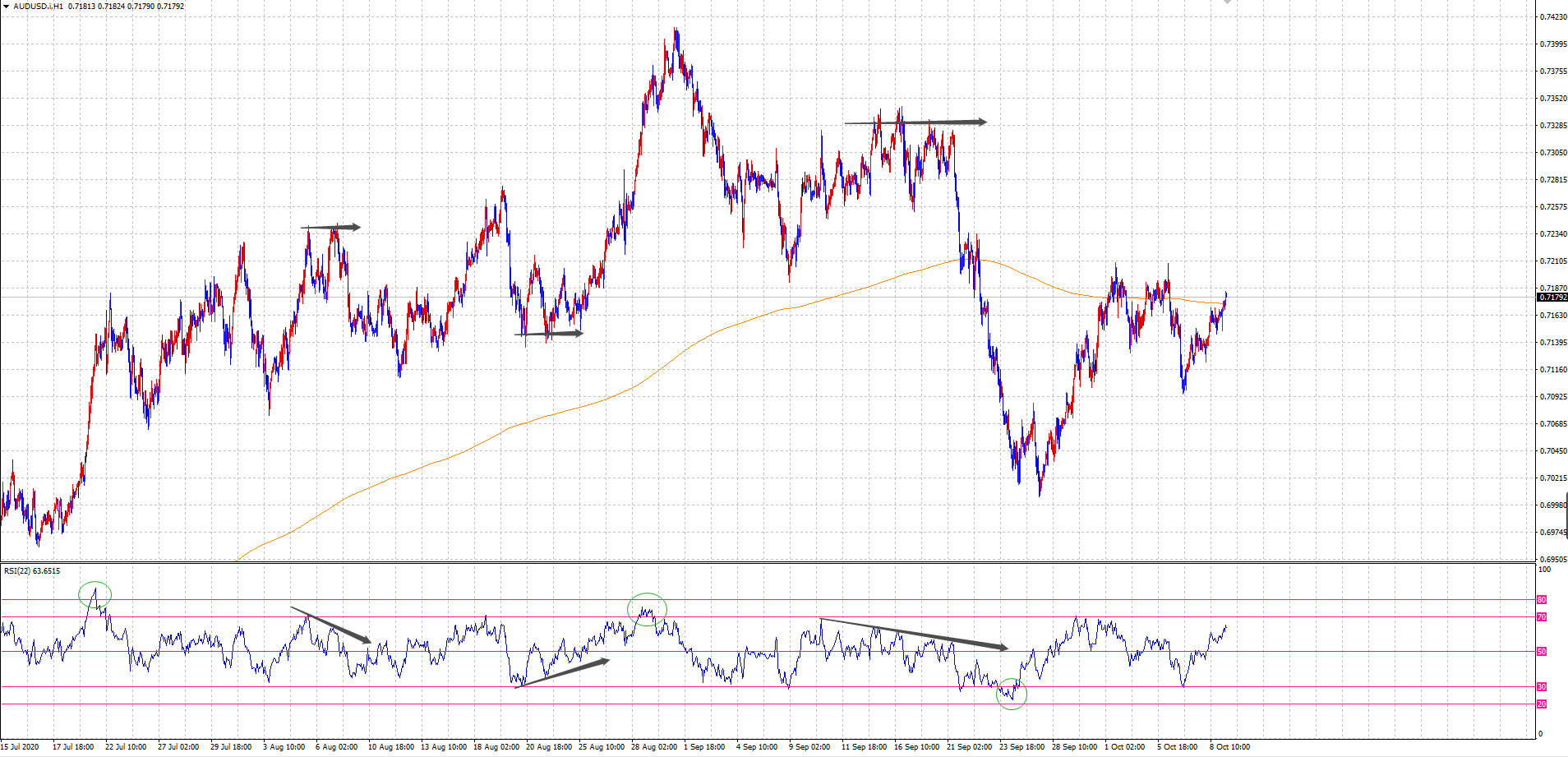
Taking the recent trend of AUD/USD as an example, you can see a lot of divergence and overbought and oversold conditions on the graph. And every time after a divergence, the market will develop better; and after overbought and oversold, the market will also have a more obvious correction with a high probability. Of course, we are not discussing its general trend here. Therefore, this indicator is of great help to me in judging the short-term market trend.
Although the indicators are lagging, the sensitivity of the RSI indicator is actually not bad. Using this kind of oscillator to catch divergence can actually give you a lot of profit margins. Of course, divergence is often a false signal, but the success rate is relatively high. The overbought and oversold signals are actually very useful within the day, after all, the intraday volatility is limited. If the AUD/USD index has risen by more than 80 points within a day and entered the overbought zone, and the average volatility in 20 trading days is 50 points, then you short-term after the indicator enters the overbought zone, the short-term success rate is very high.
In short, the rsi indicator is my indispensable analysis tool in the 1-hour chart trading. Although it is simple, I think it is very practical. If you also feel ok, give me a few more likes! If you feel that it is not easy to use, why not share your "baby"?
Copyright reserved to the author
Last updated: 08/06/2023 17:53
Add

There is no most important technical analysis tool, only the most suitable technical analysis tool. Everyone's personality is different, the length of time in contact with the market is different, and under the influence of factors such as understanding of the market, you must have your own set of market cognition and your own trading philosophy. Therefore, you will choose to recognize the trading technical tools that suit you.
Whether it is naked K trading or trading using indicators or indicator combinations, in the face of strong uncertainties in the market, any technical analysis tool will be useful for a period of time and fail for a period of time. This is a normal phenomenon. Therefore, I personally do not recommend looking for technical analysis tools like unique cheats, the one that suits you is the best.
I personally use more trend lines. Sometimes the effect of the trend line is really very precise, which has to be admired. Of course, in most cases, we don't need to find the precise point, we just need to find the approximate interval. Errors in transactions will always exist, and there is no way to avoid this.
My principles for using trendlines:
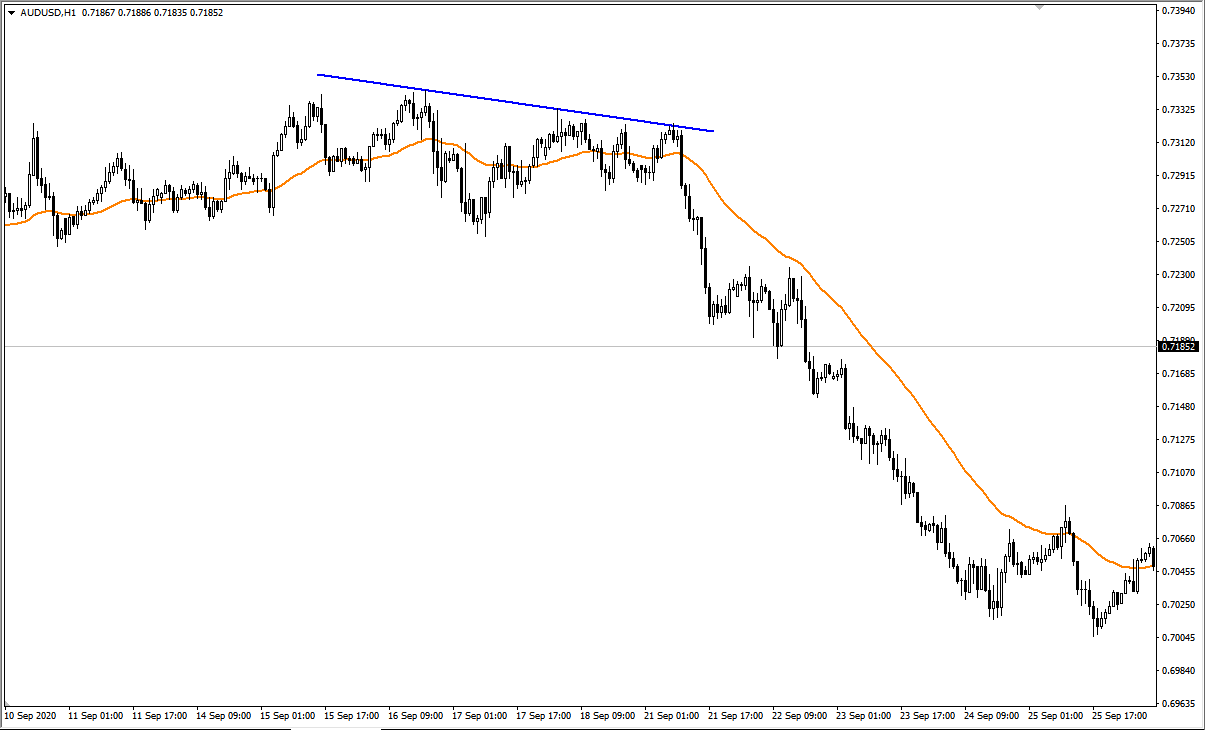
First, trendlines work best when they are visible at a glance.
This is one of my criteria for judging whether the trendline effect is easy to use. If you can see the point at the first glance on the board, then the effect of this point is generally very good. The reason is also very simple, because not only you are using the trend line in the trading market, but also others can see it, so its effect is usually better. And the kind of trend line that takes a lot of effort to see will generally not have good results.
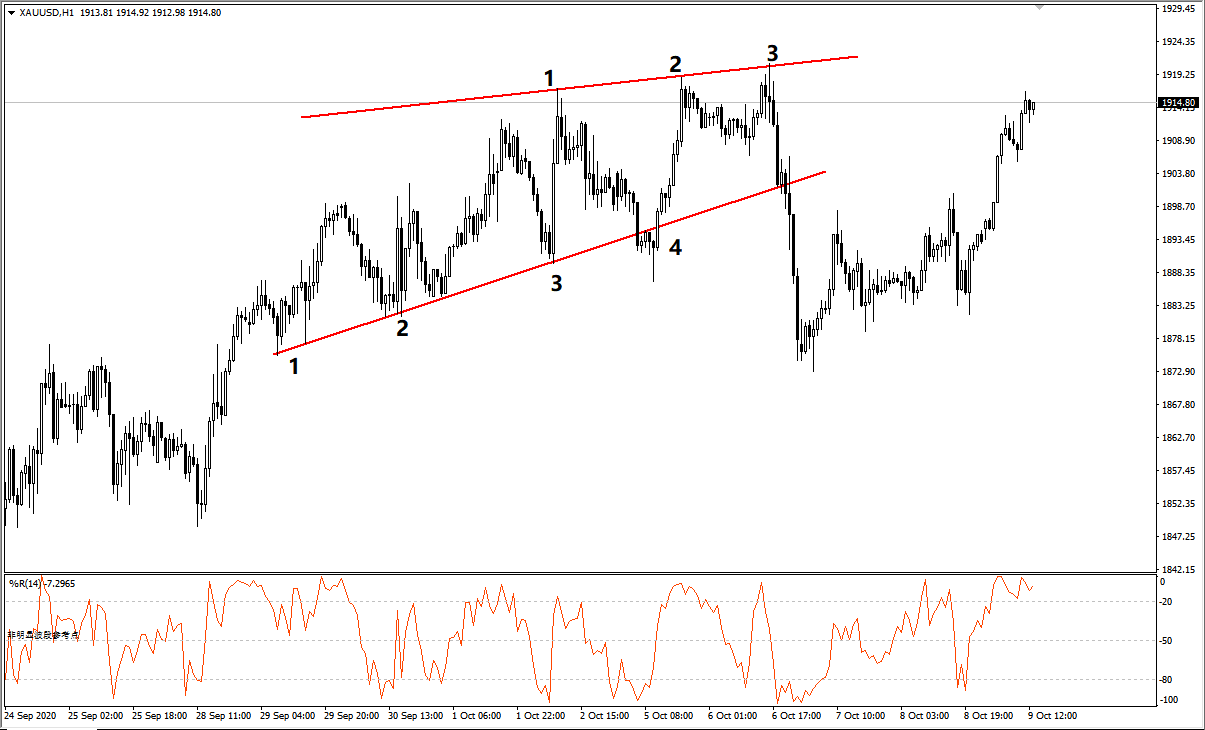
This point may be a little different from the knowledge in the book. Generally speaking, we all think in books that two points determine a straight line, the third point confirms the effect, and the fourth point is the point of operation. However, after a long period of trading, I discovered that it is enough to operate at the third point. In many cases, the market will not rigidly wait until the fourth point before there will be trading opportunities. Either the market has reversed, or the market has already accelerated upward.
Third, do not deliberately find the precise point
Trendlines are also just about finding areas where market prices are likely to stay. The pressure level is never a simple point or line, but an area. Therefore, when the price pierces the trend line, it cannot be judged that the resistance level has been broken. Whether it is broken or not, I am used to waiting for the market to close, and will measure the magnitude of the closing and the trend line.
Fourth, recognize the error in the trend line.
There are errors in any technical analysis tool, and the trend line is a subjective analysis tool. The occurrence of errors may be more common than indicators. The use of trendlines still requires acceptance of this error.
Fifth, use it with other analysis tools
No matter whether the trend line is used to judge the current trend or find a suitable point, it has a certain effect. But when trading only on trendlines, there may not be too many trading opportunities. Personally, I will use it with indicators.
Finally, it needs to be mentioned that technical analysis tools are our eyes for discovering the market, and the one that suits us is the best.
Copyright reserved to the author
Last updated: 08/07/2023 09:36
Add

K-line, price action.
It must be like this, whether it is a trend indicator or an oscillator, there is a price first, and then there is an indicator calculated by the price, that is to say, the indicator is the second-hand information of the market, and the K-line price is the first first-hand information. The analysis of price action is also the most recognized method of analysis at present.
So, what does price action look for?
1. Single K-line and combination of K-lines.
From the perspective of a single K-line, I can roughly divide K-lines into two categories. One is the reversal of special K-line patterns, such as doji, hanging man, tombstone and so on. The second is K-lines other than reversal patterns, which are divided into continuation patterns.
K-line combination forms are also divided into reversal and continuation forms. In theory, the significance of this classification is to divide the market chart into two categories of price action, reversal and continuation. In the matching position, support and resistance levels and other factors, it will have a very good effect. This is similar to the combination of K-line classification in the market.
There is a saying: when the price is in the top or bottom structure, there will be a special K-line pattern; and if the price has a special K-line pattern, the market is not necessarily at the top and bottom. There is an essential difference between the two. Especially in the big cycle, the K-line shape often has miraculous effects.
2. Market structure.
The ups and downs of the market are composed of K-lines, and the price will run according to the rhythm of the trend from the bottom to the top, and the trend has a clear definition. In price action, it appears as higher highs and lower lows, or lower highs and lower lows. It is precisely because of the constant changes in the market structure that there are various long and short forms. As long as the market fails to break out of this market structure, the trend will continue. Conversely, if the market breaks out of this market structure, the trend may change, but not necessarily reverse. Therefore, I think there will be an adjustment state when entering the market during the rising and falling trends, rather than immediately reversing.
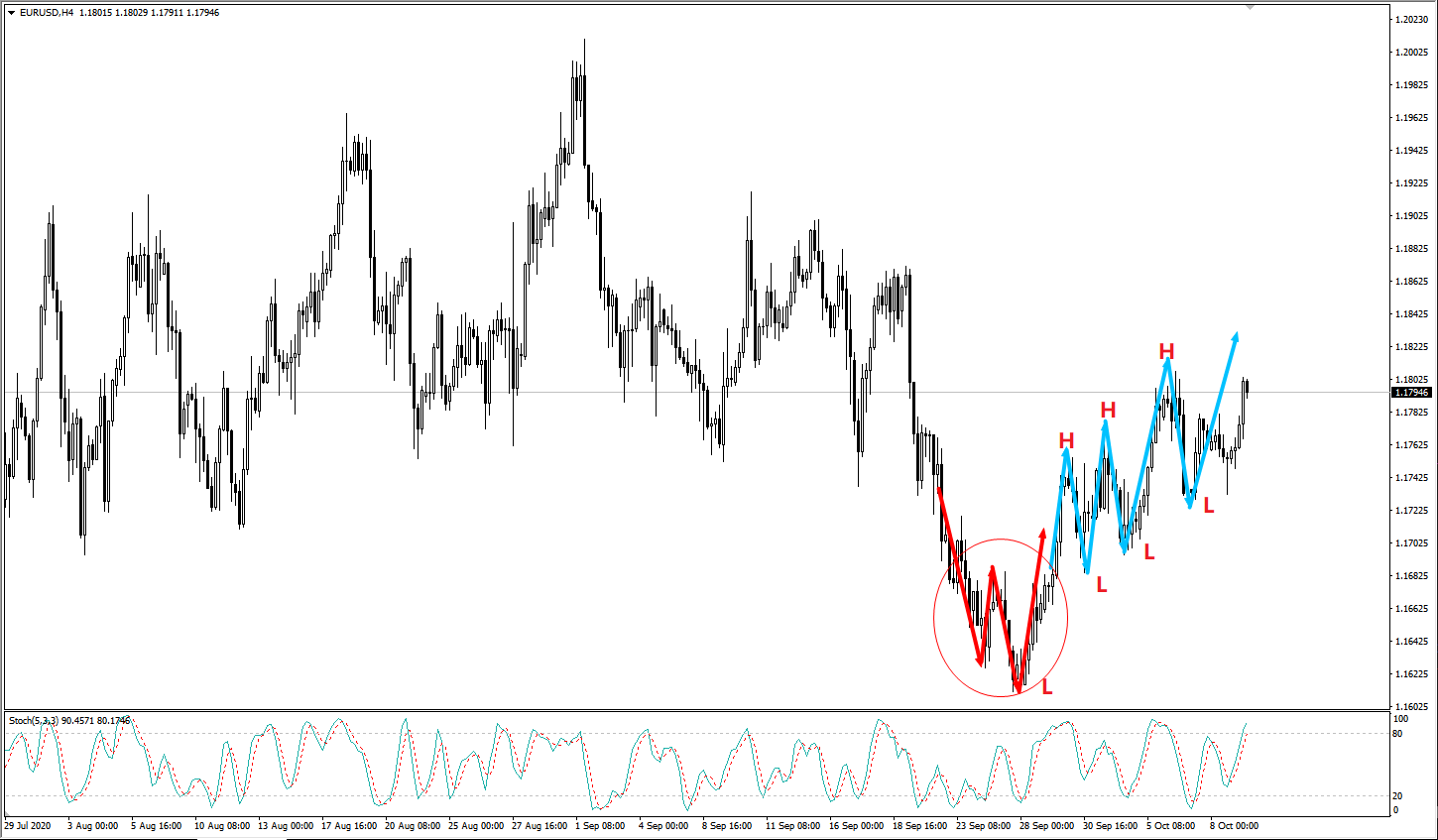
3. Pressure bit.
Through the analysis of price action, we can intuitively see the support and resistance levels of the market. Also, the more intuitive the pressure point, the better the effect is usually, because this point can be seen by you, and so can everyone else. After seeing this point, it will not directly affect the price trend, and it will affect the price only after seeing it. In other words, first see the pressure level and then operate. Therefore, some traders study their own unique indicators and complex trading systems behind closed doors, which is logically unfeasible. Because your things are not seen by others, it will not have a very good effect.
At present, I mainly analyze the K-line price behavior from the above three angles. In the actual operation process, the oscillator will still be referred to. The point is not what method to adopt. It can be said that any technical analysis tool can make money if you use it well. The key lies in how you understand and use it.
No matter what kind of technical analysis tools, it is best to form your own trading system. Clearly know every step in the transaction, as detailed and streamlined as possible.
Copyright reserved to the author
Last updated: 08/02/2023 09:39
Add

Is candlestick chart a technical tool? If you engage in naked K, then it must be essential. At this time, it doesn't matter what kind of single cycle.
Take intraday trading as an example. In addition to the time-sharing chart, the 15-minute line may be the most important K-line.
Generally speaking, if we think that today’s market is likely to be a volatile market, after switching to the 15-minute K-line, we will abandon the first two K-lines, which is to filter risky transactions. Although it is given up, it can be used for other purposes, and it can be used as a daily trading quantitative indicator. Draw horizontal lines at the lowest point and highest point of the two 15-minute K-lines respectively.
In this way, the plain K-line chart becomes glamorous after two horizontal lines are drawn. At the same time, what do you seem to realize? Yes! They are the daily long and short lines!
After having these two data, as long as the market price falls below the lower line, we will open a short order, and when the market price breaks through the upper line, we will open a long order.
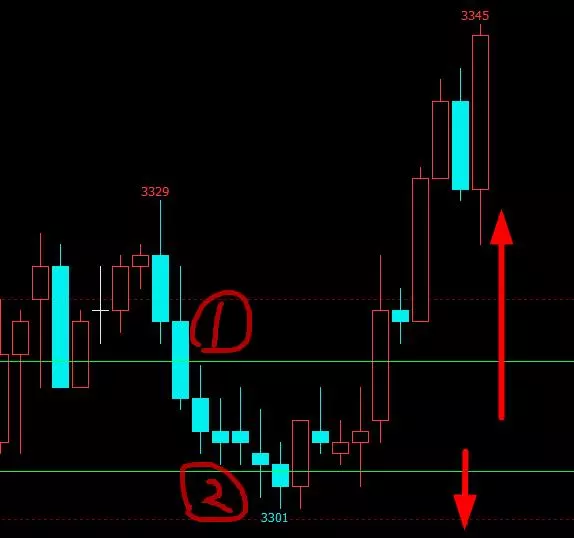
The stop loss adopts a moving stop loss to ensure that the short-term stop loss can be small and the swing can be large! Each time the stop loss is the lowest point of the previous bar, the empty order is of course the highest point of the previous bar! As shown in the figure above, a stop loss and a take profit will be generated.
Why use the 15-minute K-line chart? There is actually no standard answer to this question, it depends entirely on experience.
Because the period of 1 minute and 5 minutes is too short, the basis for judging long and short seems not so direct, and the two 15-minute K-lines are equivalent to 30 minutes. 30 minutes after the opening of the market, the market for a day is relatively stable!
Therefore, in addition to using the 15-minute K-line trading to stabilize, there is still a chance to achieve the short-term unilateral market as shown in the picture!
Of course, the above-mentioned 15-minute application processing is completely personal experience. As for the final effect, it actually varies from person to person. I work within the day, which belongs to the role of the Buddha. Trading only depends on the mood when I have time. At this time, this simple trading strategy is basically enough.
Copyright reserved to the author
Last updated: 08/11/2023 10:46
Add

thank you
I find the answer to this question very interesting, because many of us rely heavily on technical tools when doing transactions.
And there are many types of technical tools, basically each of which can be used for trading, such as trend line, MACD, Bollinger bands and other excellent technical auxiliary tools, but have we found that the performance of all technical auxiliary tools is established In the past market, when most of us use these indicators, we only use the previous performance to determine the high probability direction of future orders. In this way, many uncertain factors will be superimposed on these indicators. It is in the list, and it can have a very good auxiliary effect for some novice traders. However, if you have been trading for several years or simply rely on traditional technical assistance and other information to do transactions, I think it is still difficult to get out, because such indicators The tools are actually deceiving you when there is no follow-up market.
We all know that the delay of technical indicators is very large. It is difficult to make money by relying on this delayed indicator to trade. I have said so much to give you a direction. Indicators can be used as a reference, but they cannot be taken as a whole. In conclusion, we need to clarify two points in the use of tools to participate in the foreign exchange market
One: The technical indicators of the afterthought should not be
Two: EA that needs to strictly implement the strategy
Based on these two points, I will bring two technical tools to the audience and friends to use together. The first auxiliary tool is the review software, and the second is the EA for implementing strategies.
Why recommend these two, the main reason is as mentioned above, the core of the review tool is to quickly and continuously verify your trading level. In the historical market, you can continue to implement your trading strategy. Or a few years of historical review, you at least know your trading odds on a high-probability disk, and you can adjust it in time if you make a mistake. There is no delay in the review software, and some only continue to verify historical experience for you, which can be quickly To improve your correct handling of the market, followed by EA programmatic trading, and then use the historical review tool to optimize your trading system and then cooperate with the use of ea to perfectly remove your subjective trading, as long as you have experience There are enough, the strategy is optimized well enough, and the combination of the two will make your trading results twice the result with half the effort.
If you are interested in my answers, please follow my Huihu account. I will regularly answer some industry-related questions every week. I don’t seek the most professional, but the most authentic.
Copyright reserved to the author
Last updated: 08/05/2023 06:51
Add

0
work
0
subscriber