


Stay in touch!
Subscribe to our newsletter to get the latest updates on live market analysis, trading strategies and more. You can unsubscribe anytime.
By subscribing, you agree to Trading.live Privacy Policy.


For novices, it is normal to be confused about what is "following the trend to make orders" and "now fluctuating in a range, go long on dips". Don't be afraid of people's jokes, and learning with a correct attitude is the last word.
If you want to distinguish between shocks and trends, you must first know what shocks and trends are, right?
Chart 1: Range-bound, go long on dips
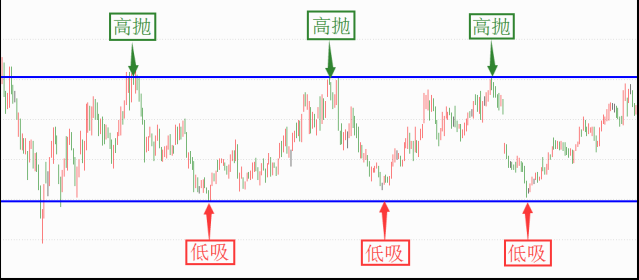
So let's start with the trends.
In the market research method of technical analysis, the concept of trend is absolutely the core content. All the tools used by chartists, such as support and resistance levels, price patterns, moving averages, trendlines, etc., have the sole purpose of assisting us in estimating market trends so that we can trade in the direction of the trend. In the market, "always trade with the trend", "never go against the trend", or "the trend is a good friend", etc., are already clichés. So we have to spend some time defining and categorizing trends.
In a general sense, a trend is the direction in which the market is going. However, for practical application, we need a more specific definition. Under normal circumstances, the market does not go straight in any direction. The market movement is characterized by twists and turns. Its trajectory resembles a series of successive waves, with fairly obvious peaks and valleys.
The so-called market trend is formed by the direction in which these peaks and troughs rise or fall in turn. Whether these peaks and troughs are sequentially ascending, descending, or extending horizontally, their direction constitutes the trend of the market. Therefore, we define an upward trend as a series of successively rising peaks and troughs, a downward trend as a series of successively descending peaks and troughs; a horizontal extension trend is defined as a series of successively extending horizontal peaks and troughs, see chart .
Chart 2: Uptrend
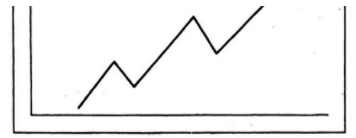
Chart 3: Downtrend
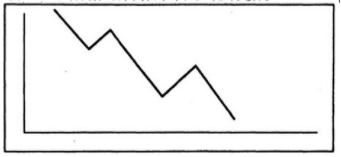
Chart 4: Oscillation Trend
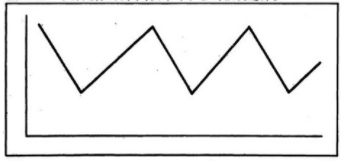
Seeing this, you may want to ask the questioner, isn’t this horizontal extension trend just a shock arrangement? If you can ask this question, congratulations, it means that you have made progress!
Yes, this horizontal extension is exactly what is often referred to in the market as a shock! Many people are accustomed to thinking that the market has only two trend directions, either rising or falling. But in fact, the market has three directions of movement - up, down, and sideways. As far as a conservative estimate is concerned, at least one-third of the time, the price is in a horizontally extended form, which belongs to the so-called trading range, so it is quite important to understand this difference. This horizontal stretch indicates that the market has been in a state of equilibrium for a period of time, that is, in the above price range, the forces of supply and demand have reached a relative balance. However, while we define this flat market as a sideways trend, the more general term is "no trend".
Speaking of this, you should understand the subject? Usually these analysts say that following the trend to place an order refers to placing an order following an upward trend or a downward trend; while "range oscillation, long bargain hunting" refers to a strategy to deal with the trend of horizontal extension. To distinguish the relationship between the three is to use the peaks and troughs as a reference to see whether they rise sequentially, descend sequentially, or extend horizontally.
Copyright reserved to the author
Last updated: 08/26/2023 01:41
 Add
Add

resonance.
In 1849, a troop of soldiers passed by on a 102-meter-long bridge in France. When they crossed the bridge in neat steps under the command of the commander, the bridge suddenly broke, killing 226 officers, soldiers and pedestrians. After repeated considerations afterwards, the bridge is extremely strong, and even if it is increased to 1,000 officers and soldiers, it will not cause the bridge to be crushed.
One day in 1906, when a Russian army marched neatly and strenuously across the Aigibite Bridge over the Fonta River in Petersburg, the bridge body suddenly broke,... .
In addition, in 1831, there was also an accident in which the bridge resonated and collapsed when the troops crossed the bridge in unison near Manchester, England.
After the discovery of the logistics knowledge of the resonance principle, the principle was gradually revealed. Because the frequency of the soldiers walking forward is exactly the same as the natural frequency of the bridge, which strengthens the vibration of the bridge. When its amplitude reaches the maximum and exceeds the bridge's resistance to pressure, the bridge will break. So now when the army crosses the bridge, they only cross the bridge after breaking up their pace.
The same is true for the financial market. Whether it can get out of the big trend frame must be a resonant trend in the same direction as the small cycle in the super big cycle. Looking at the trend of gold, the figure below shows the monthly trend. Gold is below 1380 and has been in the true range. In June 2019, after the market began to break through 1380, the original volatile market began to gradually break through to the monthly level. major trend. In the direction of the big cycle, after the general trend is determined, every time a weekly level with a smaller level enters an upward cycle and resonates with the monthly level, a wave of great operating opportunities will be formed.
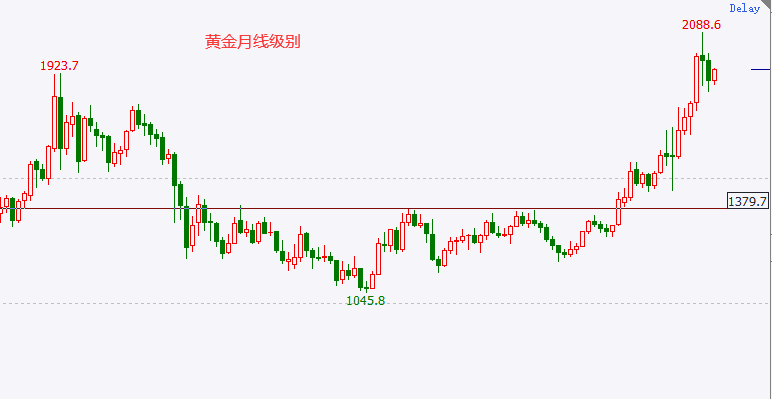
As shown in the figure below, the monthly line level, I just said that the general direction is upward. After each adjustment of the weekly line level, the opportunity to rise again is due to the resonance of the monthly line and the weekly line level, which is the resonance of the large and small cycles. After a round of resonance, the market has emerged from a super-big market, and basically all of them are new highs. If the three levels of daily line level, monthly line level, and weekly line level can resonate multiple times, it is the best buy for daily line level resonance. The entry point, and so on, the 4-hour weekly line can form a resonance with the daily line, weekly line, and monthly line. May I ask if such resonance is a super big market?
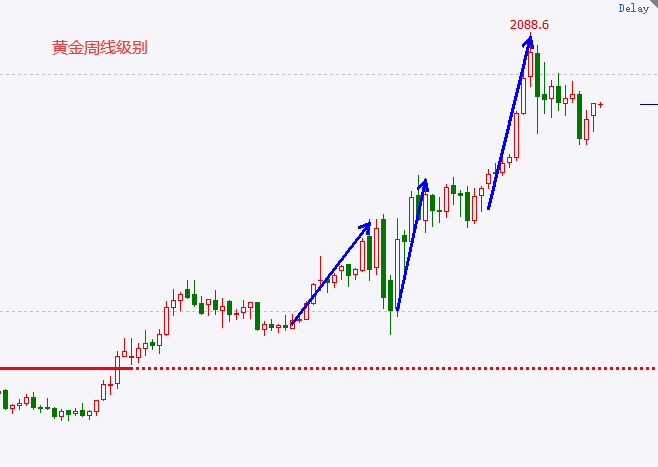
Conversely, if the 4-hour level, daily line, weekly line, and monthly line cannot form an effective resonance, or even follow their own signals in a mess, is it possible that a general trend cannot be formed, even if the volatility is large in a short period of time , It’s just a small period of big shocks, can’t follow the big trend?
Copyright reserved to the author
Last updated: 08/22/2023 09:44
Add

Oscillation and trend are things that traders often struggle with. When they want to follow the trend but are afraid of oscillating, the result of being optimistic about the oscillating market is the opposite side.
Haha, this is the only thing that has entangled too many traders over and over again, "Trading has abused me thousands of times, and I treat trading like first love."
The distinction between trends and shocks may not be complicated. Just like in a family, father and mother do not need to clearly divide responsibilities.
Looking back at the real market, the shape of a single K-line in the large-cycle chart is a summary of the market conditions of multiple K-lines in the small-cycle chart, and the trend of multiple K-lines in the small-cycle chart is the decomposition of a single K-line in the large-cycle chart. Never absolute.
Combining your own trading habits and ways of thinking to analyze, I think you should recognize two things about yourself:
Suitable for shocks or trends?
Is it suitable to refer to the large cycle diagram or the small cycle diagram?
Trading is very fair. Over 200 years of experience have given him enough tolerance. Whether you are a capitalist or a veteran of the battlefield, he will give you an equal market with resource and information sharing, so tolerant that you can Combining personal or team personality, way of thinking, information channels, etc. to develop a sufficiently personalized and exclusive method, as long as you can make money within the scope of the law, there are no other rules and regulations.
Therefore, you need to have a sufficient understanding of yourself, and use your own perspective to match the frequency of market fluctuations.
If the subject is used to the shock technique, I will teach you a method to draw a four-hour chart structure
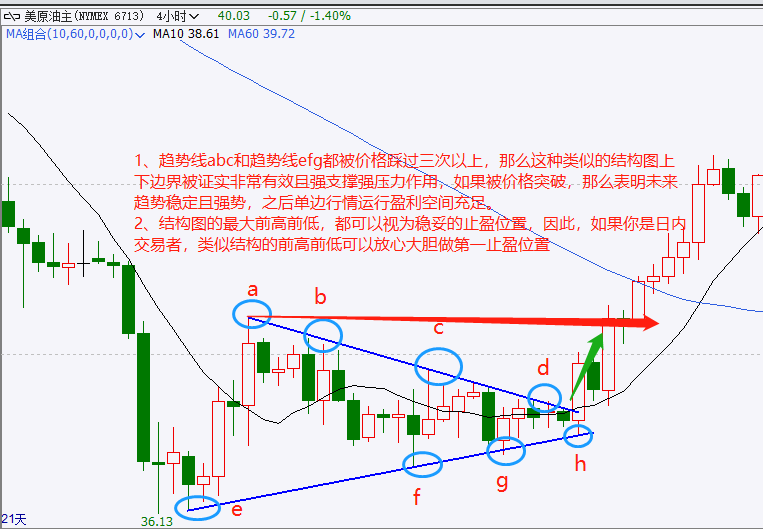
The picture above is a candle chart of crude oil from September 9, 2020 to September 15, 2020.
This is a contracting triangle candle structure. The upper and lower boundary lines have been stepped on for more than three times, which proves that the trend line abc and trend line efg are effective and stable. When there is a price breakthrough, you can enter the market and make orders.
The first high and the lower is the first safe and safe position, so you can set a stop profit position.
The good thing about this method is that you don’t need to wait for the retracement. Our usual method is to wait for the price to retrace. Sometimes the price is multiple retracements, sometimes it is superficial, or even not at all. The boundary line has already officially functioned as an effective support and resistance, so even if the price steps back, there will be no major retracement.
On the other hand, this method combines the trend and the volatile market very well, which is simpler and easier to operate than the traditional breakthroughs and selling high and buying low.
The subject can give it a try.
Of course, the setting of the entry point is also exquisite. This needs to set the entry price according to the characteristics of each variety. For example, the currency is used to retracement. The retracement position of the euro is generally 12.5%~38.2%; the retracement of gold and crude oil The position is generally at 23.6%-38.2%; the Hang Seng Index and silver are uncertain, sometimes the unilateral market is directly launched without retracement, and sometimes the retracement is 50%~61.8%... The entry point is another key point.
Some people will ask about the various ways of exiting the market. If I have free time, I will write a separate article to introduce the methods of entry and exit points in detail. I have seen many traders. The entry and exit strategies are very complicated, and multiple cycle charts are combined to do it. Decision making, I think this approach is very stupid and a very inefficient use of money, it is a waste of time and a very bad opportunity.
I hope that the topic owner can combine this method to divide and practice the structure diagram carefully, which will definitely improve your trading accuracy.
Copyright reserved to the author
Last updated: 08/19/2023 06:48
Add

Don't say you are a novice, even many veterans, even those QQ group analysts you mentioned, they can't distinguish between shocks and trends. The reason is actually very simple. Market conditions are nothing more than trends or shocks. If you can distinguish between trends and needs, then using trend strategies in trending markets and shocking strategies in volatile markets will definitely be profitable; but the fact is that There is a phenomenon of "seven losses, two balances and one profit" in the market, which shows that most of you use the shock strategy in the trend market, and we use the trend strategy in the shock market. The fundamental reason is that everyone can't distinguish between trends and volatile markets!
There is a reason why it is so difficult to tell the difference between a trending market and a volatile market. For example, in a market with an upward trend, there has been a long-term see-saw for a long time. At this time, it is a volatile market; and in a large volatile market, each period of rise is a small upward trend; in terms of tangling theory, it is The rising or falling trend of a certain level is composed of several rising, falling and oscillating levels of the next level. The actual situation is like this. Trends and shocks often have me in you, and you in me. It is difficult for us to completely separate them.
But we know that trends and shocks are indeed two completely different types of markets. Only by distinguishing them, using trend strategies in trend markets and shock strategies in shock markets, can make simple and easy profits.
So, is there any way to distinguish between shocks and trends? Here, I suggest that you can use the ATR standard deviation indicator.
ATR standard deviation and ATR are two different concepts, and ATR standard deviation is obtained after processing ATR. The arrow in the figure below indicates the ATR standard deviation. It has three tracks, namely the upper track, the middle track and the lower track.
Figure 1: Schematic diagram of ATR standard deviation
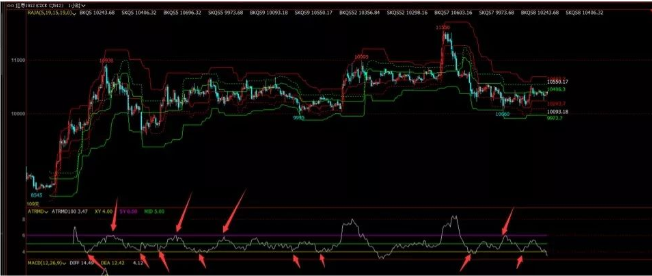
1. If the index trend is close to the downward track, it means that the ATR volatility is lower, and the market is often volatile at this time;
If the standard deviation of the indicator goes up and reaches a high point, it means that the volatility has become very large, and this time is often a characteristic of the trend market.
3. The ATR standard deviation value will regress when it becomes larger, and it will expand when it becomes smaller, and it always fluctuates around the purple and yellow channel lines. Sometimes it will go beyond the upper line, sometimes it will go beyond the lower line, but basically it will return. This shows that whether it is an upward trend or a downward trend, it will eventually return to the shock market; and then a new round of trend market will be triggered by the shock market.
Copyright reserved to the author
Last updated: 08/24/2023 06:57
Add

In my eyes, the two market trends and shocks cannot be separated but should be integrated with each other.
The subject of the question will definitely feel that I am answering irrelevant questions, or that Xiaobai's approach, regardless of fluctuations and trends, will definitely not continue to make profits in trading.
Haha, I understand your thoughts very well. If it was 2 years ago, I would definitely feel that this person is ignorant and superficial when I saw this sentence.
But for me now, shocks and trends complement each other, one after another, you have me and I have you, forcibly dividing and treating them differently will only make the trading system enter a vicious cycle of repetition.
Let's recall that the earliest entry into the industry is the trading method of selling high, buying low and breaking through. Selling high and buying low is a strategy for volatile markets, and breaking through is corresponding to trending markets. These two methods have a common disadvantage, that is, repeated damage scanning. Have you ever wondered what the root cause is? If you are a novice, it may be difficult to answer. If you are a battle-hardened trader with certain experience and technical system, you should sort out your trading strategy from the beginning to answer this question. If you can answer it, then you will have another high-accuracy trading strategy in your trading system.
Let me take the breakthrough strategy as an example to tell you about the improved usage of breakthrough.
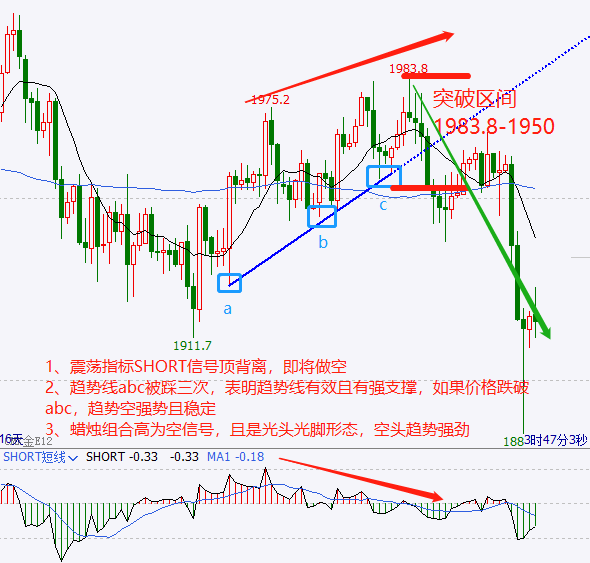
Take the trend of the four-hour chart in the figure as an example
The most critical disadvantages of the breakthrough strategy are the unreasonable division of shock intervals and weak price momentum
Solving these two problems is not a problem
1.1 Look at the divergence in the shock interval
The shock interval in the figure is 1983.5--1950
It is clearly a combination of high and empty candles
Oscillator SHORT top divergence signal, indicating that the trend is likely to turn empty
1.2 Look at the trend line if the kinetic energy is weak
The trend line abc has been stepped on by the price three times, indicating that the trend line is valid and strongly supported. If the price falls below this trend line, then the bearish momentum is strong and the bearish decline is large
In this improved breakthrough strategy, there is confirmation of the trend of the short side, including the use of the four-hour trend chart, SHORT top divergence and trend line abc breakout.
Oscillations and trends cannot be separated. The candle combination you see in the four-hour chart is a wave band in the one-hour chart, and the wave band is the trend. How can you clearly distinguish the trend from the shock. impossible!
What you should pay attention to is the method of combining strategy with firm offer and making further improvements.
Many commonly used methods seem to be bland and have many disadvantages, but in fact they have hidden holes after careful scrutiny.
As for the entry and exit points of this improved breakthrough strategy and the method of fund management, I will not make a statement. Everyone has different financial tolerance, and it will give you wrong guidance.
I hope the above cases can help the subject, and be able to look at the transaction from a more comprehensive and clear perspective.
Copyright reserved to the author
Last updated: 08/23/2023 22:03
Add

It is actually a false proposition to judge whether it is currently in a trending market or in a volatile market! Only when the market comes out, can you know whether it is a trending market or a volatile market. If it doesn't come out, you will never be able to distinguish it correctly! Therefore, the distinction between trending market and oscillating market is a false proposition in my personal opinion, because it is actually used to describe the past running trend and trajectory, but we still know nothing about how it will work in the future! If we judge that this volatile trend will continue in the future because we see that the past market is a volatile market, it is an impossible thing in itself, and the past does not represent the future.
And the trend and the shock, in my opinion, are one. This is like climbing a building. If you climb the stairs to the top of a 100-story building in one breath, you will definitely not be able to climb up; but if you are asked to climb for a while and rest for a while, then climb again and rest for a while, then you must be able to climb up! Here, the process of climbing is equivalent to the trending market, and the process of you taking a break in the middle is equivalent to the shocking market. The Dow Theory mentions that "prices evolve in the form of trends", and the shock market is a process of accumulating energy, which is an important part of the next trend market.
In the process of our trading, most of the trends that bring us huge profits are the trending market, which is also an eternal truth! But we think that no one can predict the structure, rhythm and timing of the trend (shock) operation! The only thing we can do is analyze that one price may reach another price, but how and when it will arrive, no one can predict! Therefore, expecting the result is always much less difficult than predicting the intermediate process!
If we have a position in it and are in a profitable state at the same time, we will take the state of holding! Because we have no way to predict whether it is a trending market or a volatile market? If it is a volatile market, what is the time and magnitude of the shock? But the only thing we know is that after the shock market is over, there will be a trend market. Because we are in profit, we will choose the strategy of continuing to hold. Because we know that if our judgment is correct, profit can take good care of itself and not miss the next trend (profit).
So in fact, there is no need to distinguish, just stay there, and the market will naturally tell you the answer.
Copyright reserved to the author
Last updated: 08/16/2023 14:49
Add

Trends and shocks are the whole market. In fact, if you catch the trend, the rest is shocks. In other words, it is basically possible to fix the trend in the market.
There is also a popular trading rule in the market that "look at the trend on the monthly line, look at the direction on the weekly line, and look at buying and selling on the daily line". From this, we can understand the market and conduct trend trading operations.

You can ask yourself first, can the daily line represent the trend? able. But it can only represent a short-term long-short trend. When the daily line is strong, it means that the market is coming to an end, and it often goes in the opposite direction instantly. Trading with the daily trend and following the trend is often chasing ups and downs. Therefore, look less at the daily line, it is easy to be deceived by big funds, and it is very likely that you will do the opposite or you will not be able to do it if you look at the daily line.
So what to look at in the trend of a band, the monthly line is the first choice. Regardless of whether it is retail investors or large funds, the monthly line is a stable trend from a long-term perspective. As for the weekly line, the weekly line can also point out the trend within a certain period of time.
Of course, if you are a short-term enthusiast, so whether the trend is volatile or not, it seems that it is not so necessary to distinguish them.
At this time, the moving average in the technical indicators may be a powerful tool.
As for the relationship between the moving average and the trend, the moving average on the daily line is not very stable, and the stable trend is still on the monthly and weekly lines. The long-term cost of the main force is there. In the context of the large amount of funds of the main force, only the long-term cost line can affect the operation choice of rising and falling. In other words, use the monthly and weekly lines as the analysis cycle, combined with the moving average indicator, and use such a "three-pronged approach" to fix the trend.

Monthly usage skills
1. After a long-term decline or consolidation, the price has stopped falling and rebounded. One or two monthly K-lines of the price closed above the May moving average, and the May moving average went flat or turned upward (the one with a large slope first indicates that the trend is strong and it is the leader) , (At this time, the 10-week and 20-week moving averages are about to be golden crossed or have already been golden crossed).
2. The price stepped back on the May moving average to choose an opportunity to enter the market. In the process of rising, there are more opportunities to pull back. At the same time, you can sell high and buy low to earn the price difference and reduce costs.
3. When the character explodes, the price will continue to rise as soon as you buy it, and the price will be far away from the long-term moving average. At this time, you should accept it when it is good, and you will be safe. There is no such thing as rising but not falling. It is normal for the price to return to the moving average .
Weekly usage skills
1. The weekly trend effect is more reliable than that on the daily chart. If there is a long shadow line that touches the 60-week moving average when it is rushing up the weekly K-line, it shows that the 60-week moving average is under great pressure, and the price is likely to pull back in the market outlook.
If a physical weekly line crosses or even touches the 60-week moving average, it means that the market outlook will continue to rise, and there is a high probability that the 60-week moving average will be broken. The weekly time is relatively long, and it will be very stable after the breakthrough.
2. In the weekly chart, you can observe the second golden cross, resonance, resistance level and other phenomena on the weekly and daily lines to find the buying and selling points that suit you. If the weekly indicators and the daily indicators send out a buy signal at the same time, it means that the signal is very reliable, that is, resonance, so that false signals will be filtered out.
3. In the weekly chart, the moving average can be set to 5, 30, 60, and 90, because if this is set, the characteristics of the short position arrangement of individual stocks can be seen at a glance. Moreover, the 5-week moving average can be used to judge the market turning point. If the price breaks through or falls below the 60-week moving average and is confirmed to be valid, it means that the price will further strengthen or weaken.
For example, in an upward trend, once it is confirmed that the monthly and weekly lines are up, the daily line will be used to select specific points. At this time, the simplest rule of "buy on the negative line on the trend line and sell on the positive line below the trend line" comes in handy. You can buy around the trend line every time you pull back, or break through or step back on key points for buying. .
Copyright reserved to the author
Last updated: 08/18/2023 15:37
Add

What the Huiyou said was not wrong. If you don't know the shocks and trends. Take a look at the big moves on the weekly or daily charts. It can be seen very clearly. Of course, this is just to teach you to identify shocks and trends, not how to distinguish them. I think if you can't even understand this most basic thing, it's better to wash up and sleep, don't toss about.
Regarding the definition of shock and trend, I don't want to be so official. This kind of definition is everywhere, just search online in your own area. I just want to ask, do you recognize the box? If you know it, well, the vibration is the box. Understanding the box is the basic skill of technical analysis. The opposite of the box is the trend. The box is out of a small range for a long time, while the trend is out of a large range in a short time. The interval of the trend is related to the interval of the corresponding box, which is generally 1-2 times the width of the box, and in some cases it can reach 3 times.
The standard box is a rectangle, and there are many deformed boxes, mainly horizontal parallelograms, and parallelograms that slope upward or downward. In addition to parallelograms, there are triangles, flags, trapezoids, rhombuses, symmetrical double triangles, and more.
The essence of the box is the place where the upper and lower forces oscillate, and the main part is profit settlement, but not all profit settlement.
The so-called waiting for opportunities, remember that this is a key knowledge point, waiting for opportunities is waiting for the formation of the box, waiting for the end of the box. Some people like to open positions after the box is formed. It doesn't matter whether it is good or bad, and it's okay. There are not many opportunities to operate every day, every week, every month, every year, because there are not many cabinets of the corresponding level every day and every week. Frequent transactions are too high, which proves that you are operating oscillations, not operating boxes.
It is not difficult to distinguish between a box (oscillation) and a trend, but it is difficult to distinguish a callback from a trend, that is, a reverse trend from a positive trend. If it is said that being able to distinguish between the box and the trend is regarded as entering the hall, then being able to distinguish the reverse trend from the forward trend is regarded as entering the room. Nothing can be distinguished, that is, you have not entered the room, but you are still outside the door, you are just a standard layman.
The box has a bright box and a dark box. The end of the forward trend is basically a bright box, and the end of the reverse trend is basically a dark box. The larger the K-line level, the longer the period, the more obvious the end signs of the dark box, and the less likely to be fooled. The obscura is the main force that devours the profits of entry-level players. The end of the bright box is slow, while the beginning and end of the dark box are very fast. Giving up the operation of oscillation and counter trend is a common choice for veterans who are not too experienced. As for how to identify the camera obscura, it is a bit complicated, so I won't explain it here.
As for trends, honestly, if you're new to it. Just learn to identify shocks, and the rest of the trend that is not shocks can be summarized into the trend zone. Although a little irresponsible, this is indeed a method.
The trend is actually very simple, there are only two types. So up or down. The rise is accompanied by a small step back, and the fall is accompanied by a small step back. The trend is actually very difficult to judge, which is a very difficult problem. Anyone who dares to say that he can judge the trend, you can go up and it will be two slaps in the face.
Also, to correct you, it is not only the trend that makes money. Whether it is a trend or a shock, it is a market. It's just a difference in choice, and it can't be distinguished by right or wrong.
I am a trend trader myself, and I am very disgusted and afraid of shocks, but with the accumulation of transactions, it is inevitable to often encounter shocks, so it is best to have an understanding. I found that the shock is actually an opportunity for a trend to enter the market, because after a trend ends, it will inevitably take a period of time to sort out, so as to brew the next new trend. The seemingly fierce and terrifying shock market is likely to be just a head of the trend. The trend strategy is also constantly emphasizing that you should eat the tail and not the head, so as to follow the trend instead of going against the market
Copyright reserved to the author
Last updated: 08/19/2023 00:01
Add

It is too difficult to say that this question is difficult, and it seems to be easy to say that it is easy, and it is difficult to define. If it is simple and simple to distinguish between shocks and trends, then not so many people lose money.
I'm just talking about my own judgment method, let's see if you agree or not.
The easiest way is to use indicators. The one I use the most is the moving average indicator, the slope of the moving average represents the current momentum. If the price stays above or below the moving average for a relatively long time, it must be a trend. And the price crosses the moving average back and forth and the slope of the moving average goes flat, which is obviously a shock. Of course, you have to have a time period. In the framework of the cycle, we can talk about trends and shocks. for example:
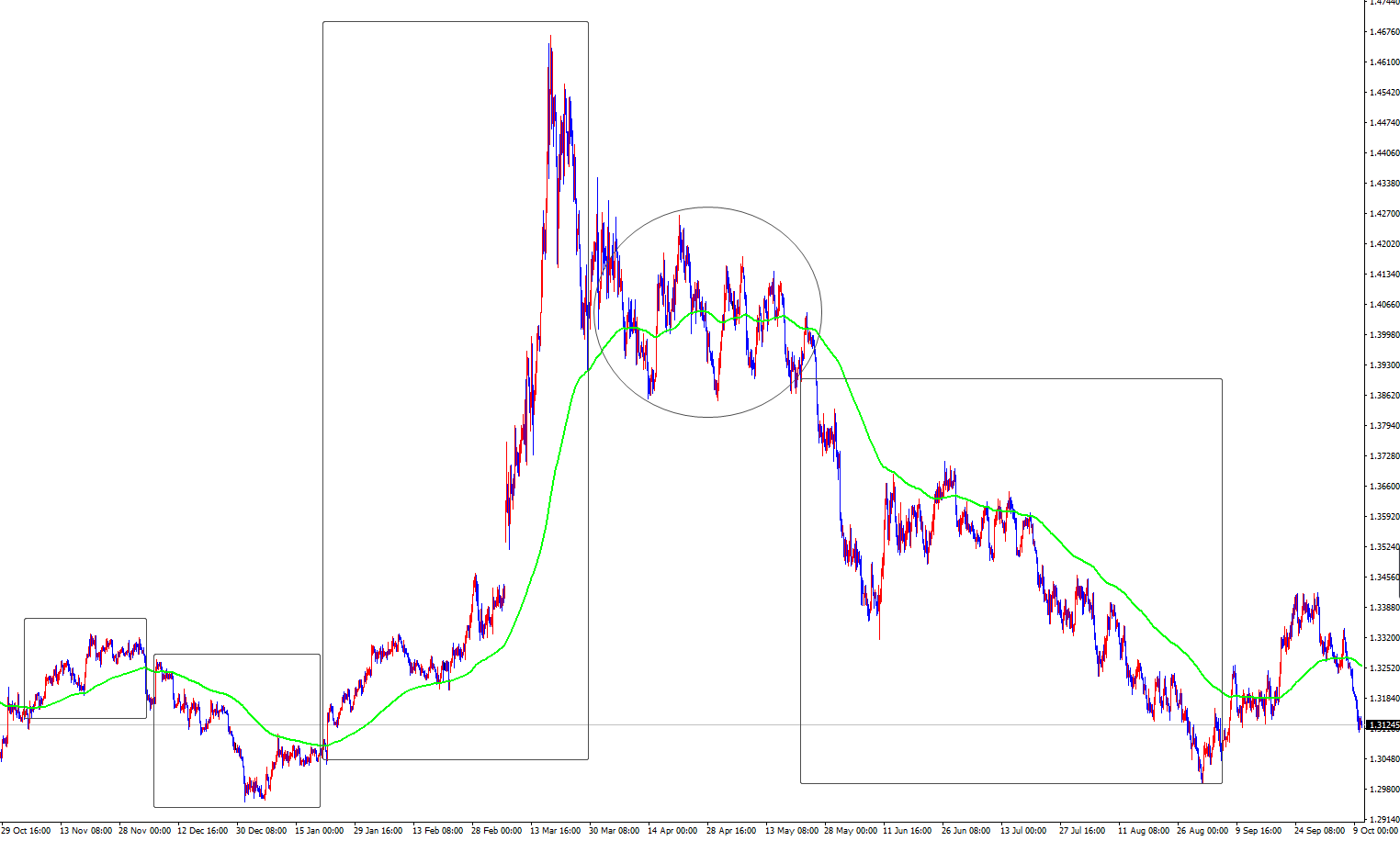
Here is the 4-hour chart of USD/CAD. We observe the slope of the moving average and the relationship between the price and the moving average, and it is easy to see what stage the market is in. The moving average in the box has a relatively obvious direction, and the price matches the moving average well, so it has a relatively strong trend; while in the ellipse, we see that the price crosses the moving average back and forth, making the moving average almost flat, so it is obvious here Shock.
Of course, the trend is divided into big and small, and generally as long as there is a moving average to capture it, it can basically be clearly distinguished. There are also many people who say that this kind of analysis is actually an afterthought, and I can say it is. Indicator analysis is an afterthought, but it provides you with some confidence to predict the future.
Although a simple moving average may not be able to accurately distinguish between shocks and trends, this is just a small method of mine to achieve the effect of attracting jade. After all, within a small cycle, there is still room for continuous optimization.
The above is for your reference only, how to find the method that suits you is the truth.
Copyright reserved to the author
Last updated: 08/16/2023 04:29
Add

Trends are divided into major trends, minor trends, and short-term trends.
A major trend (or megatrend) usually lasts for more than a year, sometimes for several years. Most investors favor the primary direction of the market.
Dow used the sea as a metaphor for these three tendencies, corresponding to tides, waves, and ripples. The main trend is like the tide, the secondary trend (or middle trend) is the waves in the tide, and the short-term trend is the ripples on the waves.
From the embankment scale, we can read the highest position rolled up by each wave, and then by comparing the relative heights of these highest positions in turn, we can determine whether the tide is rising or falling. If the readings are increasing, the tide is still pushing land. Only when the peak of the wave gradually decreases, the observer can know for sure that the tide has begun to recede. A minor trend (or intermediate trend) represents a correction in a major trend and usually lasts from three weeks to three months. Such mid-range corrections typically retrace between one-third and two-thirds of the way through the prior trend. A common retracement is about half, or fifty percent. A short-term trend (or minor trend) usually lasts less than three weeks, and is a short-term fluctuation in the trend.
Trends and shocks are relative terms. Since the market is nothing more than shocks and trends, then either shocks or trends, how to define shocks? First of all, we can't talk about things out of the time cycle. No matter you are on the daily, hourly, or monthly line, whether it is on the 30th, 60th, or 10th day, people always have an operating cycle. It is impossible to say whether it is a shock or a trend. For example, the trend of short-term traders on the hourly chart is just clutter in the eyes of daily traders. Then the shock can be defined as follows: within a unit time, the actual effective price change is less than or equal to the average volatility of the period. For example, on the 30th, you use the current price, minus the closing price before the 30th, and divide it by the ATR indicator on the 30th. If the value is very close to 1, or is below 2, then it is a shock. During this period, it is basically unprofitable to follow the trend-following trading system of the 30-day cycle.
Before the trend is over, it is unknowable. In the process of forming the trend, each price point is uncertain. Therefore, it is impossible to try to predict trends and discover trends. The thinking of many people is like this: I am a trend trader, I only do trends, and I must avoid shocks. This is very unlikely, the easiest way to tell if it is trending or oscillating is to run a trend-following system, if you are losing money during this period, then it is oscillating, if you are making money, this is the trend. Oscillations and trends accompany each other. At the same time level, when the trend is over, it is an oscillation, and when the oscillation is over, it is a trend. At different time levels, there are small trends in the big shocks, and small shocks in the big trends.
Copyright reserved to the author
Last updated: 08/19/2023 00:58
Add

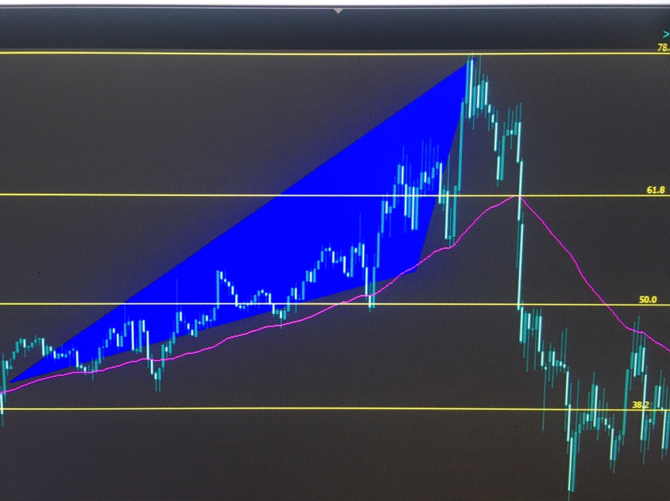
Use the golden section to divide the interval trend
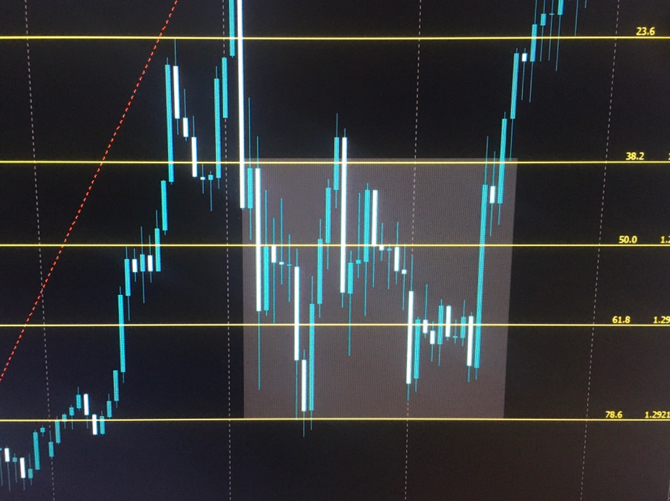
within 1 hour
Switch to small cycle 5 minutes
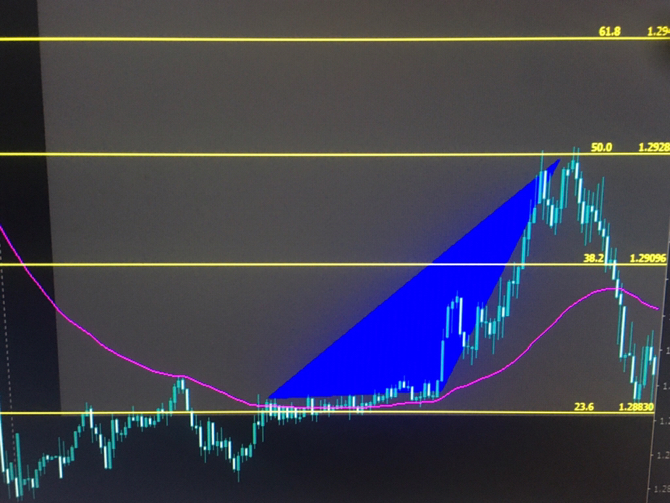
Rising intraday 5-minute trend movement on a 1-hour interval
5-minute range fluctuations within the day
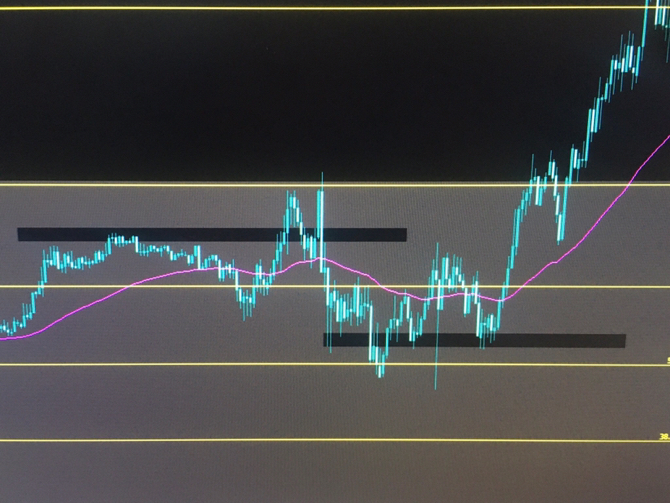
Large-cycle trend fluctuations are better observed, as follows
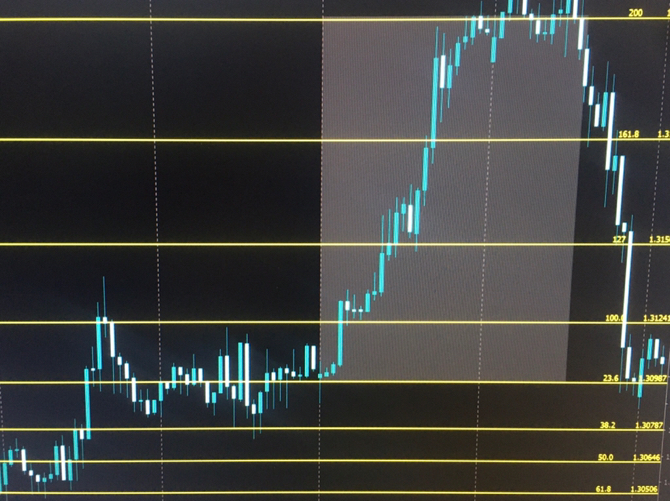
small period direct resonance
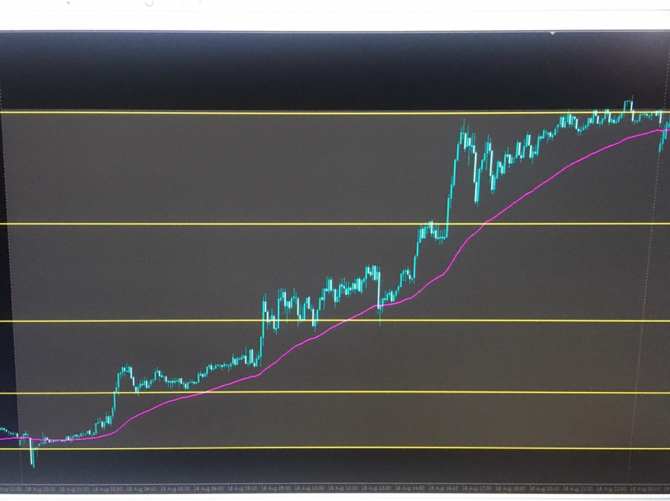
Therefore, in the interval of a large cycle, there is a trend to follow when switching to a small cycle. You only need to divide the area where the interval oscillates. It is recommended to use the golden section callback to divide this area. That is to say, taking advantage of the trend without doing intervals is not a good way to follow the trend.
Hope to help you!
Copyright reserved to the author
Last updated: 08/22/2023 22:39
Add

How do you distinguish between trending market and volatile market! To be honest, there is really no way to do this. Next, I will talk about my views on trending market and volatile market !

Yesterday's sun will never dry today's clothes
It is actually a false proposition to judge whether it is currently in a trending market or in a volatile market! Only when the market comes out, can you know whether it is a trending market or a volatile market. If it doesn't come out, you will never be able to distinguish it correctly! Therefore, the distinction between trending market and oscillating market is a false proposition in my personal opinion, because it is actually used to describe the past running trend and trajectory, but we still know nothing about how it will work in the future! If we judge that this volatile trend will continue in the future because we see that the past market is a volatile market, it is an impossible thing in itself, and the past does not represent the future.
The second aspect, in the investment market, we can only judge that one price may reach another price! But how it will be achieved and when it will be achieved is indeed unpredictable! And when we distinguish whether the current market is in a volatile market or a trending market, we are actually anticipating the process and trajectory of the middle price operation, which is very difficult. Soros once mentioned a concept in his speech at the China Europe Business School, called the "Principle of Human Uncertainty"! Just because of the randomness of the market, it is a very stupid thing to predict his middle trajectory!
There is an old saying that goes "Yesterday's sun will never dry today's clothes". If someone in the market says he can distinguish between trends and shocks, then he must be lying to you.

Trends and shocks are one
And the trend and the shock, in my opinion, are one. This is like climbing stairs, let you climb the stairs to the top floor of "Shanghai Tower (632 meters, 118 floors)" in one breath, you will definitely not be afraid to go up; but let you climb for a while and rest for a while, climb again and rest for a while Yes, then you must be able to climb up! Here, the process of climbing is equivalent to the trending market, and the process of you taking a break in the middle is equivalent to the shocking market. The Dow Theory mentions that "prices evolve in the form of trends", and the shock market is a process of accumulating energy, which is an important part of the next trend market.
On the other hand, some intraday friends like to draw line analysis based on the 1H graph, but many times we feel that the 1H graph has a very obvious trend, but it is just a shocking trend in the daily line! Some of us look at the trend at the daily level and feel that the trend has already started, but when we zoom in to the weekly level, we find that the trend is still volatile. Therefore, shocks contain trends, and trends contain shocks, but because the levels and cycles are different, we see them differently!
Trends and shocks are one, but in different forms!

Expecting results is always much less difficult than predicting the intermediate process
In the process of our trading, most of the trends that bring us huge profits are the trending market, which is also an eternal truth! But we think that no one can predict the trend (oscillation) running structure, rhythm and timing (introduced in the first part of this article)! The only thing we can do is analyze that one price may reach another price, but how and when it will arrive, no one can predict! Therefore, expecting the result is always much less difficult than predicting the intermediate process!
At present, our team treats all the market as a trend, and the volatile market is uniformly characterized as an adjustment form! We have also made a unified division of adjustment patterns into four patterns: flag, wedge, rectangle, and triangle. If there is an opportunity in the future, we will make a detailed description of the adjustment form.
In the case of short positions, after we judge the future direction of the price, we generally wait for the four analysis dimensions of fundamentals, market expectations, capital and technical aspects to form a resonance before choosing an opportunity to enter the market! There are two reasons: 1. Premature admission may consume our patience; 2. We cannot guarantee whether our judgment is correct. Only when the four dimensions are mutually verified can we gain an advantage in probability!
If we have a position in it and are in a profitable state at the same time, we will take the state of holding! Because we have no way to predict whether it is a trending market or a volatile market? If it is a volatile market, what is the time and magnitude of the shock? But the only thing we know is that after the shock market is over, there will be a trend market. Because we are in profit, we will choose the strategy of continuing to hold. Because we know that if our judgment is correct, profit can take good care of itself and not miss the next trend (profit).
Copyright reserved to the author
Last updated: 08/16/2023 22:21
Add

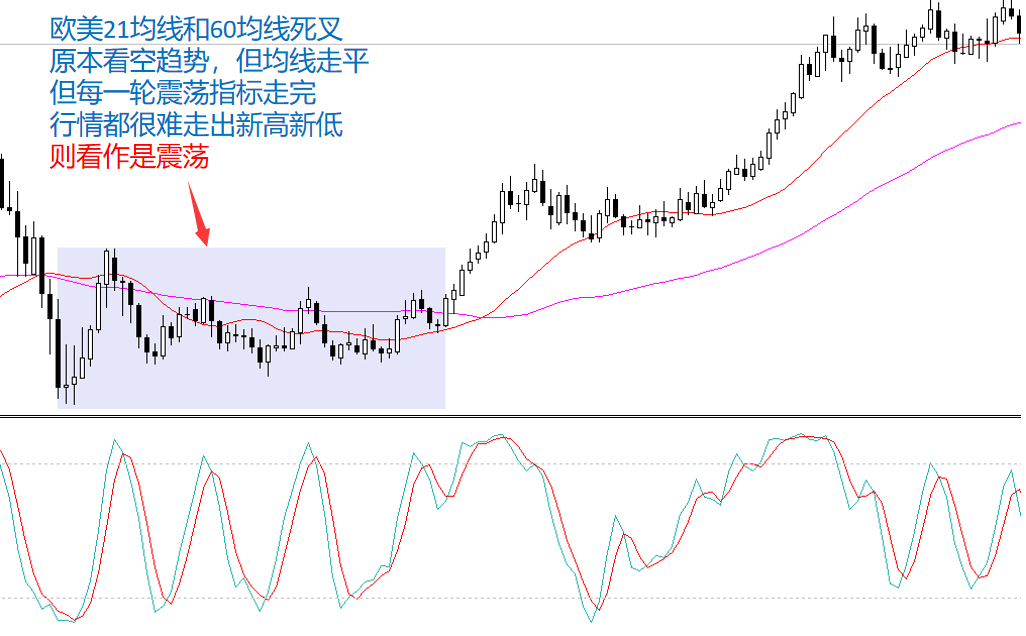
If the trend indicator and the oscillating indicator resonate, it is a large volatility, and if the trend indicator and the oscillating indicator are opposite, it is a volatile market. Of course, the market changes at the end of the end of the big cycle need to be excluded here.
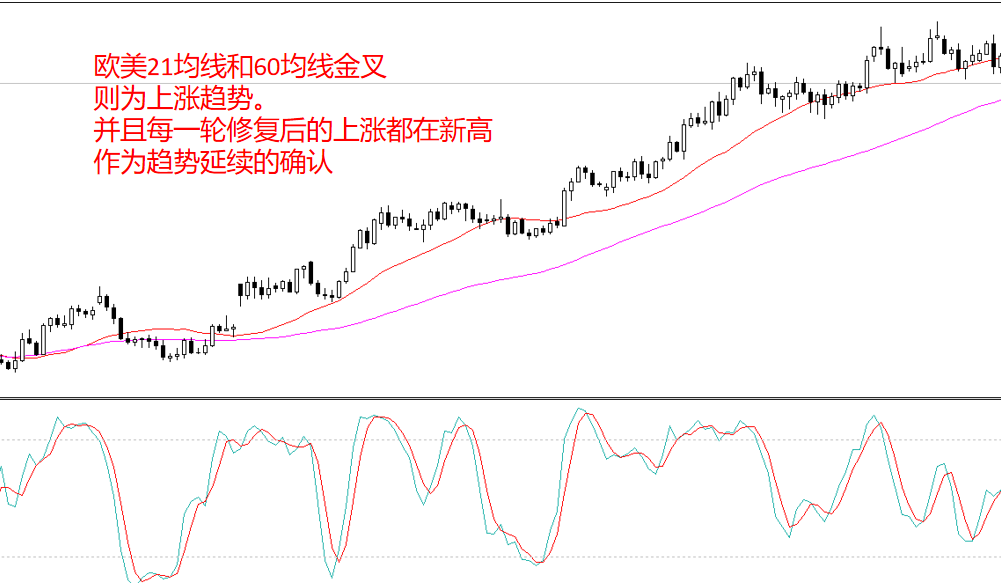
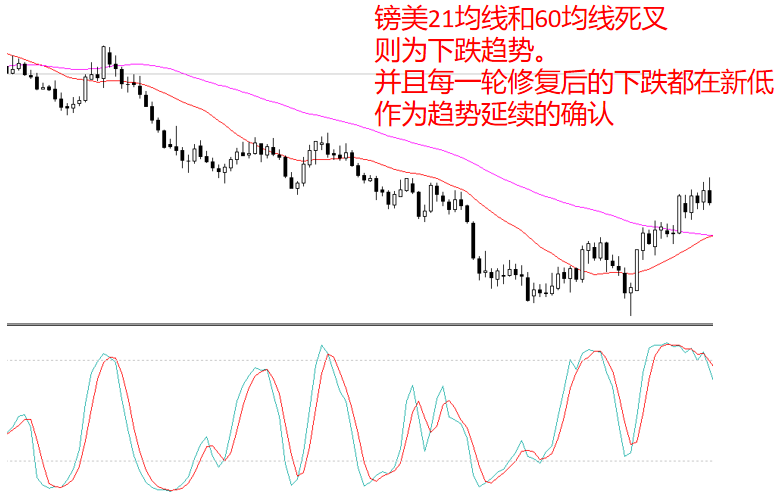
I usually use the 21 moving average and the 60 moving average as the judgment of the main trend. For example, if the 21 moving average and the 60 moving average are in the golden cross process, it is considered to be an upward trend; if the 21 moving average and the 60 moving average are dead crossing, it is considered bearish. Of course, one factor to consider here is the slope of the moving average. The flatter the moving average, the slower the trend, and the steeper the moving average, the stronger the trend.
Copyright reserved to the author
Last updated: 08/08/2023 12:26
Add

The quotations in the financial trading market are roughly divided into two types, one is the trend, and the other is the shock. Although the classification is very simple, for traders, how to distinguish and judge the difference between the two can help traders to be more comfortable in the process of trading.
Uptrend: Consisting of a series of consecutive uptrends, each uptrend continues to cross the previous high point (the crossing of high and low points is based on the closing price); the downward trend mixed in the middle will not fall below the previous wave of decline low point of the trend.
Downtrend: Consisting of a series of consecutive declines, each period of decline continues to cross the previous low point (the crossing of high and low points is based on the closing price); the rising trend mixed in the middle will not cross the previous wave of rising trend upwards high point.
Anything other than the above two is a shock.
The rising or falling trend of a certain level is composed of several rising, falling and oscillating levels of the next level. This point is very clear. If you can't see the current trend at a certain level, it is recommended to raise or lower a level and look again.
Any trader who has some experience will find that all our losses come from one reason: in the trend market, we use the shock strategy, and in the shock market, we use the trend strategy. In other words, the strategy we use does not match the market. If we can know when it is a trend and when it is a shock, and we use a trend strategy when it is a trend, and a shock strategy when it is a shock, then we will eventually survive in the market for a long time and make a profit.
In fact, this goes back to the fundamental problem of trading. In trading, being able to identify and predict trends and shocks is more important than judging and predicting directions. Remember, the market not only rises and falls, but also fluctuates more than 60% of the time. This is a question we cannot and should not avoid!
But all of the most fundamental problems are also the most difficult to solve. "A straight line has the shortest distance between two points", yes, but what is a "straight line" and what is the difference between it and a "curve"? This is not easy to answer, although we all understand that there is a difference between a straight line and a curve. The same goes for trends and shocks. Although we talk about trends and shocks every day in trading, if you want to ask you what is a trend and what is a shock, no one can give a satisfactory answer. Trends and shocks often have me in you, and you in me, and it is difficult for us to completely separate them. But we know that trends and shocks are indeed two completely different things.
【The angle of the moving average】
Although we cannot define trends and shocks, we can still know that trends and shocks have different characteristics. For example, we found that when the trend comes, the medium and short-term moving averages will have an obvious slope, that is, a slope will be generated. In an upward trend, the slope is positive, and the stronger the upward trend, the greater the value of the slope.
The slope in a downtrend is negative, and the steeper the downtrend, the smaller the value of the slope. In the volatile market, the medium and short-term moving average tends to move horizontally, and its slope is close to 0. In other words, we can convert this slope into the angle between the moving average and the horizontal axis. If the angle widens, it reflects the beginning of a price trend. If the included angle shrinks and fluctuates up and down at 0 degrees, it means that the price is fluctuating up and down, and there is no obvious trend yet.
Therefore, if we can observe the slope of the moving average, or the angle between the moving average and the horizontal axis, then we can identify trends and shocks to a certain extent. Unfortunately, the MT4 platform itself does not come with such an indicator. But we can still find some relevant information when we search for the MA angle indicator on its official website : there are some similar indicators that can be used for free or for a fee. Those who are interested can search for it by themselves.
[Bollinger bands closed]
Another traditional way to identify trends and shocks is to observe the closure of the Bollinger Bands. When the trending market comes, the closure of the Bollinger Bands will expand sharply; on the contrary, in the volatile market, the closure of the Bollinger Bands will become smaller and smaller. Therefore, if we can monitor the closure of the Bollinger Bands, it will also help to distinguish between trends and shocks.
For manual traders, it is not difficult at all to measure the closing distance between the upper and lower Bollinger Bands by directly using the "crosshair" on the MT4 platform. The difficulty is how to compare, what distance is considered "big" and what distance is considered "small". This will force traders to measure the closing distance in various historical situations and obtain an experience value. The absolute value of this distance is also very different for different trading varieties. Therefore, it is still necessary for us to use an "indicator" to objectively quantify it. Unfortunately, the MT4 platform does not have such built-in indicators. Fortunately, we can still find indicators with this function on the official website. The author found an indicator called Bollinger Bandwidth , which records the closing value of the Bollinger Bands for each closing price.
But this indicator records the absolute value of the closure of the Bollinger Bands. Obviously, for different trading varieties, for different time periods of the same variety, the difference in absolute value is very large, and they are not comparable at all.
The author is dissatisfied with such indicators, and made some improvements. The idea of improvement is: find the average length of 100 columns under the current time frame, and then divide the average length by the value of the closure of the Bollinger Bands. The formula is: relative value of closing of Bollinger bands = absolute value of closing of Bollinger bands/average length of 100 bars
When the relative value of the closure of the Bollinger Bands is greater than 12, it means that the length of the closure of the Bollinger Bands exceeds the length of 12 average columns. It can be considered that the closure of the Bollinger Bands has expanded to a critical value at this time, and the trend is coming.
【CCI Index】
We know that the CCI indicator is a trend indicator, which is centered on the 0 axis. More than 100 indicates that the upward momentum will become stronger, and an upward trend may be formed in the future market; less than -100 indicates that the downward momentum will become stronger, and a downward trend may be formed in the future market. Between [-100, 100], it means that the price has not formed obvious kinetic energy, and the market outlook may consolidate back and forth. Using this indicator, we can also distinguish the shock market from the trend market.
【ADX indicator】
The ADX indicator is an indicator that is widely used abroad, and its legitimate purpose is to distinguish between trending market and oscillating market. Most domestic traders are not familiar with this indicator. An important reason may be that they are confused by the two +DI and -DI lines of ADX. In fact, we can also ignore the +DI and -DI lines at all, and only look at the ADX line. We can set the color of these two lines to None when setting, and only the ADX line will be displayed.
The value of ADX is from 0 to 100, there is no negative value. Moreover, this value only reflects the intensity, not the direction. That is to say, no matter whether the price is rising or falling, as long as it is strong, this indicator is going up. Therefore, to judge the direction, we must rely on other indicators.
We need to set a horizontal line as the dividing line between shock and trend . If we use the default 14 periods as a parameter, we can set 30 as the dividing line. When ADX is greater than this value, we believe that the trend is formed; when ADX is less than this value, we believe that the market is still in shock.
Drawbacks of the above approach
The above are some methods summarized by the author that can distinguish between shocks and trends under the existing indicator framework. But obviously, the flaws of these methods are still obvious:
(1) There is no way to break away from the constraints of the time frame. For a daily trend, it may contain many hourly shocks. For hour-level shocks, it may seem like a trend at the 5-minute level. Therefore, using the above method, we must let our time frame be fixed and cannot be changed.
(2) The time period of the indicator also has a great influence on the observation results. Whether it is the moving average angle, Bollinger band closure, CCI indicator and ADX indicator, we must properly set the period of the indicator. However, it is difficult to have a unified standard for how many cycles are "appropriate", and it is closely related to the trader's own experience and preference relationship.
(3) The selection of the critical value is not easy. When we set the critical value for distinguishing trend and shock too tightly, it is easy to divide a large number of volatile market into the trend range, resulting in signal distortion and trading "deceived"; if we set the critical value too loose , The reaction to the trend is too slow, and the switching of trading modes is often too late.
Of course, the methods to distinguish between shocks and trends are definitely not limited to those mentioned above. For example, trend lines can also be used to judge the strength of trends. Traders can more intuitively judge whether the current market is a trend or a shock.
Copyright reserved to the author
Last updated: 08/15/2023 12:02
Add

It still depends on where you look at them. From the perspective of hindsight, most of the time the market is trending or oscillating, which is easy to distinguish. If the market is in progress, it is much more subjective to look for trends or shocks at this time.
Just talk about shocks. There is a saying in the market that "masters die from shocks." In the market that is constantly fluctuating, you may continue to open positions and fail continuously, or you may continue to lose profits after opening positions. These are common pitfalls. How to deal with shocks is an important manifestation of trading skills. So it is normal to be confused about the identification and treatment of shocks.
Why do some investors trade frequently in a volatile market and continue to suffer losses? The more losses some investors have, the more they want to smooth out the losses in their accounts through continuous trading. As a result, the losses not only did not shrink, but became larger and larger, so that they fell into a vicious circle.
For investors who lack trading skills, perhaps they know the important concept of short positions and not rushing to trade in volatile markets, but it is difficult for them to distinguish whether the market is in a volatile state or a trending state, so that they are also very busy in volatile markets Happy. It's not that they don't want short positions, but that they don't have enough basic technical knowledge to recognize that the current market needs short positions.
Purely from the perspective of technical graphics, the market is in shock, and the characteristics of short positions are manifested in: the moving averages are entangled, chaotic and disorderly, and have no direction. There is no basis for both entry and exit, and reluctant trading is tantamount to gambling, and the risks are self-evident; on the daily chart, there is a big positive line today and another big negative line tomorrow, which makes people unable to understand the strength of the market and the direction of the market. If it is strong or weak, it loses the basis for entering the market; the price jumps up and down, and the range is small, and it is in an obvious price fluctuation range. Trading in such a narrow price range is not profitable at all, and you have to pay a lot of money transaction fees. These are the basic characteristics of shock market.
In addition, the frequent trading of some investors is a major reason for their being killed in the market. In this market, many investors are always restless, and they are always eager to trade. This Achilles heel makes them unwilling to sit down and wait for short positions when the market fluctuates and there is no trading opportunity at all. For them, they would rather have no food for a day than no order for a day.
In volatile markets, there are few or no trading opportunities. If you trade reluctantly, or even indulge in frequent trading, the final result can only be losses caused by continuous transaction failures and expensive transaction fees. This will lead to the continuous shrinking of the funds in one's own account, and after a round of turbulent market conditions, the account funds will be depleted.
On the other hand, even if the market is operating in a relatively wide range of shocks, when opportunities that meet your own trading rules arise, you must participate in an appropriate amount under the premise of using a lighter position and strictly implementing a stop loss strategy. At any time, the market that really promotes the effective growth of accounts is not the shock market, but the unilateral trend market.
Therefore, the best trading strategy in a volatile market is not to trade. Short positions can not only avoid the risk of loss caused by disorderly shocks, but also ensure that the account funds will not suffer large losses. It also ensures that when the real trending opportunity comes, there will be sufficient financial strength to participate in it. At the same time, waiting and watching with short positions in a volatile market is also conducive to maintaining a clear mind, so as not to get lost in the volatile market, and not to miss good opportunities when the turbulence ends and the direction is gone.
Of course, it is emphasized that in the volatile market, trading should be minimized or short positions should not be traded, but it does not mean that there is nothing to do in the volatile market.
On the contrary, investors should keep their spirits up. First, they must closely monitor themselves and avoid frequent trading in volatile markets; second, they must patiently observe the operation of the market and pay attention to directional choices after the turmoil is completed. Generally speaking, the longer the shock, the closer it is to the real opportunity.
Opportunities are reserved for those who are prepared. For traders, concentrating on shocking the market is making full preparations.
Copyright reserved to the author
Last updated: 08/19/2023 07:47
Add

Oscillations and trends will inevitably be encountered in trading, and what every trader needs is how to deal with this kind of market. Of course, distinguishing is the first step, but I think this problem is very simple, and it is clear at a glance on the disk.
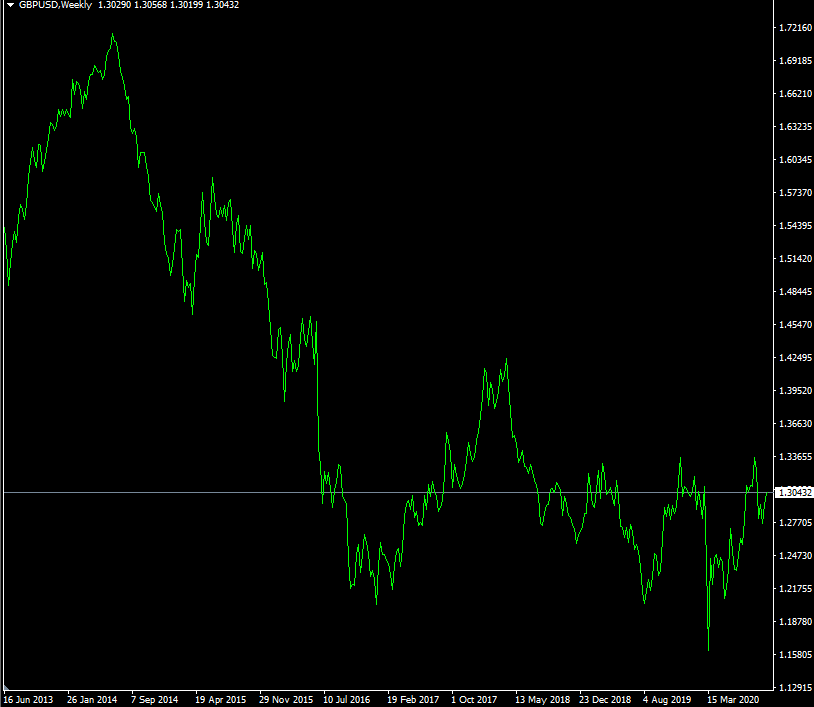
The above is the weekly chart of the British pound. From the chart, we can see that the direction is downward. It started in 2014 and is currently in a stage of irregular consolidation in a large range, but the direction has not come out. In March 2020 this year, we explored the previous low point , still did not fall, the trend does not seem to want to continue, so the upward direction of the large time period is clear at a glance. The above picture also answers the shock, which is a range of fluctuations without a clear direction. It can be long-term or irregular. It belongs to the premise that there is no change in the fundamentals and it is easy to appear, or it is based on the country. The tipping point set by monetary policy.
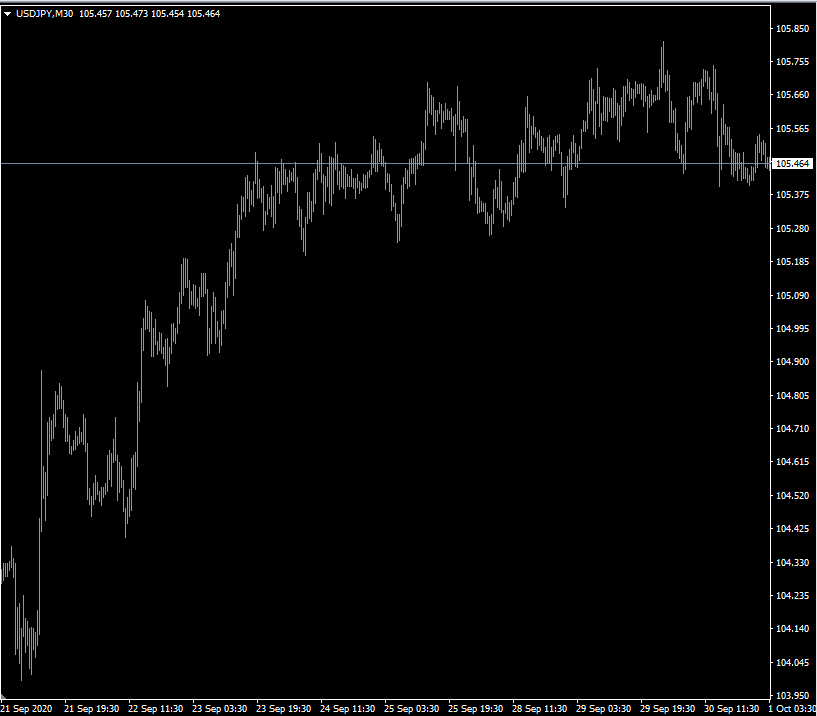
The above picture is a typical shock after rising. Of course, the time period is very small, so it is easy to go out of the direction of such a picture. You only need to wait for the confirmation signal from the upper or lower track of the interval to know whether to continue the previous rise or reverse. down.
Copyright reserved to the author
Last updated: 08/18/2023 16:05
Add

The subject must first understand that the biggest characteristic of price fluctuations is uncertainty. This uncertainty is all-round and includes different dimensions. Not only the rise and fall are unpredictable, but also when will there be a trend and when will there be a shock , the same is unpredictable, the so-called shock and trend market, you can only see it after you come out.
In fact, shocks and trends are defined by people themselves, and have nothing to do with price fluctuations themselves. Prices can only move in two ways: rising and falling.
Anyone who understands programming knows that if you focus on the distinction between shocks and trends, the program will easily fall into an endless loop, because there is no clear distinction between shocks and trends.
Under certain conditions, shocks can be regarded as trends, while under other conditions, trends can be regarded as shocks. There is me in you, and you in me, so on the basis of the distinction between shocks and trends It doesn't make any sense to drill into a dead end.
The purpose of trend traders who want to distinguish between shocks and trends should be to avoid shocks and only trade when there is a trend. Conversely, for shock traders, I think it is better to die.
Of course, as I said just now, shocks and trends are defined by people themselves. In fact, we can use the signals of technical indicators to define our own exclusive shocks and trends. It is defined as a shock market, and when another signal appears, you can define it as a trend market.
Of course, don't worry about the selection of indicators and the setting of parameters, because there is no optimal standard. Which kind of technical indicators to choose and what parameters to set, there will definitely be situations where the actual market is inconsistent with the indicator signal prompts.
So the most important thing is not whether you can accurately distinguish and predict shocks and trends, but whether you can correctly deal with the uncertainty of the market, which is the prerequisite for realizing positive return expectations.
Copyright reserved to the author
Last updated: 08/28/2023 08:58
Add

First, you can’t wait for the price shock to come out before calling it a shock, and you can’t say it’s a trend when the market goes too far unilaterally. These should be judged in advance, and the judgment in advance must determine the strength of the market pattern and resistance Weak level, equal resistance means shocks, and unequal resistance will definitely break through, and then evolve into a unilateral trend. There are many ways to judge resistance. Your problem should be done step by step, and there must be an analysis process. Learn how to find effective resistance
Copyright reserved to the author
Last updated: 08/26/2023 08:21
Add

Lu Xiwu's trend trading method deals with trends and shocks in this way:
1. Entry conditions: The structure is complete, look for the reverse small five waves or continuous reverse K-line bands, tentatively set as the reverse wave one. Then wait for the callback to 78.6% of the anti-wave 1 or when the structure of the correction wave is complete, the standard K-line enters the market for 2 hands. The stop loss is set at the same point of the reverse wave, and the stop loss space is 1-78.6%=21.4%.
2. Conditions for position reduction: if the target breaks K in the reverse direction, reduce the position by 1 lot; or, if you break the mark K in the opposite direction, reduce the position by 1 lot; or, if it reaches the 62% position and stops or the reverse standard K line appears, reduce the position by 1 lot.
3. Turning conditions: the reverse main wave 2 appears the standard K-line, and the remaining 1-handed positions are turned into 2-handed positions.
4. Passive stop loss setting: Passive stop loss is only set for the remaining 1 hand position after the 1 hand position is reduced. It is initially set at the same point of the reverse wave, and generally does not move.
Such a cyclical strategy, following the trend, will suddenly realize afterwards, oh, just went through a wave of trends...or just survived a wave of shocks...
Don't try to define the future as a trend or a shock, people on earth don't know about this. Just design a set of strategies, follow the trend with a relatively small stop loss, half of the positions will be strictly reduced according to the set conditions;
This is just a simple strategy, and you can add conditions to improve it. The more conditions, the higher the accuracy rate, and the smaller the profit-loss ratio. There is no way to have both, because it is Tao...
Copyright reserved to the author
Last updated: 08/28/2023 14:23
Add

It's hard to say, and often rely on personal experience and intuition, some things are hard to say. In Xiaobai's words, if you really can't distinguish between shocks and trends, then just set a stop loss. Ensuring that you don't lose money is the first rule of survival.
But after setting the stop loss, there is a very strange phenomenon that people often can't hold it. For example, when you buy at a certain point in time, you set a stop loss, and then the market falls, and then when you see a loss, you leave before the stop loss price, and the market goes up again. After the market went up, I was very regretful, very unwilling, unable to escape greed, and chased after it, fell after chasing, lost money, and couldn't hold on. In this way, the market price has not changed much, but your money has decreased.
It's such an endless loop, which can't stand up to patience and greed after all.
In fact, just give yourself some time. People tend to ignore the importance of time in terms of volume and price. The market does not lack opportunities, but what is lacking is timing.
Copyright reserved to the author
Last updated: 08/16/2023 22:07
Add

0
work
0
subscriber