


Stay in touch!
Subscribe to our newsletter to get the latest updates on live market analysis, trading strategies and more. You can unsubscribe anytime.
By subscribing, you agree to Trading.live Privacy Policy.


It is actually very easy to solve the problem of the contradiction between the cycles encountered in the transaction.
For friends who do not know the trend signals between different periods, the root cause is the uncertainty of the level of their own trading strategies. To give a simple example, many traders analyze the market mainly based on the daily chart cycle, but choose the one-hour cycle chart as the cycle for formulating strategies. This situation is not uncommon, and it often happens among novices.
For this kind of situation, what I want to emphasize is that we must be clear that analyzing the market and formulating strategies are two completely different parts and should not be confused. The two cannot replace each other but complement each other, and complement each other.
On the other hand, I think what I still need to emphasize to the subject is that the international capital market is a 24-hour all-day trading session, which is divided into three components: the Asian market in the morning, the European market in the afternoon and the American market in the evening. Among the three, the market trends are essentially different. The Asian session is mainly a continuation or callback of the previous night’s US market; the European session is unstable when the market has just started; It is the main trend period of the variety of the day, but it fluctuates greatly.
Therefore, according to the daily trend of these three regional varieties, traders will be more inclined to the US market, followed by the European market, and finally the Asian market. Therefore, combining the three regional trading periods, it will naturally not be difficult to answer the question that returns to the subject. When the trends shown by the large and small cycles are contrary to each other, we are more accustomed to choosing to wait for opportunities. This opportunity is to enter the market when the trends of the large and small cycles are consistent.
The large cycle and the small cycle have different usage aspects in the formulation of a transaction. Under normal circumstances, the large cycle is used to establish the trend of the variety, while the small cycle is often used to confirm the timing of the entry and exit of the variety. This way of dealing with large and small cycles is equivalent to the fact that there are two adjustment bands in the impulsive wave in "Wave Theory", and the adjustment wave contains at least two impulsive bands. They all need to be connected alternately between the adjustment section and the drive section so as to move forward.
Therefore, when the direction of the trend judged by the large cycle is contrary to the direction of the small cycle, it is likely that the small cycle chart is undergoing temporary technical adjustments. We'd better wait for the end of the small cycle adjustment, and then do unilateral trading with the same trend as the large cycle.
Some friends will ask, will it be a market change in direction when the trend has just started? Because although the small period is unstable, it is more sensitive to the signal of trend conversion than the large period. Of course this happens, and it happens every day. This requires us to be clear. This is also the trading idea recognized by international trading masters, "it is best to do trading in the third wave". Trading is about making rational trade-offs. There is no need to take risks with the bullets in your hands when the market is unstable. It is best for us to choose wisely to ignore such short-term trend-changing time periods.
Generally speaking, the safest and most sensible choice for the conversion between large and small cycles is to choose when the large and small cycles resonate. Because, for real money, there is no need to compete with the market to try your guts.
Copyright reserved to the author
Last updated: 08/02/2023 21:58
 Add
Add

How to deal with the problem of the divergence of trends between different cycles? Before answering this question, let us take a look at Dow's division of trends.

From the perspective of time length, the Dow Theory divides trends into three types, namely primary trends, secondary trends, and short-term trends, just like the tides, waves, and ripples in the sea. This image metaphor shows the length and scale of the trend.
The different cycles we usually refer to are actually the trends of different cycles. The large cycle refers to the main trend, the medium cycle is the secondary trend, and the small cycle is the short-term trend. Of course, sometimes we are very short-term in the middle of the cycle, and directly summarize the main trend and short-term trend (secondary trend) with the large cycle and the small cycle.
Let's look again at the Dow Theory's introduction to the different periodic trends: each trend is a component of the longer-term trend above it. For example, an intermediate-term trend is a correction within a major trend. In a long-term uptrend, a market that pauses its advance, corrects for a few months and then resumes its advance is a good example of this.
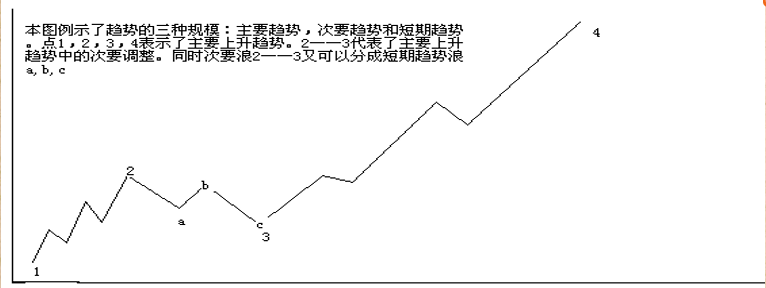
And this medium-term trend itself is often composed of shorter-term waves, showing a series of rises and falls. It should be repeatedly emphasized that each trend is an integral part of its longer-term primary trend, and at the same time it is itself composed of shorter-term trends.
Having said that, I believe everyone should understand that what we usually call a big cycle is actually composed of many small cycles. When a large upward cycle is running, sometimes it may be in a small cycle of shocks, and sometimes it may be in a small cycle of decline, but as time goes by, they must all move towards an upward trend, that is to say, shocks It is a relay of the rise, and the decline is just a normal adjustment of "big rise and small return". In such a situation, if you were a trader, what would you do? Of course, it is in line with the trend of the big cycle, and it is mainly to buy and do more on dips!
The logic of the two principles is also the same in a large cycle of falling in one direction. You can reason about this.
So, it shouldn't be a surprise when trends diverge from cycle to cycle, as it happens quite often. In the face of such a situation, what we need to do is to judge the trend of the big cycle clearly, and operate in accordance with the big trend.
Copyright reserved to the author
Last updated: 08/04/2023 11:27
Add

On dealing with divergence of trends between periods
When this question is asked, the trader's trading level should have exceeded the pursuit of various indicators and specific operating methods. At this time, he has gradually surpassed the question of "skills" and sought the question of "Tao". .
When I personally solved this problem, I read Zhuangzi and some articles about Taiji, and now I share it with Huiyou.

Just like the picture above, to put it a little bit more generally, for example, the market at the current level is equivalent to the Tai Chi diagram we see, and the yin and yang fish represent the bulls and bears of this level of trend respectively. It presents a cyclical state in which there is me in you and you in me, one disappears and the other prospers.
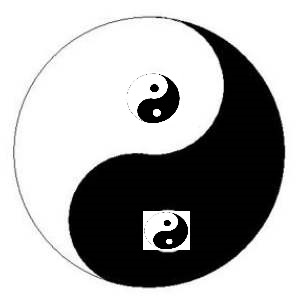
Then below this level, the two fish eyes can also be regarded as one yin and one yang at the next level, which produces its own long and short trend at the small level, and at the same time presents that there is me in you and there is in me. You, one dry and one prosperous.
Similarly, this state will also be generated at the level above the base level.
Looking at it this way, no matter what level the trend is, if you zoom in on it, it will always be part of another large level of shock. No matter what level of shock it is, if you look at it on a smaller scale, it will always be part of another small-level trend.
So, how to deal with this relationship?
In fact, if you use this kind of thinking to look at the market in a unified way of opposites.
For example, I want to operate small-level trends. So what am I going to find? Find the superior shock of this level of trend. Then the starting point, ending point, starting time, and ending time of this small-level trend are fixed. The operation of your trend at this level will be finalized. This is the so-called looking at the big and doing the small.
So how to find the entry point?
For friends who are pursuing more precision, higher profit-loss ratio and higher winning rate, they have to look for smaller levels. There is always a position with a high winning rate. The point where the profit-loss ratio is large. For example, I want to go long. The bottom of the larger level shock has just ended. It has entered the early stage of the trend at this level. At this time, the situation is unstable. It has just gone through a short period of rise and then entered a small oscillation period. At this time to observe a smaller level, there must be a position where the market changes suddenly. This location is the best entry point.
I don't know if I have been nagging for so long, but I have expressed myself clearly.

Copyright reserved to the author
Last updated: 08/09/2023 18:12
Add


My trading method is different from that of the general public. The following opinions belong to my personal trading philosophy. Let me talk about some digressions first, but these digressions are also the essence of logic. The logic itself is big and can restrain the small. Contradiction, the small one must not cross the big boundary.
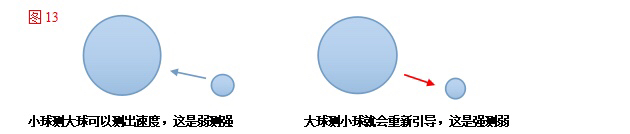
The essence of the market is the flow of funds. Strong funds are big balls, and weak funds are small balls. In this way, prices will be redirected. When small balls meet big balls, there will be tests. Weak, is the guide. Remember this relationship first.
Besides the research object,
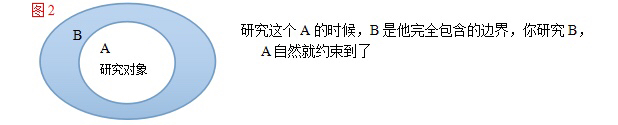
As shown in the figure, the results obtained are different depending on the research object. Then apply it to the market, take the 1-minute cycle and the 60-minute cycle as examples, you study the 1-minute K-line trend, and use the 1-minute analysis to make orders , your analysis period must be applied within this period, and the current entry cannot touch the risk of 60 points. The orders you make in this 1-minute period must not be able to see through the pattern of the 60-point K line, but in turn, you do The most important thing is the analysis of the 60-point K-line, and you don’t need to deal with the fluctuation of the 1-minute K-line. This is the constraint of the level. You can change to any environment, and the industry will benefit.
There are not many people who do 1-minute fluctuations in the transaction, and it is the same if you change the level. You deal with the 60-point K-line and the daily K-line. It is easy to deal with a few confirmed empty orders and a clear target position. It is just a market that fluctuates and goes long. Do both long and short positions. It is enough to handle the goals and risks well. It is good to hold long orders in the end. Direction and grasping trading opportunities are two different things. You will often find that no matter what the final direction of the price of the day is, many people choose different trading opportunities. Depending on your personal style, what I often say to my students is: When you can understand all the boards, all you have done is to choose, not to choose.
Therefore, different cycles can be handled differently without affecting it. A small cycle can help you test the risks of a large cycle. The strong point is that you can choose to grasp the final direction, or you don’t have to choose. Simplify complicated things and don’t put yourself Going around, the main thing is to know where the risk boundary of the small cycle is, and it will have no effect if you don’t touch the risk boundary of the large cycle
Copyright reserved to the author
Last updated: 08/09/2023 15:54
Add

Cycle against? In my cognition, there is no problem of contradictory cycles, as long as you can understand the rhythm of the market well, such problems will not appear.
For such a problem, I think the main reason is that it is influenced by some books and analysts in the market, what looks big and small. However, in the process of our transaction, if you want to take into account multiple cycles, the disadvantages outweigh the advantages. Trading should be based on appropriateness. The more you read, the more contradictions will be. In the long run, your trading will be at a loss.
Moreover, experienced traders can completely see the price structure of the large cycle through the small cycle, and there is no need to check the trend of the large cycle too much.
Therefore, my own trading is mainly based on the operation cycle, and the big cycle mainly depends on the obvious support and resistance levels.
①. Regardless of whether it is a large cycle or a small cycle, it has its own market structure. Assuming the price goes from A to B, how many ways can price action work? Most of the cases appear in the form of shocks and rises, and since they are shocks and rises, there must be a similar price structure, so no matter whether it is a small cycle or a large cycle, it must include such a structure. It's like a small sparrow with all five internal organs. Small cycles can also perfectly show the market structure.
If the big cycle rises and keeps refreshing highs, then it is also a rising pattern that keeps refreshing highs in the small cycle; if the big cycle rises and the small cycle falls, it can only mean that the price is blocked at a certain price above and there is a retracement space. There will be two situations here. One is that the retracement is just a retracement. Then the trend has not changed, and you can still use the small cycle to make short orders against the trend and grab small profits. As long as the adjustment state is over, the small cycle can also be reflected. The second is that the retracement has evolved into a reversal. In this case, it will be more advantageous to base yourself on the operating cycle, because you can detect the reversal of the trend in advance, and you can get a good point, so the pressure on holding positions will be much less.
②. Taking into account both large and small cycles may cause conflicts. Why is it possible to use it here? Because for traders who don't understand the market structure very well. Looking at multiple time periods, it is difficult to choose when there is a contradiction. The daily chart is bullish, the 4-hour chart is bearish, and the 1-hour chart is bullish. Which cycle should be the main one? Create confusion for yourself.
The transaction itself does not need so many reference standards, it only needs to be based on a certain price graph, and all market information can be reflected through a graph. This is also my view on the cycle.
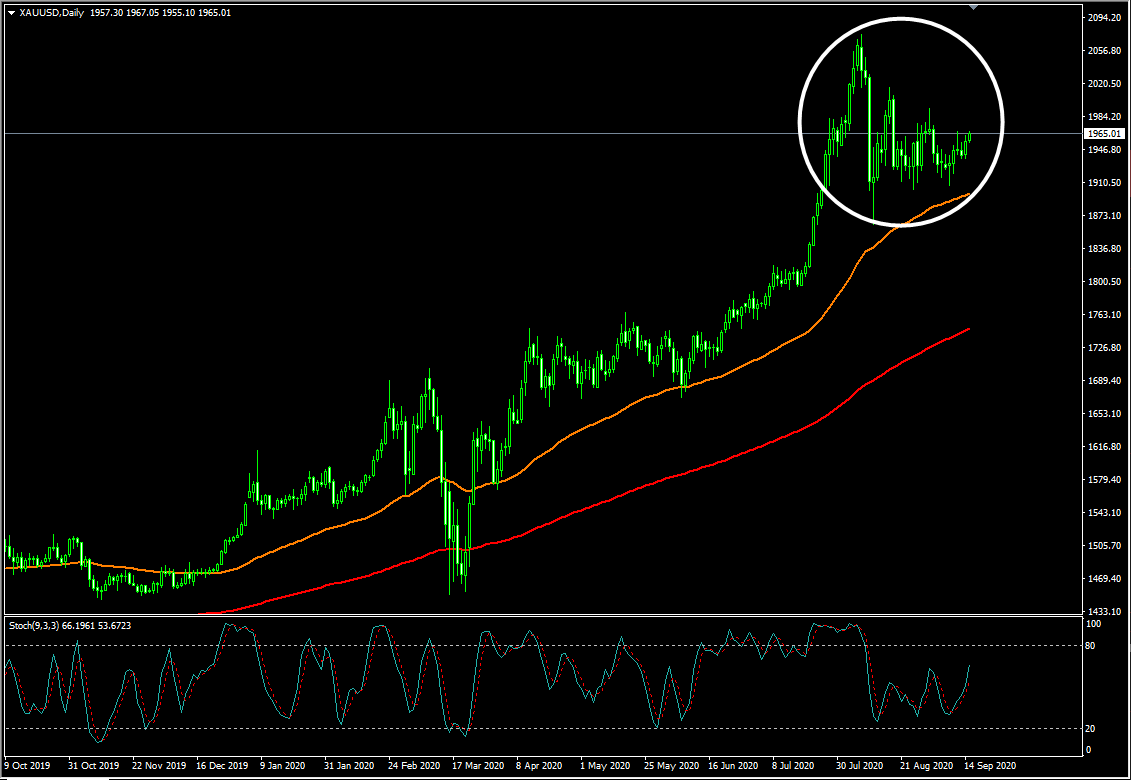
Take gold as an example in the picture below:
We can clearly see that the overall trend of the gold daily chart is upward. Regardless of the market structure or the moving average, the upward trend is no problem. (When I have time, I will write some questions about the trend. The trend is a very important concept that is easily overlooked.) During the period, even if there is a relatively large decline, the trend remains unchanged.
However, in the 1-hour period, the price has already shown a very obvious bearish structure, and the top signal is very obvious. At this time, you still have to take the trend of the large period as the criterion. Looking for a bit to do more?
And if you change your trading thinking and focus on the operating cycle, you will go long when there is a long signal, and short if there is a short signal.
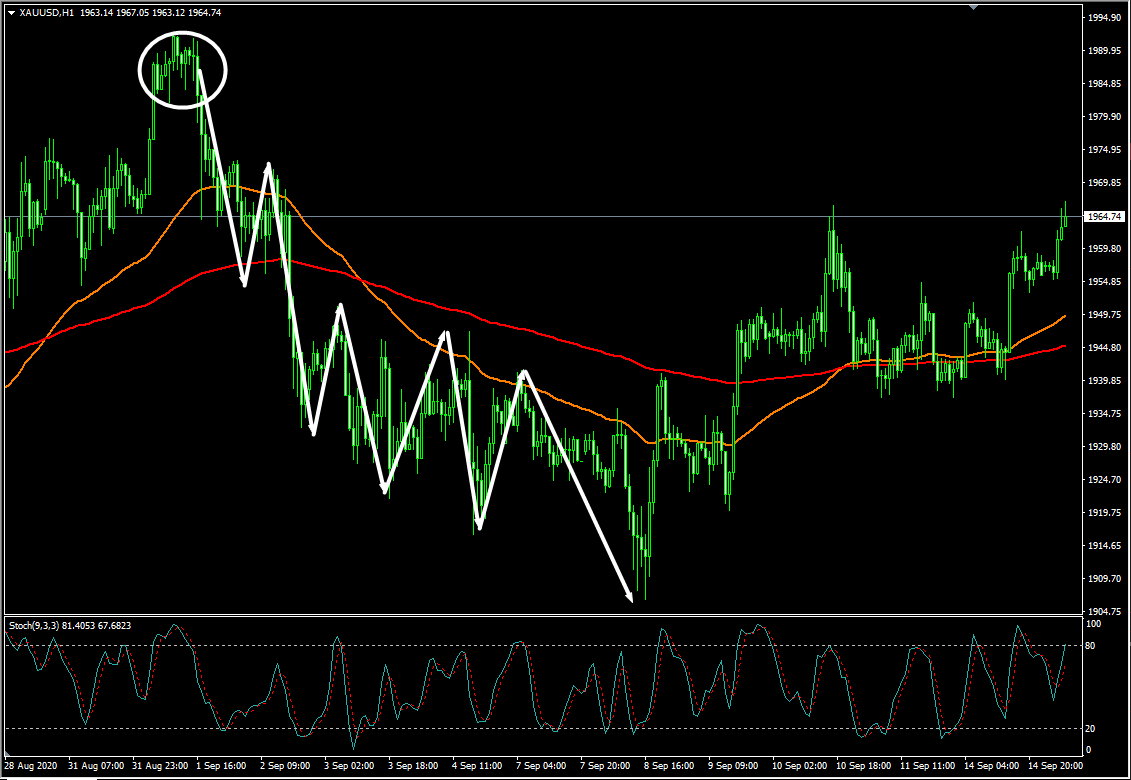
To sum up, I don't think there is a problem of contradictory cycles, and the transaction is mainly based on the current transaction.
Copyright reserved to the author
Last updated: 08/07/2023 21:46
Add

The core element of price movement is time, and the cycle is the most important in the form of time, and the relationship between price trends and cycles follows certain laws:
①. The general price trend is formed by the unity of opposites of different periodic trends. The large-cycle trend is the main aspect of this pair of contradictions, and the small-cycle trend is the secondary aspect of this pair of contradictions.
②. The small cycle is changeable, leading, and the duration is short, and the room for price fluctuations is generally small; the large cycle is stable, lagging, and the duration is long, and the room for price fluctuations is generally large.
③ The large-cycle trend is composed of several small-cycle trends that rise, fall, or sideways oscillating movements. The general price trend is determined by the large cycle, and the reversal of the large cycle is first reflected by the small cycle.
④. Small-cycle and large-cycle trends run in opposite directions. The short-term market runs in the direction of the small-cycle trend. The large cycle restricts the duration of the small cycle and the room for price rises and falls, forming a slow rebound or callback in the small cycle.
⑤. If the small-cycle trend is consistent with the large-cycle trend, different cycle trends will resonate, and the combined forces will be superimposed and magnified, resulting in a rapid rise or accelerated decline.
Therefore, on the K-line chart, it becomes the normal state of the market that the trends of different periods are contrary to each other. In a specific transaction, dealing with this kind of inter-cycle trend conflict also varies from person to person, and it depends on what type you like. Here we use the moving average indicator to give a solution.
For example, there is only one direction of the current K-line, but the directions of the moving averages of each cycle are inconsistent: on the 55-unit moving average, the daily line, 30-minute line, and 15-minute line are all up, while the 3-minute and 1-minute lines are down. Which moving average direction is the operation to take for trading?
According to the principle that we can only enter the market when the moving average and the K-line are in the same direction, then the cycle we can operate can be: long on the daily line, short on 1/3 minute. If you are long-term at the daily level, that is correct, but you can also go short within 1/3 minutes of the market.
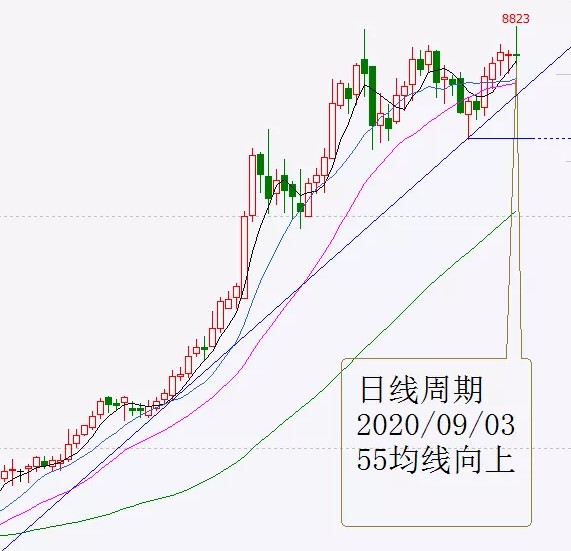
From a short-term upward analysis, the formation of a 1-minute trend will inevitably cause a turning point in the 3-minute graph. And when the 3-minute 55 moving average goes down and forms a trend, you can ignore the 1-minute fluctuation.
Furthermore, when a trend is formed in 3 minutes, a turning point will inevitably be formed on the 5-minute graph. A 5-minute trend will inevitably result in a 10-minute turning point and trend reversal. After the turning point and trend are formed in 10 minutes, a turning point must be formed in 30 minutes.
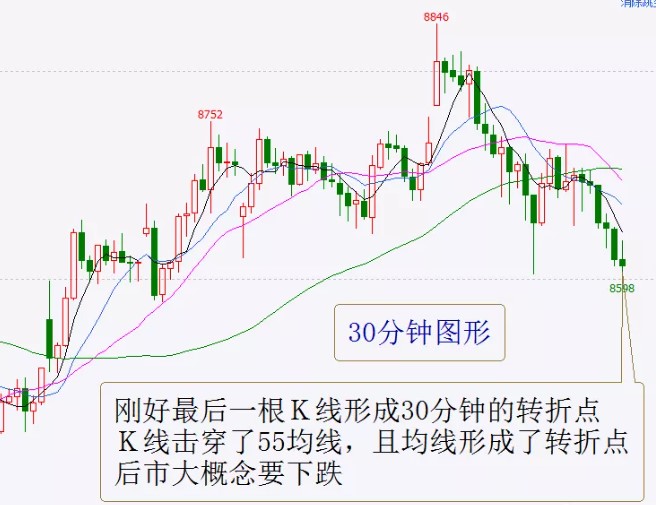
Here, after forming a turning point in 30 minutes and breaking through the 55 moving average, there is a high probability that it will cause a 30-minute downward trend. There has been no downward trend a few days ago, so the daily moving average is still upward, and the K line is downward during consolidation.
Looking at the entire moving average system, from the 1-minute turning point forming a trend to the 3/5/10/30 minute turning point, the best strategy is to hold short. But in fact, there is a period of rebound in the middle. After the trend is formed in 5 minutes, the 3/5/10 minute moving average and the K line have a period of opposite.
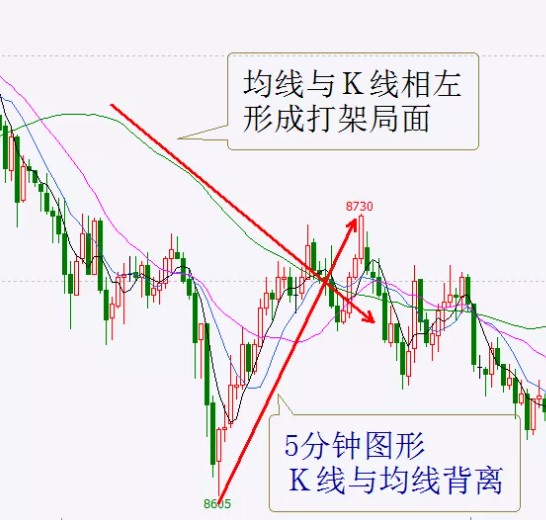
When 3/5/10 minutes there is a two-line contradictory market, if you are long-term, you can ignore those fluctuations and hold short orders, just like holding long orders on the daily line above, and holding short orders on small minutes. . If it is short-term, then an upward trend will be formed in 1 minute. In the 3/5/10 minute two-line conflict market, according to the principle of not entering the market when the two lines are inconsistent, you cannot hold empty orders.
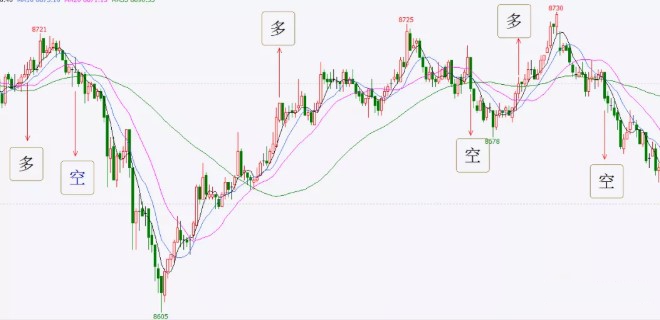
In fact, it can also be seen from the above that the multi-period moving average is different. It is also a small period that slowly affects the large period, the small period goes up, the big period goes down or the small period goes down, the big period goes up, or pulls back or reverses, These all start with small cycles.
Copyright reserved to the author
Last updated: 08/08/2023 03:05
Add

When doing trading, do you often have such questions: the daily chart trend is bullish, and the 1-hour trend is bearish, so how should we choose when trading, whether to focus on big or small? This is a situation we often encounter, and I will talk about my own understanding below.
The first concept to know is trend. The trend must be directly related to the cycle, that is to say, it is meaningless to talk about the trend without the cycle. Therefore, when you are asking others for advice, stop asking questions like "what do you think about gold today?" It's not that the other party doesn't want to answer you, but that the direction of this kind of question is unclear, and you really don't know how to answer it.
Just because trends are related to cycles, it makes sense that there will be different trends in each cycle. At present, there are two different understandings on the cycle, one is to look at the big and look at the small; the other is to take the small cycle as the standard. Let's analyze the logic of these two ideas.
The first one: look at the big and look at the small, with the big cycle as the standard and the small cycle as the supplement.
The main basis is still that the trend sense of the large cycle is better than that of the small cycle. The trend of the big cycle will not change so easily, and there will be no frequent changes in the trend. The trend is relatively stable. Taking advantage of the characteristics of large-cycle trends and cooperating with small-cycle transactions can indeed increase the probability of successful transactions to a certain extent.
The main point is that the big cycle trend is not so easy to change. Although it is not easy, there will still be changes, and when the big cycle trend changes, the price action has been running for a period of time, and the point may not be very good. In other words, the small cycle has shown a very good sense of trend.
However, in the process of changing the trend, there will still be the possibility of failure. For example, the price is still in an upward trend in the big cycle, but the price is currently in the adjustment stage. The adjustment stage in the rising process. At present, in this cycle, it is not sure whether the adjustment is a rebound or a reversal. And in small cycles the trend has changed.
The second type: where to trade in the cycle, the cycle is the main one, and there is no need to worry about the big cycle.
The main rationale is that the price action is the same whether it is a large cycle or a small cycle. The long-short conversion will definitely show up on the price chart. The advantage is that it can catch market reversals in advance, and small-cycle reversals will gradually grow into large-cycle reversals, which can capture most of the market's profits. But the disadvantage is that it may lead to frequent transactions. There are too many signals of trend conversion in a small period, and there will definitely be multiple long-term and short-term conversions. If the small cycle is the main factor, the signal of the small cycle must prevail, and the winning rate of entering the market caused by frequent trading will naturally come down.
My trading idea is that when the trend of the big cycle has not changed, and the price retreats to the watershed of the change of the trend of the big cycle, I still find a point in the small cycle that conforms to the big cycle.
To sum up: it is a common problem that the trend of the large cycle and the small cycle go against each other. How?
1. The large-cycle trend is upward, but when there is a large space for the price to retreat to the long-short conversion point, the small-cycle trend shall prevail. For long-short conversions that have been completed in a small cycle, the trend of the small cycle shall prevail;
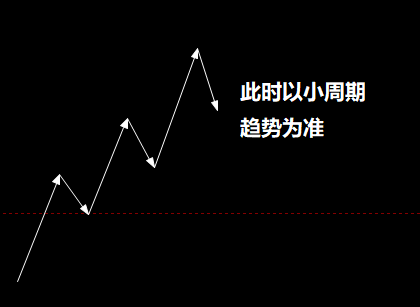
2. The trend of the large cycle is upward, and there has been a long-term retracement, and it is approaching the position of the long-short watershed in the large cycle, so look for opportunities to go long in the small cycle.
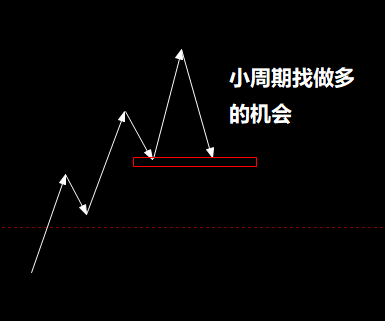
Of course, no matter what kind of thinking, there is still the possibility of failure. No trading strategy is 100% successful.
Copyright reserved to the author
Last updated: 08/23/2023 09:10
Add

When doing transactions, we often say that the big cycle controls the small cycle. If the big cycle is not completed, the small cycle will not end. This is equivalent to the overall strategy of the big cycle, but now the question is, how to judge the big cycle? Once the judgment is wrong, whether it means that it is wrong to do anything in the small cycle; there is no problem with this logic.
After a breakthrough is found in the big cycle, observe for one more day
If the price continues to develop in the direction after the breakthrough for two consecutive days after the breakthrough, such a breakthrough is an effective breakthrough, and it is a safe time to buy. Of course, I bought it two days later, and the price has changed a lot: the price to buy is high; the price to sell is low. However, even then, since the direction is clear and the general trend is set, investors will still have a lot to do, which is much better than rushing into the market.
There is a path, and the small cycle is the specific route.
That is to say, if the trend of the daily line has not finished, then the hourly line will continue to move forward in the direction of the daily line. So if we are going to enter the market, please see if the previous cycle (big cycle) cooperates? Let's see if the small cycle is also supported? Doing this is the best filter for your trading signals, and the chances of making a profit will be greatly improved.
The small-cycle market is aggregated into a large-cycle trend. If the trend of the small cycle is abnormal (the strength and intensity of the movement mode), it will inform the possible changes in the large cycle in advance. That is to say, at some point, the small cycle shows a special trend, which is opposite to the big cycle, and the trend is very strong, manifested in the slope, K-line strength, and time continuity, which may lead to the trend. reverse.
When judging that the general trend has not changed, you should decisively increase your position when the market pulls back. If you do the opposite, then the pullback is exactly the best time for you to leave the market. The 28th law is the iron law of all things in the world. 80% of my money is earned by 20% of the orders, and 80% of the same loss is also lost by 20% of the orders, so you can average how much you lose each time. You must not leave the market every time you admit how much you earn; you must be greedy when you should be greedy. There are not a few orders that make a lot of money, and the account will stretch in a straight line; greed is not a crime, and it must be timely. When it comes to greed, it is like stop loss. Not everyone will stop If the loss is appropriate, then stop profit, and stop profit is a higher art, we will talk about this topic again when we have a chance.
Copyright reserved to the author
Last updated: 08/08/2023 04:20
Add

What I want to share today is as a basic rule. The core premise is that we must realize the importance of the time frame of the transaction. This is the most reasonable analysis method for tracking price changes. It has great universality and is suitable for any Markets such as commodity markets and stocks. Knowing the time frame of your trades can greatly increase your odds of winning, and the first step in truly standardizing when to get out of any trade. Secondly, due to the different personalities, it has important reference significance for traders to choose a trading cycle that suits them. Although the moving average is rarely used as a basis for trading, the reason is the same, especially for novices who have just entered the market , the most basic things of these things must be mastered well.
How are the big and small cycles related on the same chart? What is the relationship between them?
To put it simply, if the core trading chart is an hourly chart (60 points), then the direction of the 20-day moving average on the hourly chart is the core trend of the hourly chart, which is the "potential" at the hourly chart level. It is opposite to the 20-day moving average for this cycle. In the same way, the 5-day moving average on the hourly chart represents the 20-day moving average on the 15-minute chart! The 20-day moving average on the hourly chart is also the 5-day moving average on the daily line.
Speaking of which, everyone should understand how to look at the relationship between the upper and lower cycles. What is homeopathic? How to take advantage of the trend?
If the trend of this cycle and the next cycle are the same, the trend will be relatively smooth, and this principle can be used to find the breakthrough point of price in time, that is, the critical point of price change. You can even simply see from the time frame whether the market will cause shocks and avoid it.
With the above understanding, let me talk about a basic principle about the time cycle. The large cycle controls the small cycle. If the large cycle is not completed, the small cycle will not end.
Compared with the big cycle, it is a weekly strategy, while the small cycle is the specific route. That is to say, if the trend of the daily line has not finished, then the hourly chart will continue to move forward in the direction of the daily line. Will it be supported in the next small cycle? Doing so will provide the best filter for your trading signals, and your chances of making a profit will also be greatly improved, because you cannot have a contrarian order in your hand.
Copyright reserved to the author
Last updated: 08/06/2023 12:14
Add

Periodicity refers to a wavy or oscillating change around a long-term trend presented in a time series. Accurate extraction of cycle information can not only reflect the law of current data, be applied to relevant scenarios, but also predict future data trends. This is an essential element of time series research. By observing the timing diagram with the naked eye, it is easy to judge whether the data satisfies the periodicity, but it is impossible to know the exact period length, and when the number of data sets reaches a certain amount, this method is no longer applicable.
Examples of indicators:
No technical indicator is 100% successful in this market, and MACD is no exception. The necessary conditions for the formation of a divergence are: fast (trend) - deceleration (passivation) - reversal (anti-trend). But if the market goes like this: fast (trend) - deceleration (passivation) - reacceleration (trend continues). In this case, the divergence disappears and the structure disappears.
Laws that do not change over the trading time period:
1. The small cycle must respect the large cycle, and the small structure must respect the large structure. How to put it, if there is a 5-minute bottom structure after the top structure of the daily line has fallen for a few days, then at this time, we must respect the top structure of the daily line in a large period, the downward trend, and we cannot pick up the flying knife copy for 2 hours rebound.
2. Each periodic structure resonates, and the effect will be greatly enhanced. That is, if the same structure of several cycles appears at the same time, the success rate of this structure will be greatly enhanced. For example, the MACDs with periods of 15 minutes and 30 minutes all have bottom passivation, and if the bottom divergence structure is formed in a period of 5 minutes, it is likely to cause the deviation of the bottom structure at 15 minutes and 30 minutes, forming a resonance, then this rebound is not 2 hours The span is too long, so we should look farther.
Copyright reserved to the author
Last updated: 08/07/2023 19:57
Add


Thanks to Secretary Dakang for the invitation. Different cycles are just different angles of observing the market.
Someone often asked me before, I see that your trading is not bad, can you help me to see how gold will go in the market outlook? Is it long or empty? I will answer very frankly at this time, I don't know. Others think I'm stingy, and they're afraid that my trading secrets will be exposed. Actually, I really don't know.
Why do you say that? For example, if you open the five-minute chart, gold is now in a smooth upward trend, and it seems that it is very good to do long. But when I opened the one-hour chart, I found that gold is in a box and is in a sideways arrangement. When I opened the daily chart, I found that the rise in the small period was actually just a rebound of the decline in the daily chart, which seemed to be a downtrend again. From different observation angles, the market prices seen are different. How can I give advice? Moreover, the market is uncertain, and the current ups and downs do not represent the future, so I think questions like how to look at the market outlook are too low-level.
Back to the main question, what should we do if there are contradictions in different cycles? I have two suggestions.
First, as I have just explained, different cycles are just different angles, so you just choose an angle. For example, if I want to do short-term, then I will look at the five-minute chart. I just look at the daily line. As long as there is a signal in the period you are looking at, I will enter the market. Similarly, I only look at this period when I exit the market. If the angle is fixed, you will have consistency and the transaction will no longer be so entangled. up.
Second, use filtering. We often hear a saying called multi-cycle resonance entry and exit. This is actually the use of filtering. Filtering with a large period is a bit like the rule of looking at the big and making the small. Let me give you an example, such as using the moving average to trade, if the small period k-line is below the moving average, but the large period k-line is above the moving average, then I will not open a position. I have to wait until the large and small period k-lines are all below the moving average. Open again. This is actually the use of large-cycle filtering to help you filter out the "clutter" of small cycles.
Are you satisfied with this answer?
Copyright reserved to the author
Last updated: 08/03/2023 17:35
Add

The operation plan for each time period is different, for example, the hourly level is suitable for short-term operations within the day, while the daily level is more suitable for operating medium and long-term orders
The small cycle changes flexibly, and the large cycle is stable. This is their characteristic. The reaction on the market is that when the trend changes, it will start with a small cycle, and the large cycle is often lagging behind, but once the change is successful, the large cycle is much more stable than the small cycle.
As you said, looking at the big and doing the small is a good plan for the situation where different periods are in conflict, but this kind of plan can only be used in the market where the trend at the daily level has been determined. For example, when gold is bullish in the near future, as long as the hourly level is pulled back in place, it is not a big problem to make long orders. Because there is nothing wrong with the general direction, and the fundamentals also support this kind of operation.
On the contrary, if this happens at the end of the market, and then follow the way of looking at the big and doing the small, obviously there will be multiple stop loss orders. At this time, the way to interpret the market cannot simply look at the trend and operate, the point and operation method are particularly important
In order to rule out the situation at the end of the market mentioned above, I personally have a more effective way to make orders - cycle resonance
The so-called periodic resonance, that is to say, when there is a certain state in two or more time periods that you refer to at the same time, the operation layout is carried out. Don’t go on, when there is a top divergence or even multiple top divergences at the same time, although the daily line level is still bullish at this time, you need to be cautious even if you are doing long orders at this time. Instead, you can consider diverging from periodic resonance. When some common conditions arise, consider the reverse layout operation, the probability of winning is higher than the probability of looking big and doing small.
I hope the above suggestions can help you
Copyright reserved to the author
Last updated: 08/04/2023 01:13
Add

1. There is no market that rises (falls) forever. The market trend is accumulated layer by layer through fluctuations, so the market always rises and falls, but it will eventually move in one direction.
2. Trend trading is best to "look at the big and make the small". The relatively large cycle is more trendy, and the small cycle may provide a more accurate entry position.
3. Through shock washing, the main force will obtain more chips (washing out the unsteady people), thus starting a longer trend, but the overall trend remains unchanged.
Therefore, we always see the market go up and down, and those who do not have a good analysis and firm belief in the trend will always be washed out in the shock. This is why when we look at the big cycle, it is obviously rising, but the small cycle always falls, which makes many investors afraid to buy again.
Of course, in order to maintain the overall trend unchanged, when the trend of the small cycle and the large cycle are the same, it must occupy the majority. Therefore, as long as the major trend is confirmed, it is undoubtedly a better opportunity to enter the market when the minor trend and the major trend deviate. These "violating" trends are actually a reaction of investors with different opinions. When they are all done, or they all start to agree with the general trend, then the small cycle will return to the same trend as the big cycle.
Although there will indeed be more false signals in small periods, we need to look for signals in small periods within the framework of large-cycle trends. That is to say, if the big cycle is bullish, we only look for small-cycle bullish signals; in this way, even if there are false signals, the power of the trend will help you turn the corner.
Copyright reserved to the author
Last updated: 08/06/2023 05:08
Add

My answer is very simple, there is no need to deal with the cycle between trends, just focus on the cycle you are trading on, and ignore other cycles for the time being.
Reason 1: We do transactions and want to know as much as possible about the price patterns of multiple cycles. This also reflects the problem of trading philosophy, because deep in your heart there is still a psychology of wanting to eat all the market. I want to use such a method to know the so-called excellent point, and then rise or fall as soon as I enter the market. I want to exhaust all the trends in the cycle, and at the same time let myself fall into the abyss of multi-cycle chaos.
Reason 2: Most of the use of multiple cycles will only make their transactions more confusing rather than clear. Especially when the trend of the large cycle is contrary to the trend of the small cycle, will the price reverse or rebound? Entering the market when the big cycle reverses, the price may have been running for a long time and space; entering the market when the big cycle rebounds, at which point should the rebound be entered? More importantly, if there is no fixed standard for judging rebounds and reversals, it is easy to misread the direction and confuse yourself.
Reason 3: You can see all of the big cycle in the same small cycle. We all know that the cycle is just the money trace left by the price in time. There is no cycle in the market itself, and prices are always fluctuating from the opening to the closing. It's just that we have added the concept of cycle in order to better observe the market. The price method of the large cycle can also be viewed through the small cycle, but the small cycle will be more prioritized than the large cycle.
Reason 4: The small cycle is also the completion of a trend. In other words, if there is a certain fixed pattern in which the trend reverses from the shape, then there will be a small period of this pattern. For example, the beginning of a trend-development-prosperity-recession reversal, etc., can also be seen in small cycles. That being the case, then based on the small cycle, just do it according to the rhythm of the small cycle, why bother to take into account other cycles.
The above is, in my opinion, why there is no need to take into account the considerations of multiple cycles.
Copyright reserved to the author
Last updated: 08/07/2023 21:10
Add

This question has been hanging out for a long time, and Mazhu has never come to write this article. In fact, the trend state shown by the K-line patterns in different periods has a great influence on the judgment of traders. Almost no one claims that he can use a fixed-period K-line to complete transactions, no matter whether he is long-term or short-term, heavy or short-term. For light positions, the combination of K-line patterns under different cycles can easily divide the development interval of the cyclical market and provide reference for different trading needs. Mazhao likes to think about trading from the beginning. I don’t want to simply say a few words that the big cycle determines the direction, and the small cycle determines the details. If it is so correct but useless, I would like to talk about a few of my own thoughts on this issue, hoping to inspire everyone .
What is the essence of the K line?
I said that the basic unit of most people's technical analysis is the candlestick line, and it should not be opposed. Of course, some people may also be foreigners and like to use the bamboo line. They analyzed the market conditions to a single K line/bamboo line, which is the end. But have you ever thought about what the candlestick/bamboo line is essentially? Is it an elementary particle in the world of quotes? No, the transaction prices that appear one after another are the basic particles in the market. The K line/bamboo line is just a sampling sample in an artificially divided time period , and only four points are drawn for each time period: start point, the end point, the highest point, the lowest point, even if the market makes a big fuss during this time period, as soon as the time comes, the K line/bamboo line will attribute it to an icy cold bar composed of these four points. stick. Let me put forward another concept, which belongs to the concept of "the people use it daily without knowing it". The development of the market along the time axis is extremely uneven . The market will never achieve the same space in the same time. It is common to go out of the space of an average day within five minutes. Therefore, when we use fixed time interval sampling, we will lose a lot of market development details . There are 10,000 possibilities from the lowest point to the highest point of the K line. It cannot tell us even one.
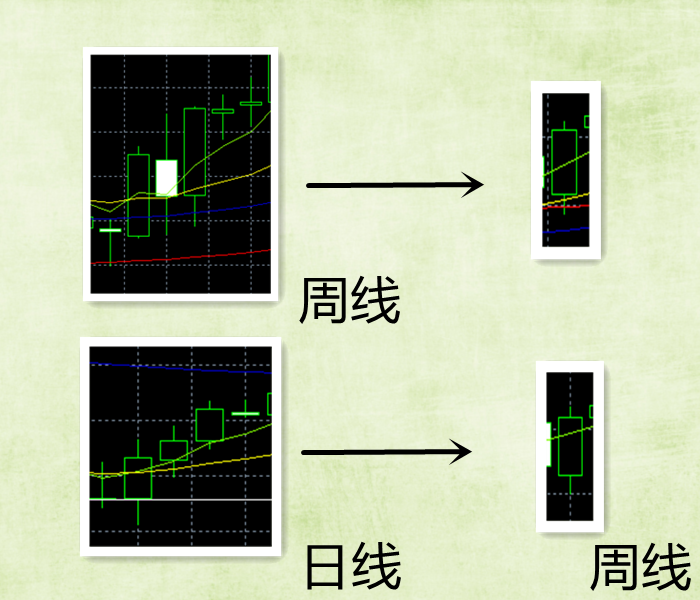
In the first picture of the three charts of strength
Market and cycle
In the concept of Mazhu, there are two concepts of the so-called long-short cycle: first, the long-short cycle of the order , whether you are long-term or short-term, and the length of time you hold the order. For example, if you want to eat 500 points in one position In terms of market space, it is probably difficult to do short-term within the day anyway. You must consider taking the position for three to five days and making a mid-level short-term at the daily level ; The duration of the trend market of your own system. For example, if you use the high and low points as the criterion for judging the trend, then the period of time that a long market lasts before a lower high and low point appears is the cycle of this long market trend. There are long-term and short-term orders, and there are long-term and short-term trends. You can do short-term arbitrage in the long-term market, or you can find the most favorable long-term opportunities in the short-cycle market pullback. The market exists objectively. It mainly depends on how the people participating in the market Operation only.
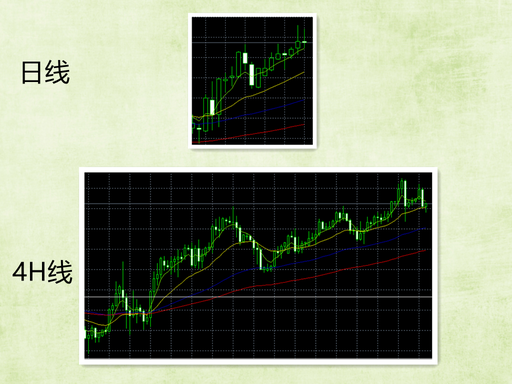
In the second picture of the three charts of strength, Mazhu randomly found the current market price of a variety. It is a standard unilateral market on the daily line. On the 4h chart, it is still a standard unilateral trend market, but There are many more details. What I want to say is that the cycle of the market has nothing to do with what level of K-line traders use to observe. No matter what level of K-line you use to observe, the starting point and end point of this trend, as well as the duration will not be different. Any changes, and any market details displayed on the large-level K-line will not be lost on the small-level K-line.
SO , the trend between different cycles is contrary? This is a false proposition!
Of course, the cycle mentioned by the subject refers to the K-line level cycle artificially divided according to fixed time intervals, not the single cycle or market cycle mentioned by Mazhao, but I can also say this sentence, between different cycles Contrary to the trend between? This is a false proposition! There is no violation or non-violation of the market between different levels of cycles, and no one dominates who decides who. The truth is: short-cycle market can destroy long-term trends, because reverse trends also develop from short to long. In this case, the short-cycle market can also confirm the long-term trend, because the trend of any cycle level develops repeatedly in waves. Sometimes the short-cycle market not only forms its own trend, but also destroys the long-cycle market that has existed for a long time, which often happens; but in most cases, the short-cycle market does not develop enough to destroy the long-cycle market The situation began to reverse, and the market developed along the direction of the long-term market. Then, compared with the original long-cycle trend, these short-cycle prices can only be called callbacks and rebounds, and cannot be called trends. Violation is not a violation.
The third picture of the power combination picture (omitted). Therefore, the key is for traders to have their own trend model, to clarify in what state the trend will be destroyed, and in what state the confirmation can be strengthened. Only in this way can they maintain a clear direction and a firm mind in the ever-changing market. Not to be reduced to drifting with the tide.
Copyright reserved to the author
Last updated: 08/13/2023 00:30
Add

What is the trend deviation between different cycles?
This is very simple, that is, we often encounter the problem that the cycle trend of the same product is different in trading, such as gold, the trend on the weekly chart is rising, but the trend on the daily chart is down, or It's trending down on the monthly chart, which is a counter-trend problem.
In fact, we are not unfamiliar with such a situation in our daily life. Let me give you a simple example. Everyone knows that the Yellow River flows from west to east; this is the general trend; but the process is not a straight line from west to east Instead, it is Jiuqu Thirteen Bay, and sometimes there are waters flowing from east to west. This is a small trend. We have seen that although the minor trend is contrary to the major trend, it did not hinder the ultimate trend of the Yellow River River in the end.
So back to our trading, how should we deal with the problem that the trend between different periods is contrary to each other?
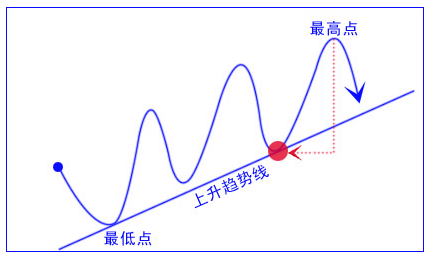
At this time, we not only need to distinguish clearly which is the major trend and which is the minor trend; we also need to understand whether our trading cycle is long-term or short-term.
If you are doing long-term investment yourself, then of course your best strategy is to "follow the general trend and go against the small trend".
If you are doing short-term investment, then you don't care about the big cycle, just follow your own cycle trend. As the saying goes, in which cycle to trade, the cycle is the main one, and there is no need to worry about the big cycle. The main basis is that the price behavior is the same regardless of whether it is a large cycle or a small cycle, and the conversion between long and short will definitely be shown on the price chart. Although the reversal of a small cycle will gradually grow into a reversal of a large cycle, since your trading cycle is mainly short-term, if you "follow the general trend and go against the small trend" at this time, it is very likely that your trading At the end of the cycle, the reversal of the general trend has not yet occurred.
Copyright reserved to the author
Last updated: 08/10/2023 11:01
Add

In my personal experience, there is no need to switch back and forth in different time periods. All the trading logic, such as direction, entry point, stop profit and stop loss, etc., are completed in one time period.
Any trading pattern in any time period can appear in a self-similar fractal manner on a larger or smaller time period. It is nothing more than that the trading pattern corresponds to different time spans and price ranges in different time periods. . Then under different time periods, the operation strategy for this trading form should be consistent, without adopting the so-called "potential-position-state" multiple trading cycle framework.
For example, you enter the market at the neckline of the "W bottom" to do long, and leave the market when it hits the previous high. This operation can be done in any time period. It is nothing more than the process on M5. You may hold the position for 60 minutes and make a profit of 20 points. On H1, you may hold the position for 6 hours and make a profit of 40 points.
In a word, since there is a complete entry and exit logic chain in one cycle, why bother with the long and short directions in other cycles?
Of course, the greater the cycle, the greater the retracement and stop loss you have to face, and the smaller the position should be. The general direction of trading evolution should be "the cycle is getting bigger and the position is getting smaller."
Copyright reserved to the author
Last updated: 08/06/2023 07:43
Add

It's nothing to worry about, it all depends on what cycle list you make. For example, as a person who does ultra-short-term, will I chat with you about the trend of the day? Don't be ridiculous, with this time, why don't I make a few orders? So what you said about looking at the big and doing the small is not a problem. It is enough to have an idea of the direction of the big cycle psychologically.
As you said, the big cycle is stable, but changes are slow. The small cycle changes quickly, but unstable. Why do you have to worry about the big cycle? Is it for taking advantage of the trend? Whether you can catch it is not mentioned for the time being, even if you catch it, how long can you hold it? In what lot size? In the stock market, there are many people who have held a list for a year or several years. Have you seen it in the foreign exchange market? Don't say a year, maybe half a year, or a few months without a quilt? The actual result is that it is rare to take one month or even one week, but worry about how the general trend of the daily chart will go. So what are you struggling with?
What you have to do is your cycle, and what you want to follow is also your cycle. Only your cycle trend and other cycle trends. There is no saying that a large cycle is more accurate and a small cycle is not. Things are good, but you can't use them, so what's the use for you?
Copyright reserved to the author
Last updated: 08/08/2023 18:39
Add

This kind of problem often arises. First of all, we must understand the trend and strength of the big cycle, and the stage we are in. For example, according to the wave theory analysis, which wave is it.
The second is what level the small cycle belongs to and which trading time period it is in. If it is the US market, just watch the one-minute transaction. If it is the Asian-European handicap, watch it for at least 5 minutes, and do 15-30 minutes of opportunities.
The author is tracking and watching multiple cycles. Generally, the large cycle affects the small cycle. After the deviation of the small cycle or technical repair, the large cycle is still dominant. Therefore, it is more important to determine the trend of the daily line, the stage of the trend of the four-hour or two-hour cycle during trading, and its strength.
As for the small cycle, try to make orders with the trend, and stop losses strictly when you make orders against the trend.
If the daily or four-hour trend has reached the end of the trend, then focus on whether the small cycle reverses and affects the large cycle.
Because the small cycle is the most sensitive, with the news and data, it is very likely that there will be a trend reversal at the daily level. At this time, it is necessary to lighten the position and strictly stop the profit and stop the loss. Of course, it is also possible to wait and see for confirmation.
A 10-year gold foreign exchange veteran, has established multiple trading systems, basic analysis, technical analysis, news analysis and other analysis and judgment systems are perfect, the transaction success rate is extremely high, but the profit and loss ratio is not good, and the transaction is not stable enough. In the past two years, Wang Yangming's mind theory has been highly praised, and the unity of knowledge and action still needs to be practiced more in matters. Welcome to join my circle to communicate more.
Copyright reserved to the author
Last updated: 08/11/2023 08:57
Add

In the investment market, it doesn’t really matter whether you know a lot or not. The important thing is whether you can integrate the techniques you know well for analysis and conduct effective analysis. In today’s investment market, in fact, investors What is lacking is not technology, but how to use it. The key point of today's technical analysis is "cycle combination".
1. Find the transaction type of the cycle
To find a suitable cycle, we first need to determine what kind of transaction we are going to do, short-term, mid-term, or long-term?
Short-term trading, as the name suggests, is a short-term operation. Such operations are generally bought on the same day and sold on the same day, so there are certain requirements for the size of the profit. Why are there certain requirements for the size of the profit? Because if Once the operation is done, the profit is 1 point, but once the loss is stopped, the loss is 10 points, so this kind of short-term trading is worthless. Because unless the accuracy rate is 100%, otherwise, it is impossible to make a profit.
In terms of short-term trading, the basic requirement is that the profit of two operations can be equal to the loss of one operation. This is also the minimum requirement. In the case of an accuracy rate of 70%, at least one order can be purely profitable, that is to say, if you make 10 orders, you can earn 5 points. Why take an accuracy rate of 70% as an example, because this is a fairly low requirement, and most people can achieve it by studying hard. An accuracy rate below 70% is relatively low.
In terms of medium and long-term trading, it doesn’t matter whether you buy or sell on the same day. Generally, a few days, a week or even a month’s holding time is acceptable. At this time, the most important thing is to judge the trend, and the position of buying is secondary. Yes, because we must be able to grasp the research and judgment of the general trend in order to obtain the final profit. The short-term rise and fall are not very meaningful.
After determining the type of transaction you want, the next step is to choose the transaction cycle.
2. How to choose the right cycle
The volatility of gold is moderate, not too big or too small. For such fluctuations, you can consider the 30-minute trading cycle and the 4-hour and daily line as the direction judgment, because from a short-term perspective, the 30-minute buying and selling cycle, The results can basically come out on the same day, and the smaller cycle is not cost-effective, because the fluctuation is relatively weak, and the larger cycle is not good, and it is not easy to fluctuate on the day.
Note that the Hang Seng Index fluctuates too fast. In terms of operation, it is recommended to use 1 or 5 minutes as the trading cycle, 15 minutes or 30 minutes, and 1 hour or 4 hours as the trend judgment cycle. Like to decide.
The short-term selection cycle, the first choice is to consider whether there is enough space for the price to rise and fall. If there is not enough space, it is easy to lose money in trading. Second, consider whether you can buy and sell on the same day. After considering these two points, the trading cycle will be very easy to choose. .
Note that when choosing a short-term trading cycle, the key point is to look at its volatility. The medium- and long-term is different. For the medium and long-term, it is recommended to use the 4-hour or daily line as the trading cycle, and the weekly or monthly line is considered as the trend judgment cycle. Of course, it is true. Friends who want to do long-term, you can also look at the weekly line as a trading cycle.
The difference between medium and long-term and short-term is that medium- and long-term does not have high requirements for grasping the details of technology. It only needs to have a good way to judge the trend, but the requirements for funds are relatively high. If you want to do medium and long-term, you must have sufficient funds. Short-term can be done with small funds, but technical analysis must be in place.
Copyright reserved to the author
Last updated: 08/03/2023 18:48
Add

0
work
0
subscriber