


Stay in touch!
Subscribe to our newsletter to get the latest updates on live market analysis, trading strategies and more. You can unsubscribe anytime.
By subscribing, you agree to Trading.live Privacy Policy.


Callback entry is a kind of conservative trading strategy, and it is a means to capture the trending market. Its operation is partly against the trend and generally follows the trend, so the operation must be short-term and long-term. On the contrary, short-term trading mostly uses the breakthrough method to enter the market, only focusing on local trends and not caring about the development direction of the big market. The callback entry strategy uses the definition of a classic trend. A trend is composed of continuous highs and lows. If the market continues to generate new highs and lows, it is a bullish trend, otherwise it is a short trend. Then in the long trend, the higher lows that are continuously formed are the callback point, and in the short trend, it is called the rebound point, which is a better trend trading method to open a position.
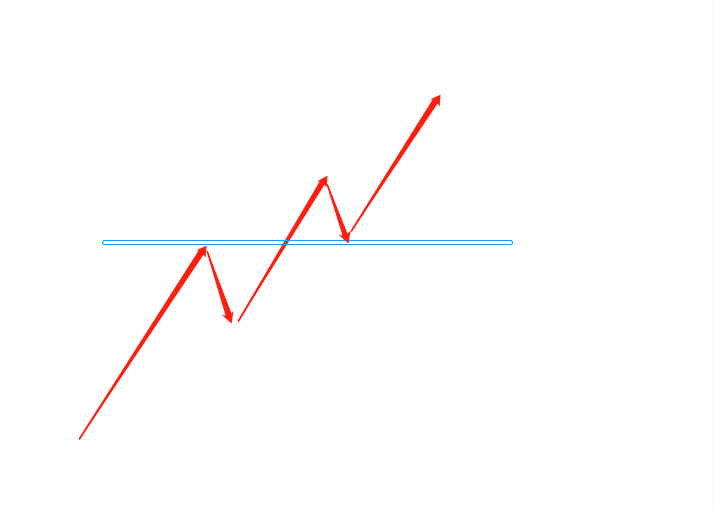
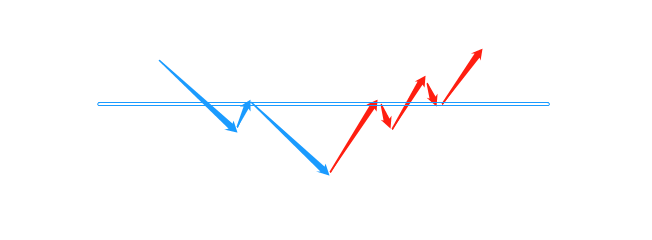
According to the position of the callback point, the callback market can be divided into two types, the first is a reversal callback, and the second is a trend relay callback. The following is a schematic diagram drawn by me:
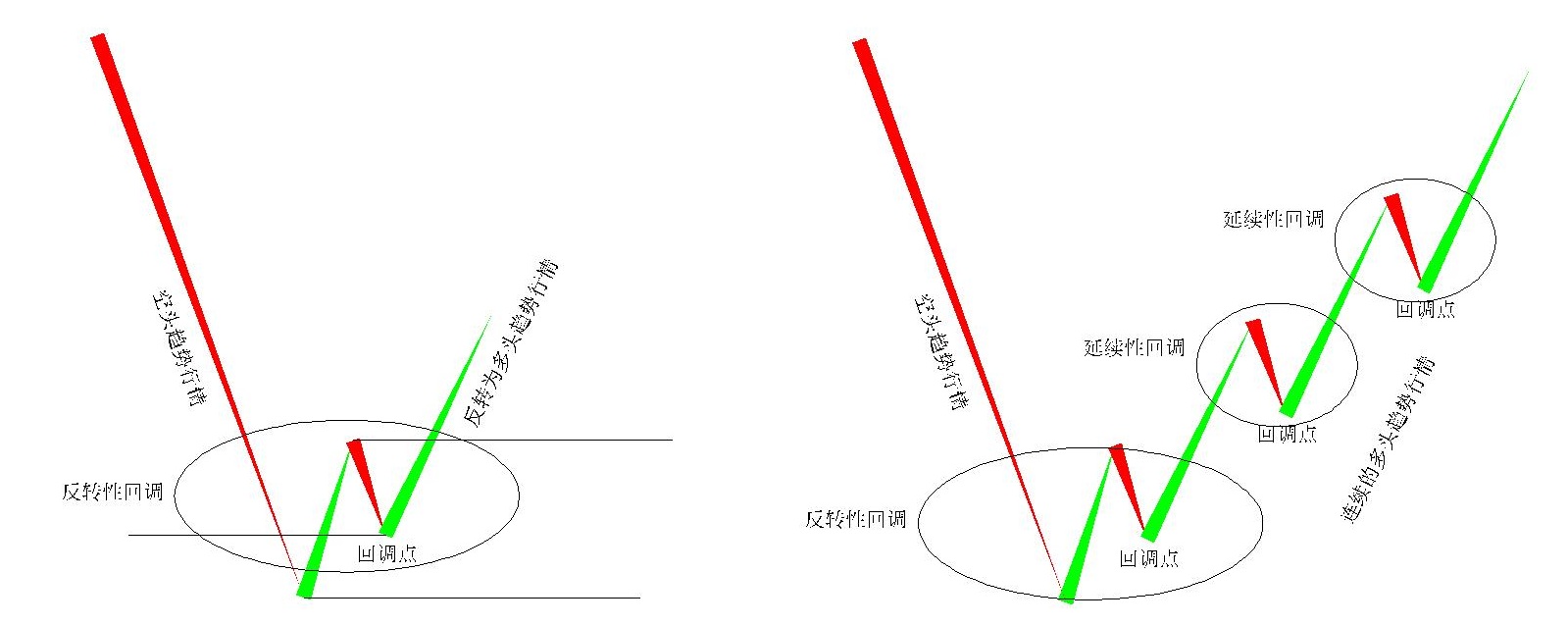
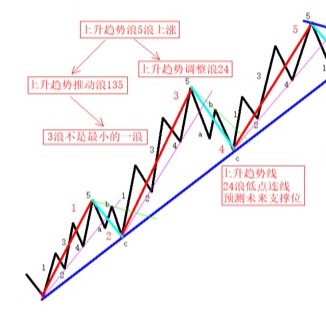
The profit margin of a reversal callback is the most advantageous, allowing us to intervene in the trend earlier. The disadvantage is that the winning rate is difficult to guarantee, because even if there is a reversal callback, the conditions for judging the occurrence of a bullish trend are not enough. There are only two low points and a high point. There is only one point. A reversal pullback is likely to turn range-bound, or reverse again, becoming a choppy relay of the previous trend. The advantage of relay callback is that the trend is already clear, there are at least three low points and two high points, and the accuracy of intervention is slightly higher. The disadvantage is that the profit margin cannot be guaranteed. In the standard five-wave market, entering the relay-type callback point is already the end of the fourth wave, and the profit space is only the fifth wave with the greatest risk. In fact, the purpose of the pullback point entry strategy is to catch a long-term trend that can last for more than a dozen waves. This trend does not happen a few times a year, which is why the winning rate of long-term traders is generally low.
It should be noted that, compared with the formation of a new reverse trend, it is more likely that the reversal callback will develop into a continuous shock range of the previous trend, as shown in the second and third pictures posted by the subject. Formed a oscillating area, at this time, it is not possible to make orders with the idea of calling back. When judging whether the market is a shock or a callback, it is more appropriate to use the central theory of entanglement theory. The central theory of judging the trend does not simply rely on the high and low points, but the area covered by at least three market processes. The most basic requirement of the central trend is that the subsequent market will no longer return to the central. If it returns to the central, it can only be judged Because the central shock is continuing, as shown in the figure below:
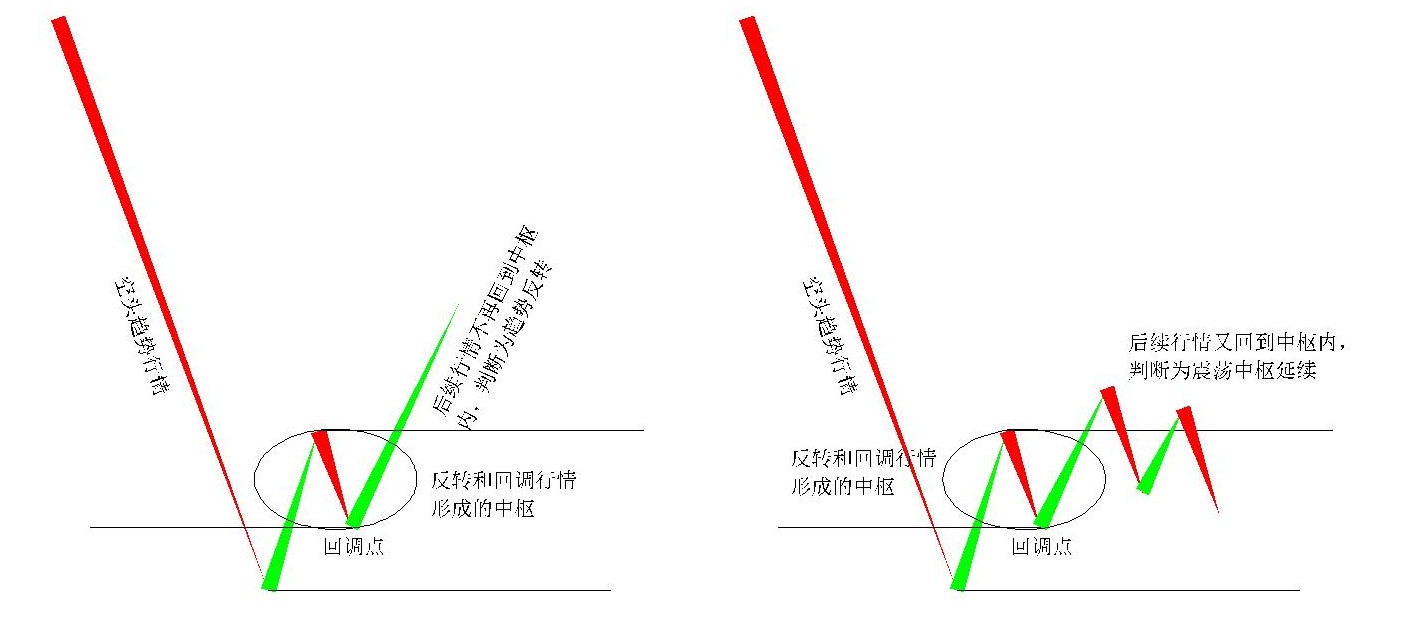
If the oscillating center starts to continue, it is more likely to be a continuation of the previous trend. The idea of ordering should be to sell short orders on rallies according to the direction of the previous short trend. All high points can be regarded as the rebound point of the previous short trend. And you can no longer consider the callback point of the bull trend, because the bull trend has not happened at all. So on the whole, the most suitable callback entry point for midline traders is not the callback point, but the point after the breakthrough after the reversal type callback, and the stop loss point is the point below the breakthrough position, that is to say, the callback type The stop loss point of the trader is only two points plus the spread and handling fee, because as long as the reversal callback is established, the market will never return below the breakthrough point, and once the market returns below the breakthrough point, it will It shows that the reversal-type callback has become a central shock, and the basis for making a callback is no longer there. Even if there is only one point, the order entered with the callback idea must stop loss and leave the market, and switch to the shock idea.
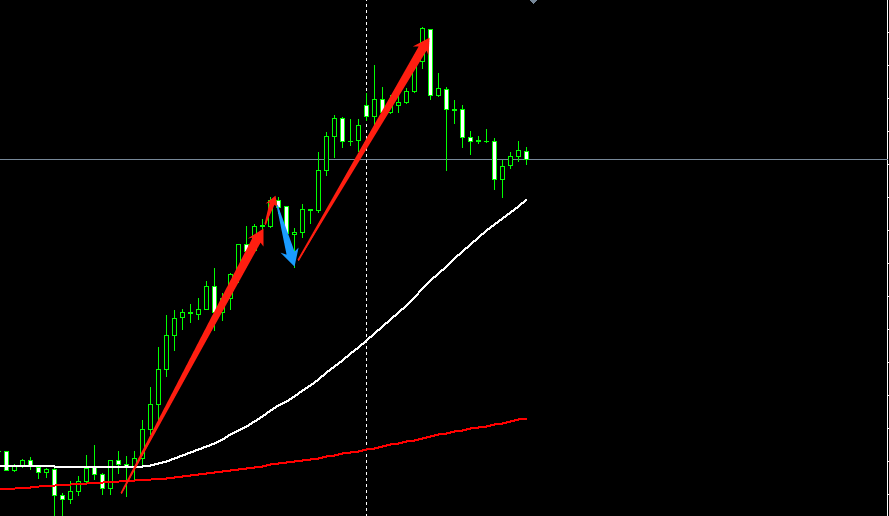
For any trend, whether there are only five waves or a dozen or tens of waves, there is only one reversal point, and you must have super patience and perseverance to wait for it and catch it. In most cases, we You can only participate in the continuous callback points of the ultra-long market that has lasted for more than a dozen waves. The risk here is how to judge whether the current callback is just a callback or the end of the current trend? I use the MACD and moving average system to judge. There are two basic principles. One is that as the trend continues to develop, the callback market will step back on each moving average from short to long. If the market directly pulls back from the five-day moving average to the 120-day Below the moving average, it is not a trending market, but a shock; second, the pullback market generally does not cause positive or negative changes in the MACD column line, or even if it causes a positive or negative change, the length and duration of the changed column line are shorter than The length and duration of the bars during the continuation of the previous trend are much less. Let me find an example for your reference:
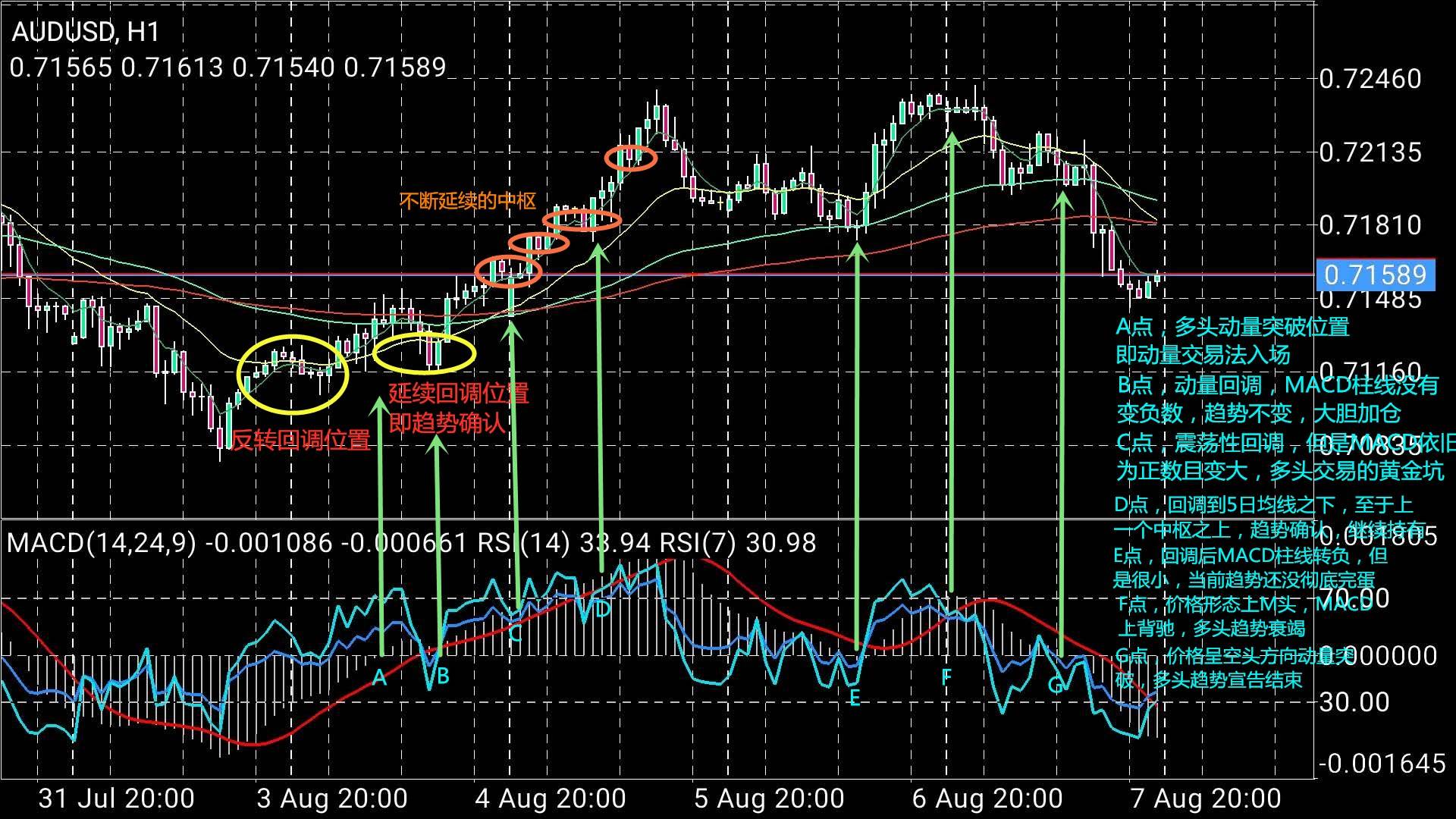
If you understand this picture, you can basically understand the essence of the "momentum-moving average" trading method of the sleeper. The callback point is just a small knowledge point in this trading strategy. In the end, I would like to declare that trading technical analysis is not mathematics and physics. There is no unified theorem formula that is universally applicable. Only you keep exploring to find a theoretical system that conforms to your own thinking logic and can be justified. The above analysis is based on my own "momentum-moving average" trading method, which is in line with my own trading logic, and it cannot be guaranteed that everyone can understand and accept it.
Copyright reserved to the author
Last updated: 08/06/2023 23:54
 Add
Add

In any wave of trends, when you go back to the early stage of the market start, there will be breakthroughs. Break through the 5-day high, break through the 10-day high, and then keep breaking. So, if we set the entry based on the breakout, then you will definitely not miss the trend. Of course, you are sure not to miss false breakouts. Trading itself is trial and error. After entering the market, if you are right to hold, but wrong to stop loss, as long as the profit can cover the cost of trial and error, then we will make a profit. In my opinion, the inevitable form of the trend is a very efficient way. So, what about waiting for a pullback after a breakout? Does that count? doesn't count. First of all, for the so-called callback, you must define what a callback is. For example, a drop of 100 points from a high point is called a callback. Then, will any trend rise in the early stage and then pull back 100 points? Not really. Many trends continue to rise, and there is no callback at all. Therefore, when you encounter this situation, you can’t get in, as shown in your chart:
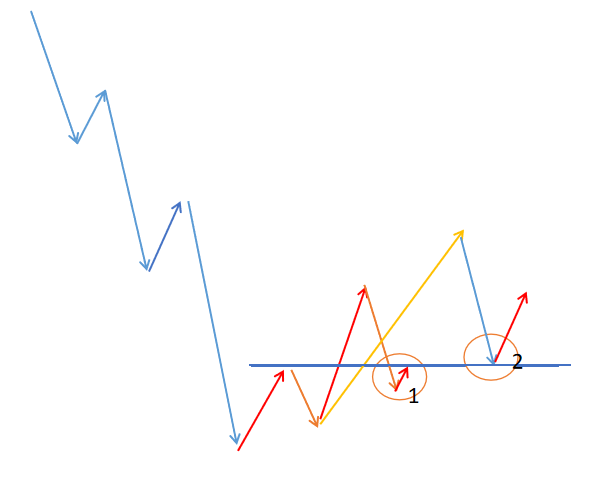
This kind of trend, a breakthrough entry has already entered the market, but if you wait for a callback, it may not appear until the highest point. So are you going to enter at this time?
Therefore, in my opinion, although pullback entry also has its advantages, for example, a better entry position, but overall, it is not as efficient as breakthrough entry.
Copyright reserved to the author
Last updated: 08/07/2023 02:41
Add

Callback refers to a technical stepping back, a technical operation method to confirm that the price has an effective breakthrough rather than a false breakthrough. Early on, when I was trading, I heard a lot of these pullbacks, including what was often called a false spike. In fact, this trading method is meaningless, and it will set the price cost line very low, which is a very unwise shortening of the profit space. Even if there is a chance to exit the market, it will suffer losses due to the unreasonable price line.
The method I often use now is to confirm whether the breakthrough is true or false from the beginning, instead of waiting for a step back.
This saves a lot of trouble and the cost of making an order. The transaction cost is not only money, but also unexpected payments of money, including time and psychological pressure.
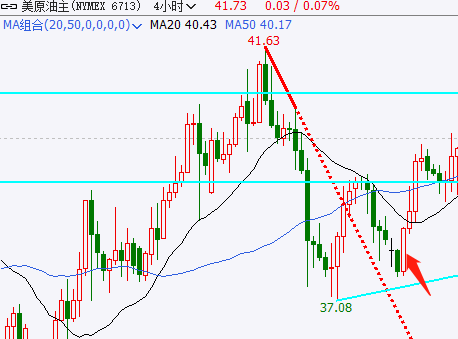
This is often said to be an example of confirming a breakthrough by stepping back. The price breaks through the trend line connecting two points. After the breakthrough, the price pulls back for a while, and then when the price pulls back to the vicinity of the trend line, it receives a candle that swallows yin and makes more money. Combination, at this time, step back to confirm after the breakthrough, you can enter the market and do long.
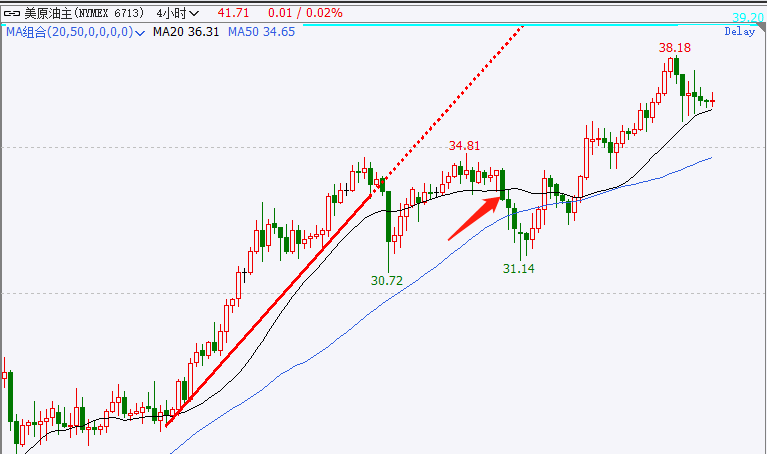
This is also often said to be an example of stepping back and confirming a breakthrough. The price breaks through the trend line connecting two points. After the breakthrough, the price pulls back for a while, and then when the price pulls back to the vicinity of the trend line, it receives a candle that swallows yin and makes more money. Combination, at this time, step back to confirm after the breakthrough, you can enter the market and do long.
Looking at these two examples, we found that they have something in common. In fact, the second inflection point of the M top candle pattern is confirmed and the market enters the market. The first target position is placed on the neckline of M.
Therefore, stepping back and breaking through often requires an effective combination of candle patterns, candle combinations and drawing trend lines, which becomes the basis for making orders.
Copyright reserved to the author
Last updated: 08/07/2023 03:51
Add

A pullback is a reverse trend after a wave of market rise or fall. Therefore, the action of callback will not only happen in the rising market, but the rebound in the falling market is also a kind of callback.
To give a simple example, it is not as obvious as the current gold. The price has been at a high level or a new high. For many investors, it is undoubtedly too risky to chase high at this time. So what should we do? Wait, wait for the market to fall back to the position you want, and then enter the market. The series of operations in the middle is a complete operation of callback intervention.
So how do you judge that the callback is over, and you can consider entering the market with the trend?
The most commonly used in the market to determine the position and strength of the callback is the golden section line. In the golden section line, the two most commonly used positions are 0.382 and 0.618. The position of 0382 is an important support for a weak callback, and 0.618 is the last important intervention point for a strong callback. In theory, this is the case, but in actual operation, the commonly used position of the callback may be different due to different trading varieties. For example, the position of gold 0.5 is more important than 0.618, so it cannot be rigid in the actual operation process To be rigid, you must be more familiar with the varieties you operate, and find a certain position that is the point where the callback will end with a high probability by replaying the market.
As for the three behaviors you mentioned, in fact, the premise is to look for the process of market reversal, which is different from the concept of callback. The concept of callback is that the market will not change. After the callback, it will continue to operate in the previous direction. And for the three situations you gave, whether it is a true or false breakthrough or a fall back to the low point, your thinking is doing the opposite of the previous downward trend, and you are choosing the opportunity to go long. So none of your three cases are callbacks. But the market reversed.
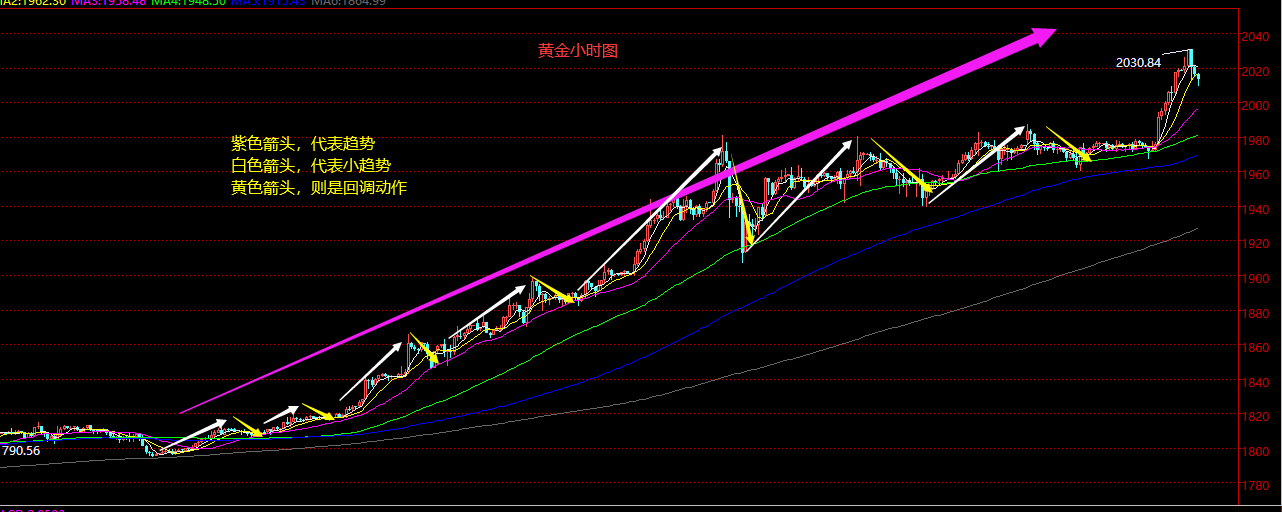
In the figure above, the purple arrow indicates that the big trend is bullish, the white arrow in the middle is the small trend in the middle process, and it is also bullish, and the yellow arrow is the callback action. Comparing the three graphs you gave, you will find that you have confused the concepts of callback and reversal.
Copyright reserved to the author
Last updated: 08/12/2023 12:01
Add

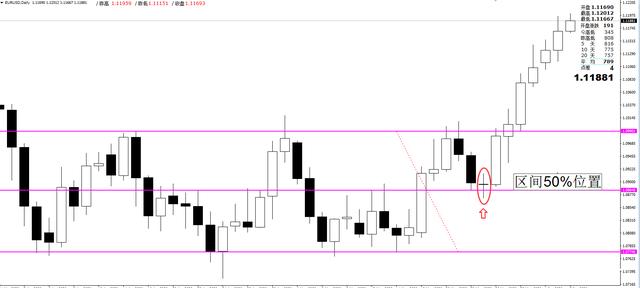
A price retracement of roughly 50% of the trend is often the termination point for short-term swings. It's a well-documented phenomenon, a lot. Therefore, we can focus on pullbacks in this 50% area, as they are usually insurmountable price levels. While it doesn't happen every time, it happens often enough that it's a key strategy in our pullback trading toolbox. Like the picture below:
Copyright reserved to the author
Last updated: 08/12/2023 15:25
Add

The title of the question is very detailed, let me tell you my opinion.
Pulling back and then entering is a relatively safe way to enter the market on the right side, and this is also the way I am currently using to enter the market.
Then, in the actual trading process, where to pull back into the market is the second problem to be solved. The first problem to be solved is still the judgment of the trend. If you have a problem in judging the trend (strictly speaking, the market failed to go according to your expectations), it is meaningless to talk about a callback at this time. The trend has not changed yet, and the position you are looking for is not a callback point It is your trading point against the trend. Therefore, trend judgment is the first problem to be solved.
Suppose, we can determine that the trend has turned. Then, the next question is the question of the pullback entering the market. In the market, entering the market with a callback is nothing more than using the FIBO indicator, or other oscillating indicators, or, as the subject mentioned, entering the market only when there is a stable positive line.
The first one is that Fibo pullback enters the market. After this wave of rise, what point does the pullback to fibo count as the end of the callback? The 50% point is still 61.8% or other points. There is no fixed standard. Even if the market has just stepped on the 50% point this time and has risen, will it have an effect at this point next time? Not sure. More importantly, such tools cannot achieve the principle of consistency. Of course, it’s not that meagerness can’t be used, the key is to see how you use it. I think it’s difficult to find this point simply by relying on meagerness indicators, and it needs to be used in conjunction with other indicators.
The second type, as the subject said, the support level + positive line stabilizes the signal structure. In comparison, I personally prefer this one. However, simply using the positive line stabilization signal that appears during the callback process does not constitute a basis for entering the market. You will find this out by reviewing the market yourself.
The Yang line is actually just a normal price behavior during the callback process, and the Yang line itself is meaningless. The key lies in whether the market has a positive line and whether it can be recognized by most other traders. Just using a positive line or a combination structure as an entry signal does not have a high probability of success.
My entry principle: plus the stop loss range on the basis of the above, I am not optimistic about whether the market will have a positive line stabilization signal during the callback process, but wait for the price to enter my acceptable stop loss range to enter the market.
Copyright reserved to the author
Last updated: 08/10/2023 10:12
Add

laxative.
I think many great gods have drawn pictures to explain it to you, so I won’t say more.
Just a quick question, what indicators do you use for trading? Different indicators have different entry positions. For example, the moving average is matched with MACD, the moving average is up, the moving average is stepped back, and the MACD is golden cross. At this time, you can consider entering the market with multiple orders; or the Bollinger Bands, the three-track upward, the general trend is long Under certain circumstances, the opening after consolidation is the best entry position, or you can also enter the market by stepping back on the middle rail and the lower rail; or you can enter the market by crocodile line formation, diffusion, and so on.
If you don’t use indicators, naked K analysis, that is support and resistance, you can choose to enter the market through a breakthrough, or enter the market when you step back after the breakthrough; as for the wave theory, you need to cooperate with Fibonacci to enter the market.
Basically, you still need to cooperate with your own trading methods and habits, and you can't listen to others. After all, everyone has different ideas and habits.
Hope to help you!
Copyright reserved to the author
Last updated: 08/05/2023 16:18
Add

The pullback entry is related to the trend. In a unilateral market, it is difficult to have a slash line go through the sky or go to the bottom. At this time, the short turning point in the market gave the opportunity to get on the bus again.
Callback entry generally refers to choosing an appropriate point to buy during a pullback in an upward trend.
The three situations you listed in the picture are essentially the same category, because they are all in a breakthrough rising market.
These operations are all previews in advance. If there is a corresponding market situation, then the entry position given in the figure is basically appropriate.
The key is, how do you confirm this rising market in the market?
In the short term, Dow Theory, Gann's Eighth Rule, and Elliott's Golden Ratio can all be used for reference. There are other indicators, such as KDJ, MACD and the like.
That is to say, the pullback entry is purely a subjective thing, how to choose the appropriate point, it is your trading system to answer!
Copyright reserved to the author
Last updated: 08/06/2023 05:53
Add

First of all, what I want to say is that the three situations you gave are not callbacks, but a form of judging that the market is about to reverse.
A pullback is a corrective action to the current trend. For example, a fall in a rising market is called a callback, and a rise in a falling process is called a rebound (it can also be understood as a rebound is also a callback), and the three graphs you gave all emphasize breakthroughs rather than corrections.
There are two reasons for the callback, one is the callback trend based on the technical form, and the other is the morphological correction based on the influence of fundamentals (such as non-agricultural, initial applications, GDP and other data).
As for where the market will pull back, I will briefly introduce two methods of judgment, one is the support position of the important moving average, and the other is the support position of the trend line.
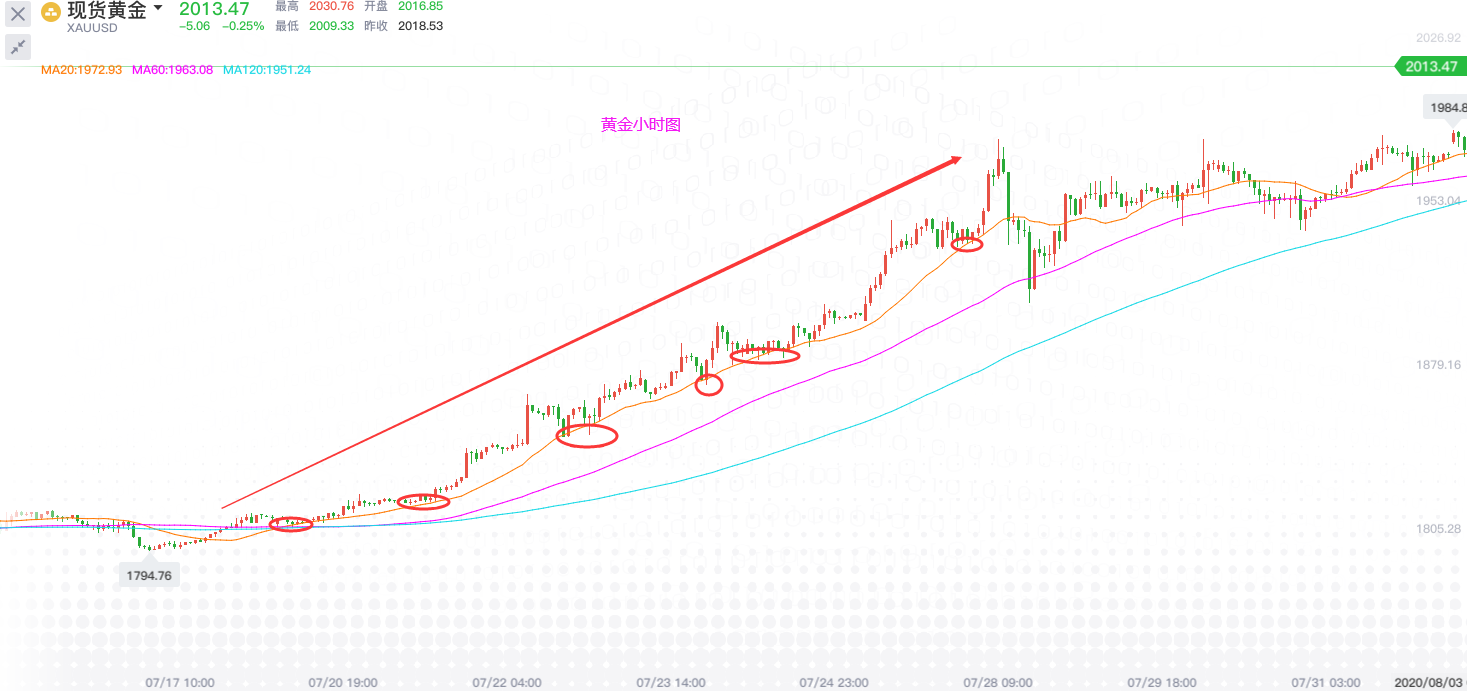
The picture above is the hourly chart trend of gold. It can be seen from the chart that gold moved upwards relying on the moving average in the early stage. In the red circle is the running track of the price relying on the 20 moving average. Therefore, for the previous market, the price will A callback to the vicinity of the 20 moving average is an opportunity to intervene in long orders.
Special reminder: During the operation of the market, there are strengths and weaknesses, and the moving averages relied on are also different. Try to retest the validity of the moving average parameters as much as possible.
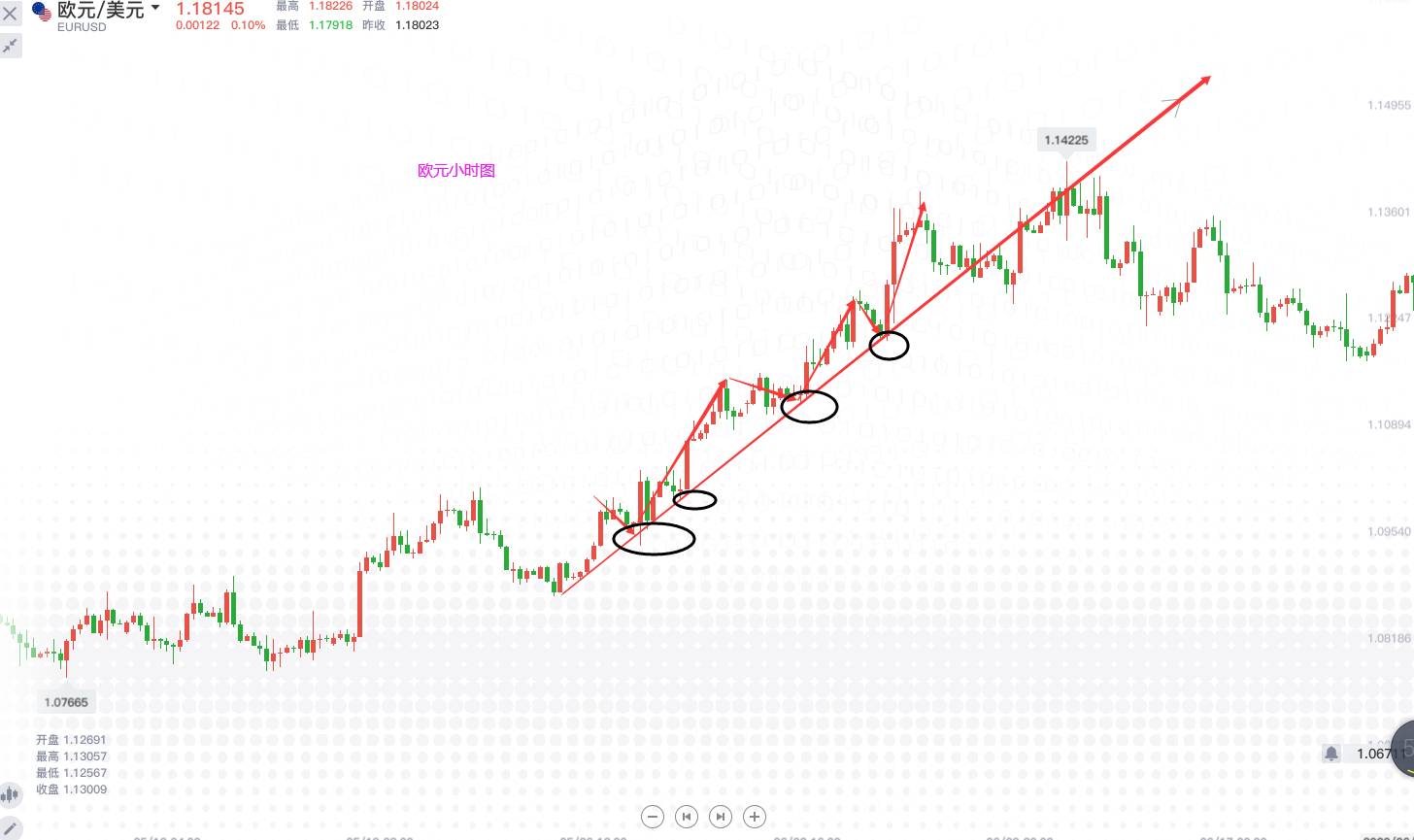
The above picture is the hourly chart of the euro. It can be seen from the chart that the rise of the euro in the early stage is based on the trend line marked by the red arrow. Then every time the price pulls back to the trend line position, it is an opportunity for long-term intervention. The black circle in the picture.
In particular, the method of drawing a trend line is in principle a connection between points, but more importantly, it is necessary to put as many points as possible on this trend line. And it is necessary to review more to understand the specific drawing method of the trend line.
The above two methods are the method of judging the position of the callback by the moving average and the trend line. The difference between them is that the moving average is calculated based on the K line, so there is a lag, and the trend line is relative to the moving average. There is no such shortcoming, and the accuracy is increased. .
All methods are inseparable from it, and the one that suits you is the best. I hope you can find a method that suits you to judge the retracement position.
Copyright reserved to the author
Last updated: 07/31/2023 19:35
Add

In my opinion, to find a callback, you must first judge the trend.
After the trend is determined, it will be meaningful to find the point of callback. Otherwise, you are just picking up throwing knives against the trend.
The subject has three methods, but in my opinion, they are all one, which is to find the point of callback.
My thinking is like this:
When a trend is determined, in principle, it is no problem to open a position at any point on the trend, because the general direction is determined, then the price will definitely continue to create new highs (new lows), so, in principle, follow the trend There is room for profit at any point of opening a position. However, in the actual trading process, we generally do not choose this method, because we need to measure the cost of trading stop loss. Always want to use a lowest cost point to earn the largest profit point. This brings us to being picky about points. This also leads to different approaches.
I mainly use the William indicator to judge the point of the callback to assist the support and resistance level. If there is no obvious support and resistance level in the price, then I will cooperate with the William indicator to enter the market. If there are obvious support and resistance levels, then use the William indicator plus the support and resistance level to operate.
Well, I have taught you all the secrets.
Copyright reserved to the author
Last updated: 08/01/2023 23:51
Add

Treat separately:
The first type of single position, if this position is a morphological position in a large cycle, then the reference is relatively high. If it is only the first time, then the callback is done, and the winning rate is relatively low. If there is a second position in this position later The first time, the third time the winning rate will gradually increase.
The second type has a better position, and has a better ability to continue rising and profit margins;
The third type of winning rate is more stable than the second type, but the profit margin is lower than that of the second type.
For these three positions, the lower you go, the higher the success rate, but in terms of profit margin, the second one is the best;
Naked K Judgment Potential ㊗️ Solution
Copyright reserved to the author
Last updated: 08/02/2023 14:21
Add

Among the three callback entry methods mentioned by the subject, I think it is very useful to judge the callback entry through the support level, and the other methods can be combined with the support level callback entry method, for example, a callback occurs during the price rise, as shown in the figure below :
The callback to the point is just the support and resistance level, so at this time, with the K-line pattern, isn’t it more sure that there will be a callback at this time? Therefore, I personally think that it is more secure to determine the callback through the support and resistance level, as the Fibonacci callback is the same.
Copyright reserved to the author
Last updated: 07/31/2023 23:13
Add


The third is that it is not easy to hit a stop loss, and if you fall, you will prove that you are wrong. The first and second are easy to chase orders, and the stop loss is large.
Copyright reserved to the author
Last updated: 08/12/2023 19:45
Add

When a callback enters the market, where is the general callback to enter the market? I saw and drew three pictures, which actually represent three ways, so which way is the best? Next, let's analyze it.
Picture 3 is currently Xiaosan's favorite way to enter the market. Without it, it is because the price is cheap. However, this kind of entry is often easy to be trapped, because Figure 3 can easily evolve into a head and shoulders top.
Figure 2 is the most formal way to enter the market, because after a breakthrough, the neckline becomes the support line, and a callback to the vicinity of the support line is the safest entry point. But in reality, the stock price often cannot return to this price. The reason is actually very simple, because everyone is waiting to enter the market at this neckline. Which fool is willing to sell at that price?
As for Figure 1, it seems to be a very aggressive entry point, but it is often the most profitable. Because the rising market likes the strong Hengqiang the most, the callback point usually cannot reach the theoretical point, but above the neckline, the callback ends and the attack starts again.
Therefore, I personally think that the way in Figure 1 is the best.
Copyright reserved to the author
Last updated: 08/03/2023 09:53
Add

Thank you for your invitation. The three adjustment methods mentioned by the landlord may appear in real transactions. The first and second methods appear more frequently, and trading in this way has a higher success rate. The difference between the two trends is: the first is the fast bull trend, which is faster, but usually does not last too long; the second is the slow bull trend, which is slow but usually lasts for a long time. The third trend is usually the entry point for a volatile trend. In the third case, it is recommended to pay more attention to specific prices when trading.
Copyright reserved to the author
Last updated: 08/01/2023 16:50
Add

In your reversal situation, the trend has the characteristic of maintaining the current state, and most reversals are failures, so when judging the reversal, more evidence is needed to prove that the trend has a probability of reversal! Taking your example as an example, it is not enough to see the evidence of the strength of the long side, but also the weakness of the short side. However, from your illustration, the short side before the reversal is relatively strong, and the probability of success of this reversal is relatively low ! If the relative probability of these three situations is slightly higher, I personally think that the third one is relatively better. If you want to enter the market, you need to have a weak space!
Copyright reserved to the author
Last updated: 08/14/2023 07:21
Add

For technical questions, the biggest feature of the market is uncertainty. Your question is precisely to find the certainty of the market. If the position of the callback can be determined, most people in this market will make money! As long as the position is called back, I think technical indicators can be used to find a reasonable explanation for the callback to any position, so deterministic market conditions do not exist in this market. The market is uncertain at any time
Copyright reserved to the author
Last updated: 08/10/2023 18:56
Add

In fact, it is the understanding of entry, and callback entry is only one of them.
However, you need to know that the term callback itself has already given a judgment. The general understanding is that it is part of the trend market.
If the general trend can be confirmed in the direction, then the callback is naturally possible to judge.
The examples given in the question can be encountered in trading, and there is not much difference in essence. They are all part of the rising market after a breakthrough, and the long points shown in the illustration are also suitable.
If you look at it simply, the above three situations are common wave forms.
Considering thousands of people and thousands of waves, the specific entry position when retracing depends on personal preference.
Copyright reserved to the author
Last updated: 08/01/2023 23:58
Add

Behind the K-line is a long-short game. The bulls beat the shorts and go all the way up, but the bears are not reconciled, so they suppress the price, forming a callback during the upward process, but the bulls are strong and quickly take the initiative in their hands. , rising again. As shown in the figure below, in the 15-minute chart of gold, gold hit 2000 again. This is the first time in history that it broke 2000, and there was a callback during the sprint.
In addition, I think what the subject said is not actually 3 ways to enter the market with callbacks, but 2 kinds, one is to judge directly through the positive line of the K line, and the other is to judge the key points. As shown in the figure above, after the price pulls back, it will After the low point, the next K line is a positive line, which stabilizes, and you can enter the market at this time according to the meaning of the subject.
Copyright reserved to the author
Last updated: 08/02/2023 08:31
Add

There are three kinds of callbacks, one is the previous low point, and the other is to go long when there is a positive line after the breakout, and the other is to call back to the bottom area to do long
Copyright reserved to the author
Last updated: 08/06/2023 07:21
Add

0
work
0
subscriber