


Stay in touch!
Subscribe to our newsletter to get the latest updates on live market analysis, trading strategies and more. You can unsubscribe anytime.
By subscribing, you agree to Trading.live Privacy Policy.


If the intuition is protective, follow the intuition, and if the intuition is risky, negate the intuition. This is my way.
Intuition is not unreasonable, but the high-speed calculation of the probability of market ups and downs in a relatively short period of time based on the brain’s experience in trading, winning rate, and information. Not scientific enough, not rigorous enough, but the brain is able to lock a possible answer in an instant.
Acknowledging that intuition plays a role in trading, but not relying entirely on intuition to trade, I think this is the unity of knowledge and action.
The reason why there is such a thing as intuition is that there are unknowns. The more we know and the more detailed the things, the weaker the conditions for intuition will be. Assuming that we can gain insight into all the factors that affect the market price, we will be very firm in the direction of the market and will not There will be intuition again.
Therefore, different trading strategies have different effects on intuition, but generally speaking, long-term trading is less dependent on things like intuition. Please try to make a list with clear information, and you will find more clear things , the weaker the influence of intuition.
For example, clarify the possible price range of a product in the next two months, clarify your position, clarify the total profit scale within two months, clarify your opening point, replenishment point, liquidation point, and whether there is any follow-up capital recovery , clarify the profit stop point, ... as long as the more you know and the more you know, the less intuitive confusion you will have.
Generally speaking, intuition is a good thing. It is the brain’s forcible completion of reality. You can’t gamble by forcibly completing a transaction. Even if you want to gamble, I have to put my chips on the word "stable".
Copyright reserved to the author
Last updated: 08/01/2023 07:31
 Add
Add

It's purely nonsense, let's just talk about my own opinion, in fact, I just want to ask others if they want to see the market.
In fact, there are only three reasons for taking the sense of the plate as a shield:
1. The most common use of futures traders in subjective trading is market sense, such as changes in market openings, the beating speed and frequency of K-lines, digital changes, etc. The most typical ones are speculators who speculate on orders. There may be 8 out of 10 orders. Just to make money, at this time you regard him as a master, a great god, and then people say that relying on the sense of the disk, basically this kind of sense of the disk can only be understood but cannot be copied and imitated, but in fact it is still your own training The rules are just not told to you.
2. The second type is traders who can make stable profits. They don’t want to explain their technical system too clearly, so they just use the sense of trading to perfuse you, so as not to expose their core things. This situation also exists.
3. The last one is purely pretending to be X. Maybe you are lucky occasionally and make a few orders, so you deliberately pretend to be X, saying that I never look at MACD, moving average, or shape when speculating in futures. It is purely based on market sense. How should I deal with it? Should I be convicted of pretending to be X? Therefore, I suggest that those novices who are still obsessed with training the market sense and confused by the market sense should wake up and build their own trading system honestly is the right way. The market sense is unreliable, only the rules are reliable Because rules are more stable than feelings, and rules are easier to copy and enforce.
Copyright reserved to the author
Last updated: 08/13/2023 13:34
Add

Regardless of technical or fundamental analysis, human nature and market prices are not separated. At the end of the review, there is still a sense of the market, the most important thing is the mentality
Copyright reserved to the author
Last updated: 08/11/2023 16:53
Add

It’s very interesting to see this question, so I’ll try to answer it reluctantly, please correct me if I’m wrong or say something radical.
Let me first talk about my intuition or what is the disk feeling?
Investors with certain experience must have had this kind of experience. They once felt super good for a period of time. What they bought went up, and what they sold went down. It can really be described as "if God helps"! But sometimes, the situation is just the opposite, as if the main force is watching his own operations, manipulating the stock trend in the opposite direction, whichever stock he buys, the stock will fall; whichever stock he sells, the stock will rise. When you feel it, you do it smoothly, and when you don't feel it, you do it in a mess.
People who operate by feeling are either novices or masters. The novice "sees the mountain as the mountain", and there are no distracting thoughts in his heart, and the feeling of not being moved is usually right; but once the novice becomes a veteran after operating for a period of time, he will start to "see the mountain as not the mountain", and his heart will also be confused. I will start to have ideas, start to guess, and sometimes I will be paranoid at one end. At this time, I am in a state of being tempted and chaotic; The mind can control distracting thoughts and distinguish the truth from the false. This is the real enlightenment stage, and the feeling at this time has been sublimated to intuition.
However, having said that, on the market, especially in the foreign exchange market, nine and a half out of ten that can actually make a profit are losses, and very few can make a profit. Thinking about such a vast market, you can exercise your sense of order How many people can there be? So some so-called masters are really just playing tricks. Instead of believing in these, it is better to implement their own trading system mechanically, which is much better than these bells and whistles.
above!
Copyright reserved to the author
Last updated: 08/11/2023 13:07
Add


Trading is also a feeling.
Copyright reserved to the author
Last updated: 08/11/2023 09:35
Add

There is no unity of knowledge and action, even nonsense must be well-done.
If you really unite knowledge and action, you still need rules to restrain yourself? Do you need to stop losses or something?
No one really believes in the unity of knowledge and action.
Copyright reserved to the author
Last updated: 08/08/2023 05:52
Add
Thank you. After seeing this question, I also thought a lot. I think the best way is to see if intuition can be directly quantified into rules, and then see if you can use this rule to trade.
If you can, follow your intuition as a rule.
If you can't, if you can't, then why should you consider your intuition? Can't your operating rules help you avoid relatively large risks? If your rules cannot avoid big risks, it is a rule problem. What you need are optimization rules.
Copyright reserved to the author
Last updated: 08/08/2023 03:23
Add

Let me talk about my conclusion first, trade strictly according to the trading rules in the transaction, and don't trade by intuition.
Because the future trend of the market is uncertain, it is necessary to establish a set of deterministic rules for trading to ensure that the overall profit is greater than the loss for a period of time (that is, the positive expectation trading system).
Because the trading rules are deterministic, they can be counted, analyzed, and optimized afterwards to improve profitability.
Intuitive trading does not have post-event statistics, analysis, and optimization functions. Even if a single intuitive transaction is profitable, it will not help the overall profitability. If the intuitive transaction is at odds with the market trend, it is not within the rules. It is easy to cause a series of wrong operations.
It is necessary to admit that intuition is a good thing. As for how intuition is produced, many people have already discussed it, so I won’t repeat it here.
The intuition generated in the transaction can be recorded, and put it into the trading rules for demonstration after the market. If it is useful, it will be added to the trading rules, and if it is useless, it will be discarded.
Copyright reserved to the author
Last updated: 08/07/2023 23:08
Add
Humans have a sixth sense, but it has degenerated. In fact, I have also experienced the feeling you mentioned. I feel inexplicably uneasy. This kind of throbbing has saved me several times in the firm operation. This instinct may be related to our usual experience, and I can't tell the specific theoretical principle.
Copyright reserved to the author
Last updated: 07/31/2023 18:56
Add
If intuition is useful, why use a trading system?
The core and mystery of the trading system is to give up microscopic thinking, obey the rules, and gain macroscopic certainty. This is the cornerstone of profitability! Wouldn't it be counterproductive to trust your intuition?
Copyright reserved to the author
Last updated: 08/03/2023 21:43
Add

Thank you for the invitation!
I'm in Xinxiang, just got off the tractor!
First of all, you must determine your own rules, perfect it, mature it, and then act strictly according to the rules!
As for intuition, are you good enough to make judgments based on your intuition? Basically no one has done it, and it is an accident if the intuition is right!
Strictly following the rules may not make you money, but it can greatly improve your risk control ability. If you want to trust your intuition, why do you need rules?
Those who rely on intuition to judge must eventually refuse to admit defeat and carry orders until they burst their positions! Because this is the weakness of human nature, every time I make a wrong judgment, I am unwilling to admit it, and there will be a voice in my heart telling myself, wait a minute, this is just a callback, and I will go up soon! This is intuition, this is unwillingness to bet and admit defeat, and then the losses become bigger and bigger, and it becomes more and more difficult to abandon one's own judgment, and finally there is a bang, and the position is liquidated!
The final result of believing in intuition must be "disappearing ashes among the masts and sculls"!
Copyright reserved to the author
Last updated: 08/09/2023 03:32
Add

First of all, we must learn the technology in an all-round way. Only when we know the technology, that is, know what is right and what is wrong, can we talk about the trading system.
This trading system can be your own or someone else's, and you have to build trust with it and give your back to the other party. It's not the kind of words that you don't dare to enter and leave according to the trading system. .
Of course, if this trading system is a good trading system, if it is not, everyone knows how miserable the death will be if you leave the back to the pig teammate.
When there is a technical logic, a correct trading system and mutual trust, and after running in the process of a large number of review and firm market tracking and trading, the correct intuition will appear. This intuition is the formation of a large number of market observations after correct technology. These market senses are actually felt through K-line combinations or price fluctuations, which are correct experiences.
And if you don't know any technology, don't understand any logic, and haven't studied the trading system carefully, just look at the market for a few days and say that I have a sense of the market. At this time, the "sense of the market" is nonsense. Extraordinary people have this ability, but what I want to say is that you ask yourself, are you this kind of chosen one?
Copyright reserved to the author
Last updated: 08/14/2023 11:48
Add

The handling of this problem is actually not that complicated. Rules and intuition seem to be two opposing sides that cannot be merged, but in fact there is a rigorous logic inside.
What is intuition? It's a sense of disk. Where does the sense of disk come from? The sense of disk comes from long-term training. What is the standard of training? The standard of training is the rules. Presumably at this point most people know what's going on.
As for the conditions for opening a position are different from the previous ones, and I feel uneasy, what is the reason for this? The reason is that we got into the dogma, we must know that the conditions for opening a position need to be optimized. The optimization here refers to the fact that the standard conditions and non-standard conditions are only different in appearance, and their internal principles are the same. As long as the principles are the same and the phenomena are different, it doesn't matter, they all meet the conditions for opening a position.
If I'm not wrong, the landlord's current opening conditions are phenomenon conditions, not principle conditions.
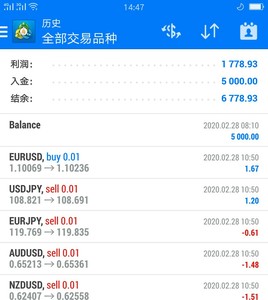
Haha, pay, 5,000 US dollars, if you don't pierce this layer of paper for you, it will be enough for you to toss for three to five years, and maybe you will lose 10,000 US dollars in three to five years.
Copyright reserved to the author
Last updated: 08/02/2023 02:48
Add

Trading is a very flexible "business". As long as you want, you can go long or short at any time. However, it is specific to whether it is correct, as you said. Rules are needed.
What are the rules? The rules are based on the operation of entering and exiting system signals under correct logic. Intuition is some self-feeling formed over a long period of trading. In fact, it is not so much intuition and feeling as it is a habit. Of course, habits are also divided into good habits and bad habits. Those bad habits (for example, stop loss, anti-order, emotional entry and exit, chaotic fund management, etc.) will make you gradually become emotional in trading, and will slowly devour your funds.
I personally think that this kind of problem should be classified as a psychological factor. Trading rules cannot be enforced and memorized, but should be self-suggested, suggesting to yourself that such rules are to help you improve your accuracy and profitability. In the process of trading, don't force yourself to suppress the irrational side in your heart, and improve step by step from opening and holding positions.
In this way, slowly, we will form a good start. Only in this way can we have good habits.
Copyright reserved to the author
Last updated: 08/03/2023 20:01
Add

Will I take into account but only limit to the opening stop loss or will strictly stop the loss according to the system
Copyright reserved to the author
Last updated: 08/02/2023 07:11
Add


I think you have the idea of intuition because your trading system is not mature enough, so the problem of intuition arises. Generally, mature traders have formed their own trading mode, and the entry and exit are very clear. Now that there is a clear entry and exit, intuition is useless, too much reliance on intuition will give you the illusion that intuition prevails over everything at critical moments, and you will eventually doubt your trading system.
Copyright reserved to the author
Last updated: 08/06/2023 09:05
Add

Learn the process of trading, see the market and trading as a chaotic whole, then cut the market and trading paths, classify them, and then integrate them into a whole. It’s like looking at a house from a distance, it’s just a small black spot, and then looking closer, there are doors and windows, and when you get closer, the details of the doors, windows, wall tiles are clear again, and then you go farther, the house is still a small black spot, but This black spot, you already know what it is
Novice subjective judgment subjective operation - evolved to subjective judgment and relatively objective mode operation - then evolved to objective judgment objective operation, then evolved to objective judgment subjective operation - finally subjective judgment subjective operation
This is the line of development that conforms to the law of cognition.
Whether you want intuition depends on which stage you have evolved to. You have experienced objective judgment and objective operations, and you know the limits of intuition and the characteristics of intuition. Only in this way can you understand how to use intuition well.
Copyright reserved to the author
Last updated: 08/09/2023 19:26
Add
This...both are important. If your intuition is contrary to your judgment, it will be difficult for you to stick to it, so first verify whether your intuition is reliable
Copyright reserved to the author
Last updated: 08/02/2023 11:36
Add

Whether the evaluation is OK or not depends on whether it can be profitable. After trading statistics for a period of time, you will be able to draw evidence of whether your intuition is trustworthy, and then design and optimize intuitive operations on this basis.
The conclusions drawn through the observation and analysis of statistical data can show whether you can trust your intuition in the transaction, regardless of materialism, the method that can make money is a good method.
Copyright reserved to the author
Last updated: 08/02/2023 06:16
Add

To be honest, I believe in intuition, that is, trading sense, but if you are a novice, you still have to follow the rules to make orders, and it is easy to make mistakes without rich experience.
Copyright reserved to the author
Last updated: 08/01/2023 12:07
Add

0
work
0
subscriber