


Stay in touch!
Subscribe to our newsletter to get the latest updates on live market analysis, trading strategies and more. You can unsubscribe anytime.
By subscribing, you agree to Trading.live Privacy Policy.


I share a break-even trading strategy , which I haven't used yet. If there are big guys who have used it, we can chat.
Trading Strategy 1
It is said to be a secret break-even trading strategy . It can bring up to 50% profit per month, and in the first few days of use, it can increase deposits by 5-10%. The essence of the strategy is to find a certain number-price channel on the currency chart . This model has been well documented. Any trading system does not need any indicators. All one needs to do is find a price channel, then wait for it to break down, set a price for that, and enter the market. Under the following rules, this strategy becomes a win-win:
① It is recommended to choose a time interval - one hour (H1);
② Two ascending vertices should be formed on the graph - one above the other;
③ Transition to D1 and find two incremental vertices (if necessary);
④ Connect the points and expect failure. This is the signal for a deal.
It is worth mentioning that the direction of the trend can be ignored.
① Wait for the subdivision to happen on H1 down and open a transaction to sell after the rollback;
②You can wait for the following retest and sell;
③ If further confirmed by disagreement, the entry point is strengthened;
④ The stop loss must be set approximately equal to the distance of the price channel;
⑤ Fixed profit when the price moves in the right direction by a distance equal to two stop losses.
Trading Strategy 2
The next win-win strategy for trading deals is called "Master Stars". If you open the charts EUR/AUD and AUD/USD for comparison, you can see their mirror images with the naked eye. On this property of these currency pairs, this trading strategy will be built. It provides simultaneous opening of two orders: EUR/AUD to execute buy, and AUD/USD to sell. A trader's position should be held until the trend returns to the general trend. Once completed, both trades will bring profits to the trader. For best results, consider the following:
① A certain time frame in this system is not interesting. You can enter the market on any of them.
② After more than 20 points in the correct direction, determine the suggested profit;
③ No stop loss is set, if the price goes to the other side, another order is opened;
④ After profiting from a transaction, it is worth opening a new transaction in the same direction;
⑤ A maximum of five orders may be opened. If the price goes against it, after 120 points a new parameter will be opened with the same parameters as the previous one. If the price again exceeds 120 pips against the trader, a third trade is made in the same way, and so on up to five trades;
⑥Consider the news, if you want to receive important news, do not enter the market;
⑦ Simultaneously, only the first orders of two currency pairs are opened, then it is necessary to consider the schedule of each currency pair separately;
⑧Before buying or selling, it is necessary to analyze and determine the general trend, slope angle and other important indicators, which will become another signal to enter the market.
money management
We all know that in order to minimize losses, one strategy alone is not enough. Fund management and sober assessment of risks in transactions are very important. Without this, any strategy can run out of deposits. Management is an important part, without which, the breakeven system will not function properly. It is important to observe the following rules:
Enter the market in small quantities. It is necessary to rely on the number of deposits to calculate their size. Each trader decides how much he is willing to risk on each trade, but it is recommended not to exceed 5% of the deposit amount;
The choice of leverage should be no less than 1:100 and no more than 1:500;
Other transactions can only be carried out if the first transaction can withstand the withdrawal at a rate of 1000 points;
Follow the clear instructions of the strategy and don't make decisions guided by emotions.
It is possible to actually reduce the loss to zero. Above are the management policies and rules that will help to achieve this goal. Everyone decides which trading system to choose. The important thing is that thanks to any of them, you can achieve excellent results and, as a result, permanent profits.
Copyright reserved to the author
Last updated: 08/04/2023 11:39
 Add
Add


I believe that everyone who is engaged in trading, no matter the novice or veteran, is tirelessly looking for a trading system that suits him, is effective, and has remarkable effects. In the previous article, Sleeper explained the content composition and establishment method of the trading system piecemeal from various angles. Today, I take this opportunity to formally summarize and talk about the trading system in a comprehensive way.
1. Three elements of transaction
First, it is an old-fashioned concept, the three elements of a trading system, market analysis, fund management, and trading psychology training . To create a complete trading system, you must work hard on these three aspects.
First, market analysis. There are two problems to be solved in market analysis, ① where to enter the market, and ② where to exit . Market analysis must give relatively fixed and high-accuracy entry and exit signals.
Market analysis can be roughly divided into two types: chaos school and trend school, and the two concepts are completely different. From the perspective of pure probability, the chaotic school believes that the market has no obvious trend and direction, and trading is nothing more than "order + hold". The trend group starts from judging the general direction of market development, and believes that the market must have a clear trend direction. Once the trend is formed, the market will move forward with a high probability. The ideal of the trend group is to enter the market at the beginning of the trend. When the trend ends, leave the market. The focus of the trend school is to analyze what stage the current state of the trend market is in.
Market analysis can be divided into fundamental analysis and chart analysis in terms of means , both of which can be called technical analysis. Fundamental analysis starts from the perspective of the overall economic and ecological environment of an economy, and uses various news events and financial data as parameters to judge the overall development level of the economy, thereby judging the development of financial markets such as the exchange rate, stock market, and bonds of the economy Direction, suitable for strategic transactions with large funds and long periods of time. The technical analysis method used by the vast majority of traders is still chart analysis. Chart analysis believes that the transaction price reflects everything and determines everything. With the transaction price as the basic parameter and various technical indicators calculated through various weightings, it belongs to the analysis of the campaign tool. As for the specific application of various technical indicators, it can only be regarded as a tactical action.
Second, money management. There are also two problems to be solved in fund management, ① protect your account from fatal losses, and ② provide a reasonable growth rate for your account . The task of fund management is to give accurate stop loss points and reasonable positions.
The concept of fund management requires you to start from the perspective of loss prevention, learn to stop loss before learning profit. In the casino, the situation of opening twenty hands in a row only happens occasionally, but in the trading market, it often happens that the loss of twenty times in a row occurs, but most people have a mental breakdown before losing twenty times in a row. Triggered a liquidation. So the basis for stop loss is very simple, which is to ensure that your account has as many transactions as possible. If you take one-twentieth of the account as the absolute stop loss amount, then your account can fail twenty times, and if you take one percent of the account as the absolute stop loss amount, then your account can fail one hundred times . As for the specific ratio to use, it depends on the winning rate and profit-loss ratio of your trading strategy. The higher the winning rate and the higher the profit-loss ratio, the larger your stop loss amount can be, and vice versa. There is a balance point between the winning rate and the profit-loss ratio. Without considering the handling fee, if your winning rate is one-third, your profit-loss ratio will exceed two to one. If your winning rate is one-half, you The profit-loss ratio is more than one to one. If your winning ratio and profit-loss ratio are not balanced, then you are destined to lose everything, stop as soon as possible, and study how to improve the winning ratio and profit-loss ratio. It should be noted that the loss of the profit-loss ratio refers to the stop loss loss. If the loss is caused by your bad behavior such as placing orders indiscriminately, carrying orders, etc., it is meaningless to calculate the profit-loss ratio.
Knowing the absolute stop loss amount, and then according to the amount corresponding to each point of your trading variety, you can easily calculate the stop loss points of one standard lot of the current variety. In actual trading, this point is related to your position. The heavier your position is, the smaller the stop loss point will be for the same stop loss amount. Except for ultra-short-term trading, you don’t need to look at the technical form and directly set the stop loss point. The stop loss position for medium and long-term trading must be at the position where the current trend form is destroyed. For example, if you go long after a callback, then the stop loss is below the callback point. If you go long at the breakout position of the box, the stop loss is inside the box. If you use the moving average to go long, then the stop loss is below the moving average. Once you know the number of stop loss points and the stop loss position, you can divide a space and expand the range of a stop loss point from the stop loss position along the direction of your transaction. Only the trading opportunities in this range are the most important for you. Yes, it meets your money management requirements. When you want to place an order outside this range, you are actually taking an unplanned risk. In order to make the risk meet your expectations, you must reduce your position and keep your absolute stop loss amount unchanged. But reducing the position is to reduce the profit expectation, so it is never cost-effective to take unplanned risks to trade.
In terms of account growth rate, fund management is not something to be taken for granted. It is also related to the winning rate, profit-loss ratio, and holding time of your trading strategy. The long-term and short-term trading concepts are quite different, and probably no trading strategy will combine long-term and short-term trading. So according to your suitable trading time, you can easily estimate your approximate number of transactions per year. For short-term intraday traders, it may be hundreds of times, for mid-term traders in units of trading days, it is dozens of times, and for long-term traders in units of weeks, the number of transactions is at most a dozen times a year. Then based on your winning percentage and profit-loss ratio, you can estimate your approximate annualized rate of return. When you make a trading plan, you should take this rate of return as your profit target. Any other target is a fantasy without any basis. Maybe you are lucky and you will get a return that is much higher than expected, but it is hard to come by. You can never make the uncontrollable, the unpredictable, the object of action . With the increase of profits, in order to maintain a relatively stable account growth rate, you also need to increase your trading positions according to the growth of your total positions. Of course, after you have suffered a major loss, if you want to continue trading, You have to reduce your trading positions, and at the same time lower or even cancel your profit expectations.
3. Trading psychology training. Trading psychology is different from trading skills. It is not something you can master by reading a few books and taking a few classes. It must go through practical training to produce results. In the previous article, Drowsyman specifically talked about the content of trading psychological training, you can refer to it. The following is a link to an article by Sleepy Home about trading psychology training.
https://www.huihu.com/answer/78757
2. Inspection of trading system
No matter what kind of trading system you get, the first thing you need to do is to test it. The purpose is to get the following four key parameters: first : ratio of placing orders to positions, second: trading frequency, third: time of holding orders, Fourth: Winning rate and profit-loss ratio, you must use a certain number of trading samples as a basis, and obtain the above four parameters through statistical analysis, and then you can specifically analyze whether your trading system is an advantage or a disadvantage. An advantageous trading system must have the following three characteristics: 1. Avoid heavy losses and liquidation, 2. Stable account growth rate, 3. As few account retracements and retracement ratios as possible . Through the statistical analysis of the sample pair, you can find out what affects your system to become an advantageous system, and you can also find out where your system is inferior to, so that there is a basis for improvement.
3. Trading philosophy
There is no master trader who does not talk about trading philosophy, and no novice trader does not hate trading philosophy. Most losers think that trading philosophy is the most empty and useless thing, while other losers equate trading philosophy with trading maxims, thinking that The trading philosophy is easier said than done, it can be said but not practiced. In fact, the trading concept is the most important thing, and the concept is the fundamental basis for a person to do things. The reason why many trading strategies that have been proved to be very successful in history cannot benefit most people is because they do not agree with this method in concept. When you learn a new trading strategy, you will subconsciously think about where the strategy is and where it is unreliable. In fact, it is the judgment given by your own trading philosophy. Everyone has their own trading philosophy, but some people know it clearly, some people don't know it in a daze, some people's philosophy is brilliant, and some people's philosophy is muddled. Here I don't want to copy and paste too many trading maxims, but just say a few trading ideas that are obviously wrong but very marketable, and friends who are itchy can take their seats;
1. The concept of causality. This kind of trading philosophy is the most marketable, and I like to talk about why everything. Today, the A-share market has soared, and a bunch of people on the Internet are asking why. Among the logical relationships in the real world, the law of causality is the most important and obvious one. However, in the trading market, there is no necessary causal relationship between something and a certain market, or between the state of a certain indicator and a certain market. Whether there is a causal relationship in the trading market is still unknown. Believers in the law of causality believe that the next time a certain phenomenon occurs, it will bring a certain market result, but what awaits them is often exceptions again and again.
2. The concept of chaotic world. Buddhists say that the world is empty, and many people are obsessed with it. Trading is the same. Many people can't find the law of causality in the market, and instead believe in the concept of chaos. They understand the market from the perspective of pure probability. Certain successive phenomena are listed in detailed tables according to the law of probability distribution. This is nothing more than changing the absolute law of causality into a relative law of causality, and probability statistics are not acceptable in the trading market.
3. What should the market be like. After trading for a long time, you will always hear or see many people, there are losers and there are winners, explaining where the market should go tomorrow, here is the top, there is the bottom, what's more, I like to draw some The messy extension lines seem to dig a river for the future market, and it seems that the market is his dog, and it will go wherever it goes. In fact, it is the causal thinking. The market never does what it should. It always does what it wants. On the contrary, we traders should do what we want when the market goes wrong.
4. Give it a go and turn a bicycle into a motorcycle. In fact, the possibility of making huge profits in the trading market with micro accounts of hundreds of thousands of dollars is almost zero, but the vast majority of retail investors have such a mentality, fantasizing about a 10% and 700% compound interest growth every day The game is like an idiot's dream.
Copyright reserved to the author
Last updated: 08/04/2023 17:47
Add

The key to whether a trading system is valuable is to pay attention to whether the capital management system of this trading system is perfect, because any trading system can make money, but not any trading system can control losses or control retracements. It is time to make money. All make money, if you can control the retracement and reduce the loss when you lose money, then you can make stable profits.
Copyright reserved to the author
Last updated: 08/12/2023 07:14
Add

How to find a valuable trading strategy, first of all, you need to determine your own market position. (short-term, long-term, band, trend)
The key is to do the next step of sorting out, because there are tens of thousands of trading systems in the market, and everyone has their own trading system.
Then we only need to find our own attributes, so we can carry out the next trading behavior only after we have done a good job of personal market positioning.
Regarding the search for valuable trading strategies for novices, I think we can start with the following methods.
First: Remember the market trap
Understand which restricted areas are absolutely prohibited in this market, such as heavy warehouse trading, dead weight, frequent orders and other trading shortcomings, and keep in mind market traps,
Put an end to these bad trading habits. Only by jumping over these pits can the subsequent trading basis be established to have a high probability of success. Always remember that in this market
Slow is fast, and it is better to give up part of the profit points than to have the risk of mining pits, so that you are most likely to become a constant victorious general.
Second: real offer & simulated two-way operation
The definition of this point is to quickly find the market feeling to trade, and the order established by the real offer is when the trader thinks that there is a high probability of profit
For the transactions made, the simulated disk is constantly testing and verifying its own theory, and summarizes the market through most of the simulation exercises.
On the one hand, it can enhance the sensitivity to the market and the verification of its own prototype system, and the most important point is to avoid the loss of principal for novices.
Third: On the basis of following the first and second points, continue to try and make mistakes, increase the sensitivity to the market and its own trading attributes,
Continue to try in the follow-up, gradually form your own operating style and system , and finally find a trading method that suits you.
Finally, let me briefly talk about the basic composition of the trading system , the key factors of opening, adding, reducing, stop loss, and how to make a profit.
Think of the trading system as an EA system, you can find the essence of each step of your own, and achieve a reasonable integration, and then your system will be almost done.
Readers, if you are interested in my answers, please pay attention to my Huihu account. I will answer some industry-related questions regularly, not seeking the most professional, but seeking the most authentic.
Copyright reserved to the author
Last updated: 08/06/2023 20:04
Add

Haha, it is a good thing for the subject to be curious, but for a newcomer to ask such an advanced question, I am afraid that he wants to take a shortcut. This is like asking how to solve a function after learning addition, subtraction, multiplication and division. It is the same logic. It’s not that I don’t want to reply positively. It’s true that you can’t understand it even after replying. I can say with certainty that with so many replies, there must be no more than three that the subject can really understand, so I can only offer you some suggestions. That's all.
What are valuable strategies for newcomers? Then study hard and practice a lot. Learning means that a newcomer is like a sponge, and it takes years to learn and absorb various trading-related theories and various indicators. This is the foundation.
First of all, learn some well-known theories and commonly used indicators. Fundamentals are rarely studied, because they are of no value to a trader (traders care about risk and profit, and fundamentals are researched by analysts. Of course, if you have enough I have no objection to time and interest), you have to go through all the learning process once or even 2-3 times, otherwise, you will not build cognition and recognition ability.
Furthermore, it is practice. Practice is to go through all the theories and indicators learned N times, why N times? Because real knowledge comes from actual combat, this is the only way to establish trading values. No one should imagine that you want to avoid it. Profound (I will provide you with the essence of trading here. The essence of trading is to cut losses and let profits run).
Finally, after 3-5 years have passed, you have firm trading beliefs, a correct trading outlook, and a solid basic reserve, and you can start to study trading systems and trading strategies. Then use another 3-5 years to accumulate and sublimate yourself, so that your sword can be sharpened and sharpened!
Note: If you meet a good teacher, you can save 3-5 years of time.
I wish the new people an early start! I wish the veterans enlightened as soon as possible!
Copyright reserved to the author
Last updated: 08/06/2023 11:01
Add

The "trend" establishment method of the three elements of trading "trend + timing + kinetic energy"
Before answering this question, let me make four important points:
1. Trading is a profession, which cannot be compared with gambling and lottery.
2. You have to suffer a lot of grievances in the early stage of this career, and this grievance will last for a long time. You have to ask yourself whether you can bear it.
3. This occupation has almost nothing to do with diplomas, academic qualifications and working background. For example, the Bank of China was confused by the United States. It dared not tell the Americans if it complained. When it returned to its own country, it used its privileges to force its demands. Customer Indemnity. So what plays an absolute role? Recognize human nature, and always recognize your insignificance! Awe of the market, humble heart and the nail spirit of exploring the truth. I often say a word, "It's the market to enjoy the food!".
4. Never compare the international capital market with the Chinese financial market. For example, China's stock market.
I declare in advance that I am a typical actual combat player. To be precise, 90% of the trading techniques come from my years of experience in the market. thus becoming its own method.
Okay, let me talk about trading strategies next.
The most effective trading strategy: breakout and support.
Ability that must be possessed: drawing trend lines and analyzing naked K.
To improve technical ability, read more disks and less technical explanation books. It is best not to read technical explanation books written by Chinese, unless the book is good.
Explore the fundamentals, learn more about American politics and American history, and less entangled in statistics.
I mentioned in yesterday's article that the effective points for establishing breakthroughs and supports are based on three elements "trend + timing + kinetic energy"
Today, in this article, I will focus on explaining to you how to establish the "trend" element
①The best way to establish a trend is to "draw a trend line"
It is mentioned in "Wave Theory" that two points determine a trend line. I tell you not two points, but at least three inflection points.
why? There is a saying in China, "Once again, twice, never three." Confirming a trend line at three points will definitely enhance the accuracy of your judgment on the trend.
②Periodic chart is preferably "daily chart"
Whether it is an intraday strategy or a band strategy, the reference period must be determined. I have seen too many people who can't look at 3 cycle charts in one transaction, but the transaction is a mess. The essential problem is not to interpret the naked K of the daily chart.
I suggest that beginner traders trade in the international market and train themselves to understand the naked K on the daily chart. As for my naked K tactics, I wrote an article about training to watch naked K this week, you can find it.
A cycle chart, preferably a daily chart. Some people say the four-hour chart, but I don’t think so from experience. The hourly chart is a way to confirm the timing of entry, and it is not very helpful for confirming intraday or band trends.
③Auxiliary one or two trend indicators
The international market is divided into three trading sessions every day, Asian trading, European trading and US trading, there must be some invalid K-lines and emergencies, so the assistance of indicators will help us reconfirm the validity of the trend.
There is no specific recommendation for this, it can be based on personal trading habits.
Tomorrow I will write about the "timing" establishment method of the three elements of trading "trend + timing + kinetic energy".
Copyright reserved to the author
Last updated: 08/02/2023 21:31
Add

Share a <flag+ABC> strategy
PATTERNS AND GRAPHICAL FOREX MODELS FOR TRADING
"flag" mode
It's very common in the currency market, but not surprisingly, usually everyone describes it as a good pattern, but after seeing this graphic combination, basically no one has detailed a clear, workable forex market entry strategy. . I recommend this combination - "Flag + ABC", consider a fairly simple system to enter the market.
It often follows a prolonged or sudden movement and is nothing more than an area of consolidation where the subsequent trend continues. For trading, I recommend choosing Forex Center with Metatrader 4.
Consider the essence of the Forex strategy "Flag + ABC":
1. We detect wild swings - an impulse - on the price chart and observe how future events will develop.
2. The thing to remember is that after intense exercise, there is often consolidation, and that's what we're waiting for.
3. With this forex strategy, there is no need to agree on the first rollback - you have to wait until we see the "flag" pattern complete.
4. Our task is to wait for three waves on the price chart: A, B, C in the "flag" pattern (see example below):
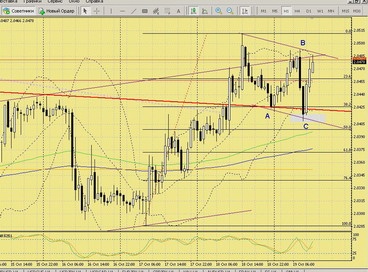
6. However, it is always worth remembering that ABC alone is not an excuse to close a deal.
Because for that entry you need to find at least 3-4 trade signals - this could be a divergence, rollback based on Fibonacci levels (if our point C happens to be at 38.2 or 61.8% Fibonacci levels then is a very good upward move).
7. At the same time, once the movement has been determined, and roughly have points A and B - through the top (the opposite is the downward movement), and point B is a straight line and parallel to it, establish a parallel line through point A - after that, The channel is drawn.
8. Until now it was not possible to place a limit order to buy or sell accordingly, but don't forget about additional trading signals - such as Fibonacci or divergences, withdrawals, support and resistance lines, channel lines and tP.
9. After taking a profit I recommend doing a haya or census of lows respectively, or pulling a safety stop high in positive territory with the help of a trailing stop.
10. Safe Stop - set at the next Fibonacci level - say 50% or preferably 61.8% - if C falls 38.2%, etc. - If it goes down 61.8% - we set it to 76.4% - I don't recommend going any further because then the market can turn around.
11. Don't forget that the market is not perfect, sometimes point C won't reach or go below the corrective channel line (so if limit order doesn't work then buy at market price if the reversal bar has formed).
12. Remember to comply with Mani Management ⇒ and don't forget that these combinations don't always appear and need to be tracked on different timeframes (even weekly) from M1 to D1.
Copyright reserved to the author
Last updated: 08/06/2023 07:59
Add

In the entire trading market, everyone will have their own different trading strategies. Some people use the wave theory, some use a combination of various indicators, and some use their own "unique" technical indicators to trade and so on. In fact, everyone is trying to find a trading system that can explain the market more accurately. Even if the teacher comes from the same source, the answer will be different.
Therefore, I think that valuable trading strategies are not existing in the market and can be used immediately, but a trading system that is slowly formed during your trading process and conforms to your own personality. Instead of looking for other people's trading systems, it is better to try to build a trading system of your own;
How to build your own trading system: (some ideas)
1. What kind of transaction is suitable for you.
Before building your own trading system, the first thing to solve is what kind of trading you are suitable for. Specifically, the following factors can be referred to:
Winning ratio and profit-loss ratio. When choosing a trading strategy, do you prefer the winning rate or the profit-loss ratio? A low winning rate and a high profit-loss ratio mean that you have to face the result of entering the market with a high probability of stopping losses. This will be a negative impact on your own funds and mentality. A big test; high winning rate and low profit-loss ratio, which means that you will miss most of your profits when you encounter a trending market or a big market. Of course, a strategy with a high winning rate and a high profit-loss ratio is the first choice.
Trading cycle: Are you suitable for intraday short-term or mid-to-long-term, whether you have the habit and opportunity of keeping an eye on the market for a long time, etc. These are all factors that need to be considered.
Method: What kind of trading strategy are you used to, indicator combination or price action; whether you are used to breakthrough trading, whether you belong to the left side of the trader or the right side of the trader, etc. In short, you must fit your own reality.
2. How does your own strategy describe the market.
We know that market movements are uncertain, non-linear markets. The analytical ideas we use can only fit the market as much as possible, not all market conditions can be understood and operated by us. Therefore, it is necessary to conduct a lot of review to observe under what circumstances, the strategy you choose is effective, why it is effective, and next time you encounter a similar situation, will the market still be effective? When is it invalid and why is it invalid?
3. Refine your trading steps, everything is as expected.
What is the basis for entering the market, what is the standard for increasing and reducing positions, what is the principle of holding positions, and what is the basis for exiting the market, etc. Only by being picky about such transaction details can you be in the process of trading. It will not affect your own position mentality and emotions because of the beating of the account amount.
4. Money management. What size position is used for this transaction, what is the acceptable loss amount, what is the ratio of increasing positions, and what is the ratio of reducing positions. When other varieties also have trading opportunities, what is the position to enter the market, etc.
5. Afterwards summary. Cultivate the habit of writing a trading log. Writing a log is not only to count your own transactions, but more importantly, to use the log to improve your transactions and record your mental journey of trading positions.
The above is my idea of building a trading system; trading is my own, and only by establishing a trading system that suits me can the trading market survive in a long-term and stable manner. This is the most valuable trading strategy.
Copyright reserved to the author
Last updated: 08/06/2023 12:56
Add

A valuable trading strategy is one that fits your trading style. It really depends on what type of trader you are. Are you looking for manual trading or algorithmic trading (EA)? Do you prefer a shorter time frame or a longer time frame?
If you are a novice trader, it is best to start with algorithmic trading as there is a lot of emotion involved in manual trading and the chances of losing money are greater.
I've been trading for over four years and I've seen many examples of people exiting badly, especially when I work for a broker. Most clients (and we are traders) get lost in this emotion. This is why I can say that the most valuable forex trading strategies are those that avoid emotional swings.
Now, if your trading strategy does not have a strict money management strategy, then you are running a huge risk. Even if the strategy is profitable, you can lose money on a few trades if you place the wrong lot size based on your account.
Very important: Every strategy has periods of failure. It is normal for a strategy to have 8-10 losing trades in a row. If you have several profitable trades and you increase your lot size greedily, you may experience consecutive losses, which will seriously affect your account.
Copyright reserved to the author
Last updated: 08/05/2023 05:04
Add

My approach is to follow the simple operation:
①It is necessary to know some information about foreign exchange, how it works, some basic knowledge and have at least one month of trading experience.
② Only one currency pair is open: EUR/USD; GBP/USD USD/JPY, any currency pair you want.
③Open the H4 and H1 charts to check the market direction, rising or falling, or in the corridor.
④ Draw levels on H4/H1 time frame, then open M5 chart and start trading between levels, just use basic forex knowledge – candles, classic patterns, graphs…
This is the most simplified valuable strategy that can bring weekly profits.
PS: There are so many trading strategies on the web, so if you don't believe in the method, you can search for another strategy and test it in live trading.
Copyright reserved to the author
Last updated: 08/05/2023 11:08
Add

What is a valuable trading strategy?
There are more than tens of millions of trading strategies in the market now. According to the understanding that existence is reasonable, they should all be valuable. But the question is, can all these valuable trading strategies bring investment returns to investors? The answer is of course no, otherwise the zero-sum game cannot be played.
The value of any trading strategy is relative. It may be beneficial to some people, but it is not helpful to others. The premise is to see whether investors agree with the trading strategy.
Therefore, instead of looking for a valuable trading strategy, it is better to find a trading strategy that suits you.
So, how to find a trading strategy that suits you?
Although there are various types of trading strategies, they cannot escape the distinction between low-frequency and large-band, fundamentals and technical aspects; therefore, in order to choose or build a trading strategy that suits you, you must be clear about which genre you belong to , and then study according to the classic theories of related schools, so as to sum up your own trading strategy.
For example, if you are technical, then Sakata tactics, wave theory, etc. are essential; if you are fundamental, then grind your Kangbo cycle and so on.
I feel that the answer is a bit out of the question. I don't know if the questioner can understand what I mean?
Copyright reserved to the author
Last updated: 08/05/2023 13:31
Add

First, the trading logic is in line with market principles, and cannot be the analysis of probability events, everything must be based on the nature of the market
Second, technical analysis is mostly a probabilistic event, and the winning rate is different in different cycles. This is also the reason why many people make money today and lose money tomorrow. I am luck, I think it is strength, this is the crux of the problem
Third, there must be clear entry and exit rules in the trading system, and orders can be floated under appropriate circumstances, but anti-orders are not allowed
Fourth, the essence of analysis is prediction. The process of prediction should be logical reasoning. The starting point of reasoning should be something that exists in the market itself. For example, various graphs, models, and indicators do not exist in the market itself. Another example is Gann theory, Wave theory, turtle trading, etc. are not things that exist in the market. These are all artificial inventions, and define a set of concepts, and then study the things you define yourself. The essence of the market is money and people, only need to study funds The flow is related to the participants, and everything else has nothing to do with the market
Copyright reserved to the author
Last updated: 08/05/2023 15:57
Add


First of all, a trader who can make stable profits for a long time needs to have a complete set of trading models. Only on this basis can he gain a foothold in the market. However, this does not mean that he can make stable profits. Your capital management + execution + market awareness Cognition + good attitude + risk control... are all very important
Copyright reserved to the author
Last updated: 08/08/2023 21:07
Add

Complete trading system, the name of my trading system: ATM trend trading method (full manual trading) trading system details: K-line cycle: daily K (D1 chart), moving average: 55 entry point: long: (BUY) Buy point 1, golden cross. Buy point 2, the backtest will not break. Buy point 3, slightly below. Short: (SELL) Selling point 1, death cross. Selling point 2, backtesting failed. Selling point 3, a small breakthrough. (According to Ge Nanwei's eight major trading rules and wave chart improvement) 1. Entry: (A is the vertical distance from the moving average to the entry price, B is the vertical distance from the stop loss line to the moving average). 1. When 0≤A≤100 points, B=100 points. 2. When 100<A≤200 points, B=200-A. 3. When 200<A<334 points, A’s pending order price A1=A*0.6, B=0. (Pending order enters BUY/SELL LIMIT) 4. When A≥334 points, A’s pending order price A1=200 ,B=0. (Pending order enters BUY/SELL LIMIT, the period of pending order is 30 days) 2. Position: A single loss is within 2% of the total funds in the account. 3. Exit: moving stop loss line 1. When the floating profit exceeds the initial stop loss and steps back to stand firm, move the stop loss line to 60% of the initial stop loss point. 2. When a single K-line entity exceeds 200 points, move the stop loss line to 1/2 of the K-line entity. 3. When the market breaks through the previous high or previous low and steps back to stand firm, move the stop loss line to the previous high and previous low. *Pay attention to the details of the operation: 1. Identify false signals (the opportunity to enter the market with a low winning rate.) 2. The art of exiting (better and better move the stop loss line to exit the market) Note: This trading system is based on the historical gold market, and the golden day is reviewed line for 14 consecutive years, with a total of about 120 orders. The historical review data has a clear winning rate, profit-loss ratio, maximum retracement, maximum number of consecutive losses, etc. Welcome to communicate and discuss with foreign exchange traders and friends all over the world.
Copyright reserved to the author
Last updated: 08/09/2023 08:29
Add

Valuable trading strategies, in fact, have various methods in the market, as follows:
Fundamental Analysis - In this case, traders will be good at grasping the fundamental indicators of the economy in order to try to understand whether a currency is undervalued or inflated, and how its value may compare to another cash. Major surveys can be deeply confusing, including numerous components of a country's currency information that can reveal future patterns of exchange and speculation.
Technical Analysis - is another major classification of currency exchange systems, especially popular among brokers. Periodically, it involves looking at the past and ongoing behavior of cash value excursions on a graph to identify where that might be driving the process. Utilizing professional exams is based on the fact that many brokers accept that the development of advertising is ultimately determined by supply, demand, and mass market brain research that establishes limit points and ranges, and floats up and down in cash costs.
Trend Strategy - This is one of the most famous and conventional methods of Forex trading. It includes distinguishing between rising or falling patterns in the cash value development and selective exchange segments, and setting priorities based on the location of money costs within the pattern and the relative quality of the pattern.
Range Trading - This is a basic and mainstream approach that depends on the likelihood that costs can stay within a consistent and unsurprising range on a regular basis over a given time frame. This is especially evident in the world of commerce, including stable and surprising economies, in forms of money that don't usually get the attention of the press.
Momentum Trading - Momentum trading and strength markers rest on the idea that reliable value development in a particular way is a likely sign that the value pattern will head down that path. Likewise, frustrating developments suggest that a model has lost quality and can be raised against an inversion. Force methodologies may take cost and volume into account and regularly use surveys of real-world helpers such as oscillators and candlestick charts.
Swing Trading - This is usually a medium-term swap method and is usually used within one to seven days. Swing traders look to build "swings" into exchanges of highs and lows in a more defined time frame. This is to screen for some "movement" or sporadic value developments that occur during intraday trading. Also, avoid setting stops with barely set opportunities, which may limit their trades to being "stopped" during extremely brief market developments.
Breakout Trading - Here the trader will try to identify a trade passing point on a breakout from a recently established trading range. Brokers may be tempted to buy in the hope that cash will continue to rise on the occasional chance that the price breaks above a high from the level of opposition on the recent feature chart. Also, if the value breaks help within a certain range, the dealer may sell the plan to buy cash at progressively increasing positive prices.
Pullback - This technique depends on the probability that the cost will never move in a straight line between highs and lows, and will usually be somewhat centered in the larger way between solid support and opposition levels Breathe and change.
Reverse Exchange - As the name suggests, a reverse exchange is when a merchant wishes to envision an inverse exchange in a value model in the hope of securing an exchange prior to entering the market. This technique is considered progressively cumbersome and dangerous. True inversions can be difficult to spot, but at the same time, they are more satisfying if they are accurately predicted.
Position Trading - This is a long-term system that may last for weeks, months or even years. Position traders regularly base their approach on the long-term macroeconomic patterns of various economies. They likewise often work with lower leverage and smaller deal sizes, hoping to potentially benefit from large value developments over an extended period of time.
These merchants must rely on strict inspections and special markings to determine their entry and exit levels. This exchange may require merchants to display a greater degree of persistence and stamina, and may not appeal to those trying to make a quick buck in a day exchange environment.
carry trade
This is an outstanding class of forex trading that seeks to increase returns by taking advantage of differences in funding costs between countries in the form of currency being exchanged. Typically, buying and holding a medium-term form of currency will pay the dealer the interbank cost of the country where the currency is purchased. Whether traders would seek out the currencies of countries with lower funding costs in order to buy cash from countries with higher borrowing costs would benefit from this distinction.
Merchants can take advantage of the process of pattern exchange and communication exchange to ensure that the difference in monetary costs and earned premiums complement each other rather than cancel each other out.
Pivot Points - Turn Guides Exchanges seek to decide opposition and support levels based on normal values of high, low and liquidation costs from past exchange sessions. Think of this normal value as helpful in predicting the following possible highs and lows and advertise reversals intraday.
Because these midpoints are commonly used in markets, they are seen as reliable indicators of how far an instantaneous pattern is likely to go, whether a particular range is outside the expected range, and whether another value pattern breakout is occurring.
Forex Day Trading Strategies - By definition, day trading is the demonstration of opening and closing a situation in a particular market in a single session. Despite the fact that it is now repeatedly cited as negative, day trading is a legal and allowed method of getting connected to the capital markets. In fact, it benefits professionals in a few different ways:
Forex Scalping Strategy - Scalping is an intraday trading technique, which means that a lot of the time there is little to no benefit to establishing a reasonable primary focus. The exchange is performed by an inflexible structure designed to maintain edge trustworthiness. Capital presentation and fundamental hazards are limited by applying practice advantages multiple times in a tight time allotment.
The content comes from the Internet, any similarity is purely coincidental.
Copyright reserved to the author
Last updated: 08/06/2023 18:57
Add

A trading strategy is essentially a decision about when to buy or sell. This in itself is a very complicated matter: what kind of products do you want to trade, stocks or futures, foreign exchange or gold and crude oil; when to open a position, when to stop profit and stop loss;
They are all inseparable from your prediction of market trends. You can consider it from the perspective of fundamentals, or deduce it by technical indicators.
Well, now that you have a judgment on the market, the trading strategy comes into play. The market calls too many "strategies", such as high-frequency trading, grid trading, T+0, arbitrage trading, especially the strategies derived from MACD, KDJ, Bollinger, RSI and other technical indicators. There are surprisingly many, and there are operations in the direction of fundamentals starting from financial data.
For a strategy to be valuable, my understanding is that within a measurable period of time, transactions must bring profits and exceed the market average.
But there is still a problem. Even if a certain strategy has good returns for a period of time, is it the contribution of the strategy itself or the market itself? And how to guarantee that it will still perform like this in the future? This seems to be back to square one.
Therefore, before looking for what is a valuable strategy, it is better to know the transaction itself clearly!
Copyright reserved to the author
Last updated: 08/01/2023 09:29
Add

If you're asking this question from a beginner's perspective, since I don't know your situation, I can only answer based on my experience. There are many, many forex trading strategies on the market, and most of them have their uses and benefits. As long as you know what type of market the currency pair belongs to and the best strategy for trading it.
If you are just getting started, you need to be able to use the charts to illustrate what the currency pair is doing before you can research strategies. For example, if the currency pair is in a state of consolidation, that is, moving sideways, then a corresponding strategy must be adopted.
etc...
I recommend keeping things simple first. Learn to trade a symbol and learn the strategies that work best for that symbol.
If you are looking for channel-bound currency pairs, this is one of the easiest and safest (low risk of spread loss) trading scenarios you will find.
Next is to draw the channels.
Selling at the top of the channel, your stop loss is wide enough above the channel so that you only lose money when the true channel breaks and take profits at the bottom.
Buying at the bottom of the channel, your stop loss is wide enough below the channel so you only lose money if the true channel breaks, and take profits at the top.
Repeat for as long as the channel remains.
If you add a counter-trend line break above it, you can increase your profits when the channel break is in your favor by not taking profits too early. Minimize entry losses by waiting for confirmation of direction changes.
Once the channel is confirmed to be broken, please move to another channel bound currency pair, or wait for the holding currency to enter the new channel and do the same operation again. These passages sometimes last for months at a time. They are easy to see and easy to trade.
Once you have mastered this strategy for these market conditions, you can add another strategy for different market conditions. Always keep adding. As your experience and knowledge grow, you can add more and more complex strategies. The simple ones still work just fine though, and the strategies above still give me easy gains, even though I can now draw on some very complex strategies.
Hope it helps your transaction.
Copyright reserved to the author
Last updated: 08/01/2023 02:29
Add

Thank you Mengmeng Yingxue for the invitation.
Let me say something first, how is it worthwhile? Is stable profit considered valuable? Is there value in long-term profitability?
How to calculate stable profit and value?
Is Dennis's turtle trading rule a particularly good trading system?
The book clearly tells you how to increase positions, how to carry out systematic position management, how to control positions in detail, and even tells you how to conduct historical backtesting. The question is can you learn it? Can you afford a maximum 50% drawdown? Accidentally liquidate the position, do you think this kind of system is good? Even now, this system is very useful for reference. Many people say that the old logic is no longer applicable. It can only be said that such people are extremely superficial! I think the biggest impact of the turtles on me is the grasp of positions. At present, the largest position range is consistently controlled between 1-5%! Such a system, how can it be given to you?
Blind searching will not help you in any way, the way is simple, learn addition well first.
Copyright reserved to the author
Last updated: 07/31/2023 18:03
Add

An important point, the more complicated the more nonsense. Must be systematic, consistent and replicable. Secondly, since we talk about the system, there is only a method of opening and closing positions, and it is nonsense without a risk control strategy.
Copyright reserved to the author
Last updated: 08/04/2023 06:55
Add

Rich people's route: Find a famous teacher and learn everything from him, and then you need to keep what suits you and throw away the useless ones, and you will be able to quickly and effectively. The poor route: learn all kinds of technical knowledge online, simulate and verify it yourself, and then keep the useful ones and discard the useless ones. The learning time depends on your understanding and depth of reflection. Rich people should be faster, because the teacher will pass on experience and where are the difficulties and shortcomings in all aspects, but the poor have to find out by themselves, just like upgrading in novels, people from rich families upgrade quickly, there is a reason.
Copyright reserved to the author
Last updated: 08/04/2023 20:40
Add

0
work
0
subscriber