


Stay in touch!
Subscribe to our newsletter to get the latest updates on live market analysis, trading strategies and more. You can unsubscribe anytime.
By subscribing, you agree to Trading.live Privacy Policy.


This problem can be big or small. After all, doing a good deal is not a simple matter, but a systematic project.
One, from a big perspective, to do a good deal is to do two things to the extreme.
1. Technology
Technology is actually to create a stable and profitable system. This is easy to say, but not so easy to do. It requires you to constantly explore, summarize, and summarize, and then continue to practice, practice, and improve.
And only a small number of people can create this system, do you have the confidence?
2. Mentality
When you build this system, can you just smile?
That's too early. The system will generate a series of trading rules, and you have to constantly discipline yourself to abide by these rules, that is, to abide by trading discipline.
You might think, isn't it just to observe discipline? Isn't that how we have been here since we were young?
Ha, think about it, haven't you made any mistakes? We have many rules, laws and other external factors to supervise us in school and society, and we may not be able to fully abide by them.
In trading, only you supervise yourself (except the team), you are both a participant and a referee, can you be so self-disciplined?
And often, as long as you don't obey the discipline once, you can go on the road of eternal doom...
then what should we do?
In other words, we often say that you should have a good mentality, which requires you to constantly cultivate your own heart, and this is a road that can never be completed in a lifetime...Of course, where there is a will, there is a way:)
Second, from a young age, to do a good job in trading is to make a trading plan every day and strictly implement it.
When you have a mature system, what you have to do every morning is to preview all possible situations in the market, and have plans for various situations, which is what we often call making plans; and then strictly implement them.
At the end of the day, before going to bed at night, you have to modify or re-formulate your trading plan based on the actual market trend of the day.
However, I feel that the meaning of the topic is not all about how to do a good deal, but about choosing a method genre.
For example, the fundamentals, technical aspects, policy aspects, news aspects, capital aspects, group behavior aspects, etc. you mentioned can actually be classified into two schools: fundamentals and technical aspects.
Which of the two factions is better? This debate has been going on for hundreds of years, so there is no need to pursue it anymore. No matter which method you pursue to the extreme, you can still make a profit.
So how should you choose?
Although in the gold foreign exchange market, I am a pure technical school, I don’t look at any fundamental information at all, and I can survive very well; but I have summed up some experience, you can refer to it, mainly depends on which market you are trading in:
1. Stock market
There is no leverage in the stock market (except for capital allocation). Technical aspects are definitely useful, but fundamentals will also affect stock prices. After all, there are economic cycles. When the economy is bad, most stocks will not do well.
However, no matter how bad the economy is, it can't stand the indiscriminate bombardment of the central bank's currency release. Didn't you see that the epidemic in the United States was so severe last year, and the economy fell into a low level, but the Fed gave you a few times, and the stock market continued to rise.
And the prospect of an industry, whether a company's moat is wide or not, and whether the company's management is good will undoubtedly have a great impact on the company's long-term stock price. Therefore, in the long-term, we must consider the fundamentals.
Unless it is short-term, it may be purely technical.
Summary: In the stock market, the combination of fundamentals and technical aspects should be better, each accounting for 50%.
2. Futures market
The futures market has started to have leverage. Once leverage is added, it is necessary to focus on technical aspects; however, the supply and demand relationship of commodity futures still has a great impact on long-term trading. Therefore, the futures market will have a better grasp of the general direction of the market by combining a little fundamentals.
Summary: In the futures market, 75% is technical and 25% is fundamental.
3. Gold foreign exchange margin market
The further expansion of leverage in the gold foreign exchange market is a highly leveraged market, so it is necessary to focus more on technical aspects.
When I first entered the market, I studied the fundamentals every day, but I gradually discovered that the fundamentals are useless at all. When the market comes out, you can explain it in any way that makes sense, but what I said before is better than the probability of flipping a coin. Not much better, so then it went purely technical.
Moreover, I can use my experience of surviving in this market for nearly 10 years to tell you that purely technical aspects of this market can survive very well.
Summary: In the gold foreign exchange margin market, the technical aspects are 100%, and there is no need for fundamental aspects.
(And if you do not use leverage in foreign exchange, it is equivalent to making foreign exchange banknotes, then the technical aspect will be relatively reduced, and it is necessary to study the fundamentals at this time.)
Copyright reserved to the author
Last updated: 08/29/2023 08:08
 Add
Add


Thank you Swordsman Youdao for the invitation. When I saw the topic, I couldn't figure it out for a while. This question has no direction and is a bit too general. Strictly speaking, all our questions and answers are to explain how to do a good deal from all aspects.
I have mentioned a lot of details about trading in many previous questions and answers, such as the construction of trading systems, the improvement of fund management, the reduction of trading expectations, etc. The very peculiar point of the trading field is that it does not allow traders to have any short board. For example, someone attaches great importance to entering and exiting the market, and he has explored an excellent method of entering and exiting the market, but he does not understand the importance of fund management, and ends up with a liquidation, or one person builds the overall trading system very well, but he himself If you can't bear the existence of unfavorable period, you can't execute it. So in terms of trading, he has high requirements for breadth and depth.
In terms of breadth, the topic owner mentioned in the topic description that there are too many things to refer to in the transaction. The technical aspects, fundamentals, capital aspects, policy aspects, etc. are dazzling. We always want to put all the I understand, everything is clear, but for individual traders or some small trading teams, this is impossible. In the end, we can only choose to refer to one or two at most to formulate our trading plan. So, according to my reasoning, can I only specify one reason from the beginning, for example, I only look at the technical aspect or only the fundamental aspect? Will this save a lot of time and advance directly? No, the contradiction lies here.
I once said that a person's trading experience is very important. There are many ways that are obviously wrong or not so correct. When we tell people later, he still doesn't listen. He always has to go through it himself. That's fine, because only in this way can he be unforgettable, and he can know how precious what he finally settled and kept is so precious. My current trading is a mechanical trading system. All the entry and exit, including fund management, trading cycle, trading varieties, how to allocate, etc., are all determined. Someone asked me whether you make orders based on technical aspects or fundamental aspects , this question makes me very embarrassed, because first of all I don't pay attention to the news, so I definitely don't count the fundamentals, but do I count the technicals? Strictly speaking, it is not, because I do not analyze the market, I only deal with the market, the market follows its own, and I only use a set of rules to deal with it. But do my achievements today have nothing to do with the previous research indicators, news, capital trends, etc.? Judging from the results, I didn't use these, so it doesn't matter, but judging from the process, it has an important relationship, because I can't believe in my current trading system without experiencing those, those previous losses, distress, Disappointment and hatred have laid an unbreakable foundation for continuing to operate the trading system today.
Therefore, in terms of the breadth of trading, 80% of the final results may be useless, but in terms of its meaning, it is crucial, and traders still need to learn more , experience more, get rid of the dross, and keep what suits you best.
When you have enough experience and set your own trading direction, the next step is to dig into its role. Here I use an example to illustrate the analysis of depth. For example, the moving average indicator, which is a very common indicator for traders, the concept of a 20-day moving average indicator is very simple, it is just a dotted line formed by the average closing price of the 20 days, many people put it on the trading board, But does anyone really think deeply about the magic of this indicator?
Many people are asking how to judge the trend, how to know the beginning and the end, and the moving average can perfectly answer this question. When you open the disk, you will find that an upward trend must be above the K-line, and the moving average is below it. A downward trend must be below the K-line and above the moving average. This simple moving average perfectly divides the disk into two areas. I can completely define that above the moving average is an upward trend and only go long, and below the moving average is a downward trend and only short. transaction model.
Some people say that this is too much, because there are too many disadvantages in this way of trading. First of all, the moving average lags seriously. It is too late to enter the market at the beginning, and when you exit the market, you lose too much profit. you. If someone has found this question, he has really thought about it and is absolutely right. Then let me increase the depth of thinking about the moving average. Since there are indeed so many shortcomings, does the moving average indicator have no guiding significance? On the surface, if the moving average and the price cooperate, I should be able to make a good deal according to this rule, but what should I do if the price moves around at will and loses frequently? At this critical moment, my biggest realization is that the market is unpredictable.
From thinking about the moving average, I can finally understand that the market is unpredictable and the future market is uncertain. This is my own thinking about it at the deepest level. So my choice is to accept the shortcomings and embrace the losses generated in the execution system. Because its logic is correct, I knew that as long as I persisted, I would be able to accumulate profits.
My above explanation is just a brief description of some very small aspects of the transaction, and it is still very far away from the standard for a good transaction. There are many details to be considered in the transaction, and many details are slowly extracted from experience. Yes, as a trader, you must always maintain a humble attitude, keep learning, keep thinking, and constantly refresh your trading cognition to wait for the peak of the trading pyramid.
Are you satisfied with this answer?
Copyright reserved to the author
Last updated: 08/27/2023 04:23
Add

1. Understand the market: Before making any trade, you need to have a deep understanding of the market. This includes understanding industry dynamics, competitors, price fluctuations, and supply and demand.
2. Set Goals: Determine what you want to achieve through trading. The goal can be to gain profits, increase market share, enter new markets, etc.
3. Be prepared: Know your trading partners and know their needs, strengths and weaknesses. Prepare sufficient information and data to support your positions and opinions.
4. Ability improvement: Requires proficiency in the skills required for trading, such as bargaining, negotiation, sales, analysis and decision-making.
5. Develop a strategy: Develop a clear strategy for trading, knowing clearly when to enter and when to exit, when to compromise and when to persist.
6. Stay calm: You will encounter various situations when trading. You need to stay calm and not be affected by emotions to make the best decision.
7. Clear contracts: Once a deal is made, be sure to sign a clear contract to prevent future disputes.
8. Follow-up: Closing a transaction does not mean it is over. The results also need to be tracked so that necessary adjustments can be made.
9. Continuous learning: The market is constantly changing, so you need to keep up with the market and improve your business sensitivity through continuous learning.
Copyright reserved to the author
Last updated: 12/13/2023 09:30
Add

Hello sir, thank you. How to do a good job in trading is a relatively broad question, so everyone's way may be different, so let me talk about my day.
I have 9 years of experience in the industry, 6 years of experience in real trading, and I have never suffered a loss on a monthly basis in the past 4 years. Well, what I personally think is that to be able to do a good job of trading, we must move closer to the day of a professional trader. I was fortunate enough to go to Wall Street and talk to the professional traders there in detail about their day's work.I Taken from it in a way that works for my time.
Without further ado, let's get straight to the point. The first thing I do after waking up every morning is not to brush my teeth and wash my face, but to look at the economic calendar first, and look at the fundamental news of the day and the next day (because sometimes the Fed’s interest rate decision will be in the early morning of the next day), Whether there are relatively large data to be released, because I am doing intraday trading, and I don’t like to do data market, so I need to avoid some large data market as much as possible, so as not to cause unnecessary losses.
Then the second thing is to wash up, eat breakfast, and go to the company. This is something that must be done in daily life, and traders are no exception. After arriving at the company, I will spend about an hour to go through dozens of varieties first, select a few varieties that meet my trading standards, and then focus on them. Make a trading plan.
The third thing is to wait patiently for the price to enter our planned entry position. If there is no time to keep an eye on the market, you can set an alarm, and there will be an alarm reminder after the price enters.
The fourth thing is to execute without hesitation after meeting the opening criteria. Because at this time, there is not much time for you to consider whether you need to enter the market, so all we have is to execute, to execute our own trading plan.
The fifth thing is to finish the day's trading, which is also essential for the review and analysis of the trading plan.
I think whether it is an amateur trading enthusiast or a full-time trader like me, if these five points are done well, it is considered as a good deal. It is not difficult to do, but the difficulty is persistence. Trading itself is a competition of winning rate and profit-loss ratio, and the pursuit is long-term and stable profit. What we are looking for will never be 100% correct, and there is no such trading method in the market.
Of course, doing a good job in trading requires a set of trading methods that suit you. What I use is "Practical Trading Thinking", a set of methods based on price action trading, with a high winning rate and a set of methods with a profit-loss ratio of at least 1:1. If you are interested, you can follow me. Happy trading everyone!
Copyright reserved to the author
Last updated: 08/05/2023 22:08
Add

Give up your cleverness and start your wisdom from the simplest principles. For example, with so many classic indicators, if indicators really work, why can't almost everyone learn them? Is it really not serious enough? Not smart enough? Or are these theories inherently problematic?
Copyright reserved to the author
Last updated: 08/01/2023 16:40
Add

Transactions require certain technical skills and must be operated by professionals
Copyright reserved to the author
Last updated: 08/05/2023 06:19
Add

From the perspective of "why and how the market fluctuates", learn to trade and move towards stable profits step by step. It's not "I want to make a lot of money every day and learn intraday trading", it's not "I want to make a lot of money in a month, so I can learn swing trading", it's not "I want to make a lot of money in a year, so I can learn long-term trading", that is to say, I want to learn trading The point of view is never "I want to learn what I want", but "I am a market spectator, observe the market calmly, understand the psychology of all sectors participating in the market, define the smallest level of fluctuation units in the market, and the large-level Volatility units, summarize the direct relationship between size and level, and establish yourself 'in order to obtain which market fluctuations, which market fluctuations need to be voluntarily given up'". If you compare the various social strata participating in the trading market to the wind, you are nothing. "University" "Things have their origins and ends, and things have their beginnings and ends. If you know the sequence, you will get the shortest way." Any thing, if compressed in proportion, has a law similar to "spring grows, summer grows, autumn harvests and winter hides". For example, flowers bloom and wither, The sun rises and sets, the moon waxes and wanes, birth, old age, sickness, and death. The road of trading is full of thorns and thorns. If you are lucky enough to meet a noble person to support you, you will be very grateful.
Copyright reserved to the author
Last updated: 08/10/2023 20:27
Add

This information requires basic knowledge, and you can learn about it in the e-book of Huichat. I don't look at these things when I do transactions. The core is filtering, fund allocation, and overall risk control. For example, the attribute of the British pound is a wide range of shocks, usually 400 points to 1000 points
point. Give you a shock strategy. GBPUSD, capital allocation ratio: 5000:0.01 (aggressive), 10000:0.01 (stable) and so on. When the shock occurs, the number of hands can be appropriately increased, and the number of hands can be reduced after a long period of shock to prevent unnecessary losses caused by unilateral market conditions. Taking the one-hour chart as an example, the occurrence of more than 350 points (large points) in a small period is a unilateral market. Experienced people can judge whether to open it according to the actual situation. Those without experience can wait 24 hours before opening it to prevent ∨-shaped reversal. After 350 points on one side, go short on the last 60 points, and go long on the down 60 points. 0.01 to open a position, 30 points to increase a position, and each level of position is multiplied by 1.6 times. 20 points will come out within 2 floors, and 15 points will come out if more than 2 floors. The volatile market is to start trading after waiting for the unilateral market to finish. It needs a package of filtering mechanisms to finally achieve the risk value that avoids the minimum probability. This strategy includes analysis, execution, and risk control, which must be strictly implemented. I have used this strategy for more than 5 years. After a long time, I only need to adjust the way of entering the market. The core idea is to filter the market.Copyright reserved to the author
Last updated: 08/12/2023 14:42
Add

I found that many fans and friends, whether it is a big loss, a small loss, a stable loss, no loss, or a small profit... will inexplicably feel that there is only a layer of window paper left for them to make a big profit... What I want to say is the trading idea you are currently insisting on , If the habit of making orders can make you make money, you will have made it long ago. So far, you still lose money is the norm, and profit is an unexpected state. The direction is wrong, hard work is in vain, and the road is wrong. The more distant the goal. Correct your trading method, say goodbye to your past trading ideas, only retrace and go long during a big rise, only rebound short during a big fall, follow the direction of the trend, and don’t get lost in the pleasure of eating both long and short in the small area No direction, no heavy positions, the opening ratio here is 10,000 US dollars, only one hand is allowed to open a position, strict stop loss, the stop loss position is set as if it is welded to death, and soon you will greatly increase your distance from stable profits not far away.
Copyright reserved to the author
Last updated: 08/10/2023 11:45
Add

Calm like water, self-discipline, self-improvement, avoid extreme stan, make more use of mediocre stan
Copyright reserved to the author
Last updated: 08/04/2023 16:53
Add

First of all, determine whether you are a technical school or a fundamental one. Generally, retail investors are technical schools, because we are all picking up other people's fundamentals.
To trade by technology, you need to establish your own trading system. In fact, it is the principle of entering and exiting the market yourself, as well as risk control. Of course, retail investors are not full-time traders, so it depends on the time. Generally, the market fluctuates during the European and American markets. big.
Copyright reserved to the author
Last updated: 08/05/2023 04:44
Add

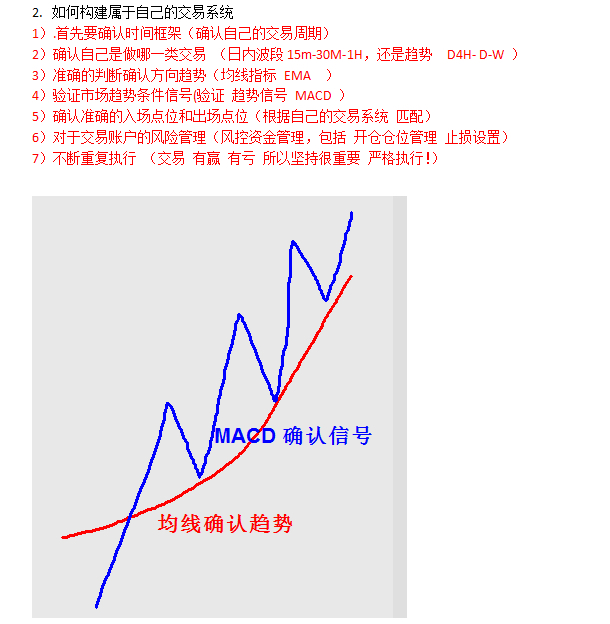
If you want to do a good job in trading, the first thing you need to do is to build your own trading system!
I hope it can be helpful to everyone...
Copyright reserved to the author
Last updated: 07/31/2023 16:22
Add
Your question is too broad, beginners should read the book first
Copyright reserved to the author
Last updated: 08/07/2023 07:48
Add

Rather than doing a good deal, it is better to be yourself. Why do you say that? If you know more about this industry, you should also know that when many financial companies recruit traders, they usually add a "veteran priority" to the column of job requirements. Are these companies doing this because they support the military and patriotism? My answer is no!
Although veterans may not be as good as college graduates in terms of professional knowledge, they have the discipline and calmness that most people lack, and this is precisely the quality that a successful trader should possess.
To put it bluntly, trading is speculation, so it is very easy to make money occasionally. It is not difficult to make several short-term gains with the help of hundreds of times of leverage. The difficulty is to achieve long-term stable profits. Since it is stable, it must be as calm as water, and it is almost impossible to make a good deal with a temper that is just a little bit. Therefore, it is not too much to say that traders are born. After all, character determines destiny. A good character is a necessary condition for a successful trader. Otherwise, I think it is very difficult to achieve long-term profitability.
Copyright reserved to the author
Last updated: 08/12/2023 07:28
Add

My circle, Ruyi Trend Pie has courses to learn. After learning and practicing as required, you can also be a master.
Copyright reserved to the author
Last updated: 08/04/2023 00:07
Add

That's too much to say, I can't explain a sentence or two
Copyright reserved to the author
Last updated: 08/01/2023 08:57
Add

If you can shoot one thing, do it naturally, as calm as still water, everything is so calm and smooth. You can do it!
Copyright reserved to the author
Last updated: 08/11/2023 11:07
Add

Learn the basics well, and the simulated trading can make stable profits. In actual combat, small and light warehouse operations, correct your mentality, don't aim to make money, and do it as a sideline
Copyright reserved to the author
Last updated: 08/08/2023 03:20
Add

Read more books, there are some relevant strategy introductions, read more news, and compare the impact of news on the market. Every time has a causal cycle, listen less to flickering, believe that you read more and learn more. It's as simple as that.
Copyright reserved to the author
Last updated: 08/05/2023 20:30
Add

Find your core profit model, and at the same time know where the easiest point to lose money in this market is.
patience.
Copyright reserved to the author
Last updated: 08/05/2023 15:37
Add

0
work
0
subscriber