


Stay in touch!
Subscribe to our newsletter to get the latest updates on live market analysis, trading strategies and more. You can unsubscribe anytime.
By subscribing, you agree to Trading.live Privacy Policy.


If the entry point is not good, it means that the time is not passed, and the resulting loss becomes a necessary cost.
Before entering the market, we generally predict the market, and this is the time to test our trading ability.
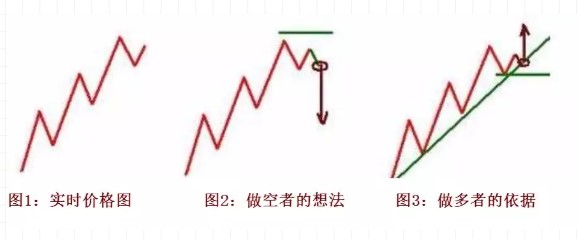
How do traders place orders when they see Figure 1?
Comrades with wave beliefs will find that the 5th wave is over, and if you see waves a and b below, you can enter the market to make adjustments to wave c.
Next, wave b is generally not significantly higher than the high point of wave 5. You can set a stop loss at a point above the high point of wave 5 in Figure 2, and enter the market to short after the price shown in the circle appears. This is a standard transaction, no matter whether it is a profit or a stop loss exit.
On the other hand, Dow trendists will see the trend line and think that they should enter the market to go long, set a stop loss below the trend line, and after seeing the price rebound near the circle in Figure 3, go long by relying on the moving average. This is also a perfect transaction.
Although their forecasts for the direction of the market outlook are completely opposite , it does not mean that their choices are not reasonable. Because the real trend of the market is unknown.
Next, in Figure 2, if the price hits a point higher than the high point of the 5th wave, it means that the 5th wave is not over yet, and there may be a sub-wave in the middle that is an extended wave. If it falls, it will fail, and stop loss is the best choice at this time.
The same is true in Figure 3. If the stop loss in the figure is triggered, it means that the upward trend line has been broken, indicating that the initially drawn trend line has been broken. At this time, stop loss is the best choice.
Copyright reserved to the author
Last updated: 08/08/2023 05:04
 Add
Add

This is a common mistake made by low-level players.
What is the general direction?
You don’t even know how high your level is. You have watched gold go up for two months, but you are doing a minute-level strategy. One minute advances, the next minute it is like once and for all. The stop loss is 15 points, and the profit is over 100 points.
I have met too many traders like this. Their appetite is bigger than the sky, and their carrying capacity is smaller than that of ants. They always blame the market for not giving opportunities, and complain that international capital manipulates the market. Lose by strength.
For a trading strategy, entry is a key factor in three aspects——
One is the trend
Second is timing
The third is kinetic energy
You only focus on one point of these three points, have you analyzed the other two key points carefully?
Appearance to analyze two aspects -
One is the variety characteristics
Second, the reference level
You can't use the one-day increase of the euro to measure gold, nor can you set a one-day stop loss for gold on the 15-minute trend of gold.
It’s all full of work, so please understand.
If you understand people a little bit, you will understand!
Copyright reserved to the author
Last updated: 08/23/2023 22:22
Add

The general direction you are talking about is the general direction of fundamentals or the general direction of technical aspects. If the general direction of the fundamentals is just starting, it is difficult to judge what point can be profitable when the general direction of the technology is in the early stage. When the market is obvious, it is often in the middle and late stages.
Copyright reserved to the author
Last updated: 08/09/2023 11:13
Add

Being able to see the general direction does not explain anything. For example, in the early stage of gold, the general direction is known to be bullish, and the brainless bullish, so the whole market is singing bullish. What can be explained at this time? So being optimistic about the general direction is just a matter of level. As the title says, if the direction is right, you will still lose money.
If you can't find the entry point, it can only mean that you either entered the market too aggressively or your technique is not in place.
The approach is too aggressive, what to do? Write a note, stick it on your forehead, and don't take it off when you go out. Be alert to yourself at all times, if you can't control your hands, you can't cover your pockets. This kind of thing is a problem of trading mentality and trading discipline, which cannot be solved in a short while, and requires long-term training of one's temperament.
The problem of insufficient technology means that your order system is not perfect. Some people say that there must be at least three reasons to persuade oneself to enter the market, not to mention whether this is too strict, but if there is even one reason that can convince oneself to enter the market, there is no such thing in your trading system. The conditions for making an order, so why do you still need to enter the market? So I think that looking for three admission reasons that can convince me at the technical level can indeed be used as a reference. The other is to strengthen the learning and strengthening of one's own skills, and more to strengthen one's entry timing and selection of entry points, so that one can improve oneself in a targeted manner.
There is another solution. If the market fluctuates greatly, it is recommended that the stop loss position can also be adjusted appropriately. For details, you can refer to the ATR index and the volatility of the recent market fluctuations, and then do what you know. Set stop loss and take profit. I believe it can help you. For example, the recent volatility of gold is around 40 to 50 US dollars. If you still set the stop loss according to the previous daily fluctuation of 10 to 20 US dollars, it must be a bit unreasonable, and it will cause unnecessary losses even if the market is right. Of course, you can also switch trading varieties according to your stop loss habits.
The above is just my personal opinion, don't spray if you don't like it
Copyright reserved to the author
Last updated: 08/13/2023 21:32
Add

The general direction is only a necessary condition for trading entry, and the ideal entry point must be supported by other signals.
Periodic resonance is a common selection signal. Some data on the Internet found that through a questionnaire survey of people with relatively large profits, multi-cycles accounted for 60-65%. According to different sources, different profit margin levels, different profit levels and other classification statistics There will be different results, but here are all multi-cycle dominant.
Multi-cycle resonance theory:
1. The varieties that go up sharply always show simultaneous upward movement in multiple cycles, and only the varieties that are synchronized in multiple cycles have the greatest upward explosive power. And if the cycles conflict with each other, the forces in each cycle will cancel each other out.
2. The big cycle determines the small cycle . The upper-level cycle has a control effect on the lower-level cycle. If the weekly chart is up, even if the daily chart is down, it only reflects the suppression. It is not necessarily a mid-term downward trend, only synchronous on Sunday Down is the mid-term downtrend.
Multi-period division method:
It mainly refers to the six cycles of week, day, 60 minutes, 30 minutes, 15 minutes, and 5 minutes. Week, day, 60 minutes can be divided into a cycle, 30 minutes, 15 minutes, 5 minutes can be divided into a cycle.
Multi-period guidance trading:
When the weekly or daily chart sends out buying and selling points, at this time, its 60-minute chart or one of the 30-minute charts should also send out buying and selling points before considering buying or selling.
If there are no buying and selling points in 60 minutes and 30 minutes, then even if the buying and selling points are issued on the weekly or daily line, it should not be considered. There must be two or more cycles to issue buying and selling points before considering entering the market.
If you are doing short-term trading , that is, when the daily chart or 60-minute chart sends out a buying and selling point, at this time, one of its 30-minute chart or 15-minute chart will also send out a buying and selling point before you can consider buying or selling.
If there are no buying and selling points on the 30-minute chart or 15-minute chart, then even if the daily chart or 60-minute chart sends out buying and selling points, it should not be considered. Only two or more cycles of buying and selling points can be issued before entering the market.
For the short-term within the day, look at 30 minutes, 15 minutes, 5 minutes, or even 3 minutes, and see whether the color of the 30-minute K-line is red in the long zone or in the green short zone. If it is in the short band, it is 15 minutes and 5 minutes In the figure, try to only go short and not go long, and in the opposite case, only go long and not short.
Of course, if there are buying and selling points on the weekly and daily lines, it means that the market outlook will be very strong. Once the buying and selling points are issued on the 60-minute or 30-minute chart, you should decisively intervene in long-term holdings.
Copyright reserved to the author
Last updated: 08/14/2023 08:52
Add

Obviously, the general direction is right, the entry point is wrong, and the losses caused show that you have a strict risk control system.
What is certain is that there is no problem at all with a strict risk control system, so why are there losses? The entry point is wrong.
Why is the entry point wrong? In your technical analysis, the entry point is not well controlled.
So how to control the entry point? Generally speaking, there are no more than three common methods for finding simple entry points.
The first type is the transaction-intensive area. In a certain time period, the market encounters a certain point that cannot be effectively broken through for many times in a row. In this area, the transaction volume will be stagnant, and it may also become the cost of reducing positions for many people. Line, so support or pressure is relatively important, when operating, you can choose to enter the market at this point.
The second method is the moving average system entry method. The moving average system is more suitable for the trending market. When the trending market is clear, choose the appropriate moving average as the entry point according to the speed of the market (which can be judged by the angle of the moving average). Put the stop loss below the next moving average.
The third is to find the point of the trend line. Once the market has determined whether it is a shock or a trend, it is easy to draw a trend line. At this time, do not operate if the market price does not reach the position of the trend line, and strictly stop loss somewhere below the moving average. point. The shortcoming of the trend line may filter out the first two entry opportunities, but this is also its advantage, which can filter out the glitchy market.
The above three methods, simply look at the previous picture
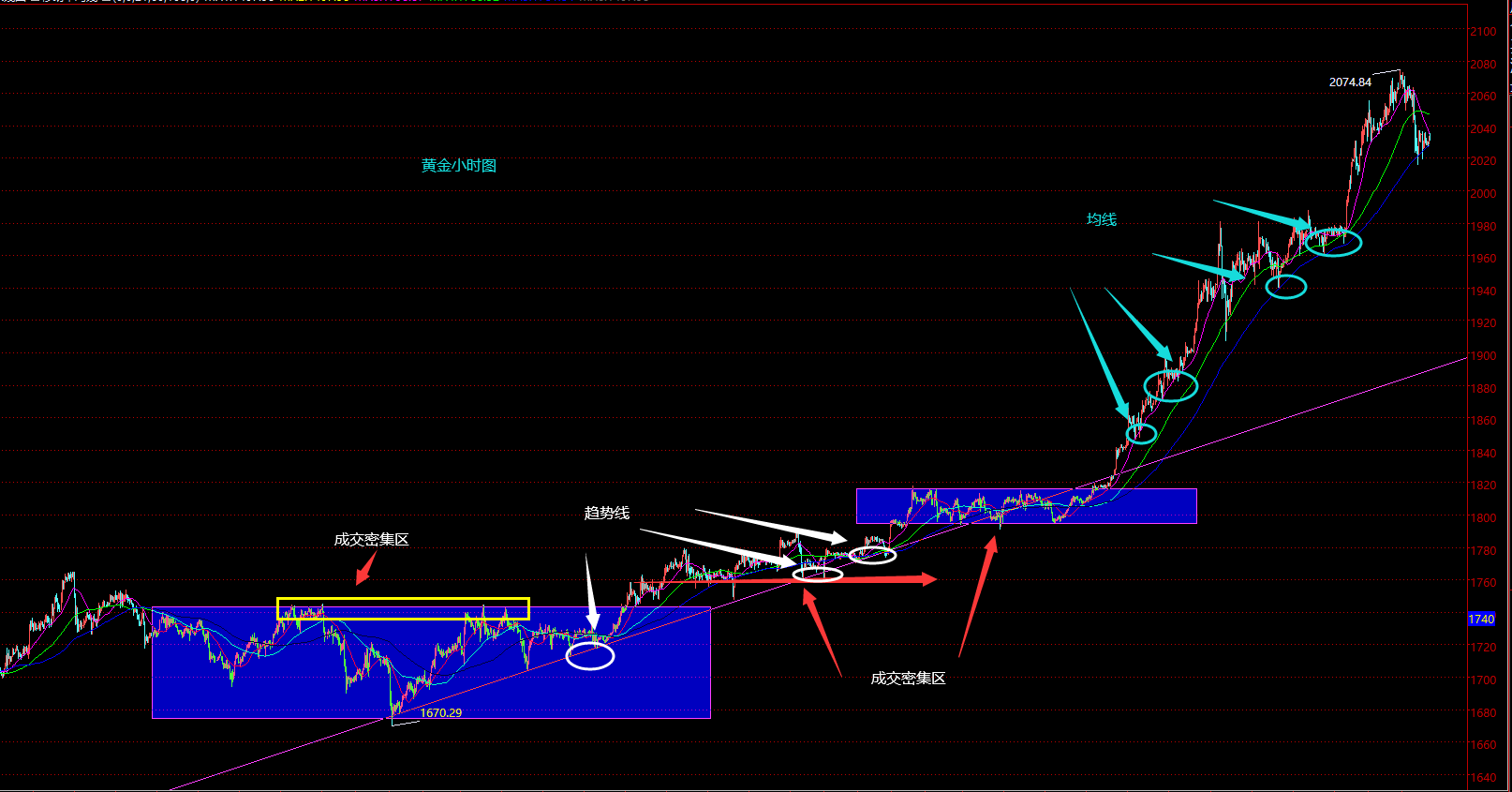
It can be seen from the figure that as long as there is no problem in judging the market in the general direction, then the remaining thing is to wait for the opportunity to enter the market.
This kind of technical analysis may already be clear to you, so for the rest, if you want to avoid losing money while looking at the right direction, you need to control your own hands.
There is another suggestion, there is no problem with the direction, do not enter the market at one time, you can consider building positions in batches, which can also reduce the occurrence of this situation.
Copyright reserved to the author
Last updated: 08/14/2023 13:29
Add

One: Look in the right direction, but always want to buy the bottom and sell the top.
The running trend of the market is nothing more than the rising rhythm, the falling rhythm and the sideways rhythm. In the rising rhythm, the buying point we usually use is callback buying. However, when the market is in a unilateral rising market, most friends do not Those who dare to chase the rise always think that the market will reach the top, so they maintain a short-selling strategy.
Short-term trading, why do you see the right direction, but you still lose money when you do it
As shown in the figure above, it is the recent trend of the corn market. The market has been in an upward trend. We know that the direction of the market is upward, and the strategy is to go long. But when the market is really going up, those who buy at a low level dare to hold Yes, but in the middle, everyone dare not go long, because they don’t know how far the market will rise, and they are worried that the market may reach its peak, and there are always people who try to sell short, but the final result is The market keeps going up. Therefore, as far as the market is concerned, if you see the right direction, you must follow the method, do not say the top when it rises, and do not say the bottom when it falls.
Two: If you look at the general direction correctly, you will lose money as soon as you do short-term trading.
The direction is the rhythm of the market, and for the trading market, we always say that the market is not that simple. The reason is that there is mutual restraint and obedience between the large cycle and the small cycle. If you look at the general direction correctly, even if the small direction deviates Wrong, this requires us to be clear about the relationship between size and direction.
A few suggestions to avoid losing money once you do it.
1. You must know whether the market you operate is long-term or short-term. There are long-term strategies for long-term and short-term strategies for short-term.
2. After looking at the right direction, you need to buy when choosing the direction to resonate in a smaller period.
3. To choose a stable operation method, you need to know the limit position of the market. If you don't break the position and hold it, you will be out immediately if you break the position.
4. Combining the top and bottom patterns of the K-line, exit and enter the market at the confirmed buying point.
5. Don't fight against orders, take profit when you want to take profit, stop loss when you want to stop loss, and trade according to the method.
Copyright reserved to the author
Last updated: 08/01/2023 08:52
Add

This situation should be attributed to the following reasons:
1: The choice of cycle is wrong. The subject’s so-called looking at the general direction should be the trend displayed by the cycle above the daily line level. But at this time, if the time cycle used in the actual order placement process is relatively small, For example, if the time period is below 30M, then the volatility of the single K-line at the daily level and the small-period level will be very different, and it is easy to cause losses at this time.
2: Frequent operations. This kind of people want to do it when they see the market fluctuations. They may have to do more than a dozen orders or even dozens of orders a day. You are not engaged in high-frequency trading. You have so many operations. In terms of the choice of investment, there will definitely be times of aggressive and aggressive development, and the losses caused at this time are also reasonable.
3: Adjust the target position at will. The originally set profit target position is, for example, at the position of the 20 moving average, but when the market moves in the predetermined direction, you feel that the profit margin brought by the market will be greater, so it is greedy , Adjust the take profit target to the 60 moving average, so normal. At this time, a random callback may cause profit taking, or even leave the market at a loss.
4: Time cycle switching, everyone knows that the larger the cycle, the less obvious the fluctuation, so impatient people often switch time cycles back and forth, and even place orders by switching time cycles. But you must know that the smaller the time period, the less obvious the sense of direction will be. Even if you follow the trend of a large period, individual circumstances can still cause losses.
5: Temporarily adjust the trading style. Originally, the trading was mainly within the day. It was because the so-called saw the right direction and started to adjust my trading style. I wanted to play a swing market. It is full of twists and turns. At this time, the retracement in the trend process will also cause unnecessary losses.
6: The retracement prediction is too small. When the overall market fluctuations are not large, the established retracement prediction is normal, but the market retracement is also divided into layers, weak callbacks, strong callbacks, etc. When you enter the market at a weak pullback position, you will definitely get out of the market when you encounter a strong pullback.
7: The stop loss setting is too small. For example, gold, most of the time the intraday fluctuation is about 20 points, but the recent market fluctuations have increased significantly, forty or fifty dollars often occurs, if it is still around 20 points If the volatility is used to set a stop loss, then it does not conform to the intraday volatility of the current market.
8:. . . . . .
Always loss can be divided into normal loss and abnormal loss. Normal loss belongs to the technical and psychological range, but very bad loss requires a long-term training process.
Copyright reserved to the author
Last updated: 08/01/2023 14:10
Add

Only when the right time, place and people are in harmony, can it last forever. A large cycle is composed of n small cycles, so it is particularly important to choose the timing of entering the market. When the big cycle rises, when entering the market, you must analyze whether the current point is the low point in the cycle. In general, foreign exchange is mostly traded within a day, so refer to M5, H1, and H4. Just analyze the general trend in the cycle on the weekly and monthly lines.
Copyright reserved to the author
Last updated: 08/01/2023 18:35
Add

Seeing it right does not guarantee doing it right! In short-term trading, the entry point is not chosen well, and the resulting losses are too common.
Why is entry point important?
The quality of the entry point directly affects the size of the stop loss position. A poor entry point leads to an increase in the stop loss rate and a decrease in the overall profit-loss ratio. The continuous back and forth stop loss caused by the oscillating market is a typical result of a poor entry point.
In fact, choosing a good entry point requires patience and a calm mind. Moreover, if the entry point is selected well, even if the exit point is slightly worse, the impact on the overall profit can be controlled.
In actual trading, we often consider the direction of entering the market from the perspective of the trend, which is "seeing right".
To "do it right", most of the time you will choose the specific position to enter the market from the perspective of volatility.
From the perspective of profit, there will be two situations: first, always buy the best position, but leave the market randomly. Second, enter randomly, but always exit to the best position.
They should all be profitable in the long run. However, the risk exposure of the former type in the position is obviously much lower than that of the latter type. That is to say, the first case spends more time in the floating win state than the second case.
This can understand the importance of the entry point.
Copyright reserved to the author
Last updated: 08/05/2023 15:48
Add

Looking in the right direction? First of all, this is already speaking from the perspective of God. Take the gold you mentioned, if it is not at the current price, you never know it will get here. From 1700 to 1800 to 1900 to 2000 to 2050, how many times and how many people think it has reached its peak during this period? Therefore, there is no such thing as a major trend at all. All major trends are driven by minor trends, and the statement that minor trends follow major trends is nonsense after the fact.
If you solve this ideological cognition, you will understand why some people make money and others lose money in a big trend.
As for how to make money? People who make money have their own systems. I tend to think that no system can be copied. What is suitable for A may not be suitable for B. A system is like a living soul, only suitable for the person who discovers it. So it’s okay to look at the reference diagrams of other people’s systems, and it’s okay to copy them. In the end, those who sell the system are all bullshit.
Copyright reserved to the author
Last updated: 08/08/2023 13:31
Add

The entry point often determines the size of the profit and loss, so it is normal to lose money if the entry point is not selected well. But as you said in your question, the possibility of such a thing happening is very low if you say that you are right in the general direction, but you lose money because of the wrong entry point.
The biggest possibility is that there is a problem with your direction judgment, and you didn't see it right or saw it correctly.
Let’s take the direction as an example. If you are doing short-term foreign exchange, when economic data and macro events occur, the market is mostly unilateral. This is what is commonly referred to as directional trading.
For example, before the release of employment data, look at the running trend of the unemployment rate to judge the direction of the unemployment rate.
If, the unemployment rate has been rising steadily. Then you can say that the odds of unemployment continuing to rise are very high.
At this time, you can start to prepare to short USD/JPY.
USD/JPY is trading in a range ahead of the jobs report. Keep an eye on the highs and lows of the range, they will be the breakout points. If the fluctuation range is smaller, the probability of a big market for the exchange rate is greater.
Since you are bearish on the US dollar, the more reasonable strategy you adopt is to set the entry point at the level below the next breakthrough point.
You may also place a stop loss at the level of the breakout and set your profit target level at the same number of points as the breakout range.
In this way, if the data is as you expected, the market will naturally be honored. Then your operation this time can be said to be suitable for entering the market in the right direction.
Copyright reserved to the author
Last updated: 08/05/2023 08:34
Add

In the transaction, it is normal to make a loss even if you judge the direction correctly. Because in addition to the direction, there is also a problem of rhythm, you must be able to step into the rhythm of entering the field.
What is the most important in the transaction process? It is most important to understand the market. The price covers all information. Basically, you need to understand the price behavior. This is the so-called understanding the market.
Don't study messy things, and don't study those messy technologies and theories. No matter how powerful the theory is, it is not as realistic as a deep understanding of the trading nature of the market.
It is not difficult to judge the direction, the success rate is already 50%, if you are lucky, you can win a lot in a row.
But trading is not about doing one thing right, but about what you did wrong, opening a position, stopping loss, and stopping profit. As long as one link is done well, the result will not be too good.
The position says that it is already the minimum position, so it should be said that the loss will not be much. A stop loss of 40 points is still relatively reasonable, and a profit-loss ratio of 2 is not bad.
Always sweep the stop loss, which means that you are making orders against the trend. Then you said the direction was right. It shows that you are following the general trend (such as H4, H1) and against the small trend (M15, M5, M1).
It is too early to enter the market. You need to wait until the small cycle trend turns and intervene after the callback. The probability of being stopped is low.
These require a lot of disk sense to better judge. Your current system should be too simple. There are fatal flaws, and you need constant optimization. In fact, there is still a lot of preparatory work to be done before there is a system. For example, analyze your own personality, choose a suitable period, find a suitable product, etc. If a novice recommends trading in euros, do a 1:1 market in the early stage, and then optimize the profit-loss ratio in the later stage, and stop the loss of the euro at 20 points.
Copyright reserved to the author
Last updated: 08/10/2023 07:13
Add


There are two cases: simply put,
One is assuming that your so-called direction is right, regardless of your time period, it should be that the position is large, and the fluctuations will be swept out of the market, and you can't hold it.
The second is that the direction is wrong, resist the order, and enter the field.
Copyright reserved to the author
Last updated: 08/02/2023 00:54
Add

Why do people do well, but I can't do business well? Is it because the market is not doing well now, is it because I am unlucky, or is there a problem with the teacher's guidance? Countless questions, countless answers, there will be reasons for everything, each has its own trading method, and each has its own reasons for losses.
Here are a few ways to find entry points:
1. Look for recent important resistance or support bands
When investors conduct foreign exchange speculation, on the basis of judging the direction, for example: in an upward trend, they can find the corresponding support level according to technical analysis as a reference for entry point. , you can buy at this time.
On the contrary, you need to continue to wait for the next support level, and then analyze according to the market trend. Downtrends operate similarly to uptrends.
2. Near the tangent position
The way to use the tangent position to find the best entry point is to test when the foreign exchange price breaks through and returns to the vicinity of the breakthrough tangent line after the graph goes out of the breakthrough form.
At this time, it will be a good time to enter the market to do foreign exchange speculation in the direction of the tangent breakthrough, and at the same time, place a stop loss on the other side of the tangent to prevent the exchange rate from appearing as a false breakthrough.
3. Wait for short-term MACD divergence
The short-term divergence mentioned here generally refers to the MACD divergence in the 5-minute or 15-minute K-line chart. In foreign exchange speculation, when investors buy upwards, they should pay attention to the bottom deviation of MACD in the K-line chart when the market pulls back.
Only near the relative low point after the market diverges from the bottom is the more appropriate entry point at this time.
Finding the right entry and exit points is of great help to our profit in foreign exchange speculation. It can be said that under the premise of the correct direction, appropriate point research can guarantee the profitability of our foreign exchange transactions.
Copyright reserved to the author
Last updated: 08/09/2023 22:52
Add

This question is easy to answer, let me give you a case, you can understand at a glance
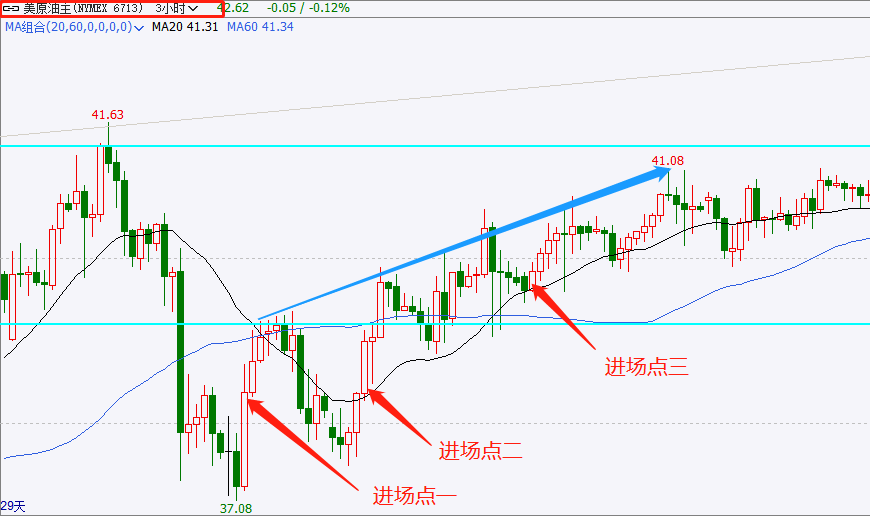
Case 1: Crude Oil 2020 You Na 00:00, June 25th - 18:00, July 21st, 2020
There are three entry points in total.
Entry point 1: A wave starts, and enter the market after receiving the combination of yang swallowing yin candles
Entry point 2: Three waves start, the candle pattern is W bottom, the market enters the market after closing the Yang swallowing Yin candle combination at the second inflection point
Entry point 3: The extended wave of the three waves starts, and the price steps back on the 20-day moving average to form a Yang swallowing Yin candle combination before entering the market
The characteristics of these three entry points,
Entry point 1: Facing a high price retracement, the retracement of wave 2 is almost 100% of wave 1, and the cost line may be lower than entry point 2
Entry point 2: The bottom of the candle pattern W is formed, and when the third wave starts, there will be no risk of a large price retracement in the first wave. Generally, the unilateral market lasts for a long time and the market is stable.
Entry point 3: Enter the market after the bullish trend has been running for a long time, and it is already the end of the market. There is a high probability that you will face insufficient momentum and continue to fluctuate or even reverse the market and lose orders.
You already know that the most suitable entry point is the second. Because it has advantages that the first and third points do not have, such as stability, continuity, sufficient momentum, and most importantly, the largest profit margin. They are all long-term trends, but the trading results are completely different. You will definitely choose the second time to enter the market. Therefore, in many cases, the most important point of trading is the entry point and exit point, not the judgment of the trend. .
Copyright reserved to the author
Last updated: 08/11/2023 00:21
Add

There are many reasons for losses, and looking in the right direction and entering the market may not necessarily guarantee that you will not lose money. If you can't see the loss, it is due to the poor entry position, or it may be that the trading cycle is too short, which magnifies the impact of market uncertainty.
Take the intraday short-term as an example. Entering the market here is a trial and error basis. When you enter the market, your judgment is that the market can try to make a profit at this position, and the subsequent market is unknown.
How to deal with the list after entering the market depends on the rules of exit. The exit rules are divided into stop loss and take profit. It is the closing of a transaction and determines the success or failure of the transaction.
At this time, it is necessary to prevent mistakes and let go of being right. That is to say, when you get out of the market, you need to stop the loss decisively when you find out that you have made a mistake in entering the market.
Due to the uncertain market trend, investors must comprehensively design positions according to their own risk tolerance, number of trading varieties, winning rate and other factors.
To put it simply, there are three stages before each entry, the first step: set the trend (up/down trend); the second step: find a point (open long/short order); the third step: risk control (open position Then adjust the stop loss and take profit targets).
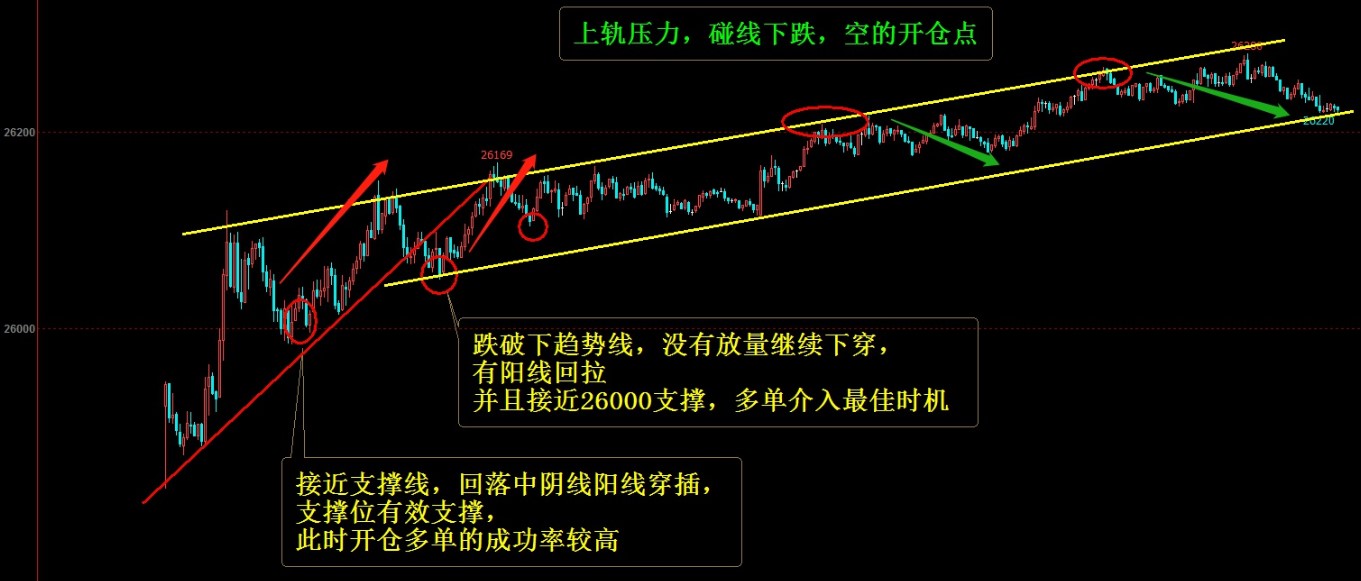
There are four main opening points in the figure above:
1) After the upward trend line is confirmed, it is close to the support line for the first time, and long positions are opened
2) If it falls below the support trend line, it will be pulled back, and long positions will be opened again
3) In the afternoon, the slope of the trend line becomes flat, touches the upper pressure line, and the signal for empty orders
4) The upper pressure line is touched again, and the short position is opened again
If you intervene at these nodes, you will basically win a complete victory. This means that you are looking at the right direction and doing the right thing.
Copyright reserved to the author
Last updated: 08/12/2023 09:29
Add

In fact, this is very easy to understand! You have already said that you are only looking at the big direction, and the implication is that you are not looking at the small direction right, right?
We know that the operation of the price is a combination of many small directions to form a general direction. For example, crude oil rose from $10 to $140. This increase is its general direction. You are right. But, it can't go from $10 to $140, right? It first rose from $10 to $20, then fell back to $15, then rose to $40, and then fell back to $25, just like this pattern of big rises and small returns; When the small direction of the object is inconsistent with the general direction. If you see the general direction, but miss the small direction, buy it at 40 US dollars, and wait until it falls to 25 US dollars and can't stand it, then you will lose money?
Copyright reserved to the author
Last updated: 08/12/2023 15:57
Add

There are two possibilities. One is false judgment. Before the market comes out, you have many times of thinking about long and short. When the market rises, you will automatically ignore the previous short thinking and strengthen the long thinking. It is an afterthought. The other is that the direction judgment is accurate, but no order is placed, because the K-lines are anti-human, and they will wash the market, making you change your long-term thinking, or shake your confidence. So on the one hand, be firm in your heart, and on the other hand, make rules to restrain yourself.
Copyright reserved to the author
Last updated: 08/01/2023 21:05
Add

We know that price fluctuations can be divided into big market and small market. Any big market is composed of countless small markets, but the big market includes small markets. That is to say, no matter how the small market changes, the final As a result, they all point in the direction of the big market.
Judging from your description, you are betting on the direction of the big market, but you made a wrong judgment in the small market, leading to losses, right? Logically speaking, since the big market includes the small market, your losses should be temporary. As long as you have confidence in your judgment of the general direction and stick to it, you can definitely make money! Investing is to do things that are sure; since you are confident in your judgment on the general direction, then just stick to it and don't care about temporary gains and losses.
Copyright reserved to the author
Last updated: 08/06/2023 12:36
Add

0
work
0
subscriber