


Stay in touch!
Subscribe to our newsletter to get the latest updates on live market analysis, trading strategies and more. You can unsubscribe anytime.
By subscribing, you agree to Trading.live Privacy Policy.


Is there any necessary relationship between long-term survival and development and transaction frequency? Those who are still talking about the long-term and short-term trading frequency, and what short-term must die, all think that the sky is only as big as his wellhead.
The transaction frequency is only related to the cost we pay, mainly time and energy and handling fees. If there are no problems in these two aspects, there is no need to consider the transaction frequency. You can safely make money in a certain way. Its transaction frequency is As much as you want, we don't need to take care of it.
For long-term survival and development, first of all, you must have a method that is positive expectation for the future. Secondly, if the method is still in the probability (frequency), you must have the ability to cut off the extreme fluctuation of losses when necessary. This is completely enough Now, the trading frequency is just a natural consequence of the method.
Considering that among all positive expectation methods that can make money, the method with a larger single loss and a lower winning rate is more likely to be eliminated by probability fluctuations. Therefore, we need a method with a smaller single loss and a higher winning rate. The trader and the level of profitability determine which method to choose for trading.
The safest method is the method of small stop loss and high winning rate. This is an easy problem to understand. If the influence of capital size and time and energy consumption is not considered, the higher the level is, the shorter the trading cycle will be. Improvement will use the method of breaking down the market to break down the market. It seems to be short-term, but in fact it does not distinguish between long and short. They have surpassed the perspective of long-term and short-term. They belong to those who have jumped out of the well.
There are also some people who are purely short-term, and they make very high profit margins every year with a small maximum retracement. Do you think such people are not strong in long-term viability? One of my methods is that it can be done purely short-term, and there is no need to consider what will happen to the long-term market, but it has both winning rate and odds, and you don’t have to worry about no trading opportunities. This can also survive for a long time.
The main purpose of my long-term approach is to obtain high-certainty innate advantages. The advantages that I already have before opening a position can be grasped after I enter it without having to keep an eye on the market. To obtain a basic profit, I really want low risk and high return. Short-term is still needed, according to the subject, the trading frequency will become higher, then I am in danger, in fact, it is just the opposite.
However, I am by no means encouraging others to do short-term trading. Short-term trading is indeed much more difficult. People who have no profitability will soon be sucked to death by the vampire of handling fees. If slippage is also a disadvantage, then short-term trading is really a disaster. . The short-term cognitive ability and detail processing ability are not suitable for people with insufficient cognitive ability. It is necessary to make money in the medium and long-term light positions first, and then use the method of first-hand to slowly train short-term ability.
Copyright reserved to the author
Last updated: 09/06/2023 20:55
 Add
Add

If you want to put it this way, high-frequency trading, scapling trades tens of thousands of times overnight, and you have already lost all your money. Why does Morgan Sachs still retain the high-frequency trading department?
Copyright reserved to the author
Last updated: 09/07/2023 04:30
Add

Whether the transaction can be profitable depends on whether your trading strategy has sufficient advantages.
When the trading strategy has a certain advantage, the trading frequency determines the amount of profit that the advantage can convert.
When the trading strategy does not have an advantage, the trading frequency determines the speed of liquidation.
In the long run, it is not the trading frequency that determines the trading results, but the degree of advantage the trading strategy has.
How do you understand this?
The frequency of transactions is high, and there is a high probability of losing money. The low frequency of transactions may not necessarily make money.
Don't think that the low trading frequency is the guarantee of profit. It is very likely that the loss is slow.
The degree of advantage is inversely proportional to the frequency of transactions under certain circumstances.
If the price trend is likened to a river.
Obviously, trading on both sides of the river will have sufficient advantages and be safer.
However, the price is not close to both sides of the river more often.
Then when the trading frequency is too high, it is likely to trade in Hexin, which is neither safe nor advantageous.
This is why many traders who manage their own funds, with the gradual deepening of their understanding of the market, the trading cycle is getting bigger and bigger, and the trading frequency is getting lower and lower.
Because there are actually very few trading opportunities that are really suitable for trading and have sufficient advantages.
Copyright reserved to the author
Last updated: 09/06/2023 15:02
Add

As far as a complete trading system is concerned, the trading frequency is only related to its trading cycle. According to the trading strategy of one-minute chart trading, it may trade dozens or hundreds of times a day, and the trading strategy of weekly chart trading may only A trading opportunity, but it can be a profitable system with positive expectations.
In addition, most people often talk about reducing the frequency of transactions, which is different from the concept of transaction frequency in your question. Some people say that they want to reduce the frequency of transactions because they can’t control their hands and want to make orders at any time. Trade in strict accordance with the opening and closing signals of the trading system. For a person who wants to open an order at any time, he will feel that he can do it in whatever form he looks at, and the frequency of transactions will naturally increase, and this is an abnormal increase that does not abide by the trading system, and this kind of person is quite There are so many, so it is often mentioned that the frequency of transactions should be reduced. So people say that those who can buy are apprentices, those who can sell are masters, and those who can sell short positions are patriarchs.
In short, the frequency of transactions does not affect the profitability of the system, but the position should be well controlled. If the frequency of transactions is high, heavy positions will die faster.
Copyright reserved to the author
Last updated: 09/01/2023 09:43
Add

I started trading in the foreign exchange market in 2007. When I first came in, I had no experience. I seldom made money. Most of the orders were money-losing, and I lost money. This situation lasted until 2012. It can be said that I have tried it all. Experienced the ups and downs of the foreign exchange market. I am a person who refuses to admit defeat. The more difficult it is, the more difficult it is to face it. After paying tuition fees for 5 years, I finally summed up my own profitable trading system.
When we conduct investment transactions, the first step is not to think about how much money we can make. The first step is to learn how not to lose money. Only when the risks are well controlled can we talk about profits. I had the opportunity to stand up, and communicated with many loss-making investors, and found that there is a common reason for the loss, that is, there is no positive profit-loss ratio, (for example, go long at 1980 gold, stop loss at 2 US dollars, and stop loss at 1978 , the stop profit is $6, the stop profit point is 1986, and the profit-loss ratio is 1:3) No one can make every order right, and on the contrary, no one can make every order wrong. If you earn one order and lose more than three orders, you will not lose your principal. If this can be achieved, God will give us a 50% accuracy rate. The account must be profitable, and often the most basic principles cannot always be implemented. Many people can carry it well when they lose money, but they get scared when they make money. If you earn a little, you will be safe, so you will never make money. Unless you have 100% accuracy, you will make a small loss when you lose. Making big and losing small is the foundation of profit.
In the final analysis, the reason for the loss is that there is no operating system that strictly implements profitability. No matter stocks, foreign exchange, or futures, you need a belief to support it. Only with confidence can you have confidence. There are many ways to make profits. After finding out the method, we only make orders that conform to our principles, and resolutely do not open positions if they do not meet the requirements. This method will not make money for every order, and long-term execution and use will be stable and profitable.
Let’s talk about the trading mentality. Many investors do a good job in demo accounts and can make money. Once they make a firm offer, they panic. There may be some bad ways to make money. Why don’t you make money so easy? It is because we do not have a good attitude, the market is fluctuating and our hearts are also fluctuating. Whether the list is a loss or a profit, the little deer in our hearts is always bumping into each other, fighting with ourselves, hesitating, so it is not possible to make profits with a strong mental quality. , but to make a profit, you must have a specific and strong psychological quality.
Whether you invest by yourself or follow others, you must have your own judgment. Don’t take your own real money and try it lightly. Now there are many fake teachers who make money. If you follow others, is he capable of making you profit? , You will know if you try it for real or fake, and you will definitely not be able to make a firm offer at the beginning. First, simulate with him for a period of time.
If you have not yet entered this industry, and there is no skilled person to guide you, it is recommended not to enter easily. It will blow your mind over and over again, leaving you scarred, miserable, hopeless! Until the myth is successfully created. My level is limited, I can't write beautiful articles, and I can't say exciting words. There is no falsehood in the transaction, let alone show affection. If you lose money, you have to really admit the compensation, and if you make money, you don’t need to thank anyone. If there is something wrong, I hope everyone can criticize and correct it. It is only for your reference and not for actual trading.
Copyright reserved to the author
Last updated: 09/01/2023 13:41
Add

Asking this kind of question ... shows that the understanding of speculative trading is not enough.
The success or failure of speculative trading is not related to the frequency of trading. The only path to success is to make big and small losses. That is to say, in the long run (not every transaction), the transaction income is greater than the transaction risk.
In fact, there is nothing in this world where the benefits outweigh the risks. This goes against the fundamentals of the world. However, in trading activities, risks and benefits often (occasionally unexpected) need to be realized through a certain period of time. In this way, risks and benefits can be controlled to some extent. Profit is thus achieved.
Trading frequency is only related to your trading system (model design). There is no broad, appropriate trading frequency.
Of course, the trading frequency of novices is relatively high, which reflects their eagerness for success and their mentality of dreaming of getting rich overnight. This is another matter.
Copyright reserved to the author
Last updated: 09/02/2023 09:11
Add

In order to survive in this market, you must have your own trading system.
The secret is finding a system that works for you. This trading system is mechanical, suitable for your personal characteristics, with perfect trading ideas, detailed market analysis and overall operation plan. Every winner in the risk market has its own trading system. Therefore, finding a suitable trading system and constantly improving it is the daily work of professional traders.
Copyright reserved to the author
Last updated: 08/31/2023 14:37
Add

Transaction frequency is divided into subjective transaction frequency and objective transaction frequency.
Subjective trading frequency: It is difficult for most foreign exchange traders to control, because the frequency and rules are set by themselves, and they can be changed at will. But the effective enforcement of the rules must be monitored by a third party.
Objective trading frequency: Being able to execute objective trading frequency shows that you are already an experienced trader who knows how to respect market laws and obey the market. The trading frequency at this time depends entirely on the possibility of the market space of your target, that is, the mood of the market. If he yells, go up, if he doesn't speak, don't move.
To do a transaction, you must solidify the theoretical knowledge from the source of the transaction, and understand it clearly, so that you can better guide the actual operation.
Copyright reserved to the author
Last updated: 08/31/2023 22:30
Add

Regarding the issue of frequency, I think that for traders, first of all, it is a question of their own style positioning. No matter how profitable they are, only when they have clarified their own trading style can they form and improve the later trading system. Then comes the question of frequency.
Secondly, the trading frequency will change as the trader grows, not inherent. Many investors have a problem at the beginning: worry about not being able to make orders, worry about making orders; panic when losing money, and panic when making profits. In fact, these are still relatively cautious, whether active or passive. Especially after suffering a heavy loss, the transaction enters a chaotic state, tossing back and forth. At this time, a small stop loss will still cause a blood loss, and the medium and long-term thinking does not rule out a liquidation. I think most investors have experienced frequent trading at the beginning, being cautious after suffering losses, reducing the frequency, and then moving towards frequent operations again, and finally reducing the frequency, and the cycle repeats.
Too many people not only value the profit margin of the mid-line, but also find it difficult to resist the excitement of short-term games. The standard of operating frequency mainly depends on the mentality and confidence in one's own trading strategy. Only with a clear stop loss and a clear understanding of the meaning of this stop loss position can one have the confidence to hold a position and wait for profits. As long as orders that do not meet one’s expectations are dealt with decisively, no matter how high or low the frequency is, it is reasonable . In short, don't let yourself be in an anxious transaction.
Copyright reserved to the author
Last updated: 09/01/2023 18:17
Add

Different strategies involve different trading frequencies. The only thing that everyone recognizes is that no matter what kind of trading strategy, it is not suitable for frequent trading. The reason for this is simple, your luck and your brain will run out. Since trading is brain-burning, let me also write some chicken soup!
I can't tell you the frequency of trading, but I can tell you that when trading, you must know how to rest. In this market, we can always hear how much someone earned in a certain period, but we don't care about the stories before and after. Especially those who have just entered the trading door, they want to hear how much money someone has made, and how many times their positions have been doubled in a very short period of time. When it's your turn to trade, as long as the market opens, you will stare at the screen in front of the market all the time, for fear of missing any opportunity to make yourself profitable. But the result of doing so is always to lose more and earn less. A few hours of trading time in the stock market is too short, unsatisfactory, switch to the futures market, unsatisfactory in the futures market, switch to the spot market, unsatisfactory in the spot market, and finally return to the stock or foreign exchange, bond and other markets. Constantly changing various trading platforms, constantly changing various trading varieties, and after several full circles, there are still continuous losses.
In fact, everyone has made amazing profits in the market within a specific time interval. Do not believe? Just find anyone who has been in the market for more than 3 years and ask him about his most glorious moment, you will find that at that specific time period, their operating records are comparable to all kinds of investment masters, but if you have the opportunity to see all his transactions If you record and calculate the total, you will find that the profit and loss are even, and the loss may even be greater than the profit. Why is this?
As people who trade in the market, we carry out various risk operations after judgment. When you are facing a computer that will not talk to you, when various news and prices are constantly displayed on the computer screen When you make a picture, your brain is running fast, trying to catch some very subtle changes, and then make a transaction. In this process, by using all the knowledge you have learned, you constantly compare the various images you have experienced or mastered with the disk, and your brain will have an illusion at this time. Because you want to see a "M-top", your brain will try to move the existing graphics closer to the "M-top" shape. After this kind of brain illusion occurs, we enter the market based on what we think is the form of the illusion. Then the correct rate of this list can be imagined.
The human brain is limited. I don't believe that scientists can fully utilize the potential of the brain in my lifetime. After long and complex thinking, our brains need to rest, and we need to break away from various K-lines, moving averages, On the disk, we need to invest in the embrace of nature, we need to invest in other things, so that the brain can perform at its best at the best time.
Many people think that the market is traded 24 hours a day, and they think that the good market will be missed during the rest time. Because I took a break, I missed the market that doubled my profit. Then I just ask you the simplest question, have you doubled your funds by constantly staring at the market?
above.
Copyright reserved to the author
Last updated: 09/01/2023 23:32
Add

Do mid-line transactions in the middle of the trend, always execute positions within 5% of your funds, and spread orders.
Copyright reserved to the author
Last updated: 09/01/2023 22:54
Add

Short-term is difficult to do, but it does not mean that there is no opportunity. The short-term disadvantages are obvious, but it also has its advantages.
Copyright reserved to the author
Last updated: 09/01/2023 12:11
Add

Frequent trading itself is not a problem. The key is whether there is a corresponding positive expectation system. The so-called positive expectation refers to how much profit each transaction can make. From this perspective, the positive expectation system has more transactions , the greater the profit, on the contrary, a negative expectation system, the more the number of transactions, the greater the loss. (Casinos have absolute positive expectations for gamblers, so the more gamblers and tourists, the greater the casino’s revenue)
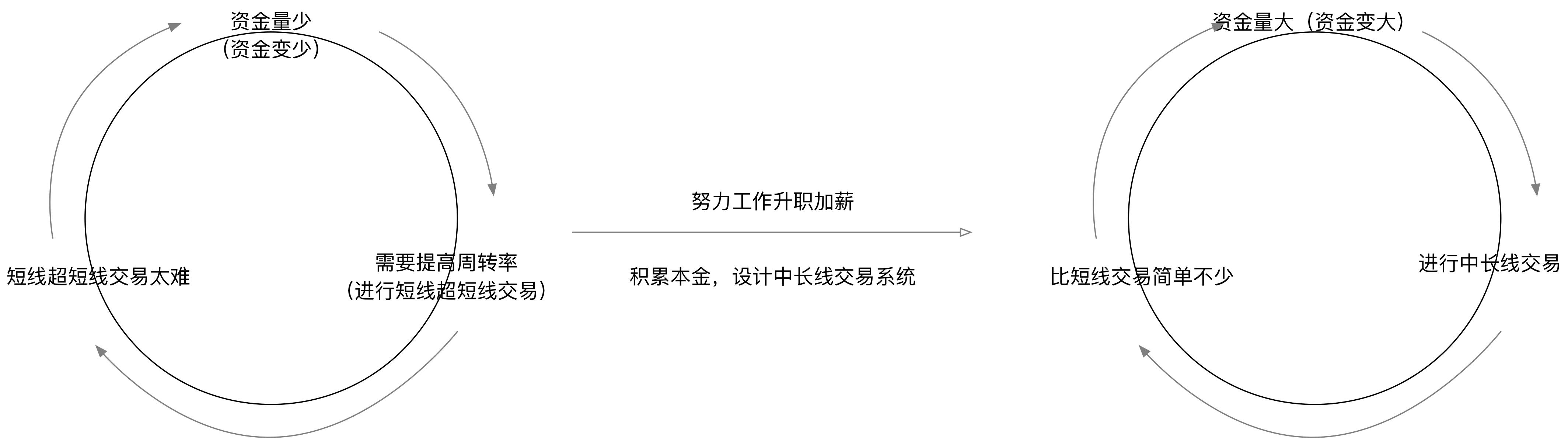
But what everyone overlooks is that there is a very high threshold for frequent trading. Transaction fees, spreads, data speed, and physical reaction speed are closely related to the results of their strategies. For ordinary traders, it is not practical. In fact, it is the same. Short-term It is much more difficult for the ultra-short-term to succeed than the medium- and long-term, so many people fall into such a predicament:
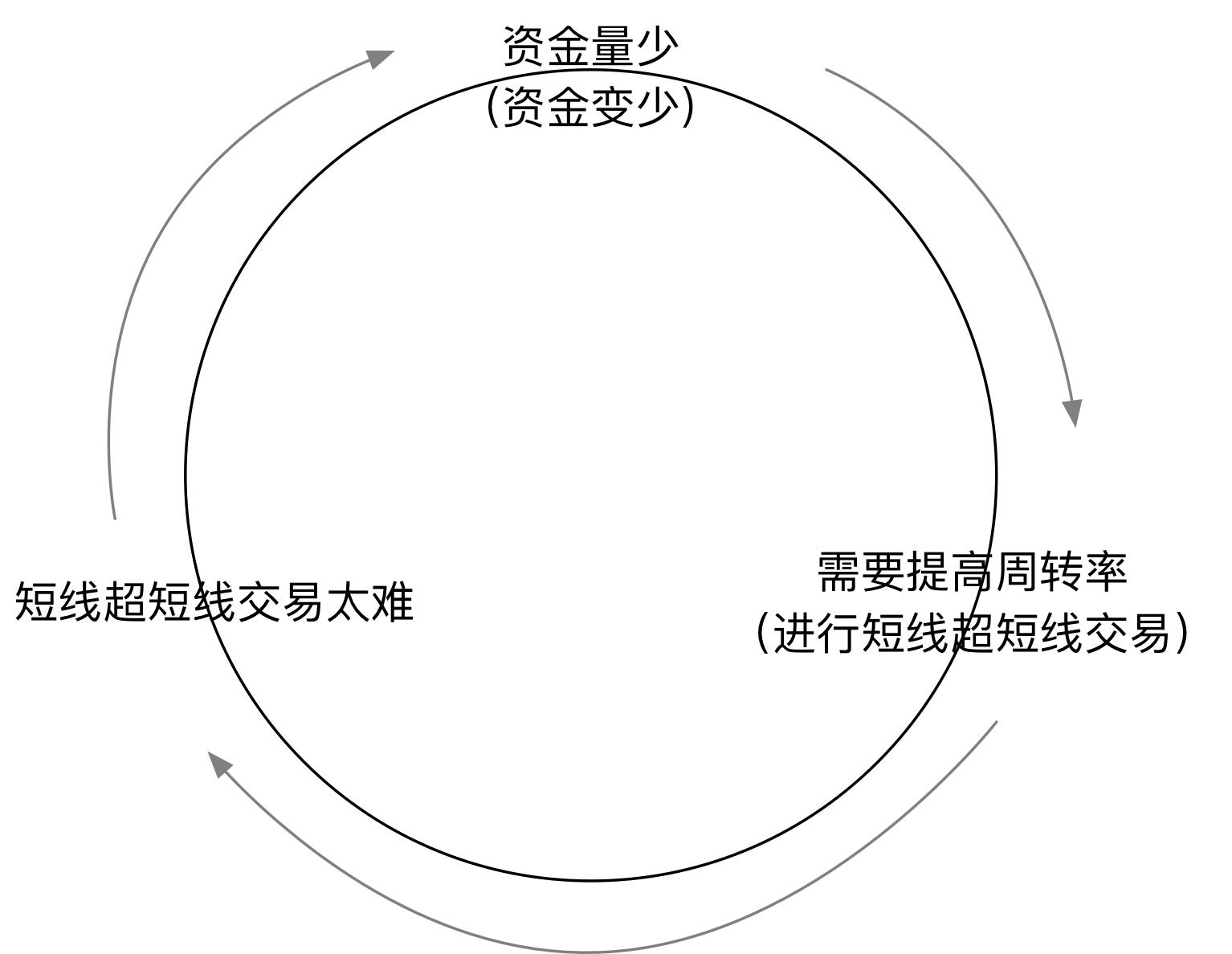
So I have always suggested that all friends who enter this industry start trading from the medium and long-term, light positions + stop losses, and do not need to watch the market a lot. Work at the unit and spend more time with your family. What's wrong.
Copyright reserved to the author
Last updated: 09/07/2023 02:43
Add

Don't lose money just thinking about earning it back quickly, proper positions and stable layout, this kind of market operation must be stable
Copyright reserved to the author
Last updated: 09/02/2023 10:27
Add

There is never a middle way in trading, and there is only one way in the consequences of the middle way, losing money...
Either the extreme short-term or the extreme long-term, both of which can make money. It is difficult to make money in the middle of the road.
In the short-term, the cost of the platform is relatively high. You can refer to the platform of the ECN trading model. In the middle line, you need a good view of the structure.
Copyright reserved to the author
Last updated: 09/01/2023 20:56
Add

The trading frequency should be determined according to your own trading methods, but except for high-frequency trading companies that rely on probability to win, the general trading masters do not have a high trading frequency, and they try to reduce their own trading times
Copyright reserved to the author
Last updated: 09/02/2023 04:43
Add

Dear subject and foreign exchange players and friends: there is no complete positive correlation between trading frequency and profit!
The transaction frequency is segmented by time, and can be divided into four levels in detail:
High-frequency trading, opening and closing positions is almost completed within 5 minutes, usually used in EA and institutions;
Scalp trading, commonly used by intraday traders, generally holds positions for tens of minutes to several hours;
Swing trading is suitable for swing traders, and the holding time can range from a few hours to several months;
Long-term transactions are generally weeks to months or even years.
However, it is very interesting that when you look at the K-line chart, the minute line, hourly line, daily line, weekly line...
As long as you remove the time and value, you will find that the K-line charts actually look similar: needle thread, enveloped line, long body, short body...
So, is it the shape of the k-line and the large shape related to the trend + the shape of opening a position that are more relevant to the range of the graph?
Maybe the expression is not very clear, what I mean is: the K-line with the time period removed can actually be analyzed in the same way. However, due to the short time, the point difference may not be able to run out at a smaller time level, and a larger event level may experience a huge retracement and may even lead to a liquidation.
Forex players, the k-line pattern and possibly related news clues are what really affect the price!
Therefore, just find a trading time frequency that makes you comfortable, and don't try to use the time period to solve the profit problem.
Profit is still related to specific strategies: breakthrough trading, reversal trading, scalp trading, "value" trading...?
You can try from these directions, and then it is: money management! How to keep within a certain retracement range.
These more specific strategies and risk management are the core of profitability, and the rest is the mentality control in the execution process.
Copyright reserved to the author
Last updated: 08/31/2023 21:15
Add

0
work
0
subscriber