


Stay in touch!
Subscribe to our newsletter to get the latest updates on live market analysis, trading strategies and more. You can unsubscribe anytime.
By subscribing, you agree to Trading.live Privacy Policy.


thank you

This is a commonplace topic, but it is indeed a very important topic. In the previous article, I have talked with you several times, and today we might as well talk about it from another angle.
First of all, please think about a question: a novice who just started trading, assuming that the funds he can use for trading is only 10,000 US dollars, how can he survive in the market forever? Or survive as long as possible?
Undoubtedly, he must build a trading system, and this system should preferably have a high winning rate and a high profit-loss ratio, so that he can survive in the market naturally without worrying about liquidation.
However, for novices, the trading skills are still lacking, and they may not even have the framework of the trading system. It is obviously meaningless to talk about the winning rate and profit-loss ratio.
So what to do?
Please think about it first, and we will talk about this issue later.
Next, let's talk about a mathematical problem involved in trading, that is, the relative value of loss and profit is out of proportion.
The following is a schematic diagram of the loss ratio and the ratio required to earn back the principal for a $10,000 account:
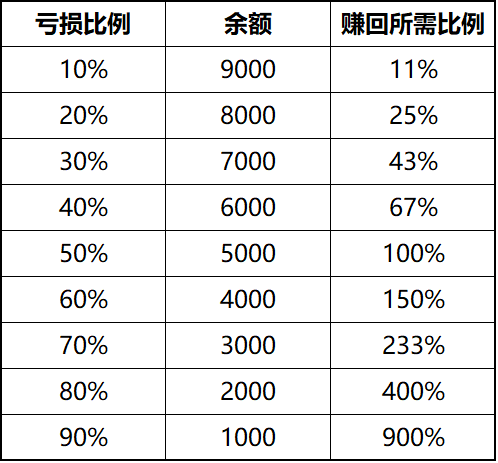
From this chart, we can see that for every 10% loss, the proportion of the amount required to earn back increases exponentially. 10% ratio.
Therefore, loss and profit have different meanings for transactions .
From this point, we can easily judge that if a trading system makes only a small profit every time, and loses a large amount every time, that is, the profit-loss ratio is very low, then no matter how high its winning rate is, it is difficult to become a trading system. A trading system with positive expected value.
If your trading system also has this characteristic, then maybe you should take a good look at it.
This is the reason why many people often liquidate their positions, because they often lose a lot, and after a large loss, the principal shrinks sharply. No wonder.
Therefore, we can draw a preliminary conclusion- in the case of loose risk control, the profit-loss ratio is obviously more important than the winning rate .

Next, let's go back to the previous question: For novices, how can they survive in the market forever when the winning rate and profit-loss ratio are unknown? Or survive as long as possible?
Studying the chart above, we can actually get the answer, which is risk control.
In other words, in trading, we should put more energy on avoiding large losses, and the retracement should be as small as possible.
So how can we make the retracement as small as possible?
Undoubtedly, it is to minimize the amount of each loss, and try to limit the risk of each loss to less than 2%.
For a trading account, the most important factors affecting liquidation are three variables: winning rate, profit-loss ratio and risk percentage (loss percentage) .
Now that we have set the variable of risk percentage to quantitative, there are two remaining variables: winning rate and profit-loss ratio.
For example, for a $10,000 account, the risk of each transaction is 2%, that is, one loss is 200. According to various winning rates, combined with the profit-loss ratio, each transaction is 10 times, and the results are as follows:
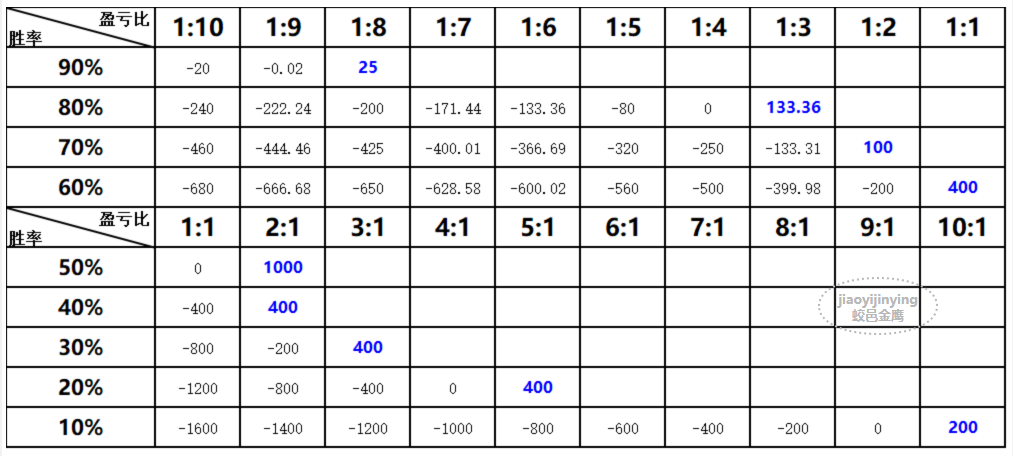
It can be seen from this result that if the winning rate is below 50%, the profit-loss ratio must be increased accordingly to be able to make a profit, that is, the expected value is positive, and the position will not be liquidated; and if the profit-loss ratio is below 1:1, it is necessary to Increase your chances of winning accordingly.
And we can also easily see that no matter which aspect of the winning rate and profit-loss ratio is neglected, the other must be raised accordingly, and this is obviously more difficult, and naturally it is easier to liquidate.
In fact, it is what we often say, the mode of high winning rate and low profit-loss ratio, and the mode of high profit-loss ratio and low winning rate. No matter which mode, the premise is to strictly control the risk, and then the winning rate and profit-loss ratio are well coordinated, so that Its expected value is positive in order to make a profit, and naturally it will not be liquidated.
Therefore, we can draw a conclusion: in the case of strict risk control, the winning rate and the profit-loss ratio are both important, and neither aspect should be too low, and they should be coordinated within a certain range .

So in the case of strictly controlling risks, how should we choose, should we choose the high winning rate mode or the high profit-loss ratio mode?
On the one hand, you have to make a choice based on your own personality and preferences.
The high winning rate mode requires traders to be responsive, while the high profit-loss ratio mode requires traders to be patient.
If you are impatient, then choosing the high profit-loss ratio mode will torture you, because the high profit-loss ratio mode can only make the profit-loss ratio continue to expand when you hold positions patiently; and if you are slow, then choose the high winning rate mode , It will also not adapt to the rapid changes in the market, because the high winning rate model can only maintain profits and ensure a high winning rate if it responds to the market's long-short changes in a timely and flexible manner.
Or, you will have to change your behavior, and your personality will adjust accordingly.
On the other hand, we can think about it, in the case of strictly controlling risks, is it easier to increase the winning rate or increase the profit-loss ratio?
Many trading systems with high winning rates on the market are generally at the expense of expanding risks. If the risk is strictly controlled, it is relatively difficult to increase the winning rate without sacrificing the profit-loss ratio.
Because there is a check and balance relationship between the winning rate and the profit-loss ratio, you can refer to "Can't a high winning rate and a high profit-loss ratio really be at the same time?" ", when you set the risk to a fixed value, it means that the loss of a single transaction is limited. In a sense, the profit-loss ratio is also limited, and at this time the profit-loss ratio is not sacrificed. If you want to increase your winning rate, it is only possible if you continue to accumulate market experience and deepen your market sense.
Obviously, this will take time.
In the case of strictly controlling risks, it is relatively easier to increase the profit-loss ratio without sacrificing the winning rate, because when you fix the loss, you can also expand the profit to increase the profit-loss ratio. And trend trading can do exactly this, and it is also one of the recognized profitable methods.
Therefore, we should rationally look at the winning ratio and the profit-loss ratio, first of all, on the premise of strictly controlling risks, and then choosing the one that suits us, which is the best .
Whether you pay more attention to the winning rate or the profit-loss ratio, as long as you coordinate the relationship between the two, you can be profitable; and only if you coordinate well, can you walk on a sustainable road to success!
Copyright reserved to the author
Last updated: 09/01/2023 05:47
 Add
Add

Brother, teach you a formula.
To judge whether a model is good or not, you need to know 3 data.
1 Average number of transactions in a month.
2 Probability of profit.
3 Profit and loss ratio.
Multiply these 3, the greater the number, the higher the score and the higher the efficiency of making money. (Do not consider transaction costs and order errors and errors)
For example, if the trading frequency is 10 orders a month, the profit probability is 55%, and the profit ratio is 1:3
Then 10*0.55*3=16.5
This model is 16.5 points, and then you can use your own data to compare and optimize.
Copyright reserved to the author
Last updated: 08/09/2023 13:54
Add

I think this is a false proposition. If you know the winning rate, you are afraid that you will not make a big profit. Trading should be: control risks and let profits run
Copyright reserved to the author
Last updated: 08/12/2023 15:23
Add


Winning ratio and profit-loss ratio, which one is more important, may determine your future trading direction.
In many trading forums, communities or documentary platforms, we can often see the winning rate when introducing traders. For example, which trader has a winning rate of 70% or 80%, is a high-winning trader, and When you want to see his profit-loss ratio, you need to click in to see it. Generally, there is no such item on the cover of the introduction. Maybe these platforms are because everyone may care more about the winning rate. Setting it according to everyone’s taste means the winning rate More important, but is it actually the case?
In the early days of my trading, I have been exposed to the grid Martin strategy. Some friends may not know what it is. In fact, it is a strategy to increase positions by fixed points in one direction. This strategy has a characteristic, that is, no profit and no liquidation , Of course, the position is very light. I saw that this is not bad, the winning rate is 100%, and the light position is invincible. As long as there is a shock, I will make a profit. As I write here, the old trader already knows the ending. This is a dead end. Maybe this strategy can keep you alive for a while, but the market will definitely trade you. Why, because the historical highs and new lows of trading are used to break through. Needless to say, you must open a position on the top or the floor, even if you are in the market Opening a position halfway up the mountain, margin trading, and overnight interest in foreign exchange trading, are you sure you can resist it?
If I say that a trading system with a high winning rate will not work for a long time, many people will definitely criticize me, because there are examples, some people may have read "Financial Geeks", in which there is a trader named Weinstein, who has not had any loss orders for several years. The winning rate is super high. I was deeply skeptical at the time. I checked this person carefully and found that I couldn’t find his recent situation except for the description in this book. It is reasonable to say that he has not lost much in three years, so he must be a top rich man. Ah, I can't find him in the rich list of his era. I am a person who believes in statistics and facts. Until now, I have been not very optimistic about high winning percentage.
As for the profit-loss ratio, there are too many examples of low winning rate and high profit-loss ratio. Livermore, anyone who has seen his master manipulator knows that the winning rate is only 40%. Dennis' turtle is even more exaggerated, because he There is a strategy of increasing positions, and the winning rate is barely over 20%. Livermore's Bethlehem Steel Period and Turtle's cocoa futures are well documented. Ultra-low winning rate, about close to five profit-loss ratio.
I didn't say which one is better in the end, I just gave an example based on my cognition.
Are you satisfied with this answer?
Copyright reserved to the author
Last updated: 08/02/2023 05:19
Add

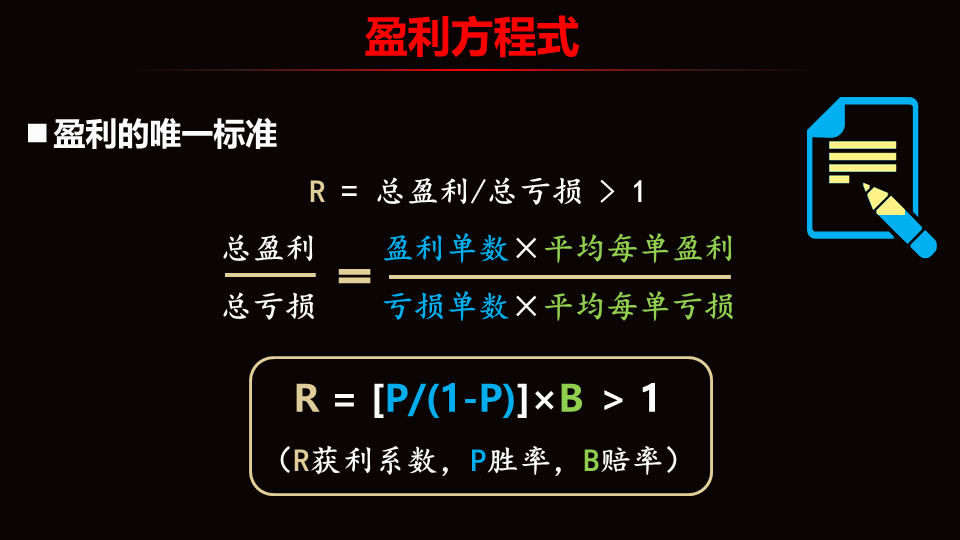
***B odds are the so-called profit-loss ratio***
【1】Winning rate and odds are based on long-term, large, sufficient, and consistent statistics of single-order samples. Don't be obsessed with temporary right and wrong profits and losses;
【2】Winning rate and odds are like the two ends of a seesaw, one rises and the other falls, don't pursue the best of both worlds that doesn't exist;
【3】Your final trading performance is determined by your trading winning rate and odds. They are like your left and right arms. Any system that separates winning rate and odds and only talks about one is one-sided and incomplete of;
[4] In the long-term repeated trading operation process, you need to form a relatively fixed winning rate and odds combination that satisfies the profit equation, that is, you need to form a relatively fixed trading method.
Copyright reserved to the author
Last updated: 08/01/2023 19:25
Add

After reading a lot of posts on Huihu about winning percentage and profit-loss ratio, I feel that they are all talking in sleep. It is necessary for sleepers to talk about these two concepts from a relatively objective perspective.
positioning.
The trading system has three components, technical analysis, fund management, and trading psychology. There are also three components to evaluate the pros and cons of a trading system, winning rate, profit-loss ratio, and execution. Execution is the object of investigation focusing on the psychology of traders, and the winning rate and profit-loss ratio are the most fundamental indicators for examining the technical aspects of the trading system.
Sleepman said in the previous article that as long as you agree with the trend trading method, no matter whether you are long-term or ultra-short-term, you must first track the trend, and the trend will not change its shape because of how you operate. However, long-term operations and short-term operations have different requirements for trading winning ratio and profit-loss ratio. It is simply nonsense to talk about winning ratio and profit-loss ratio without explaining the operation cycle first.
Intraday traders can only pursue a small profit margin, so the profit-loss ratio will not be too large, but the winning rate must be high.
The objectively existing intraday amplitude theoretically limits the maximum profit points of intraday trading. If someone plans to earn hundreds of standard points through intraday short-term trading, he must be crazy. On the other hand, the lower the time level of technical analysis, the more emotional the market volatility will be, and the less reliable the prediction of the future market will be. If an intraday trader wants to eat all the swings in the day, he will also face almost inestimable transactions risk. Therefore, in theory, the profit target of intraday traders must be very small, within a few points to dozens of points. Because the profit space is small, the positions of intraday traders are generally heavy and the number of transactions is too high. Because the positions are heavy and the number of transactions is too high, it is necessary to increase the winning rate. Theoretically, the winning rate of ultra-short-term traders must exceed 90% to be stable possibility of profit. Because the winning rate is very high, the profit-loss ratio can be lower, 1 to 1 is enough, or even 0.5 to 1 is fine, and the short-term to achieve the ultimate "scalping" trading method, the winning rate is infinitely close to 100%, and the profit-loss ratio is infinitely close to 0. Therefore, many people say that intraday short-term trading is the most difficult transaction, but at the same time it is the transaction with the most retail investors and novices. Isn't it strange?
Medium and long-term traders must pursue a larger profit margin, so the profit-loss ratio must be large, and the winning rate does not necessarily have to be high.
Many people think that the higher the trend level, the better the judgment. It is always easier to predict the price tomorrow than the price one hour later, so most successful traders are doing medium and long-term trading. Mid- and long-term traders capture the trend market based on the trading day. Successful mid- and long-term orders can eat up the trend market for several days or even tens of hundreds of days, and the stop loss interval is generally set at an amplitude of one to two days, so Its profit-loss ratio is huge, from the most basic 1.5 to 1 to 10 to 1, 100 to 1. If we print out the annual trading records of a successful long-term trend trader, you can find that they have very few profitable orders, but their final profit is brought by these few profitable orders.
Winning rate and profit-loss ratio are external and internal to each other, and are self-contained.
The two are in a trade-off relationship. If you pursue a high winning rate, your profit-loss ratio is absolutely impossible to be very large. It is unrealistic to make profits many times and catch a big market every time; if you pursue a high profit-loss ratio, your It is impossible for the winning rate to be too high, because the number of large-scale market occurrences is inherently low. In order to catch a big market, you will inevitably have to trial and error many times, resulting in a decrease in your winning rate. It is a dream to pursue high winning rate and high profit-loss ratio at the same time. Different trading styles can only choose the focus that suits you. For short-term trading, the first priority is the winning rate. For long-term trading, you must pursue a high profit-loss ratio. If you do it the other way around, you will inevitably lose your position as the final result. Looking at the winning rate or the profit-loss ratio alone cannot judge whether your trading system is superior or inferior. It must be combined with your trading style, position control and other operations to make a judgment.
The real winning rate and profit-loss ratio of the same trading system must be calculated through a large number of trading samples.
Another prerequisite for talking about the trading winning rate and profit-loss ratio is the validity of your trading samples. First of all, your orders must be made using the same trading system. If you use the moving average to make a few orders, and then use the star line to make A few orders, a few turtle trades, a few crocodile trades, and then you make a statistic, saying that the winning rate is 50%. To provide you with stable and profitable technical support; secondly, it must be based on a large number of trading samples. For short-term intraday traders, the number of samples may need hundreds or thousands of times to explain the problem. For long-term traders, it may take a period of time. Only two years of transaction records are worth discussing.
So let me make another digression. If you want to have an advantageous trading system, the first thing you have to do is to survive. Your account can last at least one or two years before you have a basis for summary and progress. If you lose your position in three days, You have no chance to study the trading system at all.
Copyright reserved to the author
Last updated: 08/13/2023 21:13
Add

I took a look at my data from January to May 25. The winning rate is 93%. How is the profit-loss ratio calculated? The profit-loss ratio is also very high for me, but I think it is useless, because I still have an order with a relatively large floating loss that has not been closed. Let’s look at the net profit margin. The current net profit margin is 24%, which is close to the monthly average of 5 %
Copyright reserved to the author
Last updated: 08/10/2023 20:09
Add

Profit-loss ratio, even if the winning rate is less than 50%, but the profit-loss ratio is 2:1, it is still profitable (for example, profit 10, loss 5), it can be calculated that 10 transactions, 6 losses, 4 profits, but the profit-loss ratio is 2:1 In this case, the loss is 5×6=30, and the profit is 10×4=40, so we can see the importance of the profit-loss ratio
Copyright reserved to the author
Last updated: 08/12/2023 04:58
Add

The success rate can bring stable income, and you can get up if you accidentally stumble. Please believe that everything is going through the truth that accumulating more and more.
Winning and losing is better than trying once in a while. Investors who have this habit of heavy warehouse stud can regard it as occasional luck or fluke entertainment, because even if you are full of confidence and do it right in the end, but this extreme There was a problem with my operating mentality from the very beginning, so I personally did not support it. Don't see other people's screenshots of Stud making money, and they won't show off to you when they lose money.
Profit-loss ratio If you want to use a stop loss cost of 5 dollars to make a profit of 5 dollars, this kind of transaction is also a high-risk transaction, which directly affects the stability of the account funds. If you are optimistic about the profitable space of $5 for bulls, then you should try to sneak in when the trend drops to $2-3. I believe that except for operational mistakes, no one will use the $6 stop loss space to earn a $4 profit margin, so a 5:5 profit-loss ratio can be said to be a high-risk transaction. Since the market reaches the target price after $5 , why it would be wiser not to wait and then do the reverse.
In actual operation, the profit-loss ratio is well grasped, which can maintain the value preservation of capital to a certain extent, and the success rate plays the role of capital appreciation, but in fact, if the capital cannot appreciate, it will face the risk of capital shrinkage. Therefore, all operations Stability should come first.
Copyright reserved to the author
Last updated: 08/06/2023 15:18
Add

Copyright reserved to the author
Last updated: 08/07/2023 08:45
Add

I personally pay more attention to profit and loss, because my goal is to make money, I don’t care about the winning rate, even if my winning rate is 1%, but I can earn 1% continuously, then my investment is successful
Copyright reserved to the author
Last updated: 08/09/2023 18:52
Add

Buffett said: If we remove our 10 most successful investments, we are a joke. Obviously, the market winning rate is not important at all. I have seen a person with a trading winning rate of more than 90% and ended up with a liquidation. The average Wall Street investment bank The winning rate is only about 35%, and 80% of the profits come from 5% of the orders. Trading is anti-human. There are only two ways to make a lot of money. The trend, through the continuous increase in the trend, to expand the position. The first method is obviously not suitable for us, because the most certain thing in the financial market is its future uncertainty. We have no way and method to judge the short-term trend and increase the winning rate. The second method, if you want to catch the trend, you need Constantly entering the field, trial and error, the winning rate is out of the question
Countless trading celebrities in the financial market, Buffett Livermore, Wall Street ghost Soros, etc., all rely on extremely high profit-loss ratios to make money
Copyright reserved to the author
Last updated: 08/14/2023 17:22
Add

Don’t use any method, do it with your eyes closed, as long as the number of times is enough, the normal winning rate should be close to 50% 1:1 profit-loss ratio
This is the winning rate of ordinary people
If you say why I memorize it like this, I only have a 40% winning rate
You won't do it the other way around, congratulations, you have a 60% winning rate right now
Back to the topic
1:1 50% winning rate You will lose money because of a little difference, slippage, etc.
1:1 60% winning rate can earn a little but not much
1:1 70% Alright, please accept it in the next worship
With a 70% winning rate, investment banks are rushing to get you to trade a p
2:1 profit and loss ratio 40% winning rate you can earn
which is more important? need to discuss
Copyright reserved to the author
Last updated: 08/04/2023 05:35
Add

Look at the profit-loss ratio in the long-term, and look at the winning rate in the short-term
Copyright reserved to the author
Last updated: 08/01/2023 13:58
Add

Trading is like a war. The winning rate and profit-loss ratio can be compared to pre-war strategic planning and protecting one's own strategic interests, and exchanging as much strategic benefits as possible with the smallest cost.
First, let's make a metaphor for winning percentage. The winning rate is equivalent to the pre-war planning in the war. We need to know the status of our own troops, training level, weapon equipment, etc. before the battle. Then, it is necessary to understand the situation of the other party as much as possible, such as troop deployment, on-site survey and reconnaissance. After knowing everything, give the opponent a fatal blow with the greatest probability to completely wipe out the opponent's vitality in exchange for the greatest benefit. But the premise is that one's own side pays the least price in exchange. Reflected in the transaction, we need to fully consider various possible small probability events before opening a position. Be confident in the analysis and tendency of the trend before you can open a position. On the other hand, it is also very important to attack rashly without investigating the strength of the opponent as clearly as possible. In the end, he was gradually eliminated by the opponent's concealed force or superior force. It is reflected in the transaction, without sufficient analysis, the impulsive operation according to the current trend, completely disregarding whether it is a callback or a consolidation. If it goes on for a long time, it will definitely explode and eventually withdraw from the market.
Next, let’s talk about the profit-loss ratio. The profit-loss ratio can be likened to fully expanding one's military strength before a battle, and gathering one's own superior forces to defeat the opponent one by one during the battle. And protect the interests you own from loss. On the other hand, and the most important point, we need to fully consider how our own effective forces can maximize the results of the battle. It is reflected in the transaction; first of all, we need to have a certain amount of funds, and then after all the analysis is completed, we can open the position after waiting for the signal to be issued. Profit prevents sharp profit taking. In the process, we need to hold positions as much as possible while the current risk is low, and let the profits run. The profit-loss ratio is unreasonable, which is equivalent to us gathering superior forces and running far away, consuming a lot of supplies, but only destroying a little bit of the opponent's strategic location, which is far from achieving the expected effect. If things go on like this, the consumption of materials will definitely be greater than the strategic significance. However, in trading, if you make a small profit and make a big loss, and often grab the rebound, you cannot reach a certain profit-loss ratio. In the long run, it will definitely lose money.
In fact, the purpose of our trading is to make money. In the process, we need to minimize the risk, and then hold positions as much as possible in the high-probability market trend to maximize the benefits. When there is no clear exit signal, try not to exit the market as much as possible, so as to gradually expand the profit.
Therefore, in the case of ensuring the accuracy rate, only by doing those high-probability trends can stable profits be made.
Copyright reserved to the author
Last updated: 08/14/2023 00:39
Add

Winning rate, profit-loss ratio, and trading frequency are dialectical triangular relationships. Everyone's trading system is different, and the value of winning rate and profit-loss ratio is also different.
Copyright reserved to the author
Last updated: 08/03/2023 06:16
Add

The winning rate and the profit-loss ratio are equally important. I am biased towards the winning rate. Every order has a stop loss, and the short-term operation is short-term within the day. Basically, the winning rate is even more important.
Copyright reserved to the author
Last updated: 08/10/2023 03:06
Add

I don’t think any of them is important. What you trade is based on the market. You have turned the final result into a basis for measuring orders. This is very unscientific.
Copyright reserved to the author
Last updated: 08/04/2023 11:10
Add

Different trading systems have different performances, which need to be chosen according to personal preference.
Copyright reserved to the author
Last updated: 08/06/2023 09:50
Add

Your question is not a good one. The winning rate is very important. If it is carried over, it will not be worth a penny. The rate of return depends on the cycle and the maximum floating loss of the position.
Copyright reserved to the author
Last updated: 08/05/2023 14:18
Add

0
work
0
subscriber