


Stay in touch!
Subscribe to our newsletter to get the latest updates on live market analysis, trading strategies and more. You can unsubscribe anytime.
By subscribing, you agree to Trading.live Privacy Policy.


Breakthrough opening positions and callback opening positions are actually the same!
If the market breaks through a price, it will reverse or continue, unless there is a greater force that causes the market to turn again. If not, it will continue in this direction, including "false breakthroughs".
All breakthrough positions and all callback positions are just different levels and nothing else.
Of course, if you define a breakthrough to build a position as breaking through the highest point of a certain range, it is called a breakthrough to build a position. You can’t understand what I said, and you will use "false breakthroughs" to refute me, but that is really not a breakthrough to build a position. Opening a position must be established when the key price appears and is broken through after the reverse trend operation is over. At this time, opening a position is called breaking through and opening a position! There is really no false breakthrough here, it seems to be opening positions randomly in the range, but in fact, the market breaks through, the key point of the range, and, it is determined, the reverse trend ends and the operation trend begins. , That is to say, when you open a position, you are already following the trend, and it must be when the trend has just started. Of course, there will be a demand for increasing positions at this time. The principle of increasing positions is just different price levels. Harvesting, and the reverse secondary fluctuation is over, and when you enter the main fluctuation again, it is time for you to increase your position. This is exactly the same as the above confirmation, and there is no difference!
Let’s talk about opening positions with callbacks. All callbacks to open positions are just to open positions when the reverse trend is over, but you have to know that the market is transmitted from small levels to large levels, and large levels in turn restrict the process of small levels. What do you mean? If you have to call back to open a position, it must be when the small-level reverse trend ends, which is no different from the above breakthrough and open positions. If you have to find fault, then it is the relationship between the level and size. Of course, there is a callback after the trend is formed. This It is during the running of the trend to find out the key points and open a position. This is a bit more cumbersome, because in the process of the trend running in the market, it needs several prices to determine whether the trend is developing normally. These prices do not seem to be The key, but once these prices are broken, it must represent the continuation and reversal of the trend. This judgment is not the price of the so-called trend line or moving average, which is especially important to pay attention to!
I don’t know if you can understand what I’m talking about. To sum it up, first define breakthroughs. Breakthroughs are not what you see on the market. Breakthroughs at high and low points in the range, and callbacks are also for the reverse trend. The second is to find them. If they are broken, you need to know which level of correlation will cause fluctuations (this fluctuation determines the size of the meat, so you won't get lost), and then do it according to your own suitable initial loss, and then Combining dynamic loss and asset management, doing a good job of protection and adding and reducing positions, you can just get in. The last thing is to track the healthy trend and keep buying low and selling high, and that's it!
The most important thing in trading is to learn to do long to let short, and short to let long. Prices move. You must learn to find normal and abnormal, and then judge and discover the key prices of the market. Go in, miss a hit, run away immediately, just wait for the next opportunity, whether it is a breakthrough or a pullback, it really doesn't matter, the market has self-similar characteristics, so it will be like this!
Copyright reserved to the author
Last updated: 09/02/2023 15:25
 Add
Add

If the expected market speed is fast and the fluctuations are small, use a breakthrough to open a position, and if the market is expected to start more turbulent and run for a long time, use a retracement to open a position.
These two methods are used differently according to the characteristics of the species.
If the market starts quickly and basically goes up without any retracement, there is no need to wait for a callback.
Sometimes there will not be too many opportunities at key points. Some varieties start slowly and are suitable for callbacks to build positions. Different methods are adopted according to different expectations.
Copyright reserved to the author
Last updated: 09/06/2023 15:53
Add

These are two trading styles, and they are two entry styles. From the perspective of entry alone, the advantage of breakthrough entry is that after the trend is confirmed, the entry can make profits. The disadvantage is that it is easy to encounter false breakthroughs and callbacks. The advantage of the market is that the stop loss is small when entering the market at the resistance level, and the disadvantage is that it is easy to go against the trend.
If combined with a reasonable stop-loss and take-profit exit method, there is not much difference between the two trading styles. Individuals are more inclined to choose callback entry, stop-loss and take-profit are easier to set, and breakthrough entry requires higher technical requirements and is not easy Find a reasonable stop loss and take profit to match.
Copyright reserved to the author
Last updated: 09/04/2023 06:23
Add

Can't choose...
How do you know a breakthrough is a real breakthrough, maybe it is a shock diving.
How do you know it's a callback? People just yawned and went down again.
Copyright reserved to the author
Last updated: 08/29/2023 22:09
Add

Buying at a test of support and resistance is generally viewed as a defensive entry.
Entering a trade at a breakthrough position is generally seen as an aggressive buy.
As shown in Figure 1:
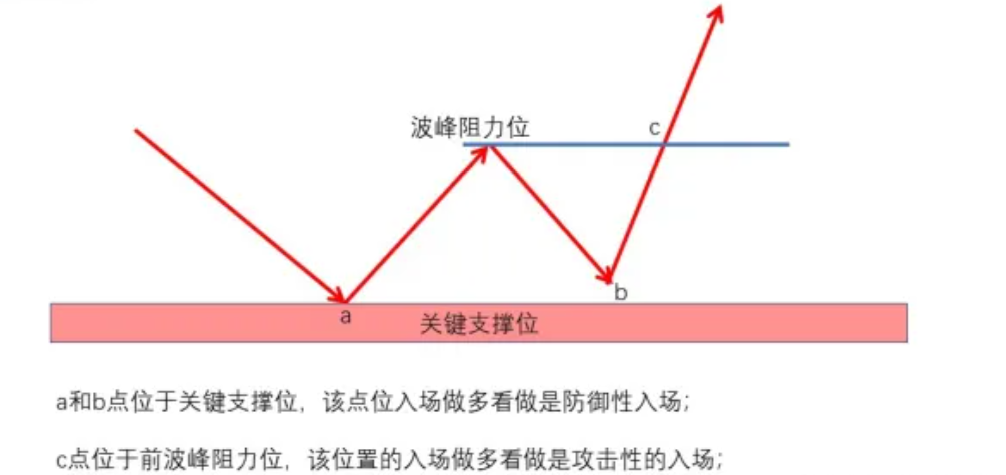
figure 1)
Defensive entry is an entry that fails to test key support or resistance. It can also be considered as a callback buying with strong defense.
Aggressive entry is an entry that breaks through a certain key support level or resistance level, and can also be considered as a breakthrough buying, with a strong attack;
as shown in picture 2:
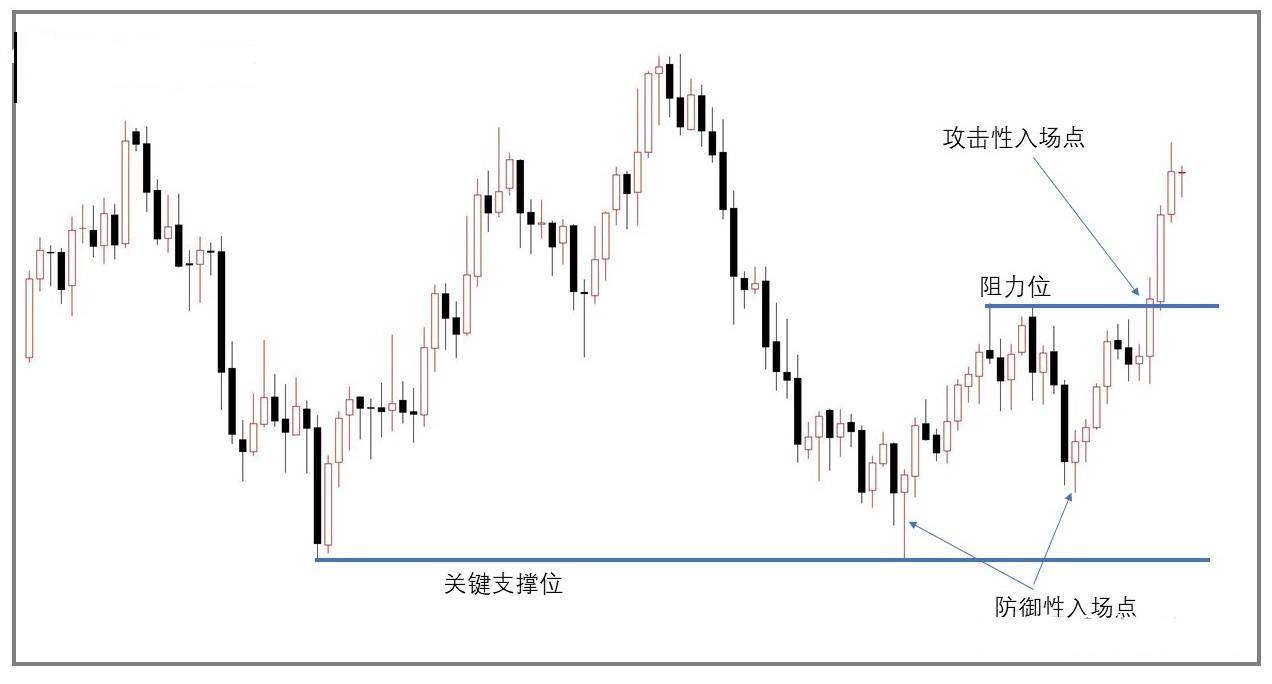
figure 2)
Defensive buying tends to be defensive, strong defense is weak and offense is weak, offensive buying tends to be offensive, weak defense is strong and offense is strong, both have their own advantages and disadvantages, there is no distinction between which is better, it depends on personal choice.
Is there a buy point that is both defensive and offensive? Answer: Yes
Platform breakthroughs have such characteristics. As a strong defensive area, platform breakthroughs open up new rising or falling space, which is offensive. The model shown in Figure (3):
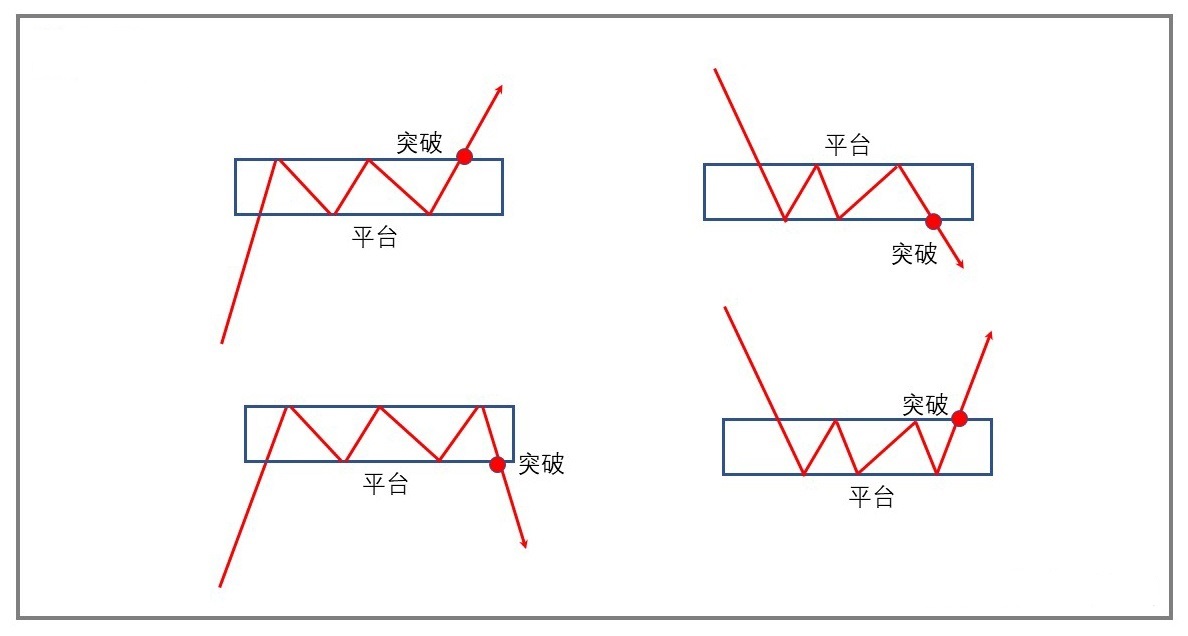
image 3)
The composition of the platform is very important. It can be a static interval composed of two or more K-lines, or a static interval composed of small bands. However, the amplitude of the platform must not be too large, and the smaller the amplitude, the better.
The K-line that breaks through the platform must be the K-line of the medium-length entity, which has strong aggressiveness. It is called the pricing K-line in the supply and demand trading method, and the K-line is considered to be the breakthrough K-line in the naked K.
In fact, this "platform + breakthrough" model, which is both defensive and aggressive, is reduced to two K-lines, which are static K-line + dynamic K-line, as shown in Figure (4):
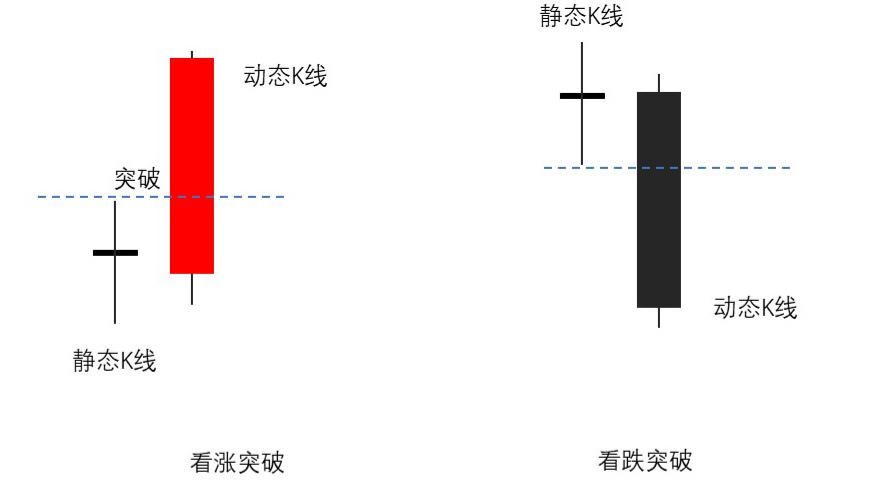
Figure 4)
There are both defensive and aggressive buying points, and its defensiveness is mainly constructed by the platform. The platform can be expressed as an oscillating platform composed of two or more static K-lines, or in the form of a triangle, rectangle, flag, etc. Tidy up the platform, but it must be in the form of convergence to narrow fluctuations before the breakthrough. The K-line that breaks through the platform range must be an aggressive mid-to-long entity trend K-line. Of course, it should not be too large. Other factors still need to consider the platform The structural trend and position, as well as the profit and loss ratio.
Copyright reserved to the author
Last updated: 09/04/2023 18:42
Add

It is a relatively common idea to break through and build 1/3 of the position, and then call back the high before breaking through and then refill.
Copyright reserved to the author
Last updated: 08/30/2023 09:21
Add

As to whether to buy on a pullback or a breakout, it really depends on the type of market you are in.
If it's a choppy market breakout more often than not it fails or doesn't make much progress, in which case I'm more likely to buy on pullbacks.
But in a strong uptrending market, breakouts tend to persist, and if you wait for a pullback, you can miss a chunk of the move.
Breakthroughs are best, of course, there are bigger gains to be made there.
However, if I miss the initial breakout, then I have no choice but to enter on a pullback.
Sometimes I buy on pullbacks to previous breakout levels, more often I buy on pullbacks to a moving average.
Copyright reserved to the author
Last updated: 09/03/2023 06:15
Add

Advantages of breakthroughs: You can get in the car as soon as you break through the key price, and you will not miss the market.
Disadvantages of breakthroughs: If you encounter false breakthroughs, you will often catch up at the lowest point or the highest point, and the stop loss range will be relatively large.
The advantage of the callback: the entry point is good, the range of the stop loss is small, and it will not cause a large loss.
Disadvantages of callbacks: If the market is really a big market, there is almost no chance for a callback to enter the market. After missing a series of market entries, what is finally missed is a big market.
There is no need to distinguish the absolute advantages and disadvantages of these two entry methods, just choose a trading style that suits you, but you must pay attention to maintaining the consistency of the transaction, and do not break through the next callback this time.
Do a good job of stopping loss. Both methods of entering the market may make mistakes. It is not terrible to make mistakes, and admit mistakes at the smallest cost.
Copyright reserved to the author
Last updated: 08/30/2023 23:12
Add

Break through and build a position. I believe that the market will never look back once it is gone, and you will earn if you buy it;
Callback Jiancang believes that the market will definitely turn back, and it will turn back after turning back.
Choose whichever you believe in.
Copyright reserved to the author
Last updated: 08/31/2023 16:16
Add

Breakthrough entry is mostly used to end sideways. After the breakthrough, the stop loss is not well set, and the position is opened with a retracement. Everything is for risk minimization.
Copyright reserved to the author
Last updated: 08/28/2023 19:31
Add

I don't choose... breakthroughs and callbacks are pseudo-concepts in themselves.
Copyright reserved to the author
Last updated: 09/06/2023 09:46
Add

It can be explained in words.
In an uptrend, it is the resistance level that breaks through. It happened earlier and is significantly lower than the previous period, but it is only higher than the current box. It indicates that the trend has started, and there will be a callback after a period of time. If the callback judgment fails, it is The decline is in the relay form, and the decline is the opposite.
I think the subconscious of this question should be to know how to judge breakthroughs and pullbacks.
Due to the existence of breakthrough failures and callback failures, as well as the disorder of their mutual conversion, the establishment of breakthroughs and callbacks is actually based on experience. If you can clearly identify breakthroughs and callbacks, you will actually judge correctly. How to open a position It's all about making money! If your correct probability is greater than 60%, then congratulations, you have a bright future!
Copyright reserved to the author
Last updated: 09/06/2023 03:37
Add

In real trading, if you want to break through and build a position at an aggressive point, just hang a break position 1-2 points above the key resistance to catch up. Generally, the market break position is relatively fast and it is difficult to enter the market manually. Even if you enter the market, the price is not ideal, especially Short-term traders, if there is no hanging, don't chase aggressively, you can choose to call back to build a position!
You can wait for the price to pull back to the breakthrough point to open a position, but if it is a relatively large breakthrough, it is generally difficult to give a chance to pull back, unless it is a volatile market!
Copyright reserved to the author
Last updated: 09/05/2023 19:08
Add

A breakthrough is a breakthrough against a shock. A callback is a callback to a trend, both of which can be taken into consideration
Copyright reserved to the author
Last updated: 08/29/2023 17:01
Add

To put it bluntly, opening a position with a callback is to open a position by breaking through the downward trend of a small cycle. In essence, it is a breakthrough to open a position.
According to my understanding, opening a position with a pullback is a way to open a position with lower trial and error costs. After all, breaking through the stop loss position of opening a position may be too far away from the position. Once you make a mistake, you need to pay a higher price, which is why we We must use the method of cycle resonance to do transactions. If the big cycle is a big trend, there must be a lot of pullback trends. It is impossible to rise 100 K-lines without any pullback. As long as there is a pullback, we can trade in small Periodically find entry opportunities, and it is a small trial and error cost opportunity.
Copyright reserved to the author
Last updated: 09/06/2023 22:23
Add

I usually mainly do breakthroughs,
The main advantage of breaking through and opening a position is that you will not miss the opportunity because you wait for the callback, but the breakthrough is often accompanied by a large stop loss, some can accept it, and some cannot, so it is good to wait for him to pull back and stabilize before buying. It is best to use one of the remedies on a regular basis to avoid mental entanglement.
Copyright reserved to the author
Last updated: 08/30/2023 17:37
Add

No choice is the fate of a violent position, and the fluctuation space of the trading market is not fixed
Copyright reserved to the author
Last updated: 09/03/2023 22:21
Add

Breakthrough opening and pullback opening in trading are two common opening strategies. They both have advantages and disadvantages. The choice of opening a position should be determined according to market conditions, personal trading style and risk tolerance. As an investment consultant, you should provide advice and assistance based on the needs and circumstances of your clients. The following are the advantages, disadvantages, and applicability of the two strategies for building positions.
Breakthrough opening positions:
Breakthrough opening refers to opening a position after the price breaks through a key level. The advantage of this kind of position building strategy is that it can capture the starting point of the trend, and there is a large upside after entering the market. At the same time, it can avoid invalid transactions when the trend is not clear or fluctuates sideways. The disadvantage is that the timing of opening a position is not easy to grasp, and false breakthroughs are prone to occur, resulting in losses.
Applicable conditions: Breakthrough opening positions are suitable for situations where the market has a clear trend. For example, the stock market starts to rise after a long period of consolidation before the breakthrough. At this time, the breakthrough opening position strategy can be considered.
Callback to open a position:
Pullback opening refers to opening a position when the price pulls back to a key level. The advantage of this strategy of building a position is that it can buy stocks with lower prices, reduce the cost and risk of building a position, and at the same time avoid invalid transactions when the trend is not clear or fluctuates sideways. The disadvantage is that it is easy to miss the starting point of the trend, and there may be a period of shock after opening a position.
Applicable conditions: Callback opening positions are applicable to the situation when the market is in an upward trend, for example, the stock market has a correction during the rising process. At this time, you can consider using the callback opening position strategy.
In short, which strategy to build a position should be selected according to market conditions and personal trading style, and investment consultants should provide advice and assistance according to the needs and conditions of customers. At the same time, when choosing a strategy for opening positions, you should pay attention to risk management, and set tools such as stop loss orders and profit orders to avoid losses and excessive losses.
Copyright reserved to the author
Last updated: 09/03/2023 02:15
Add

I think you can break through the callback to enter a small position, break through the callback and then pull up to enter the standard position. This operation is relatively safe.
Copyright reserved to the author
Last updated: 09/01/2023 04:11
Add

In the market, verify which one is applicable for your breakthrough or callback. After all, you still have to refer to your entry indicator standards to judge. This question is like asking whether you are bullish or bearish at the moment, and there are both.
Therefore, it is recommended to use the method of breaking through to open positions 50 times, and use the method of callback to open positions 50 times. Of course, the two are synchronized. In the end, you will have the answer if you see the high success rate over there!
Copyright reserved to the author
Last updated: 08/30/2023 13:18
Add

0
work
0
subscriber