


Stay in touch!
Subscribe to our newsletter to get the latest updates on live market analysis, trading strategies and more. You can unsubscribe anytime.
By subscribing, you agree to Trading.live Privacy Policy.


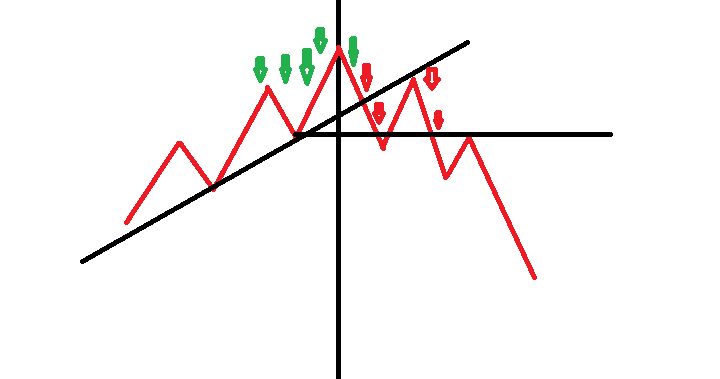
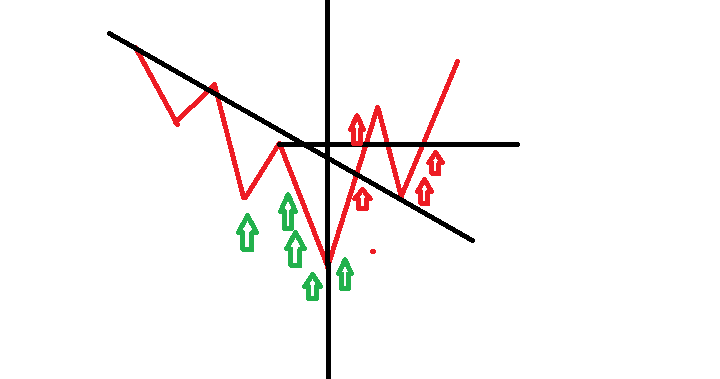
The difference between the transaction on the left and the transaction on the right, let’s not talk about the above picture first.
null------------------------------------------------- -----------------------------------
many------------------------------------------------- ---------------------------------------------
As shown in the picture, there are so many orders when doing long, several green rising arrows from the center line to the left, and an upward arrow on the right side of the center line, which are often called left-hand transactions, while some red arrows on the right are often Known as a right-hand trade.
Now let's analyze it.
The transaction on the left is often called a transaction of guessing the top and buying the bottom. Taking this picture as an example, when the market goes down sharply, there will be some small retracements. Often at this time, some shock indicators are in an oversold state. In most cases, the market will have a stagnation zone here. If the falling market is weak, there will be a slight rise here. At this time, the left side of the transaction thinks that the bottom is coming soon, or the position just past is the bottom. The downtrend has not completely ended, and when the uptrend has not yet started, it is believed that the bottom has arrived, so as to enter the market early to seize most of the profits. Or you can ignore the bottom and just focus on catching these small rallies.
Trading on the right side is often referred to as a follow-up order. As shown in the figure, when the market breaks through the trend line, or the high point of the previous wave, it can also be called a pressure position, or later, when the market stabilizes on the trend line, a certain period of time Moving average, or stepping back on a certain support level to confirm, at this time, it is considered that the downward phase has come to an end, and the upward phase has begun. Only at this time does it enter the market, and at the same time, a large portion of profits have been missed.
I believe that when most traders first enter the market, they must be staring at the market, ready to trade on the left side anytime, anywhere, looking at a certain oscillating indicator, as long as the indicator shows an oversold state, they will immediately place an order. The profits that come up are too late and run away. And trading also makes money and loses money from time to time. Some people began to study the deviation of indicators and so on, and continued to work on the left side. In the end, after trying many times, I formed my own fixed operation techniques and routines. The transaction on the left is flourishing and heading for success.
The advantage of trading on the left side is the peace of mind. How do you describe the feeling at that time? It's almost the feeling of taking the head of an admiral out of thousands of troops. That kind of pleasure, that kind of stimulation, even more than that can stimulate the secretion of dopamine, so that people can't stop it.
On the right side, the greatest pain lies in waiting. Impatience is the worst enemy here. You have to wait until the market is established before proceeding. It was only a few days to wait, but these days are as long as years. After finally waiting, I fell asleep or was busy and didn’t buy it, or I didn’t place an order in advance, or even after the purchase, the market took a sharp turn for the worse. All the hard work broke out at this time, and the stop loss was larger than the left side, which brought deep losses. The deep pain could not be relieved for several days. Maybe I'm being serious. Those who have survived also adjust their mentality, hone their skills, and slowly and often eat a lot of trends, thus leading to great success.
In the end, regardless of the left and right sides, find the operation method that suits your personality, optimize it, improve it, and find out the part of the market that operates it, and get familiar with it. can achieve some success.

Copyright reserved to the author
Last updated: 08/30/2023 02:54
 Add
Add


Novices have all heard the sayings "trading on the left" and "trading on the right". Novices who are not very new have also heard that "trading on the left is trading against the trend and is predictive trading, and trading on the right is trading with the trend. It's following the sex trade", people will tell you that the right side is better than the left side, and then you enter the market excitedly, and you will still be slapped in the face.
What are the so-called left and right reference objects? It is a reverse form. For example, the most obvious reversal pattern, that is, a V-shaped reversal, a series of rising unilateral market conditions plus a doji followed by a series of downward unilateral market conditions, so that individuals can see that the left side is there. Which side is the right side. Of course, the reversal pattern is not just a V-shape, you can find it yourself, so I won’t repeat it here.
The left-hand trading method requires you to enter the market on the left side of the reversal pattern, that is, you can enter the market when you judge that the reversal pattern is about to occur. Enter on the right. Because whenever the reversal pattern is completely completed and confirmed, the market on the right has already started a long period of space. Traders can't bear to wait, and they are reluctant to give up the seemingly long period of space, so they often enter the market in a hurry , becoming a left trader.
Some people also think that in the course of the market, as long as certain necessary conditions are met, the reversal pattern can be judged to be completed, without waiting for its confirmation point to appear. For example, V-shaped reversal, the standard determination point is that the low point of the K-line behind the cross star is below the low point of the previous K-line before the cross star. Many people can’t wait that far. When the K-line after the cross star goes deep When the K line in front of the doji is below two-thirds, you can enter the market. Another example is the M head reversal pattern. The standard confirmation point is that the market will go down through the shoulder of the M head after the second reversal. For those who are in a hurry, as long as there is another V star reversal at the same position as the previous V-shaped reversal Turn, you can judge that the M head is forming, and you can enter the market. There are many other reversal patterns, and its advance confirmation point can be found.
Therefore, it is not difficult to find that the core idea of "trading on the left side" and "trading on the right side" is to find the high and buy the bottom. It is actually not a trend trading method. Trend trading method. The trend trading method attaches great importance to breakthroughs , and only non-stop breakthroughs are the best confirmation points for trends, so the trend trading method generally uses various breakthrough points as entry references. However, the high-hunting and bottom-hunting focus on reversal , and it always wants to grasp the specific reversal point. The trend trading method is to take only one scoop of the weak water and buy the bottom, hoping to earn the last copper coin.
The quotations in the market are dominated by continuity, which is a line segment, supplemented by reversal, which is the two endpoints of a line segment. When we find the two endpoints, it is by no means to eat from the beginning to the end, but to judge where the market line segment is most likely to develop, and a smart trader will choose an opportunity with the least risk to enter the market in this interval, and speculate Speculation, that's all.
Copyright reserved to the author
Last updated: 08/14/2023 21:21
Add


There are two diametrically opposed trading strategies in the market, one is trading on the left side and the other is trading on the right side. We can use the diagram to understand the two trading methods: we can see from the diagram: 1. When falling, the bottom of the stock price is used as the boundary. Anyone who sucks low on the left side of the "bottom" belongs to the left side of the transaction, and when the bottom is reached The chasing up after the recovery belongs to the right side of the transaction. Take the most vivid letter "V" as an example, when the left side is down, it is called a left side transaction, and when the right side is up, it is called a right side transaction. To be more specific, that is to say, trading on the left is to buy when there is a gap or a long lower shadow line in the late stage of heavy volume and rapid decline for many consecutive days. The relatively stable right side is to buy when there are iconic bullish K-lines such as the morning star, Yang Bao Yin, etc. Hello, the foreign exchange market, also known as "Foreignexchange" or "FX" market, is the largest financial market in the world, with an average of more than 1.5 trillion US dollars in capital turnover every day-equivalent to all securities market transactions in the United States More than 30 times the sum. Classification of foreign exchange transactions From the perspective of the nature of transactions and the type of realization, foreign exchange transactions can be divided into the following two categories: basic foreign exchange transactions to meet customers' real trade and capital transaction needs; Prevent exchange rate risk or foreign exchange derivatives transactions for foreign exchange investment and speculation needs. The basic foreign exchange transactions belonging to the first category are mainly spot foreign exchange transactions, while foreign exchange derivative transactions include forward foreign exchange transactions, foreign exchange option transactions, swap transactions, swap transactions, etc.
Copyright reserved to the author
Last updated: 08/08/2023 02:57
Add

The transaction on the left is a forecast transaction, which is to sacrifice the success rate in exchange for profit. This transaction has a low success rate, but the profit will be greater if it is done correctly. The transaction on the left is a contrarian transaction. The transaction on the right is a confirmation transaction, which is to sacrifice profits for the success rate. This method has a higher success rate, but it will sacrifice part of the profits before confirmation. Trading on the right is a trend-following transaction.
But it should be noted that these two concepts only exist under the same time period framework. If the time period changes, the left side may be the right side, and the right side may also be the left side. For example, if the big cycle is running a short trend, then here Short transactions under the framework belong to the right transaction, and long transactions belong to the left transaction. But from a smaller cycle such as the level below the daily line, the situation will change again. In a word, don't be obsessed with trading on the left or right side. The important thing is to learn cycle conversion and have a trading system that suits you. Then the left side and the right side are not so important!

Copyright reserved to the author
Last updated: 08/30/2023 15:59
Add

First understand what is "left side transaction" and what is "right side transaction":
At the end of the market rise, with the top as the boundary, any high selling or short selling on the left side that has not yet formed at the "top" belongs to the left side of the transaction, while the sell-off after the "top" falls back belongs to the right side of the transaction. Both are shots, but the former is called "sell high or go short", while the latter is called "sell down", and the meanings are quite different.
At the end of the market decline, with the bottom of the market as the boundary, those who are on the left side of the "bottom" go long, which belongs to the left side of the transaction, and chasing up after bottoming out, belongs to the right side of the transaction. Both are buying operations, but the former is called "buying low", while the latter is called "chasing up", and the meanings are quite different.
Sometimes at the same price, there are also differences between transactions on the left and transactions on the right.
The so-called left-hand trading is contrarian trading, anti-market operation, when the market is still falling slowly, buy slowly; when the market is still rising, close when it is good; You must have tenacious beliefs, and at the same time, you need to have deep and mature technology as the backing. You can judge the top and bottom of the market according to your personal predictions to trade, which is a fish-to-fish trade.
The so-called trading on the right side is trading with the trend, or chasing ups and downs. When the market is good, it is the icing on the cake. When the trend is not good, it is better to sit on the sidelines and trade according to the graphic trend that has already appeared.
The transaction on the left thinks that the bottom (top) is now and is in progress; the transaction on the right thinks that the bottom (top) is in the past and has been completed. Trading on the left is to enter the market before there is a buying signal in the market; trading on the right is to wait for a clear buying signal in the market before entering the market, instead of constantly predicting the bottom and entering and buying at the bottom of your imagination.
Copyright reserved to the author
Last updated: 08/07/2023 18:15
Add

The transaction on the left is forecasting, and the transaction on the right is following. On the left is a transaction in which the direction of buying is opposite to the direction of price movement; on the right is a transaction in which the direction of buying is the same as that of price movement; one is completely subjective and the other is relatively objective. The difficulty of trading on the left is how you can judge that your prediction is wrong, while trading on the right is easier to set the standard for admitting mistakes.
Copyright reserved to the author
Last updated: 08/13/2023 22:36
Add

First, the price is round, and then the price moves counterclockwise, with a vertical line in the middle, and the traders on the right buy along the trend as the price rises, because the price is round, and when the price reaches the top of the arc, enter the left side, and the price starts During the price decline, the traders on the left kept predicting that this was a bottom, and then bought, until the price finally fell to the bottom and really caught the bottom.
Copyright reserved to the author
Last updated: 08/02/2023 06:20
Add

The so-called left side, for example, A shares fell to 2000 points, and it is still falling today, the drop is quite large, and then you buy a part of the position, this is called picking up cheap chips in a falling market, you don’t know when you will see Bottom, but you know that this price position is very cheap, you use time for space to make money, this is called the left side. The so-called right side is actually a relative probability. For example, first, gold rebounded when it fell to 1000 points, and then fell again after the rebound, and it did not fall when it fell to 1010 points. Then you open a long position, and you are betting that it will not fall below 1000 points, thus forming a w-bottom or 2 lows The peak is reversed, and you use the relative probability to bet on a potentially huge profit. If it falls below 1000 points, you will stop the loss. Another example is the second, gold did not fall below 1000 points, forming a w-bottom reversal, and now the trend is confirmed to be upward, and then in the next adjustment, that is, the formation of 3 low-peak buys, this is a relatively more stable right-hand transaction , but the disadvantage is that the odds are low. If you hold it for a long time, an adjustment may knock out your stop loss. If you hold it for a short time, it may skyrocket like crazy. If you think about the wave theory, a rise with 2 low peaks is like a 3-wave main rise, and a rise with 3 low peaks is 5 waves. This is the same source of profit and loss, what kind of risk you take and what kind of return you may get. When you reduce the risk, you also reduce the return, including various trading systems. So no matter whether you are on the left side, the relative right side or the absolute right side, you can only balance according to your own financial situation and personality ability, and then come up with a trading system for yourself. Finally, I would like to say that those who play on the left side are rich, very rich.
Copyright reserved to the author
Last updated: 08/06/2023 15:14
Add

Trading on the left side and trading on the right side have their own advantages and disadvantages. There is no absolute good or bad. However, most professionals in the market are more inclined to trade on the right side. It is also recommended that investors mainly trade on the right side. If Investors who operate with the trend should adopt this trading method. On the contrary, for those investors who do shock market or short-term operation, in many cases, they tend to choose more trading methods on the left side.
Copyright reserved to the author
Last updated: 07/31/2023 23:32
Add

In layman's terms, trading on the left is to predict the future trend, entering the market before the inflection point is trading on the left, otherwise following the trend is trading on the right.
Copyright reserved to the author
Last updated: 08/15/2023 07:07
Add

The transaction on the left is that the entry area that the trader is expected to reach will directly trigger the transaction signal when the current set target level is reached, while the transaction on the right is to wait for the confirmation on the left before taking the entry signal to execute. On the left side, the risk of uncertainty and possible opportunities is high, as shown in the figure below:
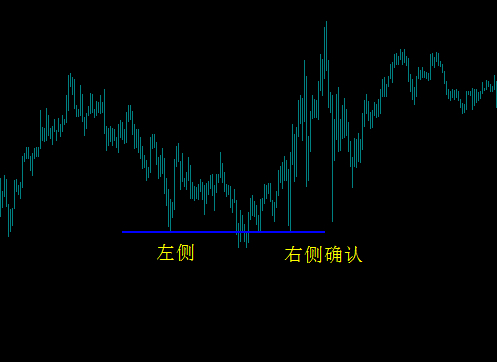
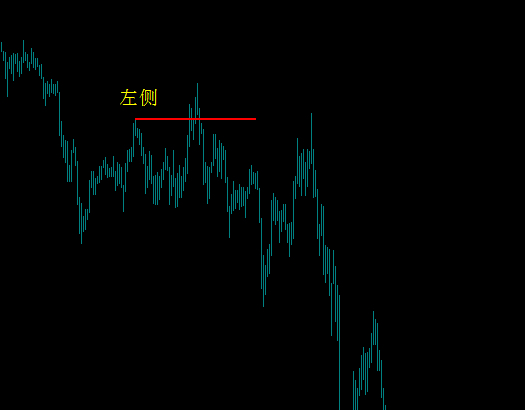
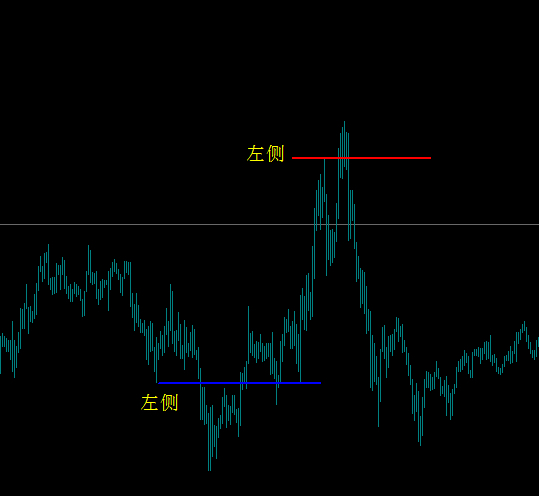
Most of them use the left confirmation, the head fails or the right confirmation enters the market, or 2B enters the market. Hope to help you.
Copyright reserved to the author
Last updated: 09/03/2023 21:54
Add

The transaction on the left is a subjective operation, while the transaction on the right is an objective operation;
On the left is analysis, on the right is transaction;
On the left is the short line, on the right is the long line;
The left side is the shock, and the right side is the trend;
Novices on the left, veterans on the right;
High frequencies are on the left, low frequencies are on the right;
Quick work on the left side, short-term benefit on the right side;
On the left is man, on the right is God;
Swipe orders on the left and make profits on the right;
Short surplus on the left, long life on the right;
left wise, right wise;
Looking at the scenery on the top of the mountain on the left, and enjoying the night by the river on the right;
Copyright reserved to the author
Last updated: 08/09/2023 09:59
Add

Trading on the left side and trading on the right side, this topic is believed to be familiar to investors who have engaged in electronic trading for a period of time, because it runs through every transaction of yours and is also a very important part of our transactions.
We know that for every trader, when entering the electronic trading market, the most important thing is that the market must have price fluctuations. Only with price fluctuations can there be price differences, and only with price differences can there be corresponding speculative opportunities. So no matter what trading method or learning method we use, it is to study the fluctuation of the whole market.
If the entire fluctuation of the market is divided into two categories, then it is the entire upward trend and the upward trend. The purpose of each investor entering the market is very simple, to maximize profits and minimize risks.
In the financial market, every investor will encounter the same question: Which is better, the left-hand trading strategy or the right-hand trading strategy? For investors with certain investment experience and level, they may think of:
Under what circumstances is it suitable to trade on the left side, and under what circumstances is it suitable to trade on the right side?
First of all, let's understand what is left-hand transaction and right-hand transaction.
Trading on the left side: the instant price trading mode, within a certain time period frame, before the phased high point (or low point) of the market, the transaction that enters the market directly, that is, at the potential high point (or low point) of the market The transaction on the left side belongs to the left side transaction.
Trading on the right side: See the signal trading mode. Within a certain time period frame, it is determined by a certain judgment standard that the phased high point (or low point) of the market has appeared and confirmed, on the right side of the high point (low point) The transaction carried out belongs to the right transaction.
Trading on the left side and trading on the right side seem to be just trading on the left and right sides of a certain high point (or low point). It seems very simple, but in fact, to really understand the essential difference between the two, you must first understand Here are two key takeaways:
1. The transactions on the left and the transactions on the right are also distinguished by time period levels. The transactions on the right side of the small-level cycle are likely to still belong to the left side of the large-level cycle. Therefore, when discussing and considering the left-hand transaction or the right-hand transaction, one must first clarify and determine its time period level! This is the most basic prerequisite!
2. How to judge the periodic high and low points? Different standards and analysis theories will lead to different conclusions, that is, what tool or theory to use to judge the so-called "high point" and "low point", this is the most critical! It is also the essence and core of truly understanding the difference between left-hand trading and right-hand trading!
Trading on the left side and trading on the right side have their own advantages and disadvantages, and there is no absolute difference between good and bad, but most professionals in the market are more inclined to trade on the right side, and investors are also advised to trade on the right side. If you are an investor who operates with the trend, you should adopt this trading method. On the contrary, for those investors who do shock market or short-term operation, in many cases, they tend to choose more trading methods on the left side.
Copyright reserved to the author
Last updated: 08/12/2023 10:12
Add

The transaction on the left is to enter the market in advance by predicting market changes, and it is cost-effective, but the market trend has not been verified at this time. The transaction on the right is to wait for the market to change, and then enter the market after verifying the previous judgment. Confirmation, at this time, the entry income is not as high as the left transaction, but the risk is smaller. Simply put, that's what it means. To sum up, there are two entry logics based on the balance of benefits, risks, and winning rates.
Copyright reserved to the author
Last updated: 08/06/2023 21:10
Add

"Buy on dips, sell on rallies" is a saying that stock market analysts often say, but how many people can really do it? Because the way of thinking of most people is "greedy when high, fear when low". Investors who really win in the stock market are often those investors with left-hand trading thinking. In a bull market that has already formed an upward trend, it should be uncontroversial for investors to buy at a bargain after the stock price pulls back, but most people can't do it. There is no doubt that this is a matter of awareness. The reason why world-renowned investment masters can become masters is because they basically have the left-hand trading idea.
Copyright reserved to the author
Last updated: 08/01/2023 01:40
Add

The so-called left-hand trading, also called reverse trading, is characterized by directly entering the market in reverse when the price reaches or is about to reach a so-called important support point or resistance point, without waiting for the price to change. The right side of the transaction is just the opposite. In the process of practice, I found that most Huiyou in China adopt the trading rule on the right side, that is, when they see the market hit a new high, they realize that the market has started, and then they start to chase, but they often catch up to the stage high, especially It is in the face of short-term fluctuations, which is the fundamental reason why only a few people make money. In fact, a rule that can continue to beat the market should be "the medium and long-term trend must stick to the right side of the transaction and the short-term trend must stick to the left side of the transaction", that is to say, when there is no clear bottom after a wave of bad market, Think of all rallies as rallies, and once a bull market is established, any pullback should be viewed as an opportunity to step in.
Copyright reserved to the author
Last updated: 08/03/2023 05:47
Add

This trading method is a methodology, in fact, the most important thing is to see the executor's operation
Copyright reserved to the author
Last updated: 08/07/2023 12:39
Add
I like the aggressive trading method in the trading on the right. Since it is an opportunity, why not take a heavy position? Is it lack of confidence? Or is there simply no opportunity there?
Copyright reserved to the author
Last updated: 08/07/2023 10:29
Add

Trading on the left is about gambling, trading on the right is about waiting; trading on the left is about sailing against the current, and trading on the right is about following the trend; trading on the left is to operate before the trend is formed, and trading on the right is to operate after the trend is formed; trading on the left is to sell high Buy low, the trading on the right is to chase the rise and kill the fall.
People who are suitable for trading on the left side are usually gamblers, greedy, impatient, bold and aggressive, and decisive. The three strategies commonly used by traders on the left side are: one is to read more news to find a sense of market, and the other is to use technical analysis flexibly , The third is to abide by the operating discipline. Regarding the actual trading on the left side, some people use the 120-day moving average as the basis for judgment, buy when the price breaks through the 120-day moving average, and sell when the price falls below the 120-day moving average. . Some people use the J value in the KDJ indicator and the distance away from the 5-day moving average as the basis for buying and selling, and strictly implement it, and they also made a lot of money. Here is just to provide you with an idea to build your own trading system.
People who are suitable for trading on the right side are generally indecisive, optimistic, forbearing, clear goals, contented, and follow the trend. Trading on the right side is mainly based on following strategies, mainly based on some auxiliary technical indicators for judgment. There are many technical indicators suitable for trading on the right side. Here we mainly introduce the MA indicator. The MA indicator is very simple. I believe that there is no trader who does not know the MA indicator. In fact, the functions of the moving average are nothing more than four: first, support and pressure; second, to indicate the direction; third, as a reference for buying and selling when prices break through and fall below ; Fourth, buy or sell when the short-term moving average crosses or crosses the long-term moving average. However, there are two key points in using MA: first, which period is most suitable; second, how to combine it best. These two questions need to be determined according to the trader's personal capital status and operating level, accumulate experience in actual operations, and find the cycle and moving average combination that best suits his operating level.
Copyright reserved to the author
Last updated: 08/04/2023 13:44
Add

The general on the left is more aggressive, wants to prove himself more, is more "greedy", is more risk-loving, and of course, is probably more "new";
The general on the right is more conservative, less willing to "adventure", and more risk-averse. Of course, most of them are "older".
There is no right or wrong between the two, and it doesn’t matter whether they are high or low. When it comes to the final result, different "offensive" methods will be adopted in different situations, such as an excellent critical point game. The left side may have an advantage. Under the same risk control , Occupying the right time and place, why not do it? This is mostly in the first eighth and the last eighth of the market!
As for the three-quarters of the market in the middle, the right side may be more desirable, and it evolves rhythmically and follows the trend.
Therefore, as the old saying goes, soldiers have impermanent potential, and water has impermanent shape!
Don't imitate it and use it to death, the one who suffers will be the boss who pays the bill!
Copyright reserved to the author
Last updated: 08/28/2023 08:02
Add

0
work
0
subscriber