


Stay in touch!
Subscribe to our newsletter to get the latest updates on live market analysis, trading strategies and more. You can unsubscribe anytime.
By subscribing, you agree to Trading.live Privacy Policy.


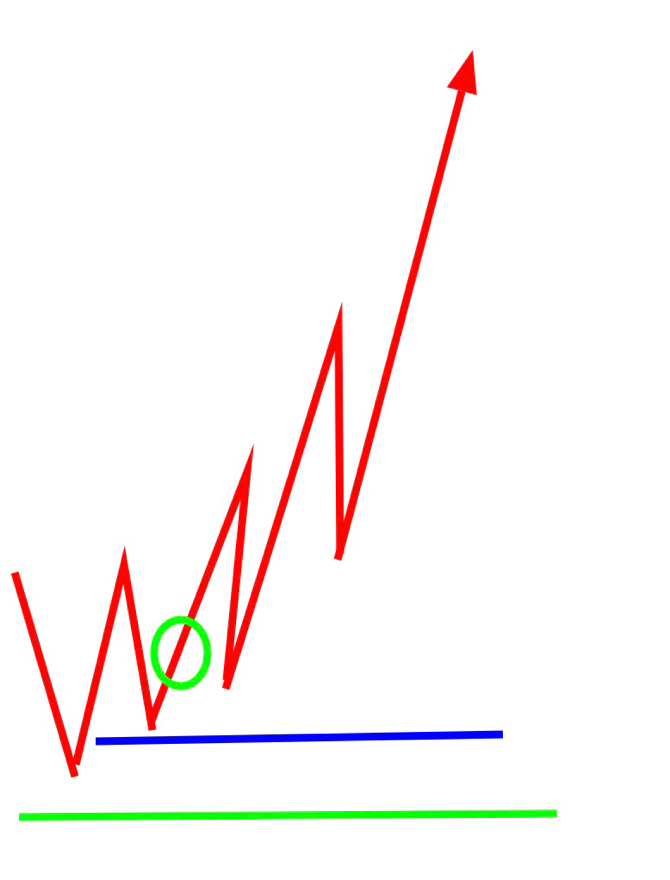
First of all, it depends on how you set the stop loss. The stop loss point must be placed at the low or high point ahead. If you have studied the Dow Theory, the low point should be placed below the low point of the Dow Theory, and you also need to judge whether there is a possibility of a false breakthrough in the reasonable theory.
As shown in the picture below: If you enter the market in the green circle, if the stop loss is placed below the blue line, it is not reasonable to place it below the green line. Because the two lowest points are too close, in this case, the stop loss position far away shall prevail. If your stop loss is smaller than the blue line, the probability of being hit is greater.
Copyright reserved to the author
Last updated: 08/19/2023 09:47
 Add
Add

You didn't see the general trend. in the consolidation zone. Where is the probability of going, and what is the reason. Which price points are absolute price points. What level is the market. It all goes together. You're screwed. Write it down before placing an order, if it is damaged or it will not be damaged. After that, you will have a very clear concept of what the market represents
Copyright reserved to the author
Last updated: 08/15/2023 07:53
Add

Hedging options
Copyright reserved to the author
Last updated: 08/17/2023 23:09
Add

Well, when you mentioned "always getting hit," it's pretty evident that there's a straightforward solution: Your stop loss might be in the wrong spot, or the amount set is too small. So, you have a few options to consider:
Take a close look at the method you use to set your stop loss. It's possible that either your method is flawed, or you're not applying it correctly.
Maybe your stop loss is too conservative for the market you're trading in.
Or it's possible that the funds you're using for trading are insufficient to support an appropriate stop loss for the market.
Let's illustrate this with an example. The S&P 500 futures market, known as ES, typically requires about a 2-point or $100-$125 "cushion." If your stop loss is set for less than this amount, even if it's correctly placed and your trade is sound, you'll likely get stopped out. Moreover, a general guideline is not to risk more than 3.5% of your account on any trade. Ideally, it's better not to exceed 1.5%, and many traders aim for the 0.5-1.0% range of their account size. So, for trading ES comfortably, you'd need an account with around $10,000 to $12,000.
To determine the necessary "breathing room" for your market, you can check the Average True Range (ATR) using readily available ATR indicators for the specific time frame you're trading.
As for evaluating your stop loss placement methodology, I can't provide guidance without knowing your specific approach. There are various methods based on the type of trading you're doing (e.g., momentum or scalping). It could be beneficial to review and possibly refine your process for determining stop loss placements, while keeping detailed records to help improve your trading.
Wishing you the best of luck with your trading endeavors!
Copyright reserved to the author
Last updated: 10/17/2023 08:24
Add


I don't do futures, so let's take foreign exchange as an example. Hitting the stop loss back and forth is because you have not judged the direction of the market, or you have not insisted on your choice. For example, if the direction is judged to be upward today, we will go long, and if the market moves downward, we will not do it, and we will enter the market when the market rises again. No matter how much the market goes down, it is not your game, so as long as the market trend does not reverse, you can definitely make more orders. At least he won't be slapped in the face left and right. Sometimes short positions are also the right choice. Losing less is earning. The market is open every day, and there will be many opportunities, so there is no need to rush to make orders.
Copyright reserved to the author
Last updated: 08/17/2023 18:20
Add

Being hit with a stop loss back and forth is a situation that anyone may encounter, and it is also the moment that tests one's will the most.
The stop loss is set too tight to accommodate the trend, and it is easy to be hit back and forth with the stop loss. If the stop loss is not too tight and is set outside the trend channel, but the stop loss is still hit back and forth, it may be because it has entered a wide range of shocks.
No one can accurately predict how the market will go in the future, anyone may be involved in a wide range of volatile markets, and no one can predict when the volatile market will end. To capture the big unilateral market, we must be in it, otherwise we will miss the best position of the bottom position when the trend market starts. Those who tell you that "you don't need to do the shock market" are not human beings, they are all gods, and only gods can predict when the shock will come and when it will end.
Here comes the question, how to deal with the volatile market? That is to be able to withstand the shock, and if you want to be able to withstand it, that is the scope of fund management. If your position is too heavy, and you lose a lot of bullets after being killed several times and stop loss, it means that there is a big problem with your fund management. It is recommended that the risk of each order should not exceed 2% of the total capital, otherwise, if you make mistakes several times, the loss will be relatively large.
Some people also propose a method of filtering out volatile market conditions with a large cycle. Historical data has long proved that the method of adding filters cannot improve our trading performance, but will destroy our trading rhythm. Because while filtering out risks, it will also filter out the best entry positions.
How to deal with the volatile market is an eternal topic that has always troubled traders.
Copyright reserved to the author
Last updated: 08/27/2023 10:00
Add

If the order is placed in the wrong position, stop loss must be hit! I will teach you where to place an order
Copyright reserved to the author
Last updated: 08/18/2023 15:00
Add

It shows that the market fluctuates, and it is out of the range before operating
Copyright reserved to the author
Last updated: 08/19/2023 14:50
Add

1. Invalid stop loss, stop loss setting is unreasonable. 2. Looking at the disk analysis in a short period of time is full of mistakes and wrong operations. It is recommended to wait and see, and it is not too late to enter the market after the trend is clear and there is an appropriate time. Instead of being wrong all the time, it is not too late to enter the market and make a profit when the trend is clear. If you still insist on making orders, you will have no money when the market trend becomes clear. Out of bullets.
Copyright reserved to the author
Last updated: 08/19/2023 16:27
Add

The description is still vibrating. Wait for the trend
Copyright reserved to the author
Last updated: 08/18/2023 05:49
Add

Mental problems: eager to recover losses, leading to emotional orders and revenge orders. System problem: there is a problem with the entry point, your stop loss is not an effective stop loss, perfect the system.
Copyright reserved to the author
Last updated: 08/17/2023 12:42
Add

This is a problem that many people will be troubled by. The market seems to be against you. Just after you hit your loss, it reverses, so many people will have an illusion that the market is only targeting you, but you must know that the market Someone opens an order every minute and closes the order. Therefore, you are not the only one who is damaged, but at the same time it is like someone making a profit.
How to solve the problem of always being lost back and forth depends on the basis of your order. If you use the Fibonacci sequence, then stop the loss according to the harmonious pattern. If you use the moving average, follow the moving average indicator. Appropriately, the loss can be amplified a little bit. If it reverses, it reverses, if it does not reverse, it loses more.
Copyright reserved to the author
Last updated: 08/26/2023 23:20
Add

Enlarge the operating time level and reduce the operating frequency.
Copyright reserved to the author
Last updated: 08/21/2023 05:02
Add

It must be that the entry position is wrong, or you can consider giving up the strategy. Maybe the strategy is not in line with the current market. Do it after understanding the limitations of your own strategy. The best entry is to wait out. So the question is, what are you waiting for? In the trend, wait until the critical point, then rise or fall, the trend will change, and enter the market at this time. When the trend is obvious, it is one or two 1-hour K-lines. Many times it is in the attack zone of the callback line, the middle ground. Once the 38th parallel is crossed, fire and attack at any time.
Copyright reserved to the author
Last updated: 08/26/2023 03:34
Add

The oscillating market is regarded as a unilateral market, and the stop loss will be hit back and forth. This means that you have no sense of control over the market, and you don’t know when it will fluctuate or when it will be unilateral. Strictly speaking, the market is planned in advance. The expectation is unilateral, so you have to get out of the unilateral, instead of talking about the trend when you see that the unilateral market has gone far It will oscillate, what is the range of oscillating, when you really understand the market, these are all achievable, keep working hard, boy
Copyright reserved to the author
Last updated: 08/21/2023 12:15
Add

stop trading
Copyright reserved to the author
Last updated: 08/19/2023 01:48
Add

If you lose the first order and don’t do it, won’t that solve the problem? doing it the next day
Copyright reserved to the author
Last updated: 08/19/2023 12:48
Add

Look for trends in large cycles, find entry points with a combination of large and small cycles, and open positions with small positions. Learn about entanglement theory, the method of entanglement theory can be used, but the idea of entanglement theory needs to be learned. Such as interval sets.
Copyright reserved to the author
Last updated: 08/18/2023 19:38
Add

There must be a concept of looking at the big and doing the small.
For example, a 60 moving average. A 240 moving average.
When the price is above the two moving averages at the same time, you cannot go short, you can only go long. In this way, many short-selling signals can be filtered out, thereby avoiding stop loss back and forth.
Copyright reserved to the author
Last updated: 08/24/2023 20:21
Add

Common reasons why a trade stops out.
1. Ordinary transactions, when you grasp the opportunities you think, you must set your transaction times. Individuals can place up to two orders a day to avoid over-trading.
2. The setting of your own trading system is not strict enough. When the market reverses, you will doubt your own trading. After a loss, there is a fluke mentality. Want to take a gamble and come back.
3. Traders need to understand that if a trade is wrong, the first step is to stop. Don't let the mistakes perpetuate. Being out of balance is very scary. dare to admit failure
4. Always reflect on yourself and spend more time reviewing. and own transactions. Find your own problems.
5. Position and risk control, this topic is commonplace. Trading is a process of accumulation, not a process of getting rich overnight. Everyone will have a liquidation experience. Because there are many different trading systems and funds. So everyone's mental capacity is completely different. It is very important to make a position that makes you feel comfortable.
Copyright reserved to the author
Last updated: 08/22/2023 07:34
Add

0
work
0
subscriber