


Stay in touch!
Subscribe to our newsletter to get the latest updates on live market analysis, trading strategies and more. You can unsubscribe anytime.
By subscribing, you agree to Trading.live Privacy Policy.


First, if we base our strategy on trend trading, we can actually think of fluctuations within a trading channel as market noise. The natural course of action is to enter a trade at a trendline in the direction of the trend.
Market noise is inversely proportional to the degree of timeframe: the larger the timeframe of the chart, the more stable the price. For example, the daily chart is more pure than the 1-hour time frame and can give you a better understanding of the general market situation.
In other words, the right choice of time frame can help, at least to some extent, to smooth out market noise. The rest depends on the trader himself and his skills.
Next, we turn to technical tools that may help us navigate market noise, focus on trends, and track them over longer periods of time. The first tool that comes to mind, and the easiest one, is the moving average.
Price fluctuations around this line can be interpreted as noise. The larger the period of the moving average, the greater the volatility. Moving averages allow traders to focus on what matters—the direction of the trend—and ignore small movements in the expectation that prices will revert to the mean and head toward the main trend.
Traders must decide whether to consider these minor countertrend moves for their positions.
Another indicator is the ZigZag, which functions to mark significant price fluctuations on the chart. Traders can set the sensitivity of ZigZag through some parameters. Price fluctuations below the indicator's sensitivity threshold are not highlighted on the chart.
Therefore, they can be ignored in the analysis. Additionally, ZigZags help identify support and resistance levels, identify trends and chart patterns, and find suitable placement for stop loss orders. ZigZag can be used with other tools and indicators such as Bollinger Bands, Fractals, Fibonacci and Elliott Waves.
The main disadvantage of ZigZag is that there is a lag in marking the latest extreme point on the chart, and its latest segment may be redrawn as the current price changes.
The combination of Japanese candlesticks and moving averages produces an indicator called "Heiken Ashi". Its formula uses the mean to adjust traditional candlesticks. The resulting chart excludes minor price fluctuations, allowing traders to gauge the strength of a trend. It is wise to combine Heiken Ashi with other indicators such as ADX or Stochastic.
Renko charts are another alternative to regular Japanese candlesticks. The strangest thing is that it doesn't take the "time" parameter into account. "Rankos" appear on Renko charts only when the price has moved up or down by a certain distance.
This allows traders to focus only on the direction of the price. By choosing the size of the brick to set, the trader decides which price movements are important. If the bricks are smaller, it is easier to spot price reversals. However, it is possible that small bricks are too low-filtering for false moves.
Renko charts work well for intraday trading and are especially popular among scalpers. Note that Renko charts are not included in MT4 by default, so custom indicators or expert advisors need to be downloaded from the Internet.
in conclusion
On the one hand, dealing with market noise is indeed a bit like fighting a windmill. In fact, such price fluctuations represent the inherent characteristics of the market, and if you are a trader, you don't like to be against the market.
On the other hand, measures to reduce the impact of random price fluctuations aim to bring some order and harmony to market analysis, making it easier to generate clear and profitable trading ideas. In this sense, the techniques and indicators described above are very useful and may form a solid foundation for a good trading strategy.
Copyright reserved to the author
Last updated: 08/15/2023 10:56
 Add
Add

It is undeniable that transactions in the Internet era are filled with a large amount of information, which usually does not have a self-filtering mechanism, and it is impossible to have a perfect filtering mechanism, because the difference in transactions will make us diversify when selecting information , What kind of signal is of quality, there is no fixed standard for this issue.
Therefore, there is no fixed standard for distinguishing between "noise" and "signal" in the trading market. Strictly speaking, there is no worthless thing in the market. Help, after all, what suits you is the best.
Base your trade on it. Everything is based on transactions.
If you are a completely technical trader, you are not interested in any news, and you always insist on the theory that market prices reflect everything. Then, you don't need to look at the information on the news side, but focus on the price action, and use your own trading rules to filter the noise on the price action.
Several ways to filter noise:
1. Improve the analysis transaction cycle.
The larger the cycle, the less likely there will be "noise" in the market. This is true whether it is price action or various indicators. The reason is this: The bigger the cycle, the longer the price action lasts, and the more people traders follow. Then it will work better. For example, there is a very obvious head signal at the daily line level. The signal has been generated for a long time, and more traders will see the effect of the signal. Usually, the probability of the effect being recognized is very high. If the signal is traded, then the price action is very obvious. Therefore, improving the cycle of analyzing transactions is a very effective way to filter "noise".
2. Support resistance level.
The more obvious the support resistance level, the better the effect. In the early stage, I made a serious mistake in the process of analyzing the market, that is, I wanted to find the precise support and resistance level of the price, and there were often dense line segments on my MT4 disk. Always try to find the reason for the appearance of the point as much as possible. However, it was finally discovered that the market price is generated by most traders. The pressure level you think will not work unless it is recognized by most traders in the market. No one else can see it. How could it be possible? Will it operate at this point? This is also the theoretical reason why it is not feasible to develop unique indicators. You must understand that the signal that everyone sees is the best. Therefore, the choice of support and resistance must be as obvious as possible, and the simpler the better. If the signal appears near an obvious pressure level, generally speaking, the effect of such a signal will be very good, and the probability of being noise is low.
3. Technical indicators or resonance.
There is a misunderstanding about the resonance of technical indicators, that is, technical indicators of the same origin do not have the effect of resonance. Just like the moving average and the middle track of the Bollinger Bands, the calculation ideas are exactly the same, and the two indicators for judging the trend have the same effect, so it will not have the effect of resonance. Therefore, in the process of selecting technical indicators, we must look at the calculation ideas of the two. Using indicators or indicator resonance is also one of the ways to distinguish good or bad signals. It may reduce the number of positions opened, but it will also avoid some signals of poor quality.
4. Stick to your trading model.
The market is objective, and signals also exist objectively. Whether you use it or not, and how to use it depends on yourself. Using the same wave theory, everyone has different ideas, and the results will also be different. The key lies in how you understand the market and how to understand your system. No matter what kind of system, it is impossible to completely avoid market noise, which must be known. Now that a trading plan has been formulated, it should be executed according to the plan. Whether it is noise or signal can only be discovered after the market passes by.
Copyright reserved to the author
Last updated: 08/25/2023 10:59
Add


From the perspective of a trader who advocates trading systems, "noise" and "signal" are completely opposite.
There are many traders who do not understand what noise is in the trading market. Before a trader has formed his own trading system, or a set of his own trading methods, all the remarks about the rise and fall of the market, for this person, It's all "noise".
Many traders like to read some trading analysis, such as weekly and monthly reports on a certain product, in order to predict the future market trend. In such articles, there will always be some such words, such as "short when you touch the 1930 line." ", "Sell high and buy low around 1950-1970" and other operational suggestions, if traders look at such reports and expect such words, then this is serious noise for him, and it is useless for their trading development.
Why is it said that all the remarks about the ups and downs of the market are noises? We need to know that the reason why this market can become a trading market is that there must be people buying and selling. What the buyer needs most is good news. At this time, he will have an effect, which is to selectively block the bad news. That is to say, he will firmly believe that it will happen when he sees good news, and he will think it is pure nonsense when he sees bad news. So will the seller. So this market atmosphere is filled with a lot of positive and negative analysis. However, if a trader pays too much attention to this information, he will be submerged in it and lose himself forever.
So I suggest that traders never pay attention to the remarks about the rise and fall of the market, because such remarks cannot be falsified before they happen, and after they happen, people who promote their own predictions are just a kind of "alternative" Hindsight, because he might finally get it right once and show off his power here.
So how to survive in the chaotic "noise"? The answer is to create your own trading "signals".
I have mentioned the necessity and how to build a trading system in many previous questions and answers, and I will not discuss the way to build a trading system here. Here we want to focus on how the trading system filters noise.
Many people have a serious misunderstanding about mentality. They always think that a good transaction requires a good mentality. In fact, this is not the case. The real truth is that if you do a good job in trading, your mentality will naturally improve, or to put it more sharply, trading has nothing to do with mentality at all.
Why do you say that, after a trader with a trading system has defined fund management and risk control, his daily trading only cares about two things: entry signals and exit signals. At this time, the trader only cares about the trend itself. When a long entry signal appears in his system, even if all his social media are promoting short, he must go long. Because it's his rule. The same is true for leaving, operate according to system rules. What is the status of his transaction at this time? Just like breathing, relax naturally. If you make a mistake, there is a stop loss, and if you make a mistake, you will exit according to the rules. At this time, all the "noise" in the market has nothing to do with him, and he only needs to stick to his own rules.
Does this process have anything to do with mentality? Some people think of course it does. In the process of execution, if you encounter continuous losses, if you have a bad mentality, you will not be able to execute. Wrong, it's not a bad mentality, but a lack of cognition, why can't we continue to implement it? It's because the trader didn't realize that the loss during the unfavorable period is part of the trading system. He couldn't execute it because he didn't have a thorough understanding of the advantages and disadvantages of this trading system. When a trader encounters consecutive losses, he clearly knows that the current market is just not suitable, and he can survive with reasonable fund management. This is the top cognition that can control the trading system.
There is a lot of information in the trading market, and most of this information is likely to lead a trader in the wrong direction. The magic here is that the leading person is not malicious, he may still think it is correct, and the person being led will also think that what the leading person says is very reasonable because he cannot discern the correct information. And all of this requires us to improve our self-awareness, so that we can identify what is useful and helpful to our transactions, and truly find our own "signal".
Are you satisfied with this answer?
Copyright reserved to the author
Last updated: 09/03/2023 23:19
Add

For most markets, whether it is stocks or futures, foreign exchange, crude oil, their signal-to-noise ratio is extremely low. That is, there is far more noise than signal. This is a fundamental feature of the financial field.
The famous Black-Scholes option pricing model proposer Fischer published a famous paper in 1986: Noise. Fischer writes that value investors cannot prove their abilities in a short period of time because there is a lot of noise in the world, and this noise prompts some so-called noise traders, who trade around noise. But it is precisely because of the existence of noise traders that the market has sufficient liquidity.
The presence of noise can get in the way of making good decisions, but the trouble doesn't end there.
As the frequency of our observations increases, the signal-to-noise ratio decreases further. If you look at the weekly line, maybe the signal-to-noise ratio is 30%. If you look at the daily line, it seems that the frequency of information has increased, but with the increase of information, the noise has increased faster. At this time, the signal-to-noise ratio may only be 10%. If you look at the 5-minute K-line, the information has increased a lot, but the noise increases faster at this time, and the signal-to-noise ratio may only be 5% at this time.
When you understand the law of signal-to-noise ratio, you can understand that after many people come to the market, they will continue to shorten the observation period. He thinks that he can be more sensitive, closer to the market, and get more information. . There is nothing wrong with getting more information, but he did not realize that behind getting more information is getting more noise, because the signal-to-noise ratio further decreases as the period shrinks, so it is easier for him to make correct decisions It's difficult.
Obviously, how to focus the signal has become something we have to consider. However, the tricky thing is that it is not realistic to completely cut off the noise to trade.
For ordinary retail investors, enlarging the trading cycle and exchanging time for space seems to be the most realistic choice. Of course, behind many technical indicators there is a logic to reduce noise. Just like the moving average, when you use the 20-day moving average to observe the trend, its fluctuations are obviously much smoother than the daily price fluctuations, because it reduces the noise.
Copyright reserved to the author
Last updated: 08/14/2023 18:35
Add

Since the international market is a 24-hour market, the whole day is divided into three stages: Asian market, European market and American market. The market in these three time periods has its own characteristics. Continuation or technical correction, the European market is the time when the trend of the day has just started, and the late market is generally the time period during which the market changes the fastest and is most likely to change from the daytime market. There is noise in the market, that is, what we call invalid K-lines often occurs, which requires us to master the methods of analyzing and screening out effective K-lines.
Commonly used methods include the following:
1. Zoom in on the cycle chart. For example, the naked K method commonly used in intraday strategies is based on the closing line of the four-hour chart as a reference
2. Multi-period combination, such as daily chart and weekly chart analysis candle pattern, four-hour chart or three-hour chart for intraday entry timing
3. Short-term analysis of candle patterns, such as one-hour chart analysis of candle patterns for price breakthroughs or stepping back for intraday entry strategies
I will focus on method 1. Compared with method 2 and method 3, method 1 is easy to learn, has high accuracy and is suitable for traders of any level.
1. Enlargement cycle - naked K in the four-hour chart
This method is an intraday strategy. Compared with the second one, there is one less candle pattern analysis on the daily or weekly chart. Don’t underestimate this lack. This is a very important key point for intraday strategies to distinguish medium and long-term strategies.
Just looking at the four-hour naked K strategy often involves rapid market reversals on the day, so this trading method is generally recommended for intraday use. Next, I will use diagrams to explain to you:
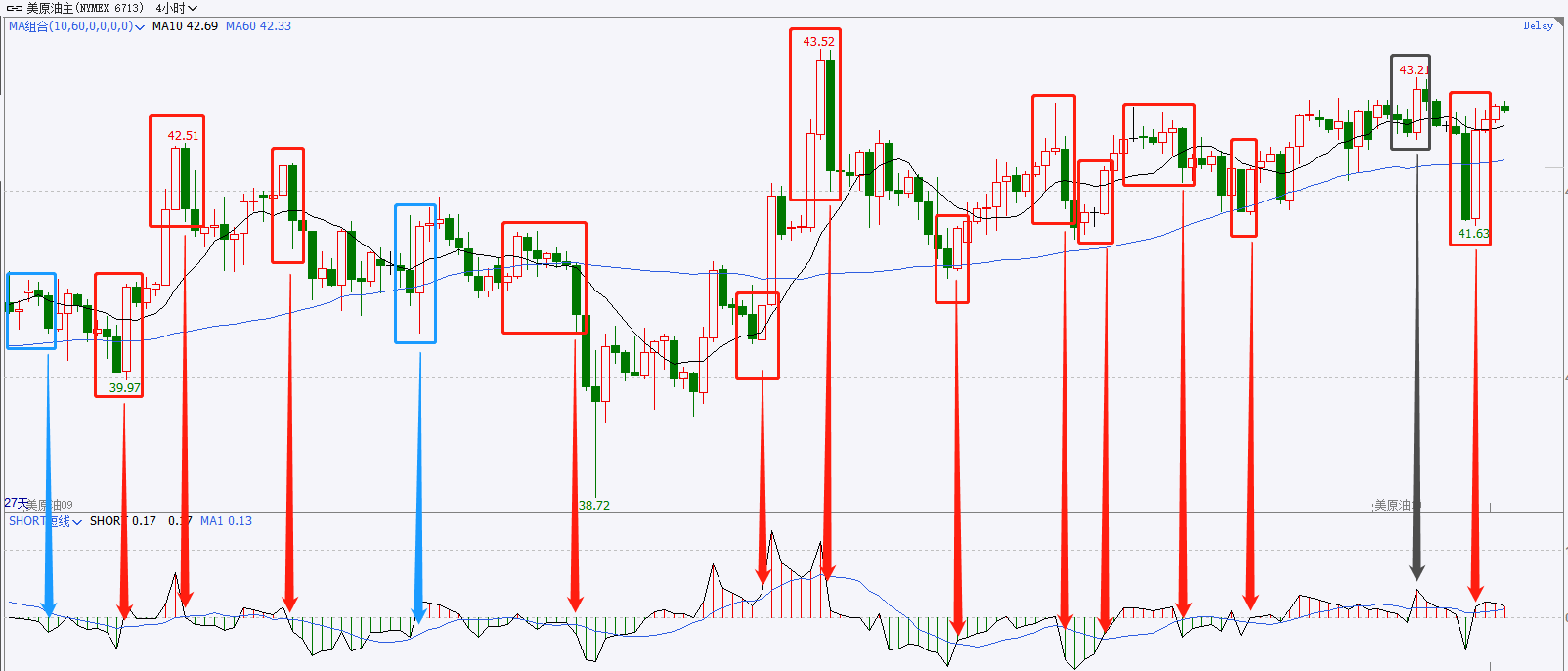
There are a total of 15 cases in the picture above, of which 2 (marked in blue) do not meet the entry conditions, 1 case of stop loss (marked in black, and the other 12 cases (marked in red) are all take-profit cases.
l The core entry conditions for the intraday strategy of naked candlestick trading:
(1) The combination of candle lines is generally 2-3, and the last one is a big yin and big yang entity with almost no shadow line, even if there is, it is very short
(2) The short intersection of the indicator must be synchronized with the candle combination, and the fast line is not in the overbought and oversold area
(3) The last candle entity in the candle pattern must annex the previous candle entity
l Entry points:
(1) Admission at current price
This method is entrusted to you, I hope it will be helpful to you, thank you!
Copyright reserved to the author
Last updated: 08/16/2023 10:21
Add

Trading is a game of probability. What we said about how to extract valuable trading signals is actually the price in essence, the probability of winning each game.
It's such a simple question, why do you have to think about so many things so complicated.
Now that we know that the final result of a transaction depends on probability, the first thing we need to do is naturally try to know this probability. If you don't even know the probability of making profits in the market, then I advise you to leave as soon as possible. To know the probability, you have to apply the same measure to make sense. (Principle of consistent trading) If you want to know the probability of flipping a coin, you have to keep flipping the same coin so that the conclusions you draw are meaningful.
What we will do next is to adopt this trading system in order to know some data related to probability. You can also use historical data, but when using historical data to measure the probability data of the trading system, what technical indicators should not be involved in the end, because the difference between the technical indicators that are being formed and the technical indicators that have become historical data is too great up. As an indicator of historical data, it is as much as it is, and the technical indicators that are being formed are constantly changing with changes in market prices. This is also the main reason why some rules that rely on technical indicators to enter and exit the market are perfect when testing historical data, but once used, the effect is greatly reduced. I think that for a trading system that uses historical data for calculation, it is best to use only the closing price, the K-line shape, and at most the moving average system for trading signals.
As for the time frame used by the trading system, it is up to personal preference, and there is no need to force it. The calculation and trading system should try to use all the trading signals, and you must not deceive yourself in the process, because your future speculative decisions will mainly rely on it. The estimated number of transactions must be at least 100. If the number of transactions is too small, the problem cannot be explained. The transaction unit is 1 lot. The data you need to obtain includes: transaction success rate, average profit of each successful transaction, average loss of each failed transaction, and overall average profit or loss of each transaction, that is, the expected value of each transaction. The expected value of each transaction is a certificate, then continue, if the result is negative, it means that there is a problem with your trading system settings and needs to be adjusted. The first priority of adjustment: minimize the loss of each failed transaction and increase the profit of each successful transaction. Don't pay attention to the success rate of the transaction. If no matter how you adjust it, the expected value of each transaction of the trading system cannot become a positive number, you can only give up it. It is also good to choose from those mature trading systems out of the box, however, you still need to test it yourself. The main purpose of measuring a ready-made trading system is not to see if it is still effective, but to convince yourself that it is indeed effective, and to be aware of your long-term possible profit prospects.
For example, if a trading system has an expected value of $5 per transaction, it means that in the long run, each transaction can bring a profit of $5. Note that this is just an average. How can you get your actual trading results close enough to this average? Probability theory tells us that the more you trade, the closer your actual trading results will be to the average. This is the truth that the longer you get in the market, the better. As the saying goes, "long-term gambling will win".
Probability theory also tells us that probabilities are not evenly distributed. Take a coin toss as an example. Although the probability of any side is 50%, it does not mean that if there is no head, there will be a tail, or every 10 times, the number of heads and tails must be 5:5. What probability tells us is only an average, an average over many repetitions. In a coin toss, 10 or even 20 heads or tails in a row are possible, and highly likely. Therefore, as a speculator, if you want to survive in the market for a long time and let your expectations move in a direction that is beneficial to you, you must learn to stop losses and control losses. The real meaning of controlling losses is to deal with the continuous emergence of adverse situations. For example, if your trading system sends out trading signals 40 times a month on average, and the maximum loss you stipulate is 20 points, then, theoretically speaking, the maximum loss you may have in a month is $800, which is 40 points. All trading signals fail, and the loss of each failed transaction is a maximum of 20 points. Then, if you use $850 to trade 1 lot, it can basically be said to be absolutely safe.
Copyright reserved to the author
Last updated: 08/21/2023 20:35
Add

Several Methods of Improving Signal-to-Noise Ratio
The first method is to use relatively long time frames.
I have given an example above. When you look at the weekly, daily and minute lines, the smaller the period, the lower the signal-to-noise ratio. If you want to improve the cost performance, do the opposite and look at the relatively large period. .
There is no standard answer for what kind of cycle to use. It is related to the time each person can invest, his investment ability, and his understanding of investment. For example, for a person who is very busy at work, he may use the weekly line to do stocks, which is suitable for him. But as a professional player, it may be a more appropriate cycle to use the hourly line.
All in all, when you amplify the period, your signal-to-noise ratio improves.
The second method is to use some technical indicators to reduce noise.
We know that noise has a characteristic in mathematics that it is random. Since it is random, it can be reduced by some mathematical methods, such as the average method.
The average method cancels out a part of the positive and negative noises.
What we usually use the most is the moving average. For example, if you construct a 20-day moving average to observe the trend, its fluctuation is obviously much smoother than the daily price fluctuation, because it reduces the noise.
The third method uses special values.
There are more than 3,000 stocks in A shares. Does the price change of each stock contain the same information? Not really.
The distribution of information in time and space is unbalanced, which means that in some special time periods, the price information content is high, and it also means that its price information content is high in some special targets.
For example. Sometimes the market volume is large, and sometimes the volume is small, so can it be assumed that the price has a higher information content when the volume is large?
For another example, some stocks in the market can drive other stocks to rise and fall regardless of whether they rise or fall. We call them leading stocks or influential stocks. Is the price information content of such stocks higher than other stocks?
Thinking about the problem from this perspective can also find some ways to further improve the signal-to-noise ratio.
The fourth method is subjective noise reduction.
The above three methods are all about improving the signal-to-noise ratio on the data side. This is the most conventional way, and it is also the direction most people work towards.
But here I want to propose a different direction, which few people are aware of, but it is also very important, or even more important.
That is, how to improve the signal-to-noise ratio in your heart subjectively.
We sometimes describe a person who is particularly sober when making decisions. It is similar to the feeling of seeing the blue sky through the clouds and mists you mentioned. The word "clear state" is used. Buddhists also like to use this word. It sounds a bit similar to the state of enlightenment.
In fact, clarity or enlightenment refers to a state where a person's inner noise is particularly low.
According to a study, there are 60,000 thoughts in a person's mind in a day. You can imagine such dense thoughts, more than flies. How much noise there is in a person's heart.
So even if the quality of the external data remains the same, if we can reduce the noise in our hearts and move towards a state of clarity, it will also help us make better decisions.
In fact, all kinds of cultivation systems, Confucianism's righteousness and sincerity, Taoism's tranquility and inaction, and Buddhism's kindness and protection, all tend to the same goal, the goal of the state of clarity, in other words, they all have the same goal. To reduce inner noise.
But this part is useless to just know, it is a process that requires constant practice. For example, mindfulness meditation is a good practice method.
I also have a friend by my side. After years of mindfulness meditation, he can indeed achieve the effect of subjectively improving the signal-to-noise ratio, which is also very helpful for his investment performance.
Copyright reserved to the author
Last updated: 08/14/2023 22:37
Add

There is a popular saying in the market, "There is no signal standard, and all information is noise." That is to say, noise and signal are relative.
In this market, there is too much information. Company and industry fundamentals, capital flow, and technology trends, only by identifying valuable signals from these information can the success of decision-making be guaranteed.
For most people, the identification of signals is disturbed by noise, which is a common situation in the market. The common practice is to establish a set of own trading decision-making system, based on which to grasp the signal and noise.
Often, the simpler the signal, the easier it is to play a role, the less likely it is to be confused by noise, and the easier it is to be identified during the transaction execution process.
Because once there are too many evaluation criteria, plus various false signals, false interference, and game traps that appear in the market at any time, it is easy to be disturbed by noise.
For example, the trading system of retail investor A is that the stock index fell below the 20-day moving average to clear the position, but at this time the stocks he held suddenly broke out with good news, and the stock price also changed. A ignored the signal of clearing the position and increased the position instead!
What about the consequences? Likely to lose money. This is noise trading, allowing noise to blur one's own judgment system.
So what if the deal turns out to be profitable? Or make a huge profit. From the perspective of decision-making, even if it is profitable, the transaction is wrong.
A profitable trading decision is not necessarily a good decision. A loss-making trading decision is not necessarily a wrong decision.
After the trading system is established and the trading decision-making signal system is in place, the next step is to keep practicing, constantly reviewing, and constantly improving the system, so as to be as perfect as possible in this system.
Only by concentrating on trading within the system will it be less prone to confusion of preferences and emotional influence on trading, and the noise can be minimized.
Copyright reserved to the author
Last updated: 08/16/2023 13:56
Add

Speaking from personal experience, just for reference:
First of all, what I want to say is that there are many ways to make money in this market. What is the difference? It is a question of earning more or less, so what traders need to do is to classify their own trading models. For example, for the trading point of Tanglun, first of all, it is necessary to classify the precise buying and selling point of the interval set of Tanglun. For the 1.2.3 types of trading points, the trading winning rate and profit-loss ratio must have their own strengths and weaknesses, so what is really said about filtering false signals is the problem of winning rate, then the winning rate must be true. To set off, so for traders on the theory of entanglement, there are three types of buying and selling points that need to be grasped at the first time. Then carry out in-depth filtering through the precise buying and selling point interval sets again or sub-levels. Remember that less is not accurate enough, and more is too cumbersome, so it is just right!
Copyright reserved to the author
Last updated: 08/25/2023 11:26
Add

In the foreign exchange market, signal filtering is one of the most important structural elements in the design of trading systems. The currency pair market in a foreign exchange market often fluctuates without direction for about 70% of the time, while directional movement occurs for 30% of the time. The latter is the profit opportunity that investors need to capture, while entanglement in the former is generally just In vain. Therefore, in addition to ensuring the effectiveness of the process of holding or shorting positions, signal filtering has a deeper meaning that it can identify a certain critical condition and use it as a criterion for trading.
False buying and selling signals are generally called "deception lines" in the stock market, while they are often summarized as "market noise" in advanced markets such as the foreign exchange market. Whether it's cheating lines or noise, in short, you have to pay the price and pay for your stupidity. Therefore, in the eyes of some professional foreign exchange experts, the importance of false signal filtering is no less than any other operating philosophy and logic.
The foreign exchange market is self-replicating, that is, the trend characteristics of a small time period such as the 5-minute line are often copied by the trend characteristics of a large time period such as the daily line. And the sinister trend of using false buying and selling signals to repair the opponent's market, causing them to be beaten on both sides, can be described as endless. If this graph is placed in the market at the daily level, it will be enough to make many investors liquidate their positions. This shows the importance of false signal filtering to investors.
First of all, judge the range. The point range for confirming the signal varies with the risk tolerance of the person and the account. Of course, it also requires the accumulation of market-watching experience and the judgment of the strength and effectiveness of the form. It is a comprehensive process. This way the first false signal can be avoided. Point range, 1/2 and 1/3 positions of high and low points, and the basic strategy of fund management, supplemented by the basic judgment of the validity of the pattern and whether it is damaged, to filter false buying and selling signals.
Secondly, with the aid of indicators, the reference of moving averages, K-lines and some major technical indicators, combined with the judgment of point range, and the use of multiple verification methods, can greatly improve the accuracy rate.
In short, the method also varies from person to person, and different people treat signal filtering in different ways. Find the filtering method you are familiar with and use it to avoid being "fooled" in the market
Copyright reserved to the author
Last updated: 08/24/2023 19:37
Add

Trading signals are a necessary condition in my trading system. If there is no trading signal, I will not trade. This is at the technical level. Let’s talk about it next. Fundamentally, it will be regarded as noise.
What is fundamental noise? Fundamentals are information, newsletter data releases, etc., and fundamental information, we mainly look at the dynamics of the news subjectively, the so-called noise is fake news, fake news and the like, so how should we identify fake news when we do transactions? News, what about fake news?
As a narrative-based style of writing, news generally contains six elements, whether it is news, news, or dynamics, commonly known as the "six elements of news", namely: time, place, person, and cause of the event , process, result. This is the basic element of news, without which it cannot be called news, and it is an important criterion for distinguishing the authenticity of a piece of news.
If the six elements of news are all present, we can use some tools to distinguish whether the news is true or false and reliable.
1. Is it a reliable source of information?
It mainly depends on the source of the news and the authority of the source. Generally speaking, the news from large news media organizations and large portal websites will be more authoritative. In addition, the identity of the publisher is also an important basis. Information released by a professional real-name certified person Often more reliable than information from anonymous publishers.
2. Is the source of the news material reliable?
Most of the news has pictures, and through the analysis of news pictures, the reliability of a news can be proved. If the news pictures are fake, then the news content will not be too reliable. Only the details composed of multiple information sources are accurate. Completely consistent, the reliability of the news will increase.
How to analyze and identify news pictures? First, download the news picture to the local, and then use the "search by picture" function of Google Image Search to search for the news picture. Usually, you will find a similar picture, that is, the source of the picture, and then we check the original source. If it is fake news, the source of the picture is often an irrelevant article.
Therefore, once we know how to identify fake news, we will not be fooled by various fake news and affect our trading.
Copyright reserved to the author
Last updated: 08/19/2023 19:27
Add

Now that we talk about noise, in my understanding, it should refer to the trading environment. Many people don’t pay enough attention to this topic. Trouble, the original plan is not as fast as the change. For example, when foreign exchange speculators are stepping up to watch technical analysis, they are suddenly dragged to karaoke by friends. what to do? How to prevent interference when doing transactions?
1. Strictly abide by the "time period" when doing foreign exchange transactions
To do foreign exchange transactions, investors need to preset the same time rules as "going to and from get off work", that is, a "schedule" exclusive to foreign exchange transactions is required, and must be strictly followed. For example: 15:00 to 23:00 is the preset time period. It is best for investors to complete it completely. Even if you leave early, it may disrupt your trading regularity.
2. Turn off the mobile phone during the trading hours and adjust it to silent
It is possible that relatives or friends will not intend to look for you. Here, you can communicate well with your family or friends in advance, arrange the life circle around you reasonably, form a regular social time, and turn your mobile phone to silent when trading, which can reduce unnecessary pressure.
3. Try to stay focused when trading online
During the trading hours, all websites that have nothing to do with foreign exchange are strictly blocked to avoid diverting your attention from other websites. Or prepare special computer equipment for foreign exchange speculation, plan the list of websites to be browsed in advance, and maintain a high degree of concentration.
4. Keep a minimalist trading environment
A minimalist life helps traders develop a quality of stability in times of crisis. Of course, if you can't live a minimalist life, you must also ensure that the surrounding environment is simple and clean during daily trading hours, instead of being accompanied by all daily necessities. Eliminate as many distracting things as possible.
Yes, it is not an easy task to maintain a high degree of concentration, but when trading, investors must be fully focused in order to achieve their trading goals.
The simple techniques above can help you limit distractions and help you become more focused and disciplined to close deals.
Copyright reserved to the author
Last updated: 08/14/2023 20:45
Add

Multi-period resonance, see big and small
The smaller the period, the more noise,
Set the direction in a large cycle, find a point in a small cycle
Once the general direction is determined, the noise will naturally be filtered
Copyright reserved to the author
Last updated: 08/11/2023 15:04
Add

In the field of foreign exchange trading, what is the so-called noise? What is the so-called signal? In fact, noise and signal mainly depend on the interpretation of information by the market. If the information recognized by the market can promote the expected development of the market, it is a signal. If the information is not recognized by the market, it is noise, also known as false signal.
Obviously, the existence of noise is not beneficial to foreign exchange trading, and at the same time it will waste the time and energy of traders, so how can we effectively filter out false signals?
To filter the interference of market noise, first, foreign exchange investors can pay attention to the fundamental information that affects the market.
Fundamentals are the many factors that affect supply and demand and form the basis for market price fluctuations. But not all fundamental factors carry weight. Traders will assess the fundamental news, filtering for factors that may affect demand.
The second, way to cut through the noise is to use technical tools to interpret price movements on the chart.
Due to the large number of factors that must be considered at the fundamental analysis level, more often, traders may rely on technical analysis to analyze supply and demand. Technical tools are designed to assess supply and demand relationships, identify trends, and filter out noise. Helps surface the best forex trading opportunities when combined with fundamental filtering tools.
Moving average, KDJ, MACD, etc. are commonly used technical analysis methods for traders in the foreign exchange market. The specific technical methods used vary from person to person, and the most important thing is to use technical methods to help investors filter false transactions. Signals to better capture opportunities suitable for trading.
Copyright reserved to the author
Last updated: 08/24/2023 05:06
Add

Thank you~
It is said that trading is "buy low and sell high", but there are very few people who can really make the right decision every time. Those who can make most of the decisions right and supplemented by the correct trading strategy can become master-level figures. Leave a name.
Why is it so difficult for us to make the right trading decisions? Why are most people "leek party"? It is because we are faced with a lot of transaction interference, and these "noises" will drown out some important "signals", thus making us miss some important opportunities.
1. The relationship between signal and noise
A characteristic of the financial market is that the signal-to-noise ratio of data in the financial market is particularly low, and there are far more noises than signals. If you receive 100 pieces of information, only 10 may be helpful to your decision-making, while the other 90 are noise. Far from being helpful, this noise can prevent you from making good decisions.
Not only that, Taleb mentioned a very important concept in "Anti-Fragility": As the frequency of our observations increases, the signal-to-noise ratio will further decrease. For example, if you are looking at the weekly line, the signal-to-noise ratio may be 30%.
If you look at the daily chart, it seems that the frequency of information has increased, but with the increase of information, the noise increases faster, and the signal-to-noise ratio may only be 10%. If you look at the 5-minute K-line, the information has increased a lot, and the signal-to-noise ratio may only be 5%.
According to this law, you can understand that after many people come to the market, they will continue to shorten the observation period, thinking that this can get closer to the market and get more information, but they don’t realize it and get more noise. So it is more difficult for him to make the right decision.
2. How to improve the "signal-to-noise ratio"
How can we extract truly valuable information from a lot of noise in the financial market to help us make better decisions? There is no ultimate answer to this conundrum, because many times the signal and noise cannot be fully disentangled, but these methods may help.
The first method: use a relatively long time frame
Following the example above, we can do the opposite and look at relatively large cycles. There is no standard answer for what kind of cycle to use, it is related to the time each person can invest, investment ability, and understanding of investment.
The second method: use some technical indicators to reduce noise
We know that noise has a characteristic in mathematics that it is random, so some mathematical methods can be used to reduce it, such as the method of averaging. The average method cancels out a part of the positive and negative noises.
What we usually use the most is the moving average. For example, if you construct a 20-day moving average to observe the trend, its fluctuation is obviously much smoother than the daily price fluctuation, because it reduces the noise.
The third method: use special values
The distribution of information in time and space is unbalanced, which means that in some special time periods, the price information content is high, and it also means that its price information content is high in some special targets.
For example, sometimes the market volume is high, and sometimes it is small, so is it possible to assume that the price has a higher information content when the volume is large? Thinking about the problem from this perspective can also find some ways to further improve the signal-to-noise ratio.
The fourth method: subjective noise reduction
How to subjectively improve the signal-to-noise ratio in one's heart is actually a way to improve the correct rate of decision-making. According to research, there are 60,000 thoughts in a person's mind in a day. You can imagine how loud the noise in a person's heart is when there is so much information.
If we can reduce our inner noise and move toward clarity, it can also help us make better decisions. In fact, various cultivation systems, such as Confucianism's righteousness and sincerity, Taoism's tranquility and inaction, and Buddhism's kindness and protection, tend to have the same goal. In other words, they all aim to reduce inner noise.
3. How to stand firm in the investment market and not fail?
Although the 80/20 rule applies in the trading field, it does not mean that you have to be a minority in order to make money. Although in many cases, "leeks" are equivalent to the majority, the minority is not necessarily right all the time.
What is the root of an investor in this market? It is your trading system. It has to be logical, fit your trading personality, and stand the test of time. Only in this way can you rely on a complete system to make money and survive in this market.
Of course, improving the correct rate of decision-making is one of the important factors for us to survive in the market, but this is not the whole key to success. Grasp the risks, do a good job in capital control, and firmly implement your own decisions... Only by doing more details of the transaction can we see the dawn of hope faster.
Copyright reserved to the author
Last updated: 09/01/2023 19:02
Add

People abandon me to take, others take me to abandon
buy expectations, sell facts
Think in reverse, always in reverse
Find the ever-changing "Zong"
think independently
Do your best and listen to fate (market)
Copyright reserved to the author
Last updated: 08/26/2023 15:00
Add

Signal and noise are determined by the individual's cognitive level.
The greater the level of awareness, all the noise is the signal.
Without cognition, all signals are noise.
If you want to distinguish between signal and noise, you must improve your cognitive level, and your cognitive level must be scientific and objective.
Copyright reserved to the author
Last updated: 08/15/2023 03:05
Add

The noise and signal in the transaction are the factors that affect the smoothness of the transaction process. I can take away the noise in one stroke. Today I will talk about the signal, and it is a technical signal, an entry signal, the so-called technical signal, including indicators Overbought and oversold, and deviations , False breakthroughs, structure, shape, etc., and the opposite falseness is the noise you mentioned.
The purpose of the transaction is whether it is worthwhile and whether the profit-loss ratio can meet our desired expectations. This is value investment. The screening method of value investment mainly depends on two points. First, whether there is a gap between price and value. The second is to look at market sentiment. When trading in this way, patience is very important. The risk lies in the people's hearts behind the market. Many novices are irrational when they do transactions. Even though the price has returned to its value, they continue to rush forward and cannot stop. This is the herd effect. When a trend starts, it can be difficult to know when the real kick-off point is. Therefore, in fact, trading on the right side of the transaction is safer. When the price exceeds the value, it is not advisable to catch up with the drop. Instead, wait for the reversal and wait for the price to return to the value trend to start again.
How to choose your own trading signal? Everyone must have their own different methods. Let me give an example that is relatively common in life and very similar to trading. For example, when talking about the road, some people cross the road based on their mood, some people cross the road based on the cars, and some people cross the road based on the traffic lights. So this may be different for everyone, and this is also determined according to everyone's perception of the market.
Copyright reserved to the author
Last updated: 08/22/2023 00:00
Add

We must master the laws of foreign exchange investment, do not invest at will
Foreign exchange fundamentals are the original driving force for exchange rate fluctuations, and changes in foreign exchange fundamentals are the cause of fluctuations in the foreign exchange market and market price fluctuations. Fundamental analysis of the foreign exchange market includes political, economic and financial developments to determine supply and demand factors. Fundamental analysis studies the causes of market movements, including macroeconomic indicators, asset markets, and political factors. Macroeconomic indicators include economic growth rates and other figures calculated from gross domestic product, interest rates, inflation, unemployment, money supply, foreign exchange reserves, and productivity; asset markets include stocks, bonds, and real estate; Political factors can affect trust in a country's government, climate of social stability and confidence. Government intervention in currency markets often has a significant but temporary impact on foreign exchange markets. The central bank can also unilaterally buy and sell its own currency with another country's currency, or intervene in the common market with other central banks to achieve more significant effects. It is also possible for governments to affect changes in the value of currencies simply by issuing intervention proposals or threats. Therefore, the factors behind price changes are very complicated, so only by mastering the fundamentals of foreign exchange, can we grasp the basic operating laws and changing trends of the foreign exchange market, which is something that any trader must deeply understand and master.
On the other hand, it is necessary to flexibly grasp technical analysis and not apply it mechanically.
Technical analysis is the method of predicting price changes and future market trends by studying past market behavior. It relies on data such as price and trading volume to judge the market. Technical analysis is an important method of observing price and volume data in the foreign exchange market. Through technical analysis, we can judge the future trend of these data and study the impact of market movement. Classical technical analysis includes the Dow Theory, trendlines and candlesticks. Technical analysis includes hundreds of technical indicators and trading tools. It is difficult for traders to use all trading tools for trading, and they can only master them flexibly according to the actual situation. There is no one way to go all out, and different investors will have different interpretations of the same method. Therefore, investors cannot mechanically apply a certain technical indicator, the key is to cultivate their own market opinion model. For friends who have just started foreign exchange investment, it is a more reasonable investment method to start with trend analysis and take advantage of trends.
Copyright reserved to the author
Last updated: 08/16/2023 17:28
Add

Wear noise-canceling headphones for active noise reduction!
Don't think I'm joking, this is actually a very important method. Sometimes a lot of noise actually comes from yourself. Your impatience, greed, pride, etc. may bring losses to your trading. Therefore, when you are not sure about the direction, you might as well calm down, put on headphones and listen to music, relax, and then look back, the market may be much clearer.
It is said that trading is the cultivation of self-mentality, so when you face so much "noise" every day, you must stay relaxed and sober. Otherwise, you won't be able to really analyze many things, and you will even dig into a dead end. For example, the United States announced good employment data, and it is reasonable to say that the dollar will rise, but in fact the dollar is falling. Then this data may be just a noise, and if we don’t stay awake and blindly go long against the trend, we will only fail miserably.
Of course, I see that some of the noise reduction methods mentioned by everyone are also very reasonable. It's just that I think that if I'm not in the state, whatever method I use may be counterproductive. Therefore, I think the most important thing is your own mentality.
Copyright reserved to the author
Last updated: 08/24/2023 13:37
Add

0
work
0
subscriber