


Stay in touch!
Subscribe to our newsletter to get the latest updates on live market analysis, trading strategies and more. You can unsubscribe anytime.
By subscribing, you agree to Trading.live Privacy Policy.


In fact, what I want to say is that this is a false proposition or this is not a problem at all. Of course, in theory, the winning rate is the winning rate, and the profit-loss ratio is the profit-loss ratio. But in the actual process, for a person with a high winning rate, his profit-loss ratio may not be the best, but it must not be unreasonable. At best, it is a mean, for example, if you earn once, you can lose twice. The profit-loss ratio of 2:1 is definitely not high, but can you say it is unreasonable? But it can't stand the high winning rate. Note that the high winning rate I am talking about here refers to honest short-term orders. It's not about placing an order and running away after earning a few points. In my opinion, this is not an order. That's billing. Therefore, a high winning rate is actually a way to reduce losses and increase profits in disguise.
That's why I said that people with a high winning rate actually have an upper-middle profit-loss ratio. The base of such people making money is definitely lower than the winning rate, but there are many people with a high profit-loss ratio. This is absolutely the case.
I don't know when it started, but the words of high winning rate and low profit-loss ratio, low winning rate and high profit-loss ratio have been spread. In my opinion, this is simply nonsense. Is it true that a high winning rate trader is a Chinese cabbage, good luck? Others have a high winning rate from fighting in the market, okay, don't you understand what the profit-loss ratio means? Give me a break.
What's even more funny is that I actually saw a lot of people with low winning rate and high profit-loss ratio, laughing at people with high winning rate, but the profit-loss ratio is not as high as them. I feel that their trading ideas are wrong, pursuing the winning rate but giving up the profit-loss ratio. . . . I really do. . . . Ten thousand horses galloped by. These people really don't know how to trade.
Among the people with low winning rate and high profit-loss ratio, are there any people who make money? have. But this kind of person will not laugh at someone with a high winning rate. Because they understand that it's just a matter of choice.
It's a bit far-fetched, can a high winning rate and a high profit-loss ratio have both? I can give a clear answer: no.
The first thing you need to know is the delay of the profit-loss ratio. Well, the reason why I say it is delayed is because the profit-loss ratio is often calculated after a transaction, or after a period of trading. Why post-trade statistics? Because it is uncontrollable. Who dares to say that if I go in, I must reach the profit-loss ratio of XX:XX? Who can guarantee? Do you dare to stick to this, and never enter the field until the profit and loss ratio target? The result speaks for itself. That's why I said that the profit-loss ratio is uncontrollable and delayed. As for the proof, it is very simple. Divide your transaction records into several parts at will, and make statistics by segments, and you can see if your profit-loss ratio is consistent. If it is several years, then use years as the unit. See if it's the same every year.
Maybe a certain market is an opportunity for you to make money. I believe everyone has this kind of market, which is commonly known as a good market. Under this kind of market, the probability of your profit and loss ratio is definitely higher than usual, and it is not even ruled out that it will exceed a lot. But this kind of market is rare.
So, how do you guarantee the profit-loss ratio? Losses are guaranteed, but profits? Well, in the case of guaranteed losses, if the winning rate is not high, it will also lower the profit-loss ratio. If the profit is not ideal, then the profit-loss ratio is simply impossible to see. So let the profits run wild and the losses cut off, I think it is quite appropriate. But the result is that the winning rate is not high.
At present, the more popular or effective methods only start from the operation method and transaction logic. But the transaction itself is a matter of planning and success. Therefore, the profit-loss ratio is essentially not guaranteed at all.
As for the winning rate, although this thing is not guaranteed. However, it is slightly different from the non-guaranteed ratio of profit and loss. The winning rate is as long as it can make a profit, it will be a real increase. The profit-loss ratio is not only profitable, but also needs to reach a certain amount.
I wondered, is it because there are more novices who have been doing ultra-short-term in recent years, they run away when they make a few points, and die when they lose money, so the winning rate is quite high, but the losses are also quite a lot. So there is a seemingly weird saying that the winning rate is high and the profit-loss ratio is low? For a person who can really achieve a high winning rate, his profit-loss ratio is absolutely impossible, although it is not high.
Copyright reserved to the author
Last updated: 08/24/2023 15:45
 Add
Add

Theoretically speaking, the profit-loss ratio and the winning rate check and balance each other. The higher the profit-loss ratio, the lower the corresponding winning rate, and vice versa. If you pursue a higher winning rate too much, you will definitely find that your profit-loss ratio has dropped. On the contrary, if the winning rate drops, it must be because you are pursuing a higher profit-loss ratio too much. This situation is what binds them both.
So, you can have your cake and eat it too, you have a pretty good idea!
The winning rate is the probability of winning. If you make 10 transactions and make money 6 times, the winning rate is 60%. The profit-loss ratio is the ratio obtained by dividing the average profit point of profit by the average loss point of stop loss after multiple transactions. If the profit of each transaction is 15%, but the stop loss range is 5%, then the profit-loss ratio is 3 . In other words, an average profit of 3 yuan requires a stop loss of 1 yuan, which reflects the risk of investing in profitable transactions.
In theory, 80% of the time the market is in a volatile market, and 20% of the time is in a unilateral market. Taking international gold as an example, when the market is in a volatile trend and near the high-intensity resistance area before the price of gold rises, go short, with a stop loss of 3 yuan and a stop profit of 9 yuan, or a stop loss of 5 yuan and a stop profit of 15 yuan (choose a plan according to market fluctuations) ); or go long when the gold price falls to the previous low-intensive support area, and the above-mentioned plan is also adopted for stop-profit and stop-loss. But no matter which plan (the profit-loss ratio is 3:1), as long as you succeed in 3 out of 10 transactions (30% winning rate), you can make a profit (excluding transaction costs).
Stop loss 3 yuan x 7 times = 21 yuan, take profit 9 yuan x 3 times = 27 yuan, profit 27-21 = 6 yuan; stop loss 5 yuan x 7 times = 35 yuan, stop profit 15 yuan x 3 times = 45 yuan, profit 45 yuan -35=10 yuan.
But what about the other way around? The winning rate is 70%, and the profit-loss ratio is 1:3. The result of long-term trading is still a loss. This example fully demonstrates that investors tend to ignore the importance of the profit-loss ratio.

Improving the profit-loss ratio is the key to profitability!
From the calculation formula of the profit-loss ratio, we can find a way to increase the profit-loss ratio-increase the average profit margin, that is, increase the numerator, or reduce the average loss margin, that is, reduce the denominator. The first way to do both is to increase your profit per trade and reduce your loss per trade.
In this method, it is difficult for investors to control how far profits can "run", but they can control the maximum loss range of each transaction, which is often called stop loss. Set the maximum loss range for each transaction, or set the exit conditions. Once the conditions are met, you will sell even if you lose money, so as to control the loss range, so as not to be deeply locked in by large losses. This is one of the reasons why stop loss is important.
However, although the profit margin is difficult to control, the position size at the time of profit and loss is controllable. This involves the second method to increase the profit-loss ratio - position management. Reducing loss-making positions and increasing profitable positions can also increase the profit-loss ratio.
However, the profit-loss ratio is a lagging indicator, and it needs to be counted after doing a lot of transactions. It is difficult to guide by the profit-loss ratio when entering the market, and the mandatory setting of the profit-loss ratio may turn profits into losses, or it may be empty.

Therefore, investors should make a plan in the transaction. After making a profit according to the plan, the cost line can be set as a forced exit point, so that at least no loss can be guaranteed. On the premise of ensuring the floating profit space, the profit can be moderately used to win a bigger market to expand the profit-loss ratio. In the long run, the profit space will also increase day by day. When the winning rate and the profit-loss ratio are fixed, the appropriate position can be calculated by the famous Kelly formula: q=p-(1-p)/R (p is the winning rate, R is the profit-loss ratio).
Copyright reserved to the author
Last updated: 08/24/2023 05:29
Add

Increasing the winning rate is in line with human nature, while increasing the profit-loss ratio is anti-human. It can be understood in this way, the profit-loss ratio and the position: try with a full position; the relationship with the winning rate, a 99% winning rate is also difficult to offset a 1% loss rate, liquidation or even bankruptcy, not only retail investors, but trading masters are no exception.
Think about how those bigwigs made their fortunes? A wave of market can make people wealth free, that is, the huge profit-loss ratio of a transaction almost dwarfs all previous transactions.
Therefore, from the perspective of the relationship between the two, the priority of improving the profit-loss ratio is obviously higher. Sometimes it's hard to have both.

How to improve the profit and loss ratio?
1. Through profitable holdings, the average holding time of profits > the average holding time of losses.
Only by ensuring the time for profitable positions can the profitable positions grow slowly. In the market situation, the fermentation of those huge "fat tail" market conditions requires patience to hold positions. Many trending market conditions may take several months or even 1-2 years to complete.
On the contrary, the holding time of losing positions is "as short as possible". For any transaction, it is necessary to reserve room and time for fluctuations. The extreme practice of "opening a position without profit is wrong" is actually against the law of market fluctuations. Reasonable tolerance is a must.
2. The average position in profit > the average position in loss;
How to realize "closed positions with profit > average positions with losses"? There are two ways: profit increase position; loss decrease position.
① Profit increase position
By adding profit to the position, the profit closing position > the loss closing position is realized.
This approach is one of the most challenging human behaviors in trading behavior. The behavior of increasing positions with profits can even be understood as "a challenge to human nature to seek advantages and avoid disadvantages", exaggeratedly speaking, a kind of battle against one's own instinct.
A simple fact in psychology: when people make money, the most direct reaction is to tend to be conservative. "Instinct to avoid harm": I have made money in trading, and any floating profit is my money, and I cannot let this money disappear.
The road to advancement for professional traders must include this "anti-human behavior", which is the behavior that most challenges human instinct.
②Loss reduction
By reducing the position at a loss, the profit closing position > the loss closing position is realized.
This approach is also a way to challenge human nature in trading behavior. The behavior of losing money and reducing positions can also be understood as "a challenge to human nature to seek advantages and avoid disadvantages", and a kind of battle against one's own instinct.
A simple fact in psychology: when people lose money, the most direct reaction is to become aggressive. "Profit-seeking instinct": If I lose money in trading, the amount of floating losses cannot be counted as my money, because these floating losses may disappear in future fluctuations.
Through the act of reducing positions at a loss, the goal of "only holding correct positions, or only holding profitable positions" is achieved. When losing money, the first reaction is to reduce or close the position, which is also against human nature.

Although the profit-loss ratio is critical, it also has a marginally weakened side. That is, as the number of transactions (including increasing positions) increases, the profitability or profit-loss ratio decreases. If it is a zero-sum game, the profit-loss ratio may even be negative-this is how you can’t get your shoes wet when you often walk by the river!
Copyright reserved to the author
Last updated: 08/24/2023 11:24
Add

The winning ratio and profit-loss ratio in trading are issues that everyone who is engaged in trading thinks about all day long. This issue is like height and weight, which are related but not closely related.
First of all, it is necessary to know what the winning rate and profit-loss ratio are.
The winning rate is a data calculated by dividing the total number of winning transactions by the total number of losing transactions after counting the number of profits and losses during the review after many transactions, which belongs to the category of after-the-fact summary.

The profit-loss ratio considers how many points the future profit and loss are expected to be before placing an order in a transaction. The estimated profit points divided by the estimated loss points are an estimated data. When reviewing after the event, it will be calculated by dividing the take profit points by the stop loss points. Generally, more considerations are taken into consideration when making decisions, and statistics will also be counted when reviewing the market after the event.
Going back to the origin of things, the currency market is the ratio of currency pairs in various countries, just like 1 US dollar can be exchanged for 6.8 RMB, the transaction is only an exchange ratio, because the exchange ratio will change every moment over time If there is a change, there will be a price difference, and transactions often use this price difference to make profits.
The purpose of each person's trading is different. Some are to stabilize the exchange rate, some are to hedge risks, and some are to make profits. In terms of speculative profits, the winning rate and profit-loss ratio are only considerations. Not much of a direct relationship. But from a psychological point of view, I hope to make 100 orders, the winning rate is 100%, and the profit-loss ratio is 100:0. But from the actual situation, the simple pursuit of winning ratio and profit-loss ratio does not make much sense. The ultimate goal is to make more and more funds in the account. Various pursuits that are inconsistent with the ultimate goal are a waste of time and energy. ,money.
In addition, taking intraday trading as an example, hundreds of orders are traded a day, and the profit-loss ratio of each order is not high, but the overall winning rate is high, and the account amount is still increasing every day. There are not many orders, and there are not many orders in a month or even a year. Among them, only one order may make a profit, and all others will lose money. However, the profit of this order minus the sum of all loss orders is still very profitable. Just like Soros once summed up his trading experience: the depth of profit is far more important than the frequency of profit.
Therefore, before making a transaction, first understand what you are ultimately pursuing and what kind of trading style you are, and then consider which indicators are the most important. Instead of simply pursuing a high winning rate, it is better to understand yourself first, otherwise you will drift with the tide and be taken away by the market, going up and down for a while, like a roller coaster, your heart is going through tests every moment.
Trading is only a part of life. It may be fun or a tool for making a living. All activities that make life better should be encouraged and supported.
Copyright reserved to the author
Last updated: 08/26/2023 22:06
Add

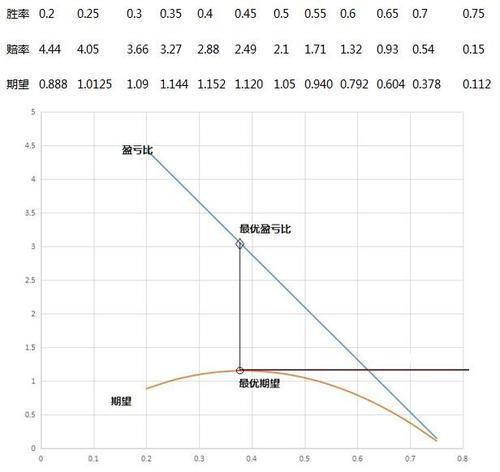
The primary purpose of all investors entering the foreign exchange market is to make a profit. In order to achieve the purpose of making a profit, investors usually strive to develop in two directions: to increase the winning rate of the transaction or to increase the profit-loss ratio of the transaction. But between the two, in addition to the left and right legs that constitute expectations, there is also a check and balance relationship with each other. If you pursue a higher winning rate excessively, the profit-loss ratio will decrease; on the contrary, if you pursue a higher profit-loss ratio excessively, the winning rate will decrease. Therefore, how to correctly choose the winning rate or the profit-loss ratio is particularly important.
win rate and profit loss ratio
First, clarify the definition of winning rate and profit-loss ratio:
Winning rate X = all times of profit / total number of transactions x 100% profit-loss ratio Y = average amount of profit / average amount of loss.
On this basis, the overall profit and loss is: total profit and loss Z = all times of profit * average amount of profit - all times of loss * average amount of loss.
According to the above formula, it can be simply concluded that under the condition that the profit-loss ratio is 1:1, the higher the investor's winning rate, the more profits he will get. But if the amount of each loss is much greater than the amount of profit, then no matter how high the winning rate is, it will be useless, so how can we improve the profit-loss ratio? (Let's look at the picture below)
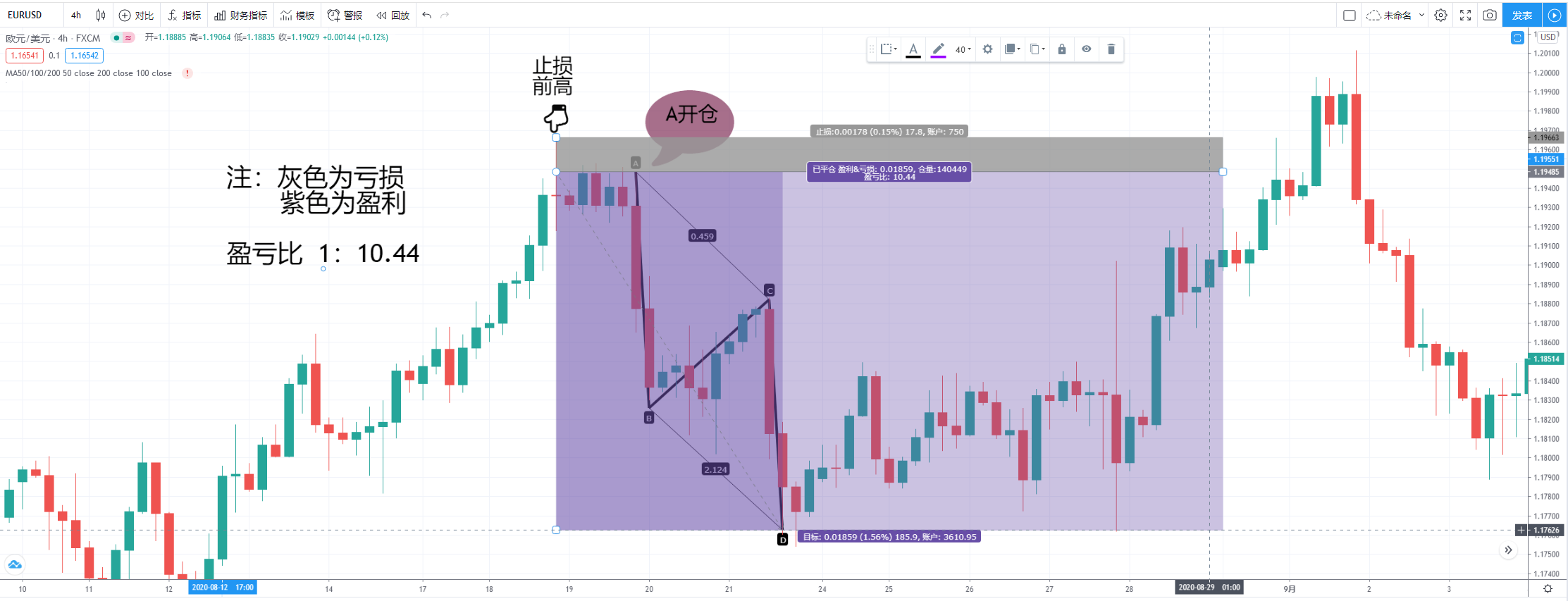
Find the key pressure level, put the stop loss at the previous high, and if you make mistakes six times out of ten, even if you lose too much, then your profit and loss will remain the same, but if you do it right once, then your profit will also be the same Yes, if you are right, then five or six times your profit will continue to expand, so what you need to improve is your winning rate.
Winning rate and profit-loss ratio, they are like a pair of twin brothers, they affect each other's expected value of a strategy, in the limited number of transactions, what we need to ensure is that the profit is more than the loss, and find a balance between the two. When you can choose a certain trading strategy by comprehensively considering the winning rate and profit-loss ratio, you will be one step closer to success.
Copyright reserved to the author
Last updated: 08/07/2023 05:50
Add

Guide:
1. Don't spend too much time on "market forecasting", and spend time on "risk control and fund management" to get twice the result with half the effort. "
2. Don't care about profit and loss is the big picture.
3. Professionals make big money because of their average profits.

Some novices often have this confusion: Some professional traders seem to often make mistakes and often stop losses. Why are their profits so high?
Similarly, many traders indulge in the analysis and judgment of various technical indicators, trying to find the most effective entry point. They often value and pursue a high winning rate, and they may have spent a lot of energy hoping to find a "peerless martial arts" that can be invincible in the futures market.
Maybe you think you can succeed in a certain period of market, but this so-called success often leads to overwhelming confidence and increased positions. In the end, it is often caused by the "peerless martial arts" he thinks he has found. In the complex market conditions, it will bite its own body.
1. No one can guarantee that they will always maintain a "high winning rate"
In futures trading, the winning rate is of course a very important part. If you can have a super high winning rate, then your chances of making money will naturally be high. But we must be soberly aware that the market is complex and changeable, and no technical system can guarantee that it will always be applicable. Spending too much energy on improving the winning rate may have little effect. Therefore, if futures traders want to grow, they must get out of the one-sided misunderstanding of "pursuing winning percentage".
"As far as professional traders are concerned, the percentage of profitable trades is often less than 40%".
("Advanced Technical Analysis", author Bruce: A market veteran who has been engaged in trading since 1975, and entered the field of research and design of trading systems in 1976, he is a first-class trading system design and application expert in the United States.)
("Trade Advice--Successful Practices and Mental Journeys of the World's Top Traders" Bill Lipschutz: The largest and most successful foreign exchange trader of Salomon Brothers, known in "New Financial Geeks" The "King of Currency", his single transaction amount is usually in the billions of dollars.
"Anyone who goes into the financial markets and expects more than half of his trades to be profitable is rudely awakened. Think of it like baseball -- the best players hit 30. % to 40%. However, good players know that the benefit of a hit always outweighs the damage of a strikeout. The reward always outweighs the risk."

2. Even if you have a higher winning rate, it does not mean that you will definitely make money
With a high winning rate, no profit-loss ratio, and no money management, you will fail, and you may fail even worse!
"So what if you look accurately, you can only earn 50,000 at a time, and you are not allowed to lose 300,000 at a time. In this way, the winning rate does not exceed 85%, and it is absolutely impossible to make money. What's more, the winning rate of most people is often lower than 50%, so , Spending more energy on expanding the profit-loss ratio and fund management will get twice the result with half the effort.
In fact, in the futures foreign exchange market, the majority of losers, and most of the losers think that the failure is because they did not see the market correctly, so they can succeed by improving their k-line skills. Little do they know that they should review why there are continuous "small profits and big losses" or "big profits and then big losses". These are the essence of failure. Remember, losses are part of profits, and losses are normal of. The most important thing is to strive to achieve "losing less each time and earning more each time". Without a trading strategy and skill that can 'maintain the profit-loss ratio' and 'fund management', no matter how high the forecast accuracy is, it will be in vain.
Many veterans still lose money after trading for more than 10 years, because they are still in the "guessing market" stage, and the maximum loss is not proportional to the maximum profit. Simply ask a person what is the maximum profit per trade and what is the maximum loss per trade, and you will know whether he is a winner or a loser.
There is only one purpose in studying the market situation and research direction, which is to find trading opportunities. More importantly: always take potential profits and risks into the greatest consideration, and don't worry about the small losses in the middle. The establishment of the entire trading system is where you should put the most thought. "
3. How to improve the profit-loss ratio is the key to making money?
The profit-loss ratio is a lagging indicator. After you have done a lot of transactions, you have calculated what your profit-loss ratio is. Only then will you know what your profit-loss ratio is roughly.
Therefore, when we enter the market, it is difficult to guide us by the ratio of profit and loss. How much you can earn is given by the market, not by you. If the profit-loss ratio is set forcibly, it is very likely that the profit will become a loss, or the market may be short-lived. The author believes that relatively speaking, it is easy to set a stop loss, but it is more difficult to make a reasonable profit after making a profit. Here are a few suggestions:
1. Therefore, you should make a trading plan according to your trading system, and exit the market according to the stop profit when the trend judged by the market you follow changes.
2. After making a profit according to the trading plan, it is recommended to set the cost line as a forced exit point to ensure at least no loss.
3. There is a certain amount of floating profit space, and the profit can be moderately used to make a bigger market and expand the profit-loss ratio! Then combine your own situation to make matching choices, and finally slowly improve your own trading system! Adhere to the implementation and ensure the consistency of transactions!
Do you have any good experiences to share!
Copyright reserved to the author
Last updated: 08/27/2023 22:24
Add

In response to this question of the subject, someone with experience as a master trader may be more suitable for answering this question. He is Mark Weinstein.
The trading master Mark Weinstein has always been a myth in the international financial circle.

Mark Weinstein's trading method is cautious. Among the thousands of trading days he has speculated in foreign exchange, there were only 17 trading days in which he lost money, and 9 of them were caused by system failures.
The reason why he can achieve a 99% success rate is due to his cautious trading method and low-risk style.
A 50% success rate for most traders is not bad, a 75% success rate would be amazing, and Mark Weinstein's success rate is almost 99%, which is unbelievable, but it is true. fact.
Since 1980, Mark Weinstein has made money every month and has no loss-making trading months. In thousands of trading days, Mark Weinstein has only lost money on 17 trading days. And 9 of them were due to a malfunction of the quotation equipment.
Trading is boring, but it is enough to show that he is a master trader, and because of this, Mark Weinstein was able to rank among the top ten fund managers in the world.

In an interview with a reporter, Mark Weinstein summed up the basic principles he follows in trading:
1. Always do your pre-trade analysis.
2. Don't be arrogant. Whenever you are proud, you give up risk control, and the best traders are often the most humble.
3. Know your weaknesses. Everyone has weaknesses – even the best traders.
4. Adhere to independent thinking, don't follow the crowd.
5. Avoiding trades before an opportunity presents itself, knowing when to stay away from a market is just as important as knowing when to enter it.
6. The strategies developed should be flexible enough to adapt to changes in the environment. The mistake most people make is to always maintain the same strategy. They'll say, "Hell, how the market always moves differently than I think!"
7. Don't get too complacent once you make a profit, the hardest thing in the world is to keep it. This is because once you reach your first goal, you make a second goal to make more money, which for most people ends up in vain.
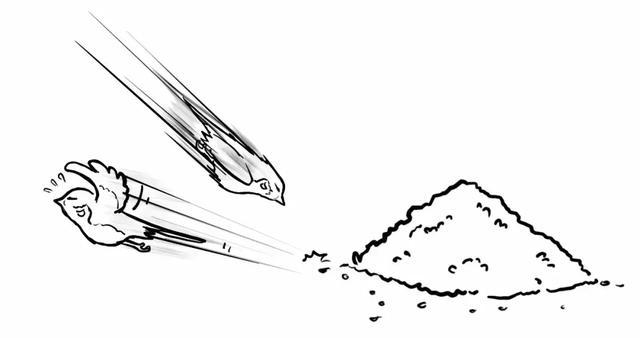
Cautiousness is Mark Weinstein's trading method, the reason why he has a 99% success rate.
Most people are bad at biding their time
Because I do have some fear of the market, I have found that the most successful traders are those who are the most cautious about the market. My caution about the market forced me to take the market seriously, sharpen my knife and chop wood, and grasp the timing of entering the market very accurately. Whenever I make a trade, I always grab the rail like a beginner swimmer.
If I feel that the market conditions are not right, I will not make a trade. The timing of my trades is based on my experience and intuition, because the changes in the market will confirm the usefulness of my knowledge and previous experience. . I didn't lose much money on many trades because I was good at waiting for really good times. Most people are bad at bidding their time. They rush into the woods when it is still dark, but I wait until dawn.
Although the cheetah is the fastest animal in the world and can catch anything on the grasslands, it waits until it is absolutely sure of its prey. It can hide in the bushes and wait for a week, just waiting for the right moment, and It wasn't just any duiker waiting to be caught, but a sick or lame duiker, which it would only pursue when it was safe to do so. To me, this is the epitome of a truly professional way of trading.

it's hard for you to shoot them
When I am at home, I often observe the sparrows in the garden. Whenever I feed them bread, they take a little at a time and fly away. In this way, they kept flying around to grab the bread, but only a little bit at a time. They try a hundred times to get the bread that pigeons get once, but it's hard to shoot them. Because they fly so fast. This is how I do day trades.
For example, one day I found out several times that the S&P was going to rise, but I neither tried to buy the bottom nor waited for it to reach the top before leaving the market. I only do the most violent market in the middle. To me, trading is like a sparrow eating bread.
learn how to lose
Mark Weinstein uses a very vivid metaphor to illustrate his trading methods. The cheetah is his metaphor for medium and long-term trading at an appropriate price, and the sparrow is his metaphor for short-term trading. What both of them have in common is waiting for the right time to win.
Finally, let's hear his advice for those new to stock trading:
First you have to learn how to lose money, which is more important than learning how to win money.
If you think you are always a winner, you will blame the market and become hostile to the market when you lose money, without thinking about why you lost.
Second, you should control your losses as soon as possible. Most traders hold on to losing positions for too long because they want their losses to shrink; and on winning positions, they close them quickly because they fear the profits will disappear. On the contrary, for an outstanding trader, one should fear the expansion of losses and hope for more profits.
From the master's experience, it can be summed up that his successful experience is a combination of short-term trading and trend trading. Short-term trading depends on the success rate, so it is necessary to increase the success rate, while trend trading is based on the profit-loss ratio, so the profit-loss ratio should also be increased. Therefore, if you want to increase the profit-loss ratio and success rate at the same time, the combination of short-term trading and trend trading may be a perfect way.
Copyright reserved to the author
Last updated: 08/26/2023 20:33
Add


Thanks for the invitation to Dancing in the Rain. We must first understand one thing, the winning rate and profit-loss ratio in the market are both result data. This article may be a bit long, because I want to explain the fallacies of many inertial thinking.
What is outcome data? That is, only the results produced through a large number of experiments are the real appearance of this matter. Let me talk about the winning rate first. There are many traders who say that their trading winning rate is very high, reaching 70 to 80%. Even better, I can pass more than 90%. There are many miracles in this world, but I am very skeptical about this kind of thing. Many people say that I am ignorant. There are many people who can reach this level. It seems to be Ernstein, with a winning rate of 99% in three months, which is amazing. But I think there is a problem here. The generation of winning rate results requires two dimensions, one is the time span, and the other is the number of samples. That is to say, for the data of the result type, it is necessary to meet the premise of a large number of samples for a long time. Short-term traders may have enough samples, but the time span of three months is obviously too much, because trading is not like rolling dice. Still 10,000 times is enough. Trading has a time dimension. The winning rate obtained by adding a ten-year time span but only trading dozens of times is also not convincing, so how to judge the true winning rate of a trading result Woolen cloth? For me, it takes at least five years to trade, and the number of transactions cannot be less than 300 times. The winning rate reflected in the results of such a trading system is meaningful, so the winning rate is not something we can predict, but It is a result data, and the final 50% or 30% result is placed there, which is called the winning rate.
Many people think that the winning rate is the probability of a successful transaction, so looking for a high-probability model may find the key to open the door to the market, which is not very feasible. Let me make an analogy. Many people think that the head-and-shoulders top or head-shoulders bottom is a very high-probability reversal pattern. When we observe the historical market, we have indeed found that the probability of this pattern reversal is objective, so we do it according to this pattern. Inverted, but many people say that it is not easy to use after using it. Why? Because the trend that might have become a head-and-shoulders pattern in the historical market did not form in the end, and the failure cases that did not form were filtered out by you when you observed the historical market, so eyes can be deceiving. The reason why the head-and-shoulders pattern It is called because it formed like this, but many things that were to be formed but did not form in the end were ignored by you, and there are many situations in which we will form in the transaction, what has become of this result? It's not that you're doing a head and shoulders pattern, it's that you're betting on whether or not this will make a head and shoulders pattern. These are completely two concepts, so it is difficult to improve the winning rate from this aspect.
Let’s talk about the profit-loss ratio. Compared with the winning rate, this data is more misused by people. Many people say that the profit-loss ratio of their trading orders is five to one, which means that the stop profit is five times the stop loss, which is very cost-effective, but often In the end, most of them end up with a stop loss. It is obvious here that it is obviously less difficult to go out of the market to double the distance than to go five times, so of course it is easy to stop the loss. Therefore, the real profit-loss ratio is the same as the winning rate. It requires a large amount of data for a long time span. In the end, the ratio of total profit to total loss, if this number is greater than one, you have a good system; if it is less than one, you still need to improve. Therefore, it is obviously not rigorous to define the profit-loss ratio with the forecast that has not yet produced results. Only the final result can tell you the answer.
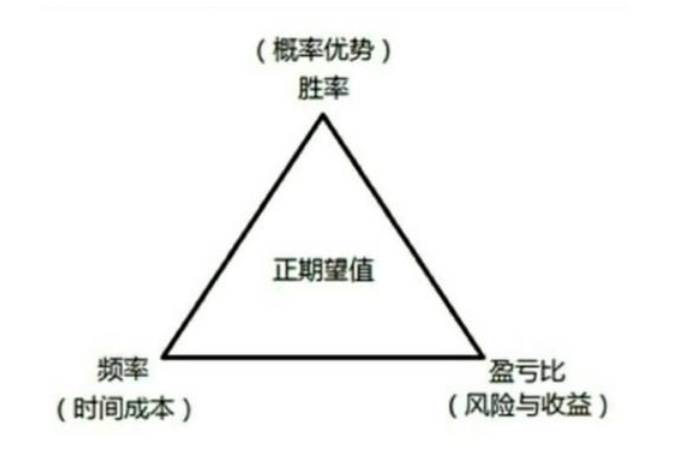
Back to the main question, how to increase the winning rate while increasing the profit-loss ratio. Improving the winning rate My own winning rate is actually not high. The highest single variety is only more than 40%, the lowest is only more than ten percent, and the overall winning rate is around 35%. After testing, there is a way to improve the winning rate, which is to add filtering. Adding filtering actually reduces the number of transactions, but the profit-loss ratio is decreasing while adding filtering, because in fact, the winning rate and the profit-loss ratio are two opposite data. It is walking in reverse, the answer is very simple, because for a certain market, it is definitely more difficult to walk twice the distance than to walk twice the distance, so if you want to earn more and lose less, your winning rate will definitely decrease. Just like a triangle, if you make one of the corners larger, the other two corners will inevitably become smaller, and the ultimate goal of our trading is to achieve a balance. For example, a system with a winning rate of 50%, the average profit divided by the average The loss can be greater than two. This is a trading system with positive logic. If it is used for a long time, the total profit-loss ratio must be greater than one.
Therefore, increasing the winning rate and the average win-loss ratio at the same time is a kind of greedy performance, which is also a delusion that violates the essence of trading science. My own approach is that I cannot control the winning rate, so I focus on increasing the profit-loss ratio as much as possible, so Letting profits run is the core logic of all my transactions. Although my winning rate is low, when I make a profit, I can cover many losing transactions at one time. Then time is my friend, and it is the secret to accumulating wealth in the long run.
Are you satisfied with this answer?
Copyright reserved to the author
Last updated: 08/14/2023 23:12
Add

The ancients have long said that you can't have both fish and bear's paw. But in the world of trading, there is nothing wrong with it.
Generally, everyone thinks that a high winning rate does not mean a high profit, because the profit-loss ratio is too small; and a low winning rate, as long as the profit-loss ratio is large enough, you can make more money. Then why can't you maintain a high profit-loss ratio while maintaining a high winning rate? This is actually not difficult to operate at all.
I think reducing the frequency of transactions is a good way. Winning rate = number of times done right / total number of times * 100%, where the denominator plays a decisive role. If the total number of times is 1 and the number of correct times is 1, then the winning rate is 100%. And every time you trade, with a reasonable profit-loss ratio with a large profit margin, you can achieve both. And if you keep trading, even if you do it right 80 times, but if you do it 100 times in total, the winning rate is only 80%. Moreover, because there are too many times to do it, every transaction within the same time period must be a short-term transaction. Short-term means that the profit space is limited. After all, the reasonable volatility of a day is limited, which is not comparable to a month or a quarter.
Therefore, within the same time frame, reducing the trading frequency as much as possible is a good way to improve the winning rate and profit-loss ratio. The profit-loss ratio is not specifically mentioned here, but as long as you have some experience, you should understand that the basis for formulating the profit-loss ratio lies in the size of the volatility. For example, if I set a profit-loss ratio of 2:1, then the volatility is at least 3; the larger the profit-loss ratio, the higher the requirement for the volatility, and the higher the volatility, the greater the time. Therefore, to have a high profit-loss ratio, it is best to trade in a longer period.
So the conclusion is actually that, in a longer period of time, trading as little as possible can increase the winning rate and profit-loss ratio.
Copyright reserved to the author
Last updated: 08/12/2023 11:27
Add

I am an advocate of the wave theory. Let me briefly talk about the actual combat method of the wave theory combined with the disk, so as to improve the winning rate and accuracy.
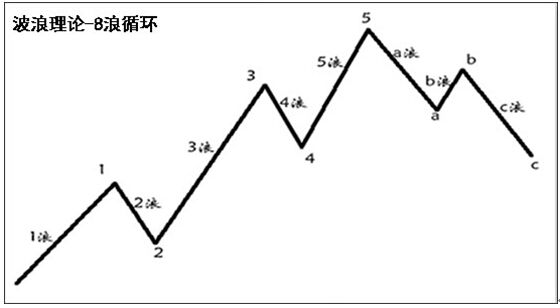
In the combined use of the wave theory and the firm offer, there are three stages that must go through the process of "simple-complex-simple". Correspondingly, there are different perceptions of winning percentage and profit-loss ratio.
We know that the wave theory has a detailed description of market trends, and there are many possibilities for the development of waves in a certain period of time. If you only use the wave theory to analyze the firm offer, you will inevitably encounter bottlenecks.
Therefore, combining channels, K-line reversals, and even MACD indicators are all powerful helpers in establishing specific directions and points, and also make the wave theory more practical.
The hourly K-line reversal combined with wave theory and channels can effectively increase the winning rate. After the hourly K-line reversal occurs, then switch back to the 5-point chart, which can effectively grasp the precise best entry point, so as to set the minimum The potential stop loss range and the largest profit margin can effectively improve the profit-loss ratio.
It is the highest state of trading to mechanize and fix trading thinking and skills, transform them into intuition in the mind, and finally use intuition to trade.
Copyright reserved to the author
Last updated: 08/06/2023 12:22
Add

There are two things to deal with in trading, one is the winning rate and the other is the profit-loss ratio.
However, these two things are often difficult to improve at the same time. Those with a high winning rate often have a low profit-loss ratio, and those with a low winning rate often have a high profit-loss ratio. Is there a way to increase the winning rate and profit-loss ratio at the same time? The answer is yes.
We all know that the wave theory is a detailed description of the market trend, and then in a certain period of time, there are many possible forms of future wave development, and sometimes it may even be the opposite. If you only use the wave theory to trade, it is bound to be When encountering a bottleneck, it is necessary to combine channels, K-line reversal signals, and even MACD indicators to assist in determining the specific entry direction and point.
Wave theory students can enter the market on the left side or on the right side. Because the wave development is ever-changing, it is better to trade on the right side if you want to increase the winning rate. If you want to use a mechanical trading system, Then it is recommended to only enter the market on the right side. After the channel and wave theory lock the entry opportunity and approximate entry point area, wait patiently for the K-line reversal signal to appear on the hourly chart, then switch back to the 5-point chart and use the 5-point chart To lock a specific entry point.
Therefore, the hourly chart K-line reversal combined with wave theory and channels can effectively increase the winning rate . After the hourly K-line reversal occurs, then switch back to the 5-point chart, which can effectively grasp the precise best entry point. Thereby setting the smallest potential stop loss range and the largest profit space, thereby effectively increasing the profit-loss ratio .

The above just provides an idea, that is, the trend system + entry timing, so that the two can be perfectly combined.
It is the highest state of trading to mechanize and fix trading thinking and skills, transform them into intuition in the mind, and finally use intuition to trade.
Copyright reserved to the author
Last updated: 08/06/2023 20:10
Add

The win rate is the accuracy rate of the trading strategy.
The profit-loss ratio is the difference between the entry and exit points, that is, stop loss-risk control. Risk control is also part of the trading strategy.
Therefore, combining the above two points, "winning rate" and "profit-loss ratio" are all about trading strategies.
If both want to achieve improvement, it is feasible and achievable, but it is also relatively difficult. It requires long hours of training and deep basic skills.

Here are a few points for your reference:
1. Risk control first
The correct trading learning steps should be based on the exit point, so as to launch the entry strategy. Strive to improve the profit-loss ratio, and then focus on building entry skills to improve the trading winning rate.
It is difficult to control the profit, but the risk of loss in each transaction and the range of retracement can be effectively controlled through detailed analysis and statistics of the varieties.
The statistics and analysis of varieties require a long period of review, and effective improvement of trading strategies must be thoroughly understood in terms of trading frequency, trading sentiment, and variety characteristics.
2. Make good use of analysis tools
The key is support and resistance. Experts will also use technical indicators and candle patterns to help predict the entry and exit direction of prices.
When long a certain product, traders can intervene when the price effectively breaks through the resistance level, and the moving stop loss is set below the resistance line. These two lines can be described as the "lifeline" of trading. Making good use of them can make the entry and exit positions more reasonable and accurate, thereby improving the winning rate and profit-loss ratio.
3. Reasonable allocation of positions
Position allocation involves the allocation ratio of initial funds in different trading varieties and the skills of increasing and decreasing positions. Some people like to divide the tradable funds into four equal parts and gradually increase the position, while others like to invest all the funds in the same product at once. This needs to be set according to the trading plan and market fluctuation rules, but the ultimate goal is to minimize the profit-loss ratio as much as possible. maximize.
Position allocation involves the allocation ratio of initial funds in different trading varieties and the skills of increasing and decreasing positions.
Some people like to divide the tradable funds into four equal parts and gradually increase the position, while others like to invest all the funds in the same product at once. This needs to be set according to the trading plan and market fluctuation rules, but the ultimate goal is to minimize the profit-loss ratio as much as possible. maximize.
Copyright reserved to the author
Last updated: 08/08/2023 05:05
Add

In the field of investment, there are currently two variables generally recognized by everyone to measure a trading system, one is the success rate, and the other is the profit-loss ratio . If the sample size is large enough, the two can basically reflect the quality of a trading system at the statistical level. The product of the success rate and the profit-loss ratio directly reflects the profitability of the trading system.
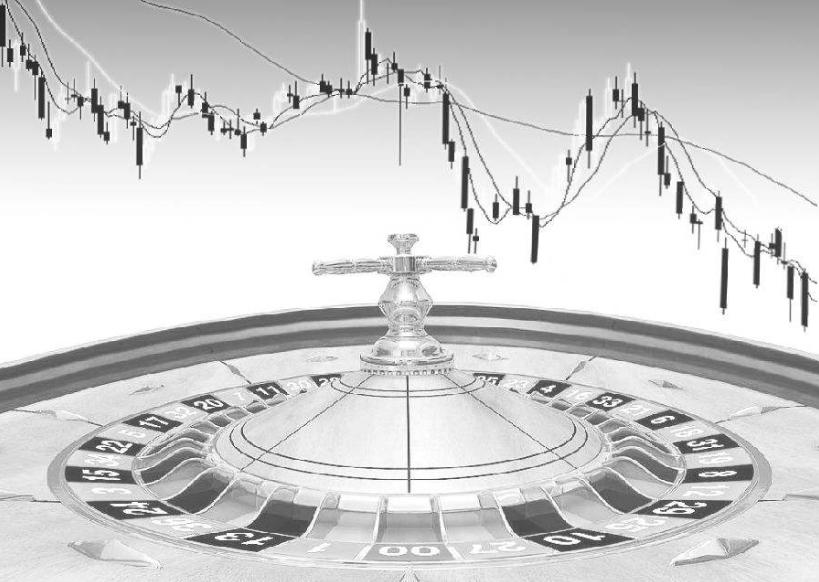
Generally speaking, most of the system models recognized and approved by professional investors have a success rate of 30% to 50%. Judging from my personal communication with some professional investors, I basically recognize this range.
However, on the basis of a not-so-high success rate, a good system model will definitely have a higher profit-loss ratio, that is to say, even if there are slightly more small losses, as long as you make a profit, you will generally make a big profit. For example, a 40% success rate, combined with a profit-loss ratio of more than 3:1, can constitute a very good trading system.
Of course, there are still some investors who use the model of "high success rate + low profit-loss ratio", and there are also investors who have done well. Of course, this model is mostly short-term, with a large number of small profits, and occasionally There have been relatively large losses, but the overall capital curve is still upward. There are not many investors who choose this model, so I won’t say more here.
Judging from everyone's general understanding, in a mature trading system, these two factors are mutually restrictive, and the corresponding curve relationship between the two is not linear, but basically they all ebb and flow.
This is easy to understand, for example:
1. Every time I trade, I enlarge the stop loss range and narrow the take profit range, so that the probability of market reversal within my stop loss range will increase, and the market will reach the stop profit position. The probability will also increase, and the effect is that the success rate will increase, but the profit-loss ratio will decrease.
2. The reverse is also the same. If you reduce the stop loss and enlarge the stop profit every time you trade, the probability of loss will increase, the success rate will decrease, but the profit-loss ratio will increase.
These two factors in the system perfectly reflect what is called "you can't have both" The success rate is neutral, it can be advanced, offensive or defensive, not extremely high or extremely low, and the capital curve is the easiest to come out and rise smoothly.

The topic is going to be reversed here. Many people in the market blindly pursue "accuracy" and "high success rate" which is not advisable, but clinging to the lower success rate and not thinking about making progress is not the way to invest. After all, the road to investment is accompanied by a lifetime of learning and progress . There are too many investors who have done well. Although they can make money, they are really tired and under great pressure. The reason is that the success rate is not high enough, and there may even be extreme continuous losses in certain periods of time, resulting in unstable income curves.
how to solve this problem? Sacrificing profit and loss ratio? of course not.
Don't forget that in addition to these two basic variables, there is actually another variable that we can make great use of, which is the number of opportunities. Recognizing this is the key to further breakthroughs for many investors.
Why do you say that? It is because in my personal opinion, the variables that really exist in the trading system are actually more than the first two, and the third variable, the number of opportunities, constitutes a real and complete mutual restriction relationship.
As far as stock trading is concerned, compared with foreign exchange currency pairs and futures products, it is obviously superior in quantity, which leads to the least valuable and most exploitable of these three variables, which is the number of opportunities . In the case that the success rate and profit-loss ratio are mutually restricted and it is difficult to improve the trading effect, we can increase the success rate and profit-loss ratio by reasonably reducing the number of trading opportunities.

How is this possible?
As for improving the success rate , I believe that any investor who already has a mature trading system must know what kind of opportunity is the most certain opportunity for his own system, and buy stocks in such an opportunity. My heart is very solid. But this kind of opportunity is definitely not as common as Dabao, and the overall effect of trading in other "general" or "suspected" opportunities will definitely be discounted. Therefore, in my own research field, only one or a few opportunities with high certainty are traded, and the number of opportunities will be reduced, but the success rate will naturally be high.
For improving the profit-loss ratio , under the premise that the success rate remains unchanged, the risk of the buying point can be controlled to be small enough, that is, buying stocks with a small enough stop loss, such as some stocks that have already risen when the buying point appears, I will definitely not chase. This will of course lead to a further reduction in the number of transactions, but the risk control ability will be greatly improved, the average stop loss will be at a very low level, and the profit-loss ratio will also be greatly increased at the same time.
The truth is actually very simple. To use good steel wisely means to use funds on the best trading opportunities.
Where is the difficulty in doing this?
1. Lack of enough patience. Good opportunities must be patiently waited for. Lack of patience during the waiting process will lead to early buying during the observation process, or to trade other "general" opportunities.
2. The effort is not enough, the less trading opportunities there are, the more effort should be made in normal times. It is necessary to review a large number of stocks on a daily basis, and select a very small number of stocks that really meet your requirements and put them into the stock pool for observation until a buying opportunity arises before selling. grasp. In reality, many people lack this motivation, so stock selection and operations are easy to be confused and vague.
3. The relationship between the three is not well handled. The success rate, profit-loss ratio, and the number of opportunities are very delicate. When setting operating standards, continuous improvement and fine-tuning are required. Some investors set too strict criteria in the screening process and the number of opportunities is too small, which is of course not acceptable.
4. Don't understand "willing to give up" and don't want to "willing to give up". Such investors are also very common. Reducing the number of opportunities must mean that many opportunities cannot be manipulated, and there are many opportunities that have a good market outlook. Who doesn’t eat dumplings during the Chinese New Year. If you are unwilling to let go of these situations where the probability is actually relatively small, you will naturally fall into the "general" opportunities mentioned above countless times, and it is difficult to make further breakthroughs.
Understand "willingness", have patience, and understand what "slow is fast". After understanding this point, many investors and friends began to trade easily and smoothly. The third variable of the trading system is the key to the further sublimation of the investment career.
Copyright reserved to the author
Last updated: 08/07/2023 22:07
Add


Winning rate and odds are like the two ends of a seesaw, which must generally go up and down. In the long run, a high winning rate strategy must face low odds, and don't pursue the best of both worlds that doesn't exist.
Copyright reserved to the author
Last updated: 08/01/2023 12:14
Add

As we all know, in the transaction we are divided into left transaction and right transaction. So why is there such a difference? In fact, it lies in the different pursuit of profit-loss ratio and winning rate.
The transaction on the left is an order that is opposite to the current market, and the pursuit is the reversal of the market in order to obtain a better entry price. Obviously, this is the pursuit of a high profit-loss ratio, but there may be problems with the winning rate, because it is uncertain when the market will reverse, and the risks to be taken are relatively greater.
The right side of the transaction is an order that is in the same direction as the current market, that is, following the trend. So obviously, the risk has been relatively reduced at this time, but the entry position may be a little worse than the left side of the transaction. However, due to the higher probability of trend continuation, the winning rate has naturally increased.
Note that the trade on the right does not give up the profit and loss ratio. Because, as we have said above, due to the uncertainty of the market, we do not know how long this trend will develop. Therefore, our profit margin can be said to be unlimited, while the risk has been limited by us. Therefore, when trading on the right side, a relatively high profit-loss ratio can be set, and the winning rate is also increased due to the relative certainty of trading on the right side.
Therefore, in my opinion, winning rate = risk, so to reduce the risk and increase the winning rate, the right side of the transaction can be implemented. The profit-loss ratio is actually a ratio relationship between profit and loss, so if the expected profit remains unchanged, reducing the loss can also increase the profit-loss ratio. And trading on the right side can reduce the room for loss very well, so it is a good choice.
Therefore, I think that in the process of trading on the right side, the winning rate and profit-loss ratio can be improved at the same time, so as to maximize profits.
Copyright reserved to the author
Last updated: 08/14/2023 05:29
Add

In the financial trading market, this is a world where heroes are judged by success or failure. The success or failure of financial transactions ultimately depends on the transaction profit system, which has three elements: winning rate, profit-loss ratio, and transaction frequency.
Winning rate, profit-loss ratio, and trading frequency form a closed trading loop, one trades off and the other grows and the other is indispensable. They comprehensively determine the mathematical expectation value of a trading system, and one cannot pursue a certain item one-sidedly.
The specific division is as follows:
1. The winning rate is high, the trading frequency is high, and the profit-loss ratio is low, which belongs to short-term trading;
2. The winning rate is low, the trading frequency is low, and the profit-loss ratio is high, which belongs to trend trading;
3. High winning rate, high trading frequency, and high profit-loss ratio do not exist;
To improve one of them, it is necessary to sacrifice the other two. In simple terms, the system can be divided into three types: high winning rate, high profit-loss ratio, and high trading frequency. For most profitable systems, one or two of these three elements are more prominent or Focus on.

What kind of system is right for you?
High winning rate, suitable for people who hate losses, conservative and prudent, earn a little and run away, which belongs to short-term trading.
High profit-loss ratio, suitable for those who like to make a lot of money at a time, it belongs to trend trading.
High trading frequency, suitable for people or EA who like a lot of trading, belongs to quantitative trading.

These three elements are combined with each other. If you want a high winning rate and a high profit-loss ratio, and are willing to wait and endure loneliness, you can go for a high winning rate, high profit-loss ratio, and low-frequency type. The biggest feature of this type of system It is to do a small amount of orders and wait until the opportunity that suits you appears before you can do it.
If you don’t want to make too few orders, you can consider the type with high winning rate, low profit-loss ratio, and relatively high frequency. These can be combined and created according to your preferences.
If you like people who have to make a lot of money once they make a profit, then I recommend the type with high profit-loss ratio and low winning rate/low profit-loss ratio.
If you are playing EA, it is strongly recommended to use the type of high frequency, because this is the biggest advantage of EA compared with manual labor. Even if the winning rate and profit-loss ratio are not prominent, it does not matter. If it is particularly large, the profitability will also be very strong.
We have to be clear about the characteristics, advantages and disadvantages of our own trading system, and create a system that suits our own preferences and personality characteristics. Because everyone's system is unique, earn your own money, let others say it!
Copyright reserved to the author
Last updated: 08/14/2023 10:35
Add

This problem is not so entangled. Change the short-term to swing trading above the 4-hour level, reduce the frequency of transactions and increase the winning rate, and at the same time increase the profit-loss ratio.
Copyright reserved to the author
Last updated: 08/01/2023 07:28
Add

Sorry, in my eyes, I don't pay much attention to winning percentage. Because this is an empty piece of paper, even if you have a high winning percentage, what is the use? ? ?
The foreign exchange market only looks at the result and not the process! Sorry, if you still lose money in the end, it's useless.
What is your original intention to come to this market? ? ?
It's not that the so-called "winning rate" is for others to see. Not an answer for yourself! What is important to us is to give our own answers, not to others...
Copyright reserved to the author
Last updated: 08/01/2023 06:03
Add

I have read many excellent answers from you, some agree that both can be achieved, and some disagree. Everyone argued with reason and gave a lot of convincing evidence and examples. But this thing, I think it depends on the individual, because indeed everyone is unique.
There are several taboos in the financial market, one of which is not to be too greedy. The main question is how to increase the winning rate and profit-loss ratio at the same time. I think I have committed this taboo. This is obviously greed. Ideally speaking, it is best for me to be 100% correct in any transaction, and every transaction can give me hundreds of thousands of points in a short period of time.
Isn't this a dream?
Of course, this scenario is almost impossible to achieve, and no one is really stupid to pursue this utopia. But first of all, we need to clarify a problem, that is, the winning ratio and profit-loss ratio, it also needs a time frame. Just like we talk about trends, it is unrealistic to talk about trends regardless of the time frame. Then the ratio of winning percentage to profit and loss is the same.
If a short-term trader makes orders every day, his winning rate within a year is definitely not as good as that of a trend trader. But if it is placed within 1 hour, short-term traders may have a 70% winning rate, but what about trend traders? There is no order at all, or only one order is made, and this order is now a loss. How do you compare?
I believe it is not easy to explain the doorway, right? So, don't get too entangled in these messy things, which make the transaction more and more complicated. Although a short-term trader is short-term, he also has risk control, so he also knows the profit-loss ratio. Take 50 points of profit each time, what is the stop loss? 30-50 points is enough; but it does not mean that the winning rate of short-term traders must be high, and there is no necessary connection between them. Therefore, short-term traders will also consider the profit-loss ratio.
In this way, everyone should understand that regardless of short-term or trend, the profit-loss ratio is actually the most important thing. To put it more bluntly, you must bring a reasonable stop loss. As for the others, the winning rate is really resigned to fate.
Copyright reserved to the author
Last updated: 08/13/2023 21:38
Add

If you want to be invincible in the ever-changing market, you must first spend more energy and practice diligently in two aspects: one is to increase the probability of profit; the second is to find a suitable profit-loss ratio.
The winning rate is a very important aspect. It is undeniable that we will pay more and more attention to the profit-loss ratio. Why is this so? Every time an investor trades an order, a transaction fee will be deducted. Purely from the perspective of the game, even if the profit probability is 50%, out of every 10 transactions, 5 transactions are profitable and 5 transactions are loss-making. If the profit-loss ratio is 1:1, the investment funds will always be In a game of diminishing negative sums, the more transactions are made, the faster the loss of funds.
Therefore, the key is to increase the profit-loss ratio. In fact, this is common sense in the industry. Livermore also repeatedly emphasized that the profit-loss ratio is more important than the winning rate. In "Memoirs of a Stock Maker", he kept mentioning: You must hold stocks without moving, and don't be disturbed by a small fluctuation. Profits are all realized, and you can't make money by fighting in and out.

At the same time, it should be emphasized that the trading profit-loss ratio and winning rate are dynamic and uncertain, and cannot be accurately calculated in advance but can only be calculated afterwards. Because the whole process needs to be dynamically grasped by the trader himself, this is also the biggest difficulty in trading technology.
We know that a very important link in Soros's investment thought system is "falsification". Falsificationism is a trial-and-error method advocated, which means that people should boldly put forward hypotheses and guesses, and then look for examples that do not conform to this hypothesis. The hypothesis is revised according to the examples, and the process is repeated until the original hypothesis is completely negated.
If we use this method to reflect on the problem of "winning ratio and profit-loss ratio", we will find that if we know the profit-loss ratio and winning ratio in advance, then in the process of formulating trading strategies, directly apply the Kelly formula or bankruptcy probability formula, we will " Invincible." If there is such a strategy, would you dare to use it?
For ordinary retail investors, fully consider the risks, first aim to achieve stable profits, and consider how to enlarge positions to achieve greater profits during the gradual growth of the account.
At the beginning, we should be relatively conservative, give up the pursuit of efficiency and pursue stability, give up the pursuit of winning rate and profit-loss ratio, but set some fixed-proportion stop-loss operations according to conventional risk parameters. After the capital curve is steadily upward, Gradually increase the stop loss ratio, and if the capital curve goes down steadily for a period of time, reduce the stop loss ratio. By gradually understanding your own system in practice, through the accumulation of time, you will know how suitable the strategy is for you in the long run.
How to improve the profit-loss ratio, in short:
1. Focus the research on how to improve the profit-loss ratio.
2. Improving the winning rate is an approach that conforms to human nature, and increasing the profit-loss ratio is an approach that goes against human nature.
3. In trading, the practice against human nature is often the right direction.
4. The winning rate is not the key, the profit-loss ratio is the key.
5. There are three main ways to improve the profit-loss ratio:
① Profitable position: the average position time of profit > the average position time of loss;
② Increase position with profit: realize profit closing position > loss closing position;
③Loss-reducing positions: realize profit-closing positions > loss-closing positions.

Copyright reserved to the author
Last updated: 08/11/2023 10:20
Add

0
work
0
subscriber