


Stay in touch!
Subscribe to our newsletter to get the latest updates on live market analysis, trading strategies and more. You can unsubscribe anytime.
By subscribing, you agree to Trading.live Privacy Policy.


I understand the mood of the subject of the question very well, that is, he saw the general direction of the market, but "Mr. Market" just made a joke. After stopping the loss, he continued to move forward as expected. He could only watch helplessly. Can't the market pullback maximize profits?
In fact, this is a bit difficult to grasp. First of all, you need tools to measure trends, and the prerequisite for measuring trends is to define trends first.
Because each of us has a different definition of a trend. Some people use trend lines to define and measure; some use moving averages to define and measure;
But if you want to find a tool that is absolutely effective in measuring trends, it is impossible. In other words, you can only use the tool of your choice to measure the trend, which is the meaning of "weak water three thousand, just take one scoop".
Don't try to catch all the trends in the market, which means you want to catch all the fluctuations in the market, because the shock market can also be regarded as a trend in a small cycle.
But, if you think about it again, if you can handle most of the trends measured by the tool you choose, you can achieve financial freedom over time, right?
So if we already have the tools to measure the trend, how to move the stop loss more scientifically?
You can refer to the following three points:
1. Move the stop loss according to the tool to measure the trend
2. Combining horizontal position or golden section position
3. Distinguish between size and level
Then let's use the commonly used trend lines and moving averages as examples:
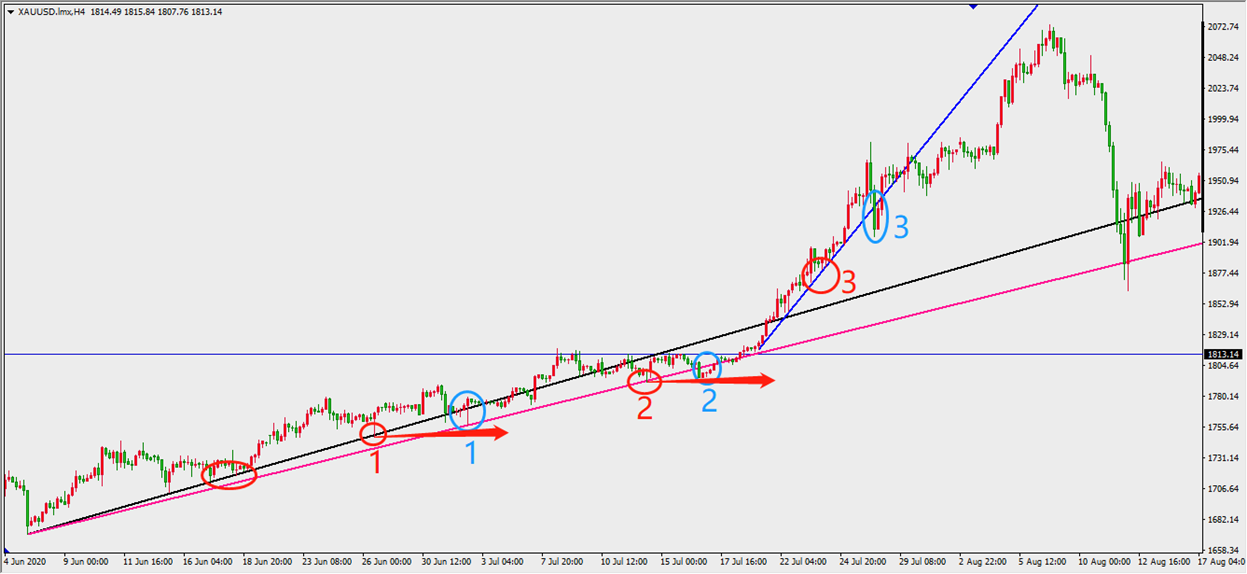
1. The red circles are the entry positions, and the blue circles are theoretically the exit positions, because measured by the trend line, it means that the stop loss is continuously moved as the trend line rises, and the stop loss is broken.
However, if you combine the levels, you can still hold positions in the blue circles of 1 and 2, which can maximize profits, but at the same time, it also has its drawbacks, that is, if the market reverses, you have to bear more Profit-taking, so choose the method that suits you after weighing the pros and cons.
2. The entry and exit positions of the next 3 are the trends of the next level. When entering the market at the next level, you should exit the market at the next level instead of the trend line of 1 and 2 above; It's about to lose money.
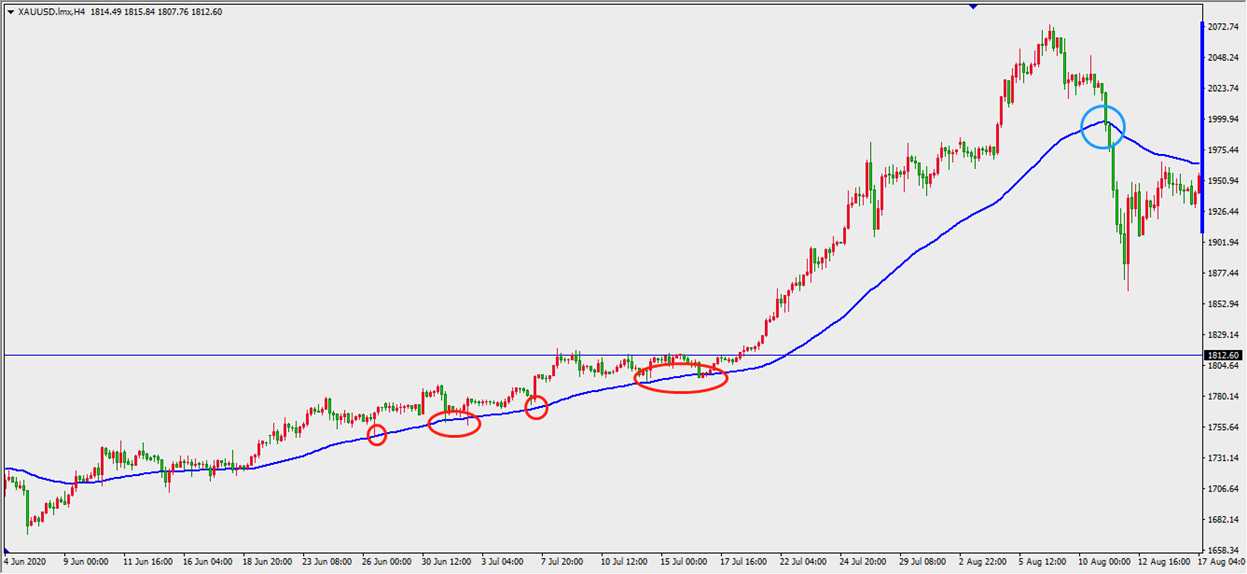
And if you choose the 60 moving average as the basis for entering and exiting the market, it is naturally completely different from the previous position measured by the trend line, but the stop loss is also the same as the moving average rises, and the stop loss is broken; or combined with the horizontal stop loss .
In this figure, the moving average can better grasp the market and obtain more profits.
But does this mean that the moving average has an advantage over the trend line?
In fact, not necessarily, it is just more suitable at this time, we can look at another picture:
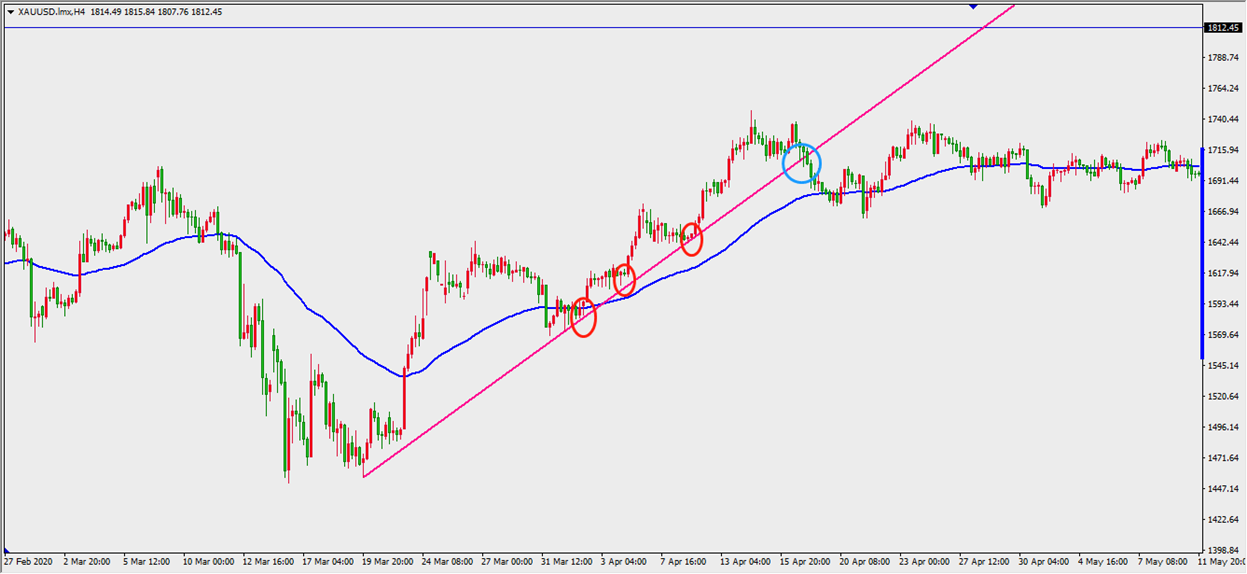
At this time, the trend line is more suitable for the market at this time, and more profits can be obtained; and the 60 moving average has almost never been backtested. If it is a strategy of breaking through the backtest before entering the market, it has no chance with this market portion.
Of course, if you adopt the strategy of entering the market as soon as you break through, you can get a part of the profit, but at the same time, you will face more false breakthroughs at other times.
Therefore, for this problem, the first is the choice problem, and then we must understand what we often say- stop loss is something you can control, and profit is given by the market. Only by being favored by "Mr. Market" can we maximize our profits. This cannot be deliberately pursued, but can only be "obeyed by fate."
Copyright reserved to the author
Last updated: 08/14/2023 18:57
 Add
Add

First of all, you have to make sure whether what you are doing is a trend order. If it is a trend order, then your stop loss can be placed at a point where the order may change, instead of letting the stop loss follow the market when you have a little profit. On the disk, it is not a trend order, it is a short-term; if you make it clear that what you are doing is a trend order, then if you have a profit to reach your target, you first sell half of the position and take the profit first. If there is no breakthrough later, then the rest There is no need to move half of the stop loss; if it breaks out of the new range, then increase the stop loss by an amount; in summary~ the first stop loss is to change the position instead of running along, the second is to make a profit and go for half, and the rest Half of the stop loss does not move, and the third is that if it breaks through, then adjust the stop loss, and if it does not break through, it will wait. To be honest, although there is a lot of profit in long-term, it is really not easy to do it; according to your style, it is recommended to do band, give up considerable possible long-term benefits, and get real profits~㊗️Half
Copyright reserved to the author
Last updated: 08/04/2023 20:01
Add

Every time I place an order, I only need to make a profit of a few points, and then I will move the stop loss above the cost price, and then move according to the subsequent trend
Copyright reserved to the author
Last updated: 08/14/2023 17:28
Add

It's very simple, as long as it is a stop loss, its purpose is the same, and it must be reasonable. Once the loss is swept away, although the direction will not be guaranteed to change, but the end of the market must be ensured. This is a more reasonable stop loss, then track capital preservation The only difference in stop loss is that you must have a medium and long-term trading mentality, because the profit maximization can only be done in the trending market
For example, in a wave of upward trend, the high point keeps breaking new highs, and the low before each callback is its stop loss position. The previous high, the stop loss position is still at the previous low point instead of the current low point) As the price continues to break new highs, the stop loss position continues to rise with the previous low point, only such a reasonable stop loss will not sweep the loss and continue Upward, if you do it in the trend, you will feel like a fish in water. If there is a wide range of fluctuations in the period of more than one hour, you can also find short-term trend market in a small period to do so. It is also possible to increase the position every time the stop loss is raised, or reduce the position once. The former is to maximize profits, and the latter is to minimize risks.
Copyright reserved to the author
Last updated: 08/03/2023 15:55
Add

I have also thought deeply about this issue, and I would like to give you a suggestion. The order is divided into two parts, and the ratio is determined by yourself. Both are based on 50 profit points to protect the capital and losses, and one part is short-term orders. For example, the profit is 100 points. No matter how the follow-up market goes, All positions are closed first, and the other part is the band order. After pushing the guarantee, choose a moving average to track, and leave the market when it hits the moving average.
Copyright reserved to the author
Last updated: 08/14/2023 08:47
Add

It should be asked how to enter the market scientifically, and the stop loss is brought by the way
Copyright reserved to the author
Last updated: 08/06/2023 01:44
Add

Trailing stop loss is two concepts, one is moving, and the other is stop loss. The purpose of moving is to pursue greater profits within a limited transaction, and the purpose of stop loss is to prevent profit taking or loss of principal.
In trading, if the market is smooth, traders often use the method of trailing stop loss to maximize profits. Combined with the author's trading experience, I personally think that this trailing stop loss is not suitable for novices, because the market will not be unilateral forever. If you pass the technical analysis by yourself, you can consider this kind of trading method. If the technical analysis is not in place, it is recommended to choose the form of short-term running.
If you have a good grasp of technical analysis, you can look for the support and suppression of the market at that time while keeping an eye on the market, and move on the basis of short-term support and suppression, because the distance between short-term support and suppression is not large in the market operation. One-step moving stop loss can reduce profit taking and even lock the principal security
Copyright reserved to the author
Last updated: 08/04/2023 12:12
Add


About trailing stop loss: With profit, immediately move to the cost price?
Of course, based on the principle of capital preservation first and profit second, after making a profit, move the stop loss position to the cost price and exit the market with the worst outcome to protect the capital. This idea is good, but there are some details that need to be paid attention to:
First of all, after each position entry, the initial stop loss is very objective, based on technical analysis, but the transfer of loss to cost is subjective, after all, it is not based on technical analysis, it is based on psychological influence.
Secondly, moving to the cost as soon as possible does not mean that the loss will be lost just after a few points of profit, otherwise it will mostly be swept back and forth. As soon as possible but "properly", when the market has been profitable for a period of time, or the small cycle retraces again, you can consider shifting losses.
Third, although moving the loss to the cost is very subjective, the initial stop loss is very objective, but does the market respect us? In a large number of disorderly oscillations, all forms have no rules at all. After the loss is removed until the cost is wiped out, and the market turns back, I can enter the market again. This is the so-called "chasing high". But is this the worst? Have you ever tried to be hit with a small cycle stop loss 8 times in a row (there was no concept of transferring loss to cost at that time), and the unilateral profit was wiped out, (this is the sadness that most people will have but will encounter) Based on this, it is no problem to move the stop loss position to the cost price.
Fourth, but it cannot move in time, the system must be able to withstand the worst situation, you respect the market, and it makes you lose 10 pens in a row. The market is regular during a trend, and there are a lot of Dow waves, but what about when there is no trend? Does it still respect you? After you have a certain floating profit, for example, you can push the loss for the first time. You should wait until you see that the price has passed the latest support/resistance before you can immediately move the stop loss to the cost price, at least you have to wait until you see the price Push the stop loss after the nearest small level of support/resistance, otherwise it will be easily swept out and become a bystander.
Therefore, for moving stop loss, it should be "appropriate" as soon as possible, but the specific method varies from person to system. It must be both quick and appropriate. This kind of opportunity cannot be grasped at once, so be cautious and hardworking. You have to use a lot more and a little more effort to find opportunities and make up for shortcomings. As for the specific "appropriate" grasp, different people have different opinions, but you must not be ambiguous. Even if a certain person believes in someone and loses money, he must be firm in his heart. Losing money is not terrible. The terrible thing is that the feeling will continue. Shock the will that we think we are tough.
As for how "appropriate" science is, it is essentially the balance between odds and odds. Winning odds and odds are a pair of eternal contradictions. For example, if you enter the market in a daily cycle and enter the market with a 30-minute K-line, you can ensure that the odds are small (that is, the profit-loss ratio), and the winning rate is also within an acceptable range (about 40%~50%). But if the daily line goes out and enters in 5 minutes, the odds are guaranteed higher, but the success rate is greatly reduced, perhaps only 10% or even lower.
Therefore, how to master the winning rate, odds and balance in the transaction is very important, and everyone's psychological endurance is also different. Mastering the "speed" of your own transactions is the key!
The famous trader Dennis said: 95% of my profits come from 5% of my transactions, and the rest are small losses and small profits. That's his "proper". Therefore, even after moving the stop loss and false stop loss several times, as long as one or two of them make a profit and catch the trend, it is enough.
Of course, when you finally determine your "appropriateness", it belongs to your own trading system (I always believe that any trader must sum up a trading system that suits him), after having a clear system, do a good job of basic The management and psychological control is basically to put the order and run away. It doesn't matter where you run, as long as you don't touch the stop loss (take profit) and continue running.
Trading is not complicated. After forming a mature trading system, you still need enough experience and self-control. Too lazy to predict, too lazy to analyze, make orders when there is a signal, and wait if there is no signal, just like eating and sleeping (trading is inherently boring work). From the past when I made a profit of 2,000 to 3,000 a day, I was so excited that I couldn’t sleep at night, now I don’t even feel a profit of 10,000 to 20,000 a day.
In addition, you have not reached a certain level, and trading is not simple. There are many things you don’t know. It is possible that what you see is the same as those old traders with a lot of market experience, and even the conclusions are the same, but you just turn around. He turned one corner, but he turned ten corners. From the avenue to simplicity, there must be a process from complexity to simplicity. The simplicity you see is simplicity, and the simplicity they see is the essence, not the same thing. The water in every industry should probably be this deep.
Similar to trailing stop loss: if there is no quick profit after entering the market, then your order is probably wrong. A correct order should be in the right direction and the right point, both of which are indispensable. In fact, this is also a subjective color, not objective. Some people will do this. This approach is just a consideration of opportunity cost, which is a bit like the feeling of minimum tolerance. As for whether it is scientific or not, it is difficult to know.
I hope everyone can reap their own financial freedom, guard their own hearts, strengthen their will, know what they want, and be able to rely on their own efforts to get what they want.
Copyright reserved to the author
Last updated: 08/14/2023 16:20
Add

Copyright reserved to the author
Last updated: 08/12/2023 13:58
Add

Moving stop loss, commonly known as protection loss, is generally set below the small structural support level of the price.
Copyright reserved to the author
Last updated: 08/07/2023 15:50
Add

Copyright reserved to the author
Last updated: 08/02/2023 17:18
Add

Science I usually just believe in numbers
I usually do trend trading
Therefore, following the trend, there will be a wave of ups and downs
And my stop profit and stop loss all come from the Fibonacci sequence
There are several complex patterns that also come from the concept of Fibonacci
Simply put, once the retracement starts
My stop loss will be set at about 38.2 or even 50 ratio line
If you go up, you are pulling the series to study the proportional line according to the new high point
For your reference
I didn't play a lot because I don't like to complicate too many concepts
thank you
Copyright reserved to the author
Last updated: 08/07/2023 19:33
Add

I personally think that moving stop loss is the first thing to do in the case of profit. If you lose money, you should not move the stop loss. First of all, when the market moves in a direction that is beneficial to us by more than 50 points, I will First move the stop loss to the breakeven position, and then wait for the new inflection point. After the new inflection point appears, move to the new inflection point, and so on, for reference only! I want to build a Huiyou group so that our Huiyou can better communicate and learn from each other. If you don't mind, welcome to join.
Copyright reserved to the author
Last updated: 08/03/2023 14:46
Add

Personal point of view: After making a profit, moving capital protection and above are all scientific moving stop losses
Copyright reserved to the author
Last updated: 08/14/2023 07:14
Add

Each moving stop is placed near the next SR
Copyright reserved to the author
Last updated: 08/11/2023 13:08
Add

It’s not impossible, it’s a matter of probability. You may be in the right direction many times, but after a pullback, you just hit your breakeven and started to sprint the market. There are many such cases. Bad luck eight times out of ten. But have you ever thought about it. If you reduce your position after setting a capital guarantee and loss, will you lose money later? No, you still have a small profit. Then the remaining two times are the time for you to eat meat
Copyright reserved to the author
Last updated: 08/05/2023 08:35
Add
I think all scientific trailing stops are based on not losing money. If you set a stop loss, no matter how you move it, you will not lose money. You are scientific.


Copyright reserved to the author
Last updated: 08/01/2023 05:50
Add

When you move the stop loss position, you have already lost to the market, and the fluctuation of the market has already affected your judgment, indicating that your trading method is not stable, just like two people playing chess, there is a strong side and a weak side On the one hand, in your preparations before the start of the transaction, you are strong, and you think you can control the current market fluctuations, so you will enter the market. After entering the market, you will be led by the nose and modify the stop loss. From this moment , you have already lost, even if you are lucky this time, you can make a profit by modifying the stop loss, but your luck will run out
Copyright reserved to the author
Last updated: 08/14/2023 07:09
Add

Whether the trailing stop is scientific or not depends largely on your trading philosophy and logical thinking.
Trailing stop loss is an ability to reduce stop loss or protect existing profits while following trend continuation
The embodiment of science lies in whether the above two points can be well achieved and can be retained in the market to seize the market profits in the later stage.
For specific operation details and strategies, design your own trading system, each trading plan!
Copyright reserved to the author
Last updated: 08/05/2023 02:46
Add

Copyright reserved to the author
Last updated: 08/02/2023 19:23
Add

0
work
0
subscriber