


Stay in touch!
Subscribe to our newsletter to get the latest updates on live market analysis, trading strategies and more. You can unsubscribe anytime.
By subscribing, you agree to Trading.live Privacy Policy.


Thank you Brother Money for the invitation. It’s another question about exiting the market. With the improvement of traders’ awareness of trading, more and more people pay attention to exiting the market, and everyone’s overall level is gradually improving.
The main point of the question is to fit the market and be objective. But in fact, these two points are somewhat contradictory. First of all, how to define the fit of market fit? The market is constantly changing and unpredictable. With our ability, we can't keep up with it. If we can keep following the market, wouldn't all the profits be in our pockets? Many people refuse to accept it and tell me that every Varieties have the attributes of each variety, some are easy to trend, some are easy to fluctuate, some are very volatile, and some are not very active.
If you follow this line of thinking, then I would like to ask, do you think the variety of gold is a trending variety or a shocking variety? Is the volatility large or small? From 2008 to 2011, gold went straight from $700 to $1,900 in two years with almost no retracement. At this time, it may be a trending product in the eyes of many traders. It fluctuates in a range. If you change to selling high and buying low at this time, then you will be miserable, because from 2013 to 2015, it will fall by 1,000 US dollars, and then it will be in a small range until 2018. Shock, until this year there is no big trend again, you see, how do you judge what kind it is? What about volatility? Friends who do gold know that in the past few years, the non-agricultural may only fluctuate by 20 to 30 US dollars, usually 10 US dollars is not much, but this year, it is commonplace to fluctuate by 30 to 40 US dollars a day, and there are many trading days Both fluctuate more than 80 US dollars. Is this big or small?
We have no way of judging. It may continue to trend in the future, or it may fluctuate for several years. It may fluctuate by tens of dollars every day, or it may return to the era of daily fluctuations of ten dollars. So fitting the market is just our fantasy, our wishful thinking.
There are many objective ways to enter the market. In fact, it is very good to have an objective trading thinking when doing transactions, because once you are subjective, you may fall into the trap of assumption. The market will not change with your subjective. It will go where it should go. Let me briefly introduce several objective appearances.
First, the turtle-style appearance. In the process of holding positions, retrace the lowest or highest point of the ten days, and exit the market. This is the method I introduce the most, and the efficiency is also very high. The high efficiency here does not mean that I can make money quickly, but the execution efficiency is high, because the ten-day high and low The point is clear at a glance. When it arrives, you will enter the market, without judging others or predicting the market, without hesitation or receiving any news influence. This is a very efficient way to enter the market. very objective.
Second, technical indicators appear. Here we can use the indicators in hand, for example, we use the moving average, when the price rises above the moving average, we leave the market with an empty order, and when the price falls below the moving average, we leave the market with a long order. Or the rsi indicator, if it is higher than the 80 line, we will leave the market with an empty order, and if it is lower than the 20 line, we will leave the market with a long order. There are many indicators of this kind, so don’t use too many. One is basically enough. If you are satisfied, you will leave the market without any hesitation. If there are too many indicators, it will be troublesome. If one is satisfied and the other is not satisfied, it will easily be affected subjectively.
The third type is fixed appearance. I don’t use this way of exiting the market myself, but there are also many people who use it very well. It is to set the take-profit before the transaction, such as setting an N-shaped move according to the golden cutting line, and then directly set the take-profit It is twice the stop loss. After it is fixed, you don’t need to worry about it. If you want to stop the loss or stop the profit, the reason why I don’t use this method of exit is because the stop profit method limits the advantage of letting the profit run, but it is good to use it. Winning is not bad either.
One more thing, entering the market in shape is a typical way for managers to enter the market, such as breaking the trendline neckline, head and shoulders, xx, etc., or counting waves. These are very competent, because everyone has a different way of drawing trend lines or counting waves. Even the same person may not be sure how to draw when facing different market conditions, and the market is sometimes very messy. Don't be too superstitious about the examples when explaining, because they are all special cases they find in the historical market to explain, and there is no universality. This way of exiting the market also greatly tests the skills and mentality of traders, and it is not very recommended.
The objective way of appearance is almost recommended first.
Are you satisfied with this answer?
Copyright reserved to the author
Last updated: 08/11/2023 08:05
 Add
Add

If you look at it purely from the perspective of technical analysis tools, I often use moving averages more often. The moving average can be regarded as a technical analysis tool that our traders use more. If the moving average is used properly, the effect is not inferior to any analysis tool.
Technical analysis tools themselves are not good or bad, it mainly depends on whether this technical analysis tool is suitable for you. I generally consider the use of moving averages from four aspects:
First, use the moving average to judge the trend.
This is my main use of moving averages. However, there will be a problem involved here, which is the problem of the moving average cycle. In the process of using the moving average period, I found that no matter what kind of moving average period you choose, the results are the same. There will also be phenomena such as repeated crossings of oscillating markets and deviations in trending market moving averages. The larger the cycle, the more you can avoid the market's shock range. Of course, the delay in the reversal signal will be greater, and the reversal will be insensitive. Therefore, in the process of using the moving average to judge the trend, the parameter selection of the moving average is not the most important. The most important thing is to use a fixed parameter and use it repeatedly for a long time.
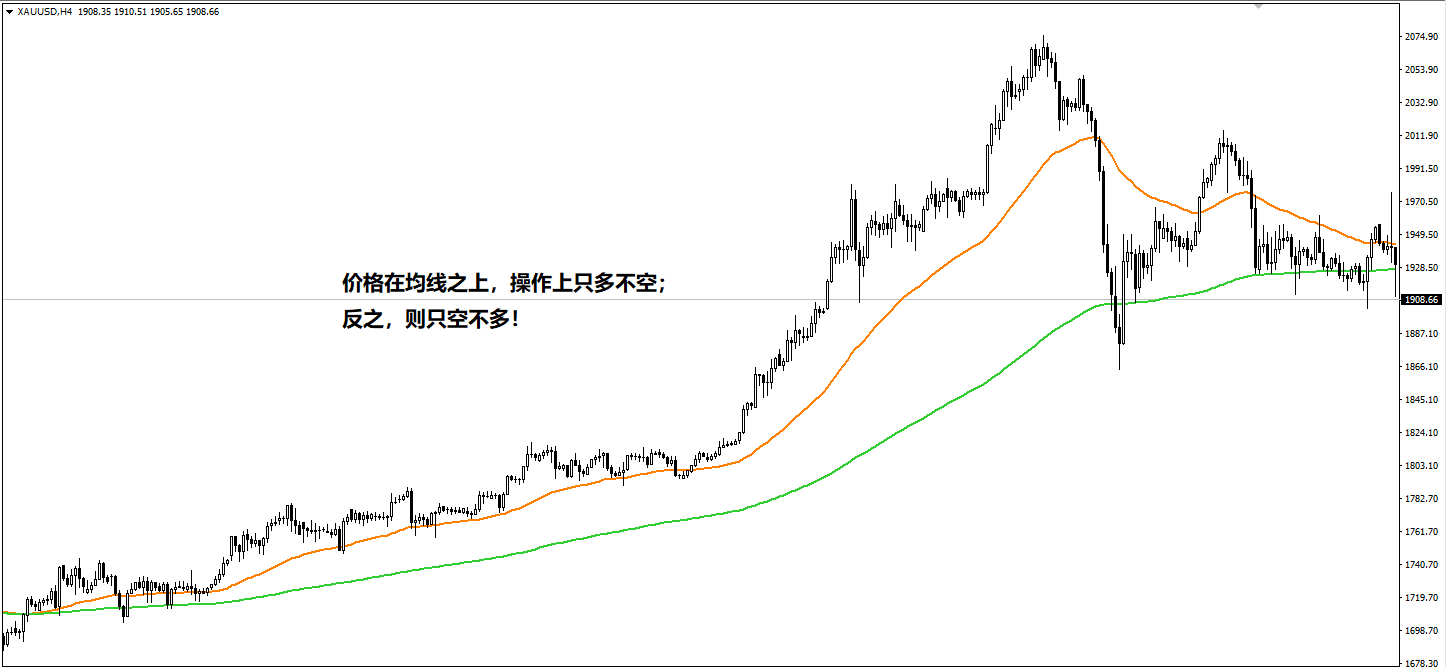
Second, use the moving average to find the pressure level.
The effect of the moving average is the same as that of the trend line, but the effect of the trend line in fitting the market trend is weaker than that of the moving average. When the market price stops at a certain point, there must be a reason for its existence. Of course, some points can be clearly found, while some price points are difficult to find the reason for. Don’t fall into it and find all the price positions Stay in the train of thought of the cause.
Use the moving average to find the pressure level of market price behavior. The moving average cycle must change frequently, because the price is also changing all the time. My idea is that the moving average should change with the price change. In the past, 50EMA may be used to find the support and resistance level. When the price breaks through the given price level, the market may not recognize this point. Then, we need to make changes based on the latest point.
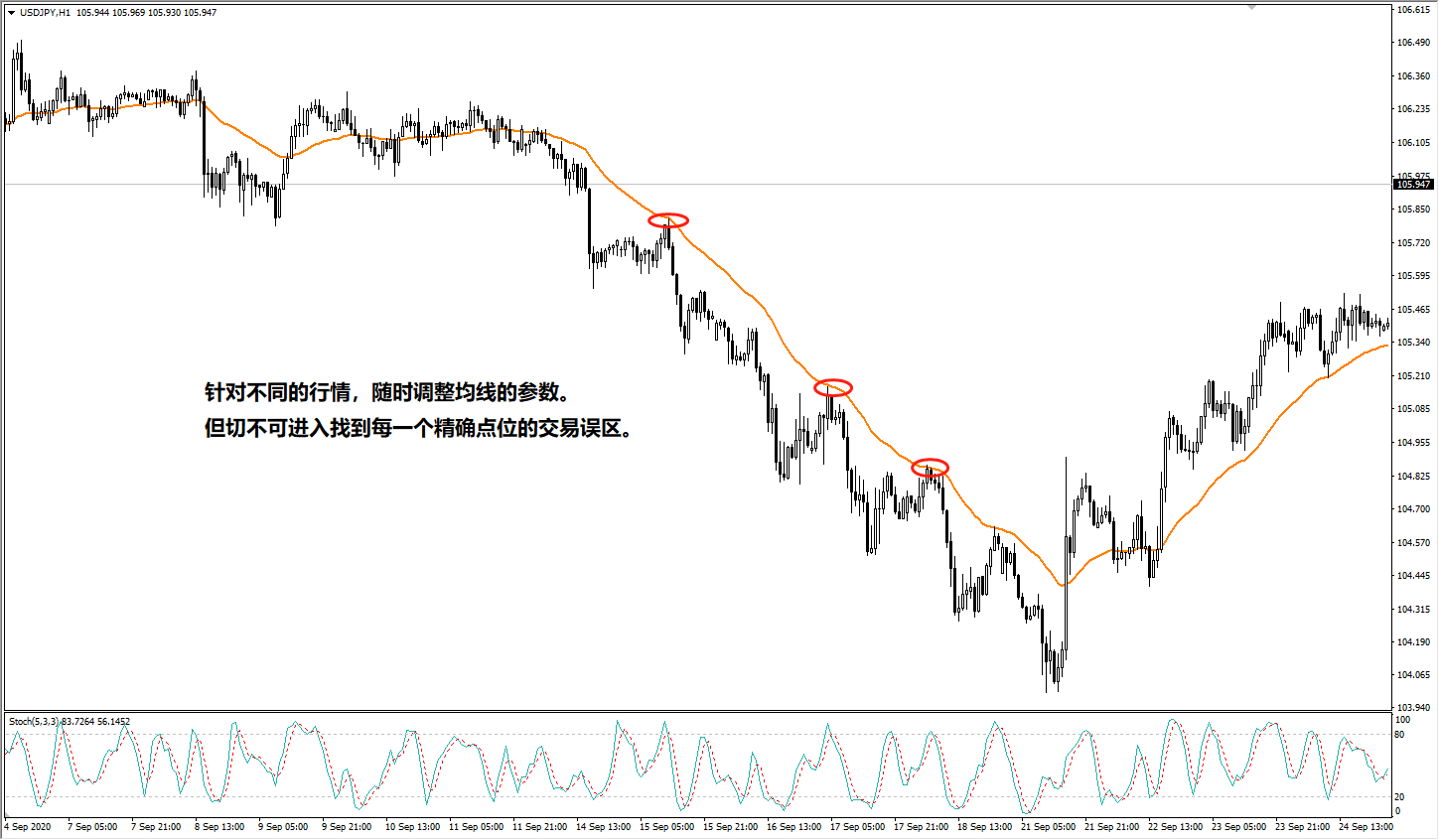
Of course, there must be other ways to use the moving average, but I habitually use the moving average to identify trends and find support and resistance levels. No matter what kind of method, as long as it can be used well, as long as it suits you. There is no need to pursue particularly sophisticated means of analysis.
Copyright reserved to the author
Last updated: 08/09/2023 09:40
Add

One thing worth explaining is that there is no objective exit signal in this market, and almost all trading signals have their own subjectivity, no matter what exit method you use, exit at support resistance level or trend change, etc. These are all appearances based on your own subjective thinking, not the objective of the market.
Of course, it doesn't mean that subjective appearances are necessarily bad. When we trade, it is impossible to fit the market every time we enter the market. As long as it is in line with our own trading system and can get positive feedback from the market, this way of exiting the market is personally acceptable.
In my opinion, the strict exit signals are nothing more than two types: one is the behavior of early exit. That is, the exit behavior of using the support and resistance level, or the indicator entering the overbought and oversold area. The second is the behavior of entering the market after the market confirms. Personally, I prefer trend swing trading, which is also the way I am currently taking out the market. Get out when the market tells you that the trend has reversed or the tempo has changed. Of course, there is no difference between these two different ways of playing. No matter which way of playing, there is a possibility of failure, and it is impossible to catch all the highs and lows.
The first type: early appearance behavior.
The advantage of this type of exit is that using the pressure level as the basis for exiting the market can avoid the risk of price backtesting or even trend reversal in advance, and lock in vested profits. Of course, the disadvantage is that you may miss the huge profits brought by the trend. The logic of early entry is mainly that when the price reaches an important pressure level, the market price may be affected by the pressure level and there will be liquidation or reverse trading actions, locking in profits and pocketing it.
The second type: exit after confirmation.
One thing I have to mention is that "confirmation" only exists as a signal in your trading system, not a market confirmation. After all, there will still be errors in transactions. The logical point of this type of exit is that it is a follower of market price action. Based on market signals, we will take corresponding actions when there are signals in the market. The market did not signal the end of the trend, so the position will continue. The advantage is that you can capture most of the profits of the entire trend or band, especially the price fluctuations during your rest time. The disadvantage is that there will be a large backtest, and the risk of reversing and taking profits.
The two different ways of exiting the market are shown in the figure below. Yesterday, the short-term upper pressure level of gold was more obvious, and the price behavior also fell immediately after touching the pressure level, and broke through the low level all the way. Above this cycle, the price trend has turned from bullish to bearish. A place may be the first exit point; B point may be the second exit point.
If it is an entry, point A may be the first entry point ahead of time, and C exits; point B may be the second entry after confirmation, and the empty order will continue to be held after breaking position C.
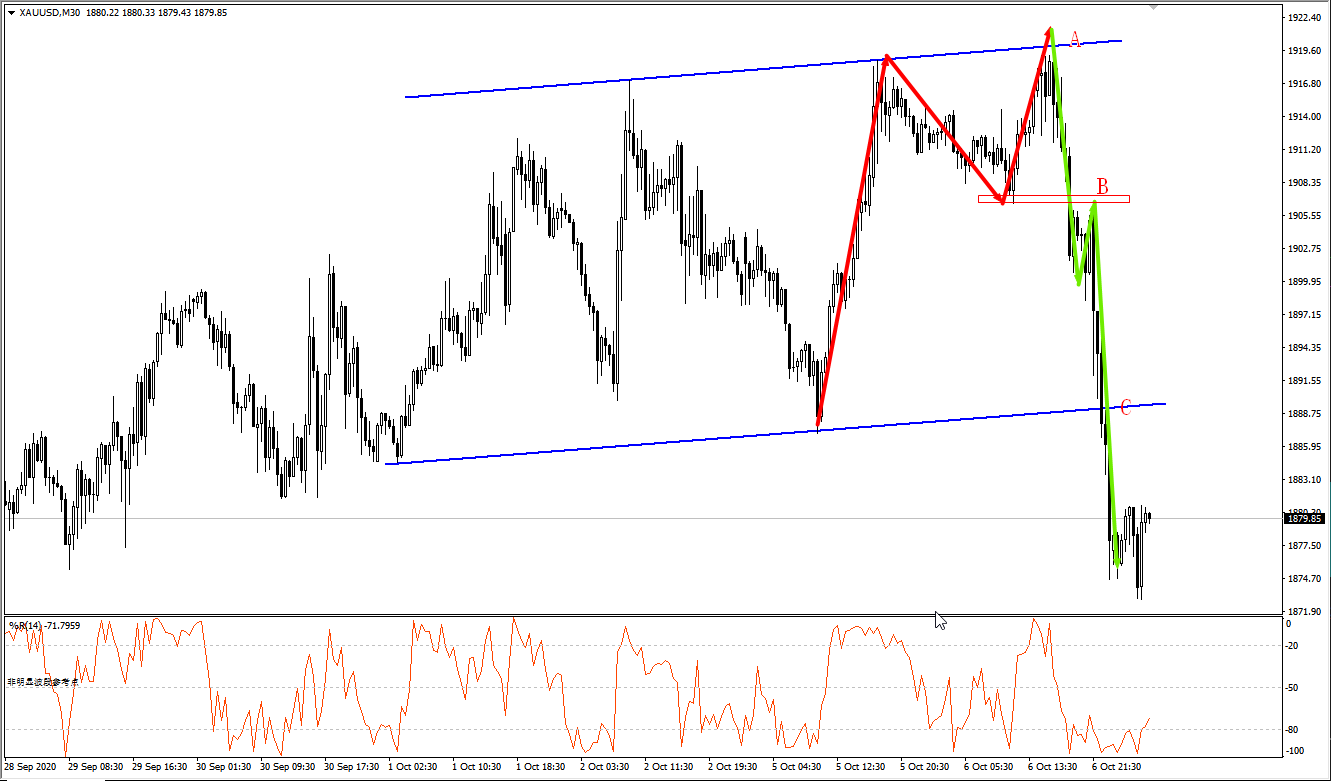
As for what kind of exit method to choose, it mainly depends on your own trading system. As for whether the exit signal fits the market, I think no one can answer this, because there is no such way of exit.
Copyright reserved to the author
Last updated: 08/01/2023 09:22
Add

0
work
0
subscriber