


Stay in touch!
Subscribe to our newsletter to get the latest updates on live market analysis, trading strategies and more. You can unsubscribe anytime.
By subscribing, you agree to Trading.live Privacy Policy.


Before answering this question, I suggest the subject to watch a TV series called "Don't Call Me Brother". There is a plot in it. I think it can answer your question. Simply upload a screenshot first.
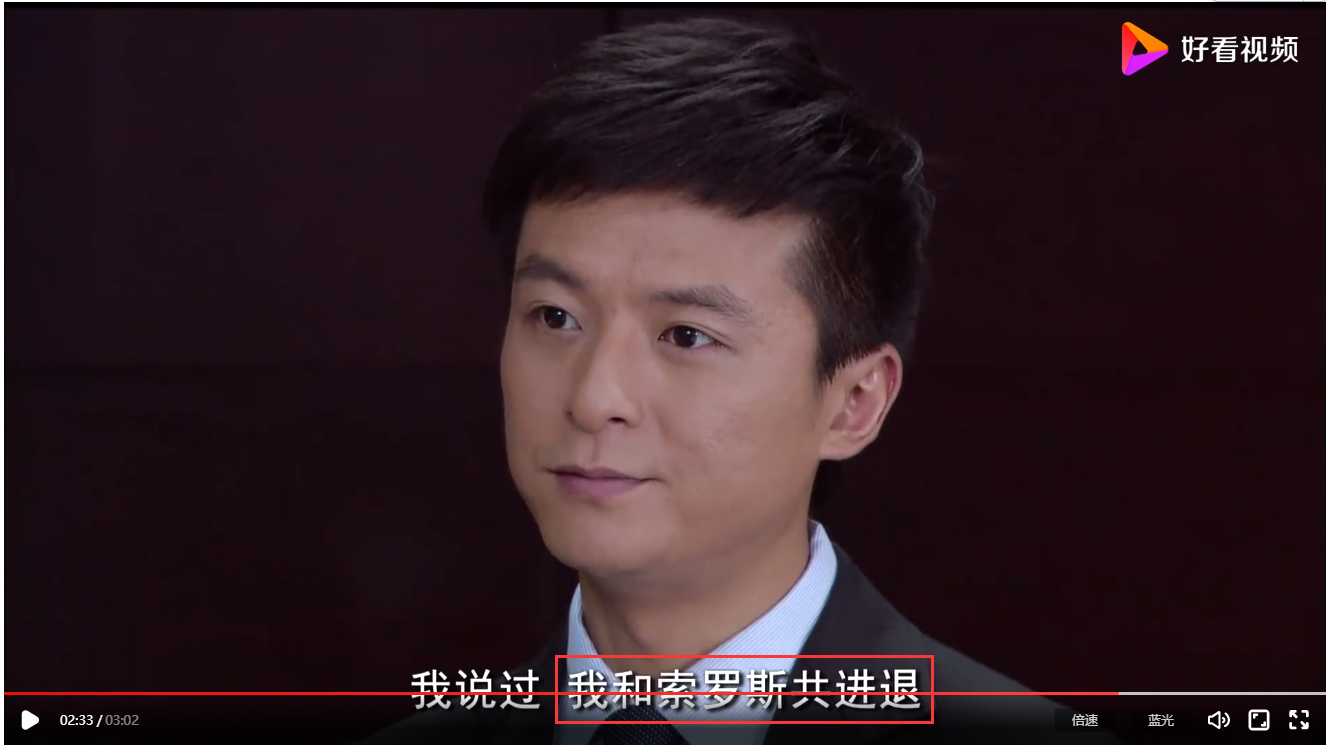
This story is about the time when Soros attacked Hong Kong, the second man followed Soros to short the Hang Seng Index, and could have earned 1.5 billion, but because of greed on the one hand and wanting to earn more money, on the other hand On the one hand, the trust of Soros, the representative of large institutions, has been followed. But it is very regrettable that Soros failed to attack Hong Kong back then, which eventually led to the bankruptcy of the male number two. There are still many underground banks and usury money to be repaid, and finally ended the battle by jumping off a building.
Through the above statement, what I want to say is that whether it is to imitate the large-scale structure's single-handling method, or follow the large-scale structure's joint operation, it can be done, but first of all, there must be enough capital to deal with all unknown risks. , Secondly, don't be greedy. The most important thing is that you have to know how the organization works.
In a certain period of time, the exchange rate trend of a specific currency pair may be affected by the buying and selling behavior of a certain type of investors. In fact, market trends are often initiated by some large investment institutions. Dissecting the investment behavior of some large investment institutions in the foreign exchange market will help investors grasp the market trend and follow the main institutions to obtain profits.
Behavioral characteristics of the main players (institutions) in the market
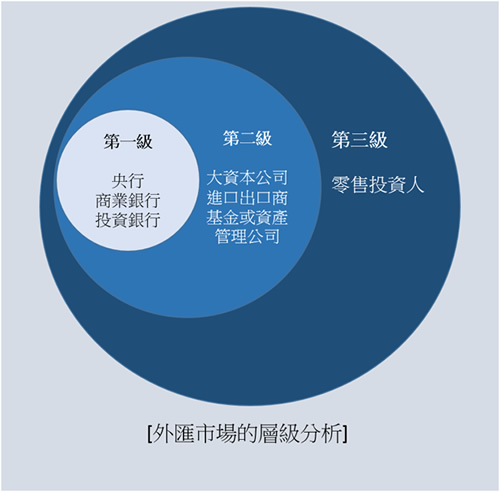
1. large commercial bank
Commercial bank accounts account for a very large proportion of the transaction volume in the foreign exchange market, and about one-third of the daily foreign exchange transactions occur between banks. Large commercial banks may conduct transactions for their customers and only charge commissions, not for the purpose of earning exchange rate differences. They may also invest in the foreign exchange market through their own investment departments to obtain profits from the bid-ask spread. In the interbank market, you can see the flow of all funds, and you can see at a glance the market entry of institutions including the central bank and hedge funds.
2. central bank
Central banks are one of the major players in the money market. They occupy a very important position in the spot price. The central bank is not a foreign exchange speculator. Their main purpose of entering the foreign exchange market is to observe the market and control the money supply and exchange rate trend. A government often monitors economic activity through a central bank in order to maintain an appropriate money supply to achieve economic goals.
3. investment fund
As global fund managers investing in securities, trust funds, pension and arbitrage funds and other foreign financial instruments are constantly repositioning and adjusting their fixed income portfolios of foreign exchange assets, these transactions usually involve considerable capital flows, so They have a great influence on the market exchange rate movement.
Generally speaking, many foreign exchange investment funds invest in a country's financial assets, and only affect the exchange rate trend by adjusting the position of the assets. For example, due to Japan's zero interest rate policy, its domestic bonds are not very attractive to Japanese investors. Many Japanese institutional investors, as well as trust funds purchased by individual investors, will use part of their funds for overseas securities Investing, for example in German bonds. These investment funds tend to adjust their positions in response to price movements in overseas financial assets. When the market expects the European Central Bank to raise interest rates, German bond yields will rise, which will attract Japanese investors to increase their investment in German bonds. Thus forming the buying of EUR/JPY, pushing up the trend of this currency against the exchange rate.
Operation traces left by the mechanism on the disk
These institutions have the best technical analysts, they know how retail investors analyze and trade the market, know where your stop loss and profit targets are, and they can manipulate the market and take profits from you if they want. This is the truth no one will tell you.
Give an example to show you how market makers know how you trade the market and how they take money out of your pocket.
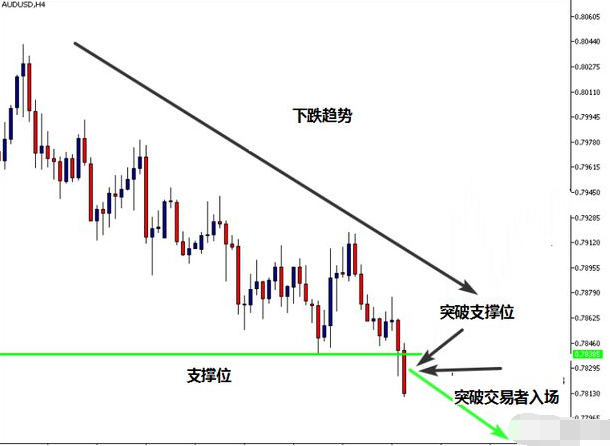
As shown in the figure above, the market is on a downward trend in the short term. After breaking through an important support level, some breakthrough traders enter the market. The reason for entering the market is to take advantage of the trend, break through the support level, and enter the market to short. Feel confident. So what happens next?
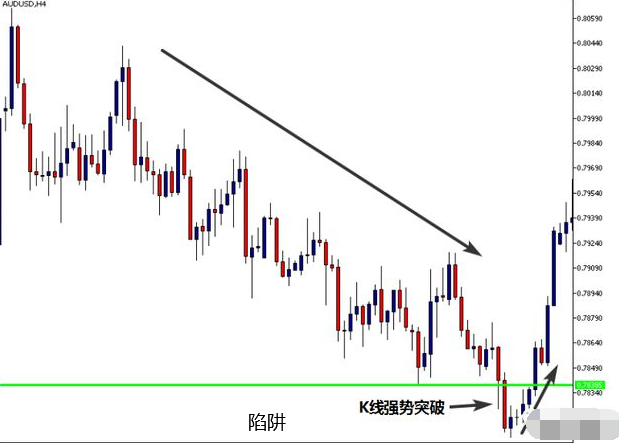
You have to know that if banks and large institutions want to do more in the future, they must have a large number of sellers to provide them with chips. Therefore, they usually create a lot of traps in the market to induce retail investors to go short in order to obtain enough chips. At the same time get lower cost.
As shown in the chart above, a strong breakout immediately started to reverse.
Banks and financial institutions will conduct buying and selling operations in certain areas of the market. If you can effectively identify them, you can do the same operations with them and make money with them instead of becoming their opposite.
How Large Institutions Use Supply and Demand to Trade
Markets are governed by supply and demand. Prices rise and fall due to supply and demand imbalances.
If supply exceeds demand, prices will fall; if demand exceeds supply, prices will rise.
The market is dominated by large investors such as central banks, hedge funds, market makers and other financial institutions. These big investors are also influenced by some factors that affect their trading decisions, such as daily news affecting the world economy, economic data of some countries. And, when they make a trading decision, they move the price drastically and create an imbalance between supply and demand. The greater the imbalance, the greater the price movement.
I don't know if you often find it when you look at the chart. When the market fell back to the level at which it last started a sharp move, it immediately started another violent move in the same direction. This phenomenon often occurs in the market.
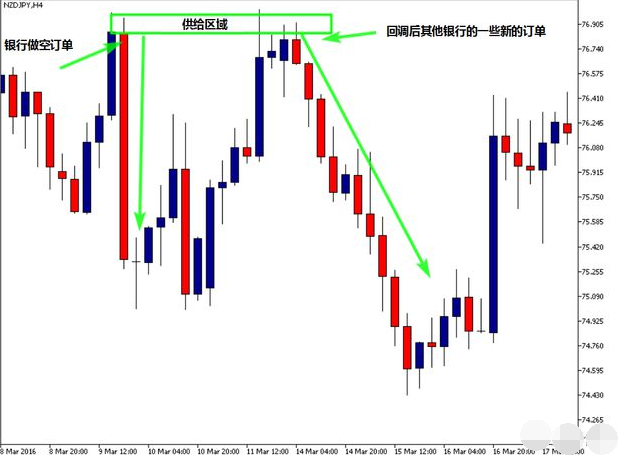
As shown in the chart above, the large red candle represents a sell order from a large bank whose decision to sell was influenced by major economic news.
We don't care about news, we only care about big moves like this because it's the footprint of banks and financial institutions.
When the bank accepted the sell order and quickly let the market price crash, it couldn't get rid of all the money at a good price, so it left some to sell from the same area. The amount remaining in the area is up to the buyer. If the bank finds a large buyer for sale, it can liquidate the entire amount.
But in most cases, banks leave part of their limit orders in their original sell area.
The area where the surge started will be a very important price area as there are also some limit sell orders in that price and when the market pulls back to test this area, other banks and financial institutions will sell from the same area .
Since they know there are other financial institutions that will be selling in the same area, this is the easiest way to make money without conflict.
You don't need to know how to analyze the impact of economic news on the market. Because you are not a bank trader, you are just a small retail investor with a small amount of capital.
Here's what you do: discover areas where banks and financial institutions are likely to make "big moves" in the future. Then follow them to make money together.
Generally speaking, institutions will drive the price to fluctuate rapidly with high trading volume during the process of action, and their capital intervention will be carried out in a certain area. This is one of the agency's single-handed methods.
After you understand this, you will find that you cannot imitate this kind of technique. After all, the amount of funds is limited, and it is already very good to be able to follow the organization. Sitting in a sedan chair is much more comfortable than carrying a sedan chair.
Copyright reserved to the author
Last updated: 08/21/2023 19:00
 Add
Add

First of all, we will not discuss the order-making methods of retail investors and large institutions, but only talk about the differences between the two.
Retail investors are defined as individual investors with a small amount of investment. The main components of retail investors are students, wage earners, laid-off workers, retirees, etc., as well as some self-employed individuals with certain capital.
Institutional investors refer to legal entities that specialize in securities investment activities with their own funds or funds raised from scattered public hands. In Western countries, securities companies, investment companies, insurance companies, various welfare funds, pension funds and financial consortiums whose main source of income is securities are called institutional investors. The most typical institutional investors are mutual funds that specialize in securities investment. The so-called "institution" of institutional investors is a legal person organization in the financial industry.
Now that the definition between the two is clear, let’s summarize the characteristics of the two types of investors.
First of all, due to the limited funds and large number of retail investors, the behavior of retail investors in stock market transactions is obviously irregular and irrational, and their emotions are easily influenced by market conditions and atmosphere. The efforts of retail investors are undeniable. Many people learn technology and strategies on the Internet, and they find a lot of things and messy things. Accepting without judgment or screening is not enough for people to make substantial progress. Market analysis and information collection will be missing, and most traders are advancing in groping.
Looking at the institutions again, they have a large number of professionals and have absorbed many professionals to do various parts of the work, with professional investment management. Institutional investment generally has relatively strong financial strength, and has set up special departments in investment decision-making operations, information collection and analysis, listed company research, investment and financial management methods, etc. Theoretically speaking, the investment behavior of institutional investors is more rational, the investment scale is relatively large, and the investment cycle is relatively long. Institutional investors have more capital in the market. In order to reduce risks as much as possible, institutional investors will make a reasonable investment portfolio during the investment process. The huge funds, professional management and multi-faceted market research of institutional investors also make it possible to establish an effective investment portfolio.
To sum up, personal trading is a relatively casual investment behavior. However, the institutions are more rigorous, and there are big differences in terms of professional staffing, learning channels, and investment management. Different trading styles are inevitable, and there is no mastery under different conditions. So can retail investors imitate it?
Copyright reserved to the author
Last updated: 08/19/2023 16:47
Add


For this question, I would like to reply with two words: Hehe.
First of all, you have to make it clear that it is not that retail investors are fighting against large institutions, but that large institutions are mostly fighting against retail investors. Think about it, where can retail investors see the order layout of large institutions, and go against it? And large institutions can clearly see the orders of retail investors, but this is actually okay. In the foreign exchange market, no large institution has the ability to manipulate the exchange rate trend alone. Therefore, it is not a matter of losing money by doing it right.
In addition, if a large organization tells you the location of the order, will it definitely make money? It is also whimsical. Nowadays, many statistics websites will count and publish the transaction orders of some top investment banks, but you can follow along and try to see if you can make money?
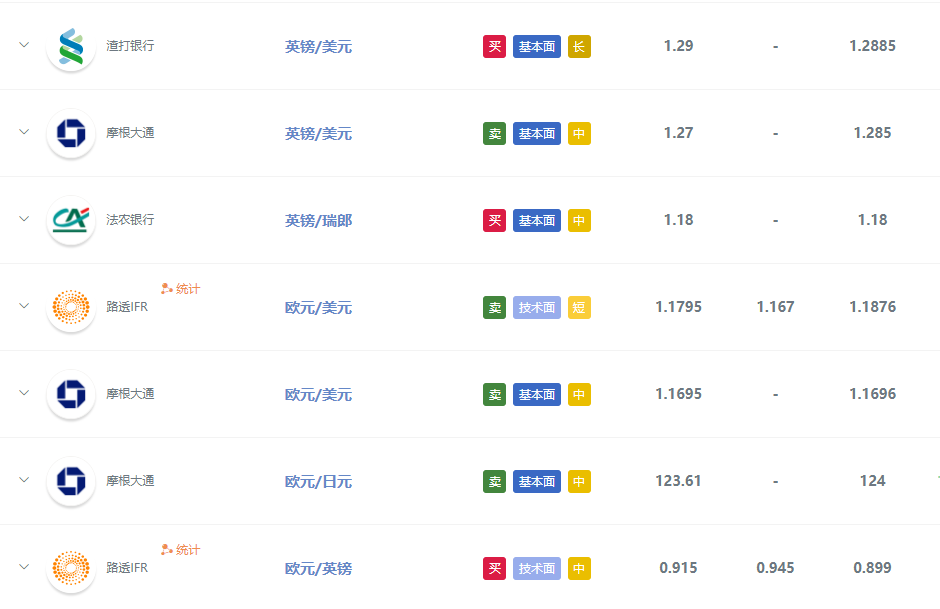
It can be seen that the orders of investment banks actually have a basis for cyclical and market entry, whether it is a long-term order, a medium-term order, or a short-term order; is it based on technical aspects or technical aspects; and can ordinary retail investors clearly position themselves? Besides, different investment banks have obvious differences in the analysis results of the market, so the types of orders are also different. Who are you with? The huge amount of funds in investment banks can allow them to withstand large adverse fluctuations in the market, while ordinary retail investors may be able to bear 300-500 points before they will be wiped out.
To imitate, you must have a similar temperament to be successful. Star face can be useful because it looks like a star. So you imitate the order of the institution, what are the similarities between you and the institution? Is there the same amount of funds? Still have professional analysis? Or have extreme patience? If not, then give up this unrealistic idea as soon as possible.
In addition, large institutions do not necessarily make money; when the market is bad, you can see how poor the performance of institutions is. These are obvious facts. This big market institution is indeed the main force, but there is not only one institution, and not all institutions are of one mind. What is the difference between thousands of institutions trading in this market and thousands of retail investors?
Therefore, study your own trading system well, do a good job in your own risk control and mentality management, and don't care about what others do.
Copyright reserved to the author
Last updated: 08/19/2023 05:10
Add


To be honest, your problem is not an investment problem, but a gambling problem!
how you said that?
We know that gambling is actually very simple, such as playing dice and betting on the size, the result is either big or small. If you lose more and win less every time you bet, then do the reverse operation, and bet small if you want to bet big; or if you have a particularly lucky opponent, then follow him to bet big and small to make money.
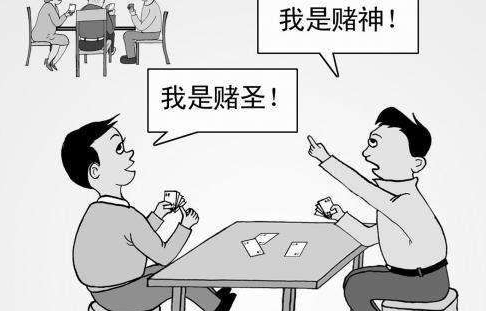
This is the standard gambler mentality and gambler logic! We know that the result of gamblers is that nine out of ten bets lose, which shows that this kind of gambler logic is absolutely unworkable!
The questioner, you are now saying that you want to imitate the single-handed approach of the institution to make money. Isn’t it actually a typical gambler’s logic? Even worse than a gambler! Because gambling is either big or small, it is easy for you to imitate; but investment is different. The way institutions make orders involves many steps that retail investors cannot complete, such as the allocation of strong funds, etc.; how can you imitate their orders? Of course, the result is nothing more than imitation, which is counterproductive.
But then again, since we know that retail investors lose nine times out of ten in the market, while institutions make money out of nine out of ten, can we find any way to improve the profitability of retail investors?
The answer is of course yes!
We all know that investment transactions are actually a place for capital games, and the profits of a few people in the market are the money from the losses of the majority of others. This minority generally refers to institutions, which we call dealers (of course, dealers not only have institutions, but also Niu San); and this majority, needless to say, is a group of retail investors.
Therefore, if you want to make a profit in the transaction, you must know the skills of hunting with the dealer! The so-called follow-up is not just about imitating the single-handling methods of large institutions as you said, but to understand their operating logic and dance with the dealer; Operation, eating meat before the dealer, thus defeating the dealer.
The follow-up and bank hunting here is an inviolable system. Only by successfully following the bank can you hunt the bank in the later stage; only by understanding the dealer's operating methods and formulating your own trading system on this basis can you defeat the dealer.
Let me give you a simple example. Everyone knows about entanglement theory, right? As the No. 1 trader in the A-share market, Master Zen is extremely knowledgeable and versatile, but when trading, he is like a demon wielding a butcher's knife, and he pioneered the world-famous "drop limit washing method". Because this method is extremely cruel and harmful to stockholders, the Zen master revealed this method through entanglement in his later years. The purpose of course is to prevent Xiao San from being hurt.

If you follow the topic "retail investors imitate the single-handling methods of large institutions", then although you know the "drop limit washing method" through entanglement, you can only avoid being washed, right?
But hot money masters are different. After fully understanding the "drop limit washing method", they began to develop a set of trading strategies with the dealer and hunting dealers on this basis, such as: board tactics, wolf tactics , Second board fixed faucet and so on. The hot money death squad came from this, and the theory of "the second board determines the leader" has achieved the brilliant record of Brother Zhao 10,000 times in 8 years, successfully replacing "big and small Xu" as the first hot money brother.
And the recent Taoxian masters have extended the completely opposite theory of "bad boards become demons" on the basis of entanglement theory. The classic Tianshan Laoyao's 11 boards have increased by 6 times, allowing all retail investors participating in it to earn a lot of money. Bowl full!
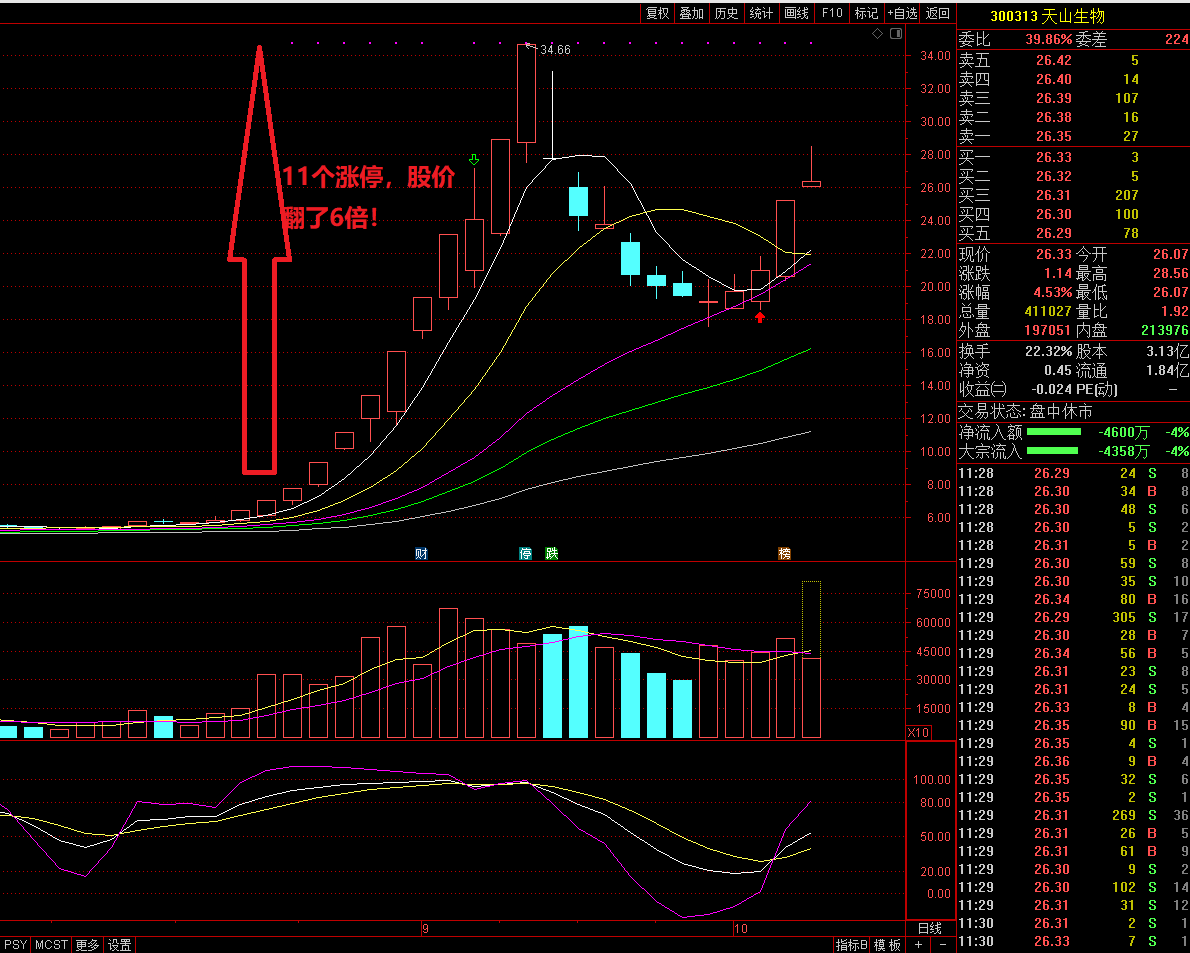
Having said so much, the subject must understand, right? Simply imitating the single-handling methods of large institutions has no way out, and may even fall into a vortex of losses. Only by innovating on the basis of understanding the single-handling methods of large institutions, and formulating their own trading strategies to counter-kill the dealers, can they be proud of the world in the trading arena, and wealth and freedom are certainly not a dream.
Copyright reserved to the author
Last updated: 08/20/2023 00:33
Add

First of all, I want to clarify a point of view, why do retail investors like to confront big institutions when doing transactions? of course not! Retail investors like to follow the big institutions when doing transactions, how can they do it against them? However, due to the asymmetry of information, the pace of tracking is often half a step slower; and in the trading market, even a small difference may turn short, let alone half a step? Therefore, due to the time lag, placing an order with the institution eventually turned into working against the institution. You say, is this ridiculous or sad?
Alright, let’s go back to the subject’s question, you said, “Recently I heard about an institution’s order area strategy, as long as you master the ability to identify and discover the order area of an institution, and by identifying the trading methods of banks and large institutions, you can follow Their footprints make money". I think this is a good idea. After all, information time lag is a major obstacle when making orders through information tracking institutions; if you follow them to make orders by identifying the trading methods of banks and large institutions, then there will be no problem of information time lag.
As for the "regional tactics of institutional orders" you mentioned, I have already mentioned this, and now I will briefly introduce it to you. In general, institutional order areas are formed by four different patterns, which is why you must understand the different types of supply and demand area patterns to easily identify them.
Copyright reserved to the author
Last updated: 08/22/2023 23:58
Add
This question is actually very difficult to answer. But I still have to complain, the size is different, and the gameplay is different.
As for the regional strategy of institutional orders you mentioned, to be honest, it is very complicated. The institutional order area is formed by a variety of different forms, and the form here is not the K-line combination form we are familiar with. But another kind.
For example: fall - level - rise; rise - level - rise; fall - level - fall; rise - level - fall. These are the 4 most commonly used at present. There are also some others, such as engulfing patterns, harami patterns, etc., which can be used to draw institutional order areas.
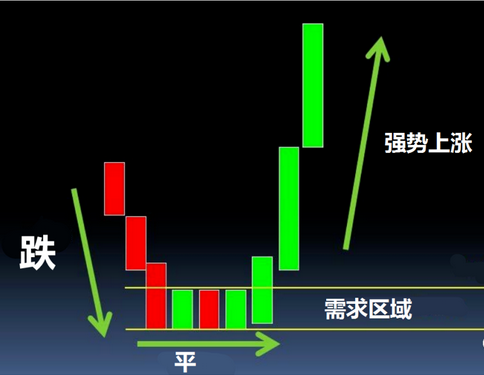
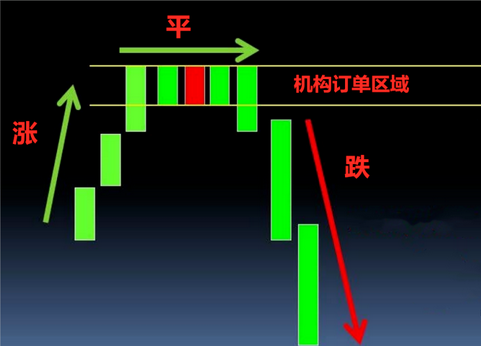
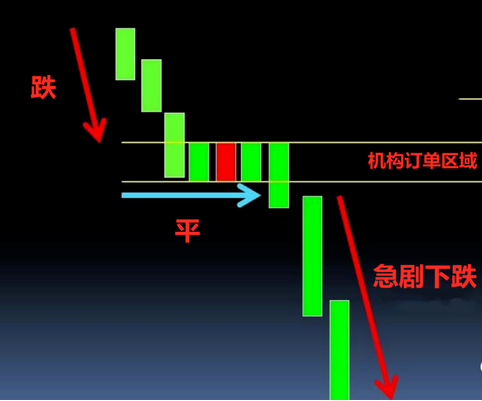
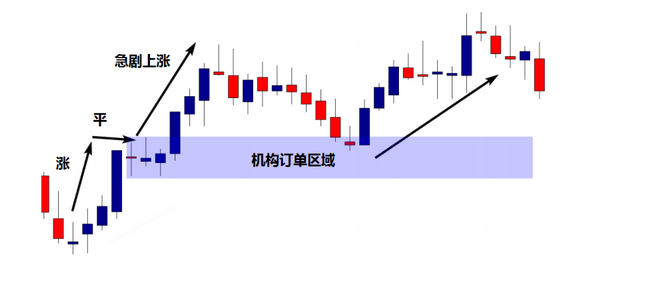
The above is what these 4 commonly used forms look like. To be honest, it looks like a good judgment. But in the actual operation process, it is difficult.
This thing is highly coincident with the price action trading method and Wyckoff theory. Compared with its Jack line, it is not much different from the support pressure line plus the K line.
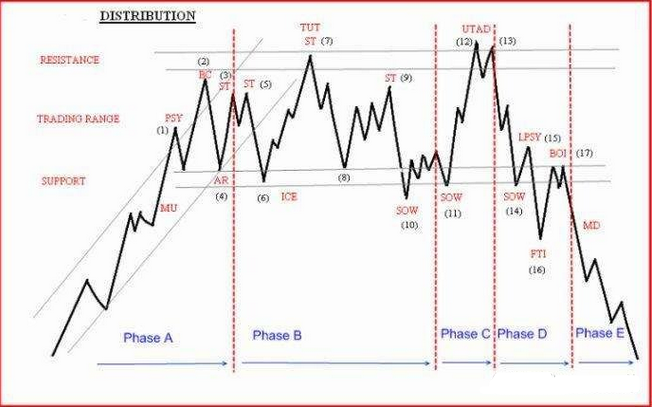
The diametrically opposed principle of institutional orders is the clear source of harmonic theory. "Harmonic pattern is JMHurst published "Principle of Harmonicity" in 1973, which first proposed the concept of harmonious trading. In 1999, Scott M Camey published "The Harmonic Trader" (The Harmonic Trader).
If you take this as a trading method and philosophy, learning may be rewarding. If it costs a lot, then you have to ask more people who have experienced it, especially if anyone has used this method to obtain long-term positive returns.
Copyright reserved to the author
Last updated: 08/24/2023 04:18
Add

difficult. But you can refer to the direction
The exchange rate market cannot be bound by the thinking of stocks. A stock with a small market value of no more than 3 billion and a few million funds can be used as a seal. For stocks with a market capitalization of tens of billions, the daily limit can be closed for tens of millions of funds, and for stocks with a market value of more than 100 billion, the daily limit can be closed for funds of less than 1 billion. However, the total amount of currency in a country is hundreds of trillions, or even tens of trillions, which cannot be driven by ordinary funds. Although Soros sniped the British pound, the Thai baht, and the Hong Kong dollar, they were all at a critical juncture and short-term speculation took advantage of the trend, and he never influenced the currency trend of a country. Japan intervened in the trend of the yen in 2012, spending a total of more than 200 trillion yen (estimated to be far more than this number) and the total number of interventions was no less than 10 times. The trend of the exchange rate depends entirely on the economic strength of a country. For example, the renminbi has strengthened recently because China is currently the only country with positive GDP growth.
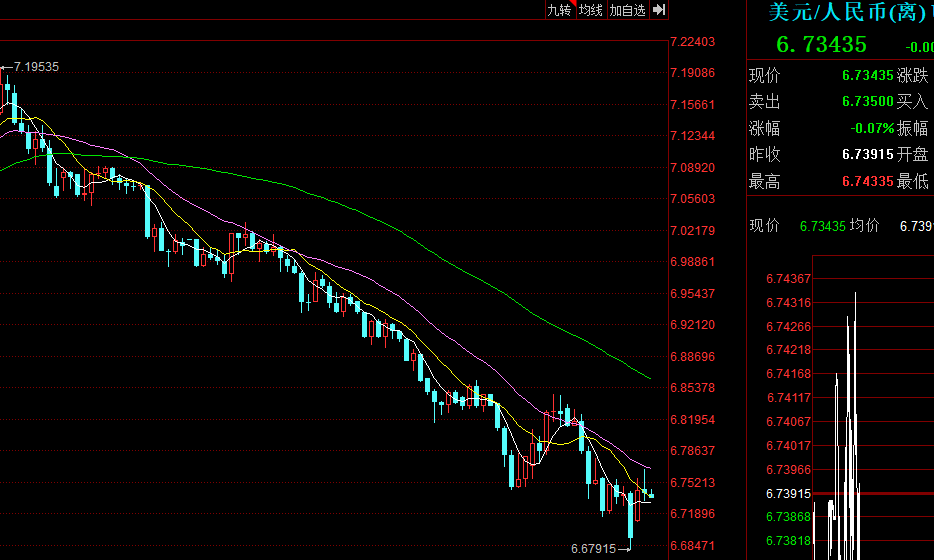
Many measures of exchange rate changes, except for the impact of economic strength, if some particularly significant interventions are made, in most cases they are kept secret, and the results will only be announced after the event. However, many economists in China are basically poor in strength. Although they have obtained very high diplomas and academic qualifications in the world, when it comes to practical application, most of them are just talking on paper. It is not necessarily applicable to the Chinese economy.
For international investment banks, the fundamentals do have outstanding research. But still can't control the trend. This year's gold ETF holdings continued to rise, but in March, it fell from 1700 to 1450, and they still couldn't control such a deep drop.
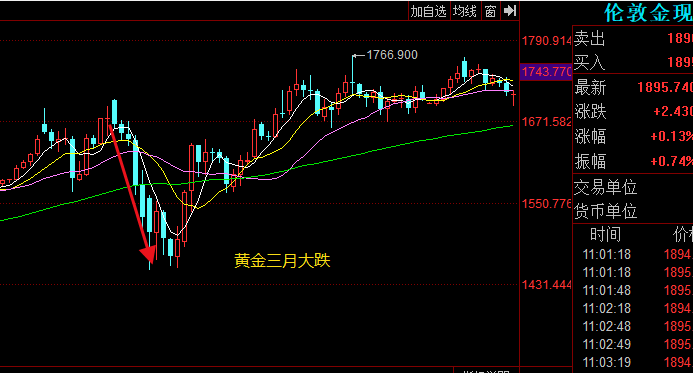
Although no one can control it, everyone has equal technical rights. The layout of international ETF funds can give us a reference for the direction of the general trend. I often refer to the gold ETF holding funds to judge the direction. If the funds continue to increase, every time the daily line level falls, it is a big buy.
Copyright reserved to the author
Last updated: 08/23/2023 17:16
Add

First look at the advantages of institutional investors
Institutional financial management is much broader than personal financial management in terms of investment channels. For example, the national bond market is divided into two types: the primary market and the secondary market. The primary market is the market for issuing government bonds, and the secondary market is the transfer market for government bonds , generally speaking, individual investors can only invest in the secondary market and are not allowed to participate in the issuance of the primary market; while institutional investors can either trade in the secondary market or underwrite in the primary market. , Underwriting activities, to obtain relatively rich profits.
In terms of investment varieties, institutional investors have more choices in investment varieties than individual investments:
1) Institutional investors can directly invest in financial bonds. At present, domestic financial bonds are mainly issued by institutional investors. The interest rate of financial bonds is higher than that of national bonds, and the risk is lower than that of corporate bonds. It is a relatively ideal security , Efficient financial management tools.
2) Institutional investors can invest in either book-entry treasury bonds or certificate-style treasury bonds, while most individuals invest in certificate-style treasury bonds, and cannot purchase some book-entry treasury bonds issued directionally. For example, on June 18, 1999, the country’s 9.4 billion yuan book-entry (three-period) treasury bonds were issued only to institutional members in the national inter-bank market, and were listed and traded on the inter-bank bond market, and were not issued to individual investors. According to statistics, the Ministry of Finance issued a total of 43.4 billion yuan of book-entry government bonds in the inter-bank bond market this year. These government bonds cannot be purchased by individuals.
3) Institutional investors can invest in both interest-bearing bonds and zero-coupon bonds, while individual investors generally can only directly purchase zero-coupon bonds. Investing in interest-bearing bonds can recover interest income as soon as possible, and reinvest this part of the funds to increase value, while zero-coupon bonds do not have this advantage.
4) Institutional investors can invest in both fixed-rate bonds and floating-rate bonds. In 1999, the 20 billion floating-rate bonds issued by the China Development Bank were limited to the inter-bank market and did not directly face individual investors. Therefore, individual investors are at a disadvantage compared with institutional investors in avoiding interest rate risk.
In terms of investment methods, institutional financial management is much more flexible than personal financial management in terms of investment methods. Institutional investors can conduct cash bond transactions, repurchase transactions, and arbitrage transactions, while individual investors can only conduct cash bond transactions. trade.
In terms of investment skills, institutional investors have a group of investment experts with profound knowledge and strong professional skills. Compared with individual investors, financial experts often have more comprehensive professional knowledge and rich practical experience, and have more systematic and advanced skills. This advantage is unmatched by ordinary individual investors.
From the perspective of investment scale, institutional investors often form a huge scale of funds by pooling small funds from many individuals. Large-scale funds are more conducive to investors' investment portfolios and reduce investment risks. This type of investment portfolio, It can only be completed when the funds are abundant, and institutional financial management just has the advantage in this aspect. On the other hand, large-scale investment operations are also conducive to obtaining economies of scale and reducing investment costs.
From the perspective of information sources, today's society is an information society. Whoever has the information will have the initiative to make profits, especially for the ever-changing investment market, the accuracy, timeliness and comprehensiveness of information directly determine investment decisions. Quality, institutional investors have professionals to collect, sort out and analyze information. However, due to the collapse of information channels, individual investors have a comparative advantage over institutional investors in terms of information sources and statistical analysis of data.
Finally, look at the advantages of retail investors:
Small amount of funds: Although the amount is small, they all have the mentality of making a lot of money. Greed is the biggest fatal point of retail investors, but it is also the biggest advantage. They have less funds and run fast. Inside, all leave. In addition, other advantages are difficult to reach the institutional level. If information is obtained through channels, Davis can double-click it. Unfortunately, it is just a dream of Zhou Gong, which is unrealistic.
There is a way that retail investors can imitate, and that is to copy homework: for example, check the direction of the institutional layout of heavy positions, such as whether the gold ETF positions continue to increase, etc. Once the institutional layout is established, you can copy the homework according to the direction of the institutional layout. Although the profit target It will be less, but it can greatly improve the transaction success rate.
Copyright reserved to the author
Last updated: 08/19/2023 22:37
Add

Institutions play tricks in the short term, while the medium and long term are the talkers. Any kind of retail investors can only hitch a ride.
Short-term tactics rely on money, and medium- and long-term strategies rely on cooperation. Retail investors are one poor, two white, three ignorant, five imaginative, and six more frustrated and courageous.

The various senses of human beings do not respond to any stimulus. The intensity of the stimulus is too weak or too strong. Dependence is called sensory threshold, only when it reaches a certain level, will it cause feeling, imagination, thinking and decision-making!
I often hear people say that when the market is stable before entering, you need certainty, and before entering when it is safe, the public wants a definite answer. When the information is not fully confirmed, the public is skeptical and dare not enter. When you are a banker, you must make full use of information and public suspicion to move up!
When there is a lot of bullishness, and when the media information is rising, the shipment will be repeatedly oscillated, and the shipment will be oscillated in a sideways or slightly rising structure! As a private equity, it is necessary to ship in batches at a high point, taking advantage of the public's bullishness and the media's favorable conditions, and when the general public is relaxed and the index is stable, ship quickly!
The public is ignorant, take advantage of the public's bullishness and ignorance, quickly fall, and hold on to the public. When the stock is sold out after repeated shocks, when the index does not change much sideways, it is necessary to break through the gap and jump down, and the stock price falls rapidly, quickly holding on to the public , When the lower support level fell, let some technical positions buy bottoms, but did not reach the psychological threshold, and then suppressed downwards, selling out in fear, and breaking the second copy the next day to create fear and despair! Wash off the technical faction, and put in those who may be out of space!
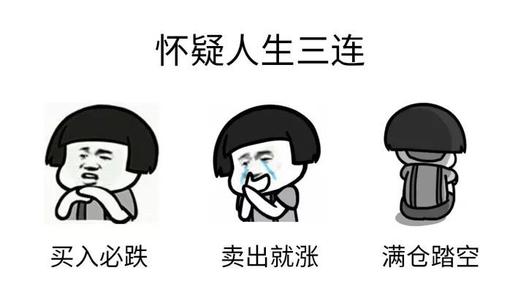
Wash off the technical faction, second-time bottom hunters, and then quickly pull up, let the short-sighted ones catch up, let the hold-ups hope to be released mid-term, and then rebound to ship, the second or third trading days, rapid decline, and then break the position, and then break the position to create psychology Threshold, create fear! As a private equity trader, you must understand the process of making a banker, but also understand the psychological purpose of the public, and understand the means and prices of the game, make full use of short selling to lure more, build positions, kill up, let time, will, and patience create value!
The purpose of the organization’s process, thinking, principle, and purpose is to understand the psychological laws, behavioral characteristics, and psychology of the public. It is necessary to understand the value of time, patience, will, models, and the value of bold and careful thinking in order to be successful in the market. Make money from the public!
More games are games with the psychology of the public. If you think contrary to the public, you can make money easily. If you know the purpose of being a banker, you can make a lot of money. You must also understand that real money is time, will, patience, and thinking models. That's the root! Wealth can be obtained from the masses!
Copyright reserved to the author
Last updated: 08/19/2023 16:23
Add

This is actually a very ignorant question. Between retail investors and institutions, the conditions in all aspects are not equal, and the playing methods are also different. You can't imitate, even if you force imitate, the final result can only be a liquidation.
First, the information advantage. As an institution, it has better control over market sentiment than ordinary people. It is also easy to get in touch with more corporate executives.
Second, monopoly advantage. It may be a bit exaggerated to say this, but this is roughly what it means, and it is good to understand. The combination of several large institutions has a certain ability to control the market. Retail investors can't do it. If you are not in this circle, it is useless to know.
Again, model advantage. Some complex models cannot be developed by individuals alone. Institutions can be composed of traders, quantitative analysts and programmers working together.
Finally, the risk management advantage. Individual investors tend to have poor risk management skills. Institutions are relatively well controlled. Moreover, there are many businesses in the organization, and even if something happens to a certain business, it can often be supported. For example, the JP Morgan London whale incident and the Everbright oolong finger incident, the institutions have survived. Private equity and personal risk resistance are poor, and once a major incident occurs, they often have to be liquidated. In extreme cases, it may even jump off a building.
These things, what retail investors want is nothing, and there are no supporting measures, so why should you imitate others' one-handed operations.
Copyright reserved to the author
Last updated: 08/23/2023 17:12
Add

I don't think it's possible to get money. It doesn't matter what technique you imitate. Because the size is completely different. Furthermore, one is in the primary market and the other is in the secondary market. In the case of different volumes and different markets, if you use the other party's single-handed approach, you will definitely not make money.
The sources of information in the primary market are very narrow, and finding projects has become a common task for people in this industry, and projects often require face-to-face contact.
Relatively speaking, the sources of information in the secondary market are very extensive. With a computer, you can obtain almost endless sources of information, such as announcements, financial reports, research reports, and various news, free or paid. Information.
Therefore, in terms of obtaining information, there will be many restrictions in the primary market. Basically, you need to have a small circle and visit your door, and your personal or company's ability is particularly important.
People in the secondary market will be more free, they can go out for research, they can also search for information on the Internet, and they can also find good targets. In theory, it is also possible to build a car behind closed doors, so even relatively introverted people can survive in the secondary market.
The threshold for the secondary market is of course very low, because anyone can operate it for a few thousand dollars, and more than 90% of investors invest less than 100,000 yuan.
The threshold of the primary market is relatively high, and a few million may be just the starting qualification.
Generally speaking, the secondary market is more free, it is really "inclusive of all rivers", all kinds of people can come, and it can be operated in various ways. In contrast, the primary market is Xiaojiang Xiaohe. But it is not always easy to make money with too simple things, and the threshold for things that are easy to make money is often high. This principle still exists in the primary and secondary markets.
Next, let me talk about the value of the linkage between the primary and secondary markets that I understand, many times. There is a saying, "A lot of times, what we make is money with poor information." This sentence is actually quite reasonable.
A thing, you can know in advance, then you can earn income.
The primary market is often ahead of the secondary market. Many new technologies and new frontiers are often researched by people in the primary market first, and then people in the secondary market catch up. Especially in the early venture capital, it is really early to look at the project, and the vision is also very forward-looking.
By the time the information reaches the secondary market, the primary market may already be in full swing, or even want to exit.
this point is very important. People who can play in the primary market have their own information channels, so the big institutions you mentioned also have them. Therefore, their operating direction or methods cannot be ruled out based on this point. If you imitate rashly, you may just find it for yourself. Not happy.
Copyright reserved to the author
Last updated: 08/17/2023 02:55
Add

Institutions can see the overall current market holdings, but retail investors cannot.
The other is that institutions eat retail investors. It’s not that retail investors want to fight against institutions. Retail investors also want to hug their thighs and follow institutions to drink soup, but few can hug this leg.
The reason why retail investors are retail investors is because there is insufficient follow-up funds, and the positions are heavier than institutions. Institutions are completely in line with the market rules and do not interfere. The order disorder and high risk of retail investors are also tightly controlled by institutions. To put it bluntly Institutions may hold 10,000 lots of 50 million, while retail investors may hold more than one lot of 5,000 US dollars, maybe 3-5 lots!
In terms of risk, retail investors can't compete with institutions, and in terms of overall advance payment and unified execution, retail investors can't compare with institutions, so institutions have nothing to discuss with retail investors. Even in this way, the wealth growth of institutions is at most about 50% annually, and many Institutions will also make layout mistakes and fail to achieve this profit! On the other hand, many people look down on the 100% annualized return of retail investors!
So retail investors gradually let themselves go and become gamblers. Doubling in a week is awesome, but if you can double in one night, that is even more awesome, and there are many people with more popular ideas!
A friend of mine who doesn’t understand anything came to this industry. Seeing that the direction was wrong, but he had a lot of funds. He didn’t like to lose. He fought hard for more than 20 days, and the deposit was increased from 3,000 to 100,000. The profit of more than 5,000 US dollars, I didn't see what skills he has, and I didn't see him getting angry. The account has a maximum floating loss of 7,000, 5% a month, and it is not bad to carry it back when he makes a mistake. Of course, some market prices are real. It's over, I may not be able to resist for 20 days, but I still think that $100,000 is enough to resist! If you don't make money, it's hard to lose money. It's just that there are a few who are willing to invest 100,000 yuan for thousands of profits, I'm afraid there are very few.
I have many years of experience in the industry. The market has never been afraid of good technology. Any technology has timeliness. What I am afraid of is: 1. Knowing that making money is safe;
I have seen some orders that resist more than 200 days, and the holding time is more than 6000 hours! Didn't pay in the end. This kind of anti-law will be laughed to death, but I don't know whether the person who laughs has lost or not, and the person involved has nothing to lose. . .
It is not impossible to earn money from the organization. When the organization has nothing to do with you, it will naturally not make money from you. It's as simple as that
Copyright reserved to the author
Last updated: 08/17/2023 18:26
Add

What is the single method? If you don't even know where the institutional funds are, how can you imitate them. We often say that the advantage of institutional funds, the most critical part of this advantage is the huge scale of funds. That is to say, due to the large amount of funds, its specific operation is destined to be different from that of retail investors with small funds. That being the case, why do you imitate as a small retail investor, they can't take you to play at all.
Even if an agency order is found, the agency is not monolithic. Disagreement between agencies is common, and it is commonplace for each other to be counterparties. At this time, institutions have long and short attitudes, how do you choose to follow?
Furthermore, there is no guarantee that every transaction of an institution will be profitable. You have to imitate. If the character is good, all the imitations are loss orders. At this time, you will cry to death.

Therefore, these so-called ideas are purely fanciful and have no realistic operability. Imitation refers more to appearances, and making money is obviously a little deeper than superficial skills.
Take the stock market as an example. In the A-share market, since the capital activities of all market participants are relatively concentrated, the distinction between the main funds of institutions and the small orders of retail investors is still very easy to grasp. These are easy to recognize from some of the handicap performance.
Handicap information mainly includes: time-sharing trend chart, entrusted order, entrusted trading table, each transaction volume, price and volume transaction detailed chart, large-scale transaction, external market, internal market, total transaction, average price line of the day, etc., of course, it also includes the largest price of the day Trading volume price area, highest and lowest price, opening and closing price, etc. The above handicap information constitutes a comprehensive handicap information language.
For example, if there is a sudden big sale order for the main force, will ordinary retail investors think that the main force will ship at this time? If you also follow the pending order, then you will be fooled. The main funds just take advantage of this, and use their own funds to quickly eat up these sell orders, forming a posture of strong main funds entering the market, attracting retail investors to buy, helping to raise the stock price, and the stock price rises rapidly in the short term.
On the other hand, when there is a big buy pending order in the market, you may be careful, because the main force is just trying to create a posture that seems to have a large amount of money to buy, but in fact the top selling order is the real intention of the main force to ship quietly. A large buy order appears below the market, which is often the last market for institutional shipments, and the stock price may plummet rapidly.
In addition, when there are large pending orders in the trading order, it often indicates that the main funds are in reverse, and this kind of inversion also needs to be careful, and it may be one of the harbingers of the main capital shipment.
Generally speaking, if the main funds want to deeply intervene in a certain stock, they will usually go through the whole process from building a position to washing the market and pulling up shipments.
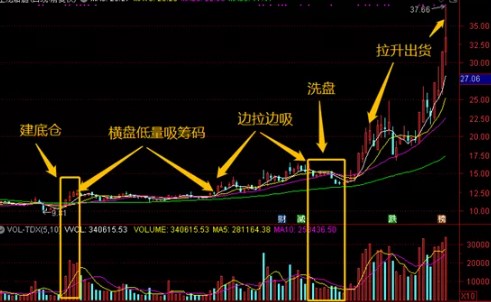
Due to the large amount of funds, the main funds usually build part of the bottom position through daily limit, lower limit, etc. Usually at this stage, it is difficult to identify whether it is short-term funds of the nature of hot money, or in institutions such as social security funds. long-term funds.
In the sideways low-volume accumulation stage, there may be some special time-sharing chart trends. It can be judged that the main funds are still in this stock, which proves that the funds involved in the early stage are not short-term hot money funds. .
In terms of the difference between shipments and dishwashing, the main force’s shipments, due to the limitation of capital volume, usually appear in the stage of large trading volume, and there is no large-volume decline.
Copyright reserved to the author
Last updated: 08/24/2023 10:06
Add

Institutions hold positions in a stock for a year or even years, while retail investors only hold a stock for a few weeks or even a few days. Holding a position for a variety of months, retail investors usually focus on short-term within the day or within the week. Institutions will not do short-term, or in other words, they will not do short-term easily. But this point is difficult to imitate, because in fact, long-term orders will be more difficult to make and test people. In addition to this method of operation, there are many institutions in the market and no one can control the market. I don’t talk about stocks here. There is another point for institutions, which is the amount of funds. Fighting, but it is not enough to shake the market. As I said before, it is just that there are much more funds available for retail investors, but in terms of analysis or judgment, there is actually not much difference between everyone.
Retail investors have the way of survival of retail investors, and there is no need to imitate institutions. As long as you establish the correct philosophy, polish your own methods, continue to implement them, and cultivate your own humanity, you can live well in the market. The method is easy to copy, but the mentality and experience are difficult to copy and need long-term training. Upgrade the system through the management of funds and positions to avoid uncontrollable events. When we do trends, it must be done with hindsight. It is impossible for us to enter and leave the market at the highest point and the lowest point. We can do it in the middle of the market. This part of the profit is enough for us to stop losses many times in the volatile market. , A wave of market prices can cover many losses, and through such a profit-loss ratio, you can make a profit.
For small funds, it is important to use the best method and the most familiar indicators to do it. The difficulty lies in short-term execution. The market forecast has nothing to do with my trading logic. Although I often predict the market, forecasting and trading are two different things. Don't regard the market as a casino, it is a market for personal asset allocation. Don't use the thinking of short-term profiteering to understand futures, you should consider the long-term.
Many people make transactions just to gamble, because this market has created a lot of myths about huge profits, and most people want to make a fortune through the highly leveraged market mechanism. But if you can't keep the money you make, you might as well not do it. What is stability? We can understand it as similar to buying financial products. As long as there are correct and reasonable trading methods or systematic operations, steady profits can be achieved. For example, if someone wants to earn some pension money, or earn some money for children's education, this can be achieved. Realize the slow growth of profits under the condition of risk control.
Copyright reserved to the author
Last updated: 08/21/2023 06:36
Add

The difference between retail investors and institutions must be clear to everyone. Whether you can trade with institutions or not, you can find the answer from history. We all know that Soros shorted the British pound. The following is a review of the British pound in 1992.
Background: Less than a year after the signing of the Maastricht Treaty, some European countries are having difficulty coordinating their economic policies. When the British economy is in a long-term recession and is in a lot of difficulties, it is impossible for the UK to maintain a high interest rate policy. The only feasible way to stimulate the country's economic development is to lower interest rates. But if Germany's interest rates are not lowered, the UK's unilateral rate cut will weaken the pound and force the UK to withdraw from the European exchange rate system.

Process: Soros alone spent $10 billion in this contest with the British government. In this gamble, Soros sold 7 billion U.S. dollars in sterling and bought 6 billion U.S. dollars in a strong currency-Mark. down), bought another $500 million worth of British stocks, and sold German stocks. If Soros was alone in the contest with Britain, the British government might still have a glimmer of hope, but the participation of many speculators in the world made the two sides in this contest very different, and the British government was doomed to fail. Soros is the biggest gambler in this "gamble". After placing the bet, Soros began to wait. In mid-September 1992, the crisis finally broke out. Rumors of the imminent depreciation of the Italian lira were circulating in the market, and there was a lot of selling in the lira. On September 13, the Italian lira depreciated by 7%. Although it was still within the floating range limited by the European exchange rate system, the situation looked pessimistic. This gives Soros sufficient reason to believe that some member countries of the European Exchange Rate System will eventually not allow the European Exchange Rate System to determine the value of their currencies, and these countries will withdraw from the European Exchange Rate System.
Method: On September 15, 1992, Soros decided to short the pound in large quantities. The exchange rate between the British pound and the Mark fell all the way to 2.80. Although it was reported that the Bank of England had purchased 3 billion pounds, it still failed to stop the decline of the pound. By the end of the evening, the exchange rate between the pound and the mark had almost fallen to the lower limit stipulated by the European exchange rate system. The pound is on the brink of exiting the European exchange rate system.
Result: In the end, it suffered a disastrous defeat and was forced to withdraw from the European exchange rate system. The British called September 15, 1992, the day they withdrew from the European exchange rate system, Black Wednesday. Soros was the biggest winner in this attack on the pound, and was once called the man who broke the Bank of England by the magazine. Soros has earned close to $1 billion from his short sterling trades, and his long positions on British, French and German interest rate futures and his short trades on the Italian lira have brought his total profit to as much as $2 billion, of which Soros' personal income is 1/3. During the year, Soros' fund grew 67.5%.
After reading the story, in this event, one is based on fundamentals. Senior investors are very good at finding opportunities, and they all have great profit margins. The second is the amount of funds of 7 billion. At that time, England could not stop it from using 3 billion funds. The third is that the stock, bond and foreign exchange markets were involved in the operation at the same time, and finally won a big victory. Do you feel that you have not encountered such an opportunity, but how many people made money in the nearby Chinese stock market in 2015, and how many people were stuck. Therefore, institutions can enter the market at the beginning of the market or at a relatively good price. Since the capital base is large and the industry sees the wind direction, it will follow, achieving a unified direction. Retail investors can take a share in big events, but due to the lag of information, the amount of funds is too small, we care about the position, because we cannot withstand the reverse fluctuation of prices, and the space we can bear is too small. So even if you want to participate in the incident, my suggestion is not to pay too much attention to the organization's movements, because the information you get is limited, and more consideration is still to be loyal to the disk and the facts.
Copyright reserved to the author
Last updated: 08/13/2023 09:38
Add

Institutions are generally profitable. How you come to this actually depends on the overall market situation. If the market is in a bear market, institutions cannot escape the tragedy of overall losses. Take the U.S. stock market as an example. In this mature market, it is difficult for most institutions to outperform the index, let alone other markets.
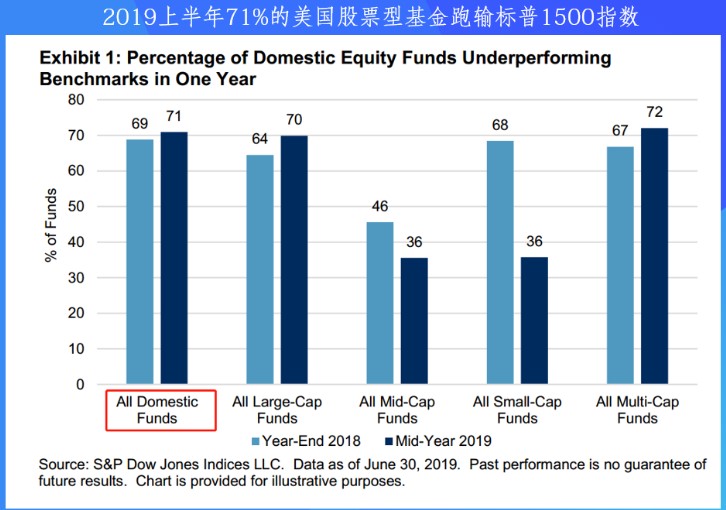
Therefore, institutional funds do not mean that they are profitable, it still depends on the market environment. If it is short-term, the profit and loss will not be much different from random events.
In other words, under the background that the profit probability of institutional funds exceeds that of ordinary investors, you have to imitate and follow, which is also a long-term process. The premise of this is that you have to accurately identify institutional funds.
Then how to identify them? Institutions are not warming the market. Their buying and selling trends directly determine the success or failure of the transaction. There is no reason for them to release their cards for free. Therefore, it is almost impossible for you to confirm the institutional ownership of an order. In this case, your imitation will be distorted a lot.
Therefore, it is basically nonsense to think of trading by imitating institutional orders to make money.
Like the regional strategy of institutional orders mentioned in your question, this kind of thing has little guiding significance for trading.
So what is order flow? The original English word is called Orden Flow, which refers to the limit price pending orders made by institutions or individual traders in the market. Because these orders have not been executed yet, they will be hung there waiting to be executed, and the quantity will increase or decrease at any time according to the market price situation. Because the amount of individual traders is small and does not affect market fluctuations, investors focus on the order flow of institutions.
In A shares, we can see about 10 orders. In different countries abroad, you can see different information. In some countries, you can see all pending orders throughout the day. This is called DOM (Depth of the market) pending orders.
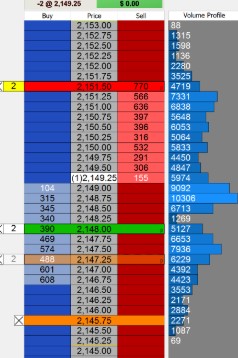
For investors, regardless of the fundamental and technical aspects, we all face a question, which point to buy? Which point to sell? The size of support and pressure can define the extent of the callback in the end price.
Then, if you only analyze and judge from the fundamental and technical aspects, it is like in a war, you can probably judge in advance which positions will be ambushed by the enemy, but how many enemy or friendly troops are ambushing in each position, do you know? You know, only the handicap order flow information can fully see the truth of the team.
In addition, you can also refer to the information of VolumeProfile (price share chart), which is the distribution of chips in our A shares. It is a transaction accumulated by unit price. Then the price share chart can analyze the transaction-intensive areas that have occurred. , and then use the pending order to judge the transaction-intensive area of the future possibility. When the two are combined, there will be an important point where the future and the past will double determine that the stock or futures will turn.
This is completely different from indicators, waves, Gann mathematical charts, fundamental derivation formulas, etc. currently used in the market. From the perspective of funds, they are real, visible, and most logical information.
From the above information, it can be seen that identifying large institutional orders and judging the real support and resistance that a trading product may encounter based on the size, position, increase or decrease of the order is the core of institutional order flow trading.
But there is still a lot of work to be done to make money from these distances, and relying on them to make money also simplifies complicated things.
Copyright reserved to the author
Last updated: 08/25/2023 18:21
Add

Let me just say that an institution makes orders. I have worked in a large company before. Specialized large-scale hedge fund companies generally focus on medium and long-term investments. Based on the economic cycle, the macroscopic aspect, and the news aspect, combined with a little bit of technical aspect, the order placed by the institution is also called collecting chips. Generally, the reverse position building method is adopted, that is, the more the price goes down, the more you buy. Everyone is scrambling for chips at the time. If an institution makes a big order, it is easy to pull the limit and cause a follow-up market. (Unless the chips are collected) this can be done. Relatively speaking, institutions are more rational in making orders, and there is no emotion involved. , more like a comprehensive tool man
Copyright reserved to the author
Last updated: 08/21/2023 01:04
Add

To be an institution, you must first have huge funds, and the funds are for controlling the initiative of the stock. It is control, commonly known as chips, the more chips, the right to speak will become the right to decide.
1. Gather chips to control votes
Wash the dishes to attract money. In the main fund-raising stage, some shrewd investors may be aware of the main force's movements and follow up in time. This is intolerable for the main force. The main force's hard work is to enjoy the benefits. Therefore, it is necessary to wash out the chips of short-term customers through dishwashing.
Wait for the signal to attack.
Lay a solid foundation for attack. The so-called how long is the horizontal, how high is the vertical, the continuous horizontal is to consolidate the foundation of the attack, so that when the attack is launched, the predetermined range can be achieved.
2. Six common dishwashing methods
(1) Pressure washing dishes. First pull up and then implement backhand suppression, but generally the time (or number of days) staying in the low position will not be too long.
(2) Wash while pulling. In the process of pulling up, it is accompanied by a retracement, which we call three advances and one retreat, to shake out those who are not firm.
(3) Significantly lower. Generally, when the general trend is adjusted, institutions will follow the trend and take the opportunity to absorb cheap chips. Speculative stocks often use this method, or institutions in the market have already made a lot of profits.
(4) Build a platform sideways. In the process of pulling up, stop doing long suddenly, so that those who are impatient will be out, and the general duration is relatively long.
(5) Oscillate up and down. This method is more common, that is, to maintain a fluctuation range and make investors confused about the hype rhythm of the market maker.
(6) Kill tactics. This is the most ruthless way to wash the market. It usually takes 3-6 months or even longer to wash the market. Investors who know that the stock is good can only stay away and lose the patience to wait.
The method of retail investors as institutions, lack of funds will eliminate most retail investors.
As for professional research, fund management, and firm offer skills, it is even more blank.
Therefore, retail investors have a very low probability of making a profit using institutional trading techniques.
But it is not without a quick solution, just like many musical instrument training schools nowadays, for the training of adults, they use a piece of music to practice repeatedly to achieve practice makes perfect. All professional related parts are ignored and only performed mechanically. Practice repeatedly until you can play this piano piece completely and smoothly.
In the same way, if you know a good trading strategy, you can only review and simulate this strategy and one product repeatedly until you can achieve a stable monthly return. Afterwards, you can work with institutions to provide you with financial support.
Copyright reserved to the author
Last updated: 08/20/2023 04:11
Add

Where did you find that retail investors are against big institutions? Can you tell who is an institution and who is a retail investor?
Simply following the footprints of orders to identify institutions and retail investors is of little significance, except for some orders with huge funds, you can be sure that they are institutions. If they split the list, you'd be foolish to tell the difference.
For spot foreign exchange gold, many times your counterparty is the platform itself, so it is even more impossible for you to identify the operation of so-called institutional funds. If it is a direct-connected order from an exchange and a purely bidding transaction, it is still possible to identify institutional funds. For example, in A shares, you can see large funds from entrusted orders.
Most of the time, your idea of following the organization and eating meat is just obscenity, and the final result is naturally different in different scenarios, and it is commonplace to make a mistake.

You have always heard of the loss of the mouse warehouse.
The mouse warehouse lost nearly 4 million in 4 years
In September 2007, Du Moujiang, a 35-year-old doctoral student, entered the Research and Development Center of China Merchants Securities and worked as a securities analyst. Then in January 2010, he was transferred to the Financial Investment Department of the Asset Management Headquarters of China Merchants Securities, mainly responsible for directional asset management business investment manage.
During the period when he was an investment manager from February 2010 to June 2014, Du Moujiang, who failed to withstand the temptation of money, used his brains.
"The specific way I use undisclosed information to trade is to 'co-invest'." Du Moujiang said, which stocks the company's investment clients under his management need to buy, and he also bought those stocks in the 8 stock accounts he operated privately. ; When selling stocks, they are also sold.
According to the investigation, Du Jiang used undisclosed information to operate a total of 8 securities accounts including Ma, Jie, Chen, Fan 1, Liu, Li, Zu, and Feng 1 in private. crime of information trading.
After investigation by the Shenzhen Securities Regulatory Bureau, it was determined that the underlying stocks, trading time and quantity of 26 directional asset management businesses including China Merchants Securities "Bao Mou" belonged to other non-public information other than inside information stipulated in the criminal law. As the directional investment manager of China Merchants Securities, Du Moujiang used his position to be fully aware of the above-mentioned non-public information and has complete control within the investment authority.
After investigation, Du Moujiang directly operated 8 accounts that were synchronized with or slightly later than his managed "Bao" and other 26 directional asset management business accounts to trade related stocks. There were 116 converging trading stocks, and the cumulative amount of converging trading stocks was about 492.554 million. RMB, and the cumulative loss of convergent trading stocks is about 3.9451 million yuan.

This kind of investment is not just following the institutional funds, it is completely synchronous operation, and it still ends up at a loss in the end. Therefore, it is wishful thinking to make money by imitating institutions. It's very simple, the organization can't guarantee 100% profit, there are pig teammates everywhere, you want to follow the meat, but in fact you don't even have to drink the soup.
Copyright reserved to the author
Last updated: 08/23/2023 16:16
Add

I don't understand the regional tactics of institutional orders you mentioned. But many answers in Huihuli also said some tricks, I read it, but still don't understand.
I don’t know if they didn’t understand it, so they just found it anywhere, or if it’s because I’m just ignorant and have a low IQ. The so-called ups and downs, at least in their case, are nothing more than looking for support and resistance. And these support and resistance levels are also very perfunctory, they are all previous lows or previous highs.
Just ask, these things can be seen by individuals, will the organization's orders be laid out here like a fool?
So this thing is completely nonsense. How can you find out the movement of the organization casually? It's not that it can't be found that small-scale assets like stocks can indeed see every move of institutions after long-term and careful tracking. If stocks are compared to lakes, then the global market such as the foreign exchange market is the sea. How can you see it, and how can you track it?
I won't talk about this, anyway, I don't know how to play. What about other single-handed techniques, can they be learned? Of course there is.
For example, institutions will have their own clear entry signals, exit signals, risk control and position management. Everyone says it, but few do it. But why do institutions do this? Just because they are so important.
Therefore, instead of doing everything possible to find orders from institutions, it is better to do these well. Even if your order is at the same level as that of the institution, the institution may make money and you lose money in the end. Because you may not control your positions and risks well and lead to liquidation, while institutions are still firmly in this market.
Don't sacrifice the basics, the most important thing in this market is position management and risk control, doing these well is more reliable than anything else.
Copyright reserved to the author
Last updated: 08/25/2023 08:57
Add

0
work
0
subscriber