


Stay in touch!
Subscribe to our newsletter to get the latest updates on live market analysis, trading strategies and more. You can unsubscribe anytime.
By subscribing, you agree to Trading.live Privacy Policy.


In fact, what I want to say is that this is a false proposition or this is not a problem at all. Of course, in theory, the winning rate is the winning rate, and the profit-loss ratio is the profit-loss ratio. But in the actual process, for a person with a high winning rate, his profit-loss ratio may not be the best, but it must not be unreasonable. At best, it is a mean, for example, if you earn once, you can lose twice. The profit-loss ratio of 2:1 is definitely not high, but can you say it is unreasonable? But it can't stand the high winning rate. Note that the high winning rate I am talking about here refers to honest short-term orders. It's not about placing an order and running away after earning a few points. In my opinion, this is not an order. That's billing. Therefore, a high winning rate is actually a way to reduce losses and increase profits in disguise.
That's why I said that people with a high winning rate actually have an upper-middle profit-loss ratio. The base of such people making money is definitely lower than the winning rate, but there are many people with a high profit-loss ratio. This is absolutely the case.
I don't know when it started, but the words of high winning rate and low profit-loss ratio, low winning rate and high profit-loss ratio have been spread. In my opinion, this is simply nonsense. Is it true that a high winning rate trader is a Chinese cabbage, good luck? Others have a high winning rate from fighting in the market, okay, don't you understand what the profit-loss ratio means? Give me a break.
What's even more funny is that I actually saw a lot of people with low winning rate and high profit-loss ratio, laughing at people with high winning rate, but the profit-loss ratio is not as high as them. I feel that their trading ideas are wrong, pursuing the winning rate but giving up the profit-loss ratio. . . . I really do. . . . Ten thousand horses galloped by. These people really don't know how to trade.
Among the people with low winning rate and high profit-loss ratio, are there any people who make money? have. But this kind of person will not laugh at someone with a high winning rate. Because they understand that it's just a matter of choice.
It's a bit far-fetched, can a high winning rate and a high profit-loss ratio have both? I can give a clear answer: no.
The first thing you need to know is the delay of the profit-loss ratio. Well, the reason why I say it is delayed is because the profit-loss ratio is often calculated after a transaction, or after a period of trading. Why post-trade statistics? Because it is uncontrollable. Who dares to say that if I go in, I must reach the profit-loss ratio of XX:XX? Who can guarantee? Do you dare to stick to this, and never enter the field until the profit and loss ratio target? The result speaks for itself. That's why I said that the profit-loss ratio is uncontrollable and delayed. As for the proof, it is very simple. Divide your transaction records into several parts at will, and make statistics by segments, and you can see if your profit-loss ratio is consistent. If it is several years, then use years as the unit. See if it's the same every year.
Maybe a certain market is an opportunity for you to make money. I believe everyone has this kind of market, which is commonly known as a good market. Under this kind of market, the probability of your profit and loss ratio is definitely higher than usual, and it is not even ruled out that it will exceed a lot. But this kind of market is rare.
So, how do you guarantee the profit-loss ratio? Losses are guaranteed, but profits? Well, in the case of guaranteed losses, if the winning rate is not high, it will also lower the profit-loss ratio. If the profit is not ideal, then the profit-loss ratio is simply impossible to see. So let the profits run wild and the losses cut off, I think it is quite appropriate. But the result is that the winning rate is not high.
At present, the more popular or effective methods only start from the operation method and transaction logic. But the transaction itself is a matter of planning and success. Therefore, the profit-loss ratio is essentially not guaranteed at all.
As for the winning rate, although this thing is not guaranteed. However, it is slightly different from the non-guaranteed ratio of profit and loss. The winning rate is as long as it can make a profit, it will be a real increase. The profit-loss ratio is not only profitable, but also needs to reach a certain amount.
I wondered, is it because there are more novices who have been doing ultra-short-term in recent years, they run away when they make a few points, and die when they lose money, so the winning rate is quite high, but the losses are also quite a lot. So there is a seemingly weird saying that the winning rate is high and the profit-loss ratio is low? For a person who can really achieve a high winning rate, his profit-loss ratio is absolutely impossible, although it is not high.
Copyright reserved to the author
Last updated: 08/24/2023 15:45
 Add
Add

The primary purpose of all investors entering the foreign exchange market is to make a profit. In order to achieve the purpose of making a profit, investors usually strive to develop in two directions: to increase the winning rate of the transaction or to increase the profit-loss ratio of the transaction. But between the two, in addition to the left and right legs that constitute expectations, there is also a check and balance relationship with each other. If you pursue a higher winning rate excessively, the profit-loss ratio will decrease; on the contrary, if you pursue a higher profit-loss ratio excessively, the winning rate will decrease. Therefore, how to correctly choose the winning rate or the profit-loss ratio is particularly important.
win rate and profit loss ratio
First, clarify the definition of winning rate and profit-loss ratio:
Winning rate X = all times of profit / total number of transactions x 100% profit-loss ratio Y = average amount of profit / average amount of loss.
On this basis, the overall profit and loss is: total profit and loss Z = all times of profit * average amount of profit - all times of loss * average amount of loss.
According to the above formula, it can be simply concluded that under the condition that the profit-loss ratio is 1:1, the higher the investor's winning rate, the more profits he will get. But if the amount of each loss is much greater than the amount of profit, then no matter how high the winning rate is, it will be useless, so how can we improve the profit-loss ratio? (Let's look at the picture below)
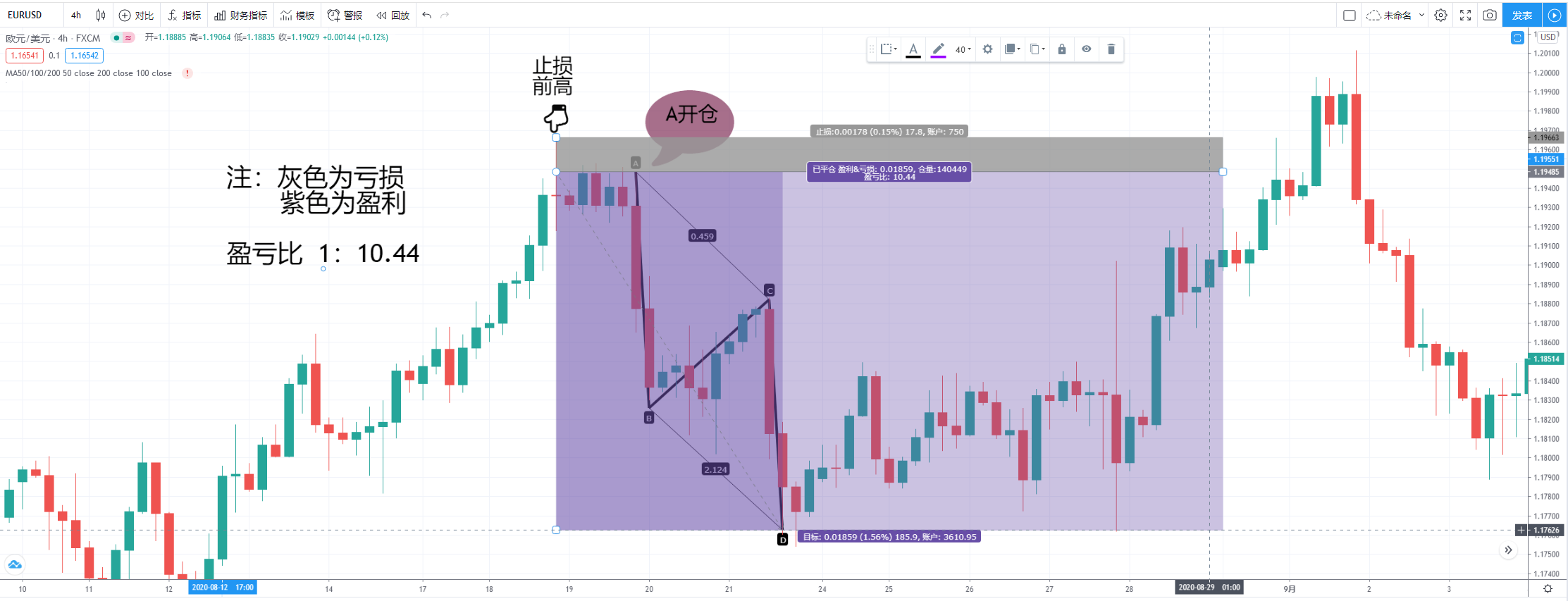
Find the key pressure level, put the stop loss at the previous high, and if you make mistakes six times out of ten, even if you lose too much, then your profit and loss will remain the same, but if you do it right once, then your profit will also be the same Yes, if you are right, then five or six times your profit will continue to expand, so what you need to improve is your winning rate.
Winning rate and profit-loss ratio, they are like a pair of twin brothers, they affect each other's expected value of a strategy, in the limited number of transactions, what we need to ensure is that the profit is more than the loss, and find a balance between the two. When you can choose a certain trading strategy by comprehensively considering the winning rate and profit-loss ratio, you will be one step closer to success.
Copyright reserved to the author
Last updated: 08/07/2023 05:50
Add

The winning ratio and profit-loss ratio in trading are issues that everyone who is engaged in trading thinks about all day long. This issue is like height and weight, which are related but not closely related.
First of all, it is necessary to know what the winning rate and profit-loss ratio are.
The winning rate is a data calculated by dividing the total number of winning transactions by the total number of losing transactions after counting the number of profits and losses during the review after many transactions, which belongs to the category of after-the-fact summary.

The profit-loss ratio considers how many points the future profit and loss are expected to be before placing an order in a transaction. The estimated profit points divided by the estimated loss points are an estimated data. When reviewing after the event, it will be calculated by dividing the take profit points by the stop loss points. Generally, more considerations are taken into consideration when making decisions, and statistics will also be counted when reviewing the market after the event.
Going back to the origin of things, the currency market is the ratio of currency pairs in various countries, just like 1 US dollar can be exchanged for 6.8 RMB, the transaction is only an exchange ratio, because the exchange ratio will change every moment over time If there is a change, there will be a price difference, and transactions often use this price difference to make profits.
The purpose of each person's trading is different. Some are to stabilize the exchange rate, some are to hedge risks, and some are to make profits. In terms of speculative profits, the winning rate and profit-loss ratio are only considerations. Not much of a direct relationship. But from a psychological point of view, I hope to make 100 orders, the winning rate is 100%, and the profit-loss ratio is 100:0. But from the actual situation, the simple pursuit of winning ratio and profit-loss ratio does not make much sense. The ultimate goal is to make more and more funds in the account. Various pursuits that are inconsistent with the ultimate goal are a waste of time and energy. ,money.
In addition, taking intraday trading as an example, hundreds of orders are traded a day, and the profit-loss ratio of each order is not high, but the overall winning rate is high, and the account amount is still increasing every day. There are not many orders, and there are not many orders in a month or even a year. Among them, only one order may make a profit, and all others will lose money. However, the profit of this order minus the sum of all loss orders is still very profitable. Just like Soros once summed up his trading experience: the depth of profit is far more important than the frequency of profit.
Therefore, before making a transaction, first understand what you are ultimately pursuing and what kind of trading style you are, and then consider which indicators are the most important. Instead of simply pursuing a high winning rate, it is better to understand yourself first, otherwise you will drift with the tide and be taken away by the market, going up and down for a while, like a roller coaster, your heart is going through tests every moment.
Trading is only a part of life. It may be fun or a tool for making a living. All activities that make life better should be encouraged and supported.
Copyright reserved to the author
Last updated: 08/26/2023 22:06
Add

0
work
0
subscriber