


Stay in touch!
Subscribe to our newsletter to get the latest updates on live market analysis, trading strategies and more. You can unsubscribe anytime.
By subscribing, you agree to Trading.live Privacy Policy.


Thank you.
What the subject wants to ask is how to use support and resistance to make better trading decisions?
We know that support areas are areas where asset prices tend to stop falling, and resistance areas are areas where prices stop rising, but traders need more information before trying to make decisions based on the areas in the chart. An article collected and sorted out before should be useful to you. The specific instructions are as follows:
1. Use Trendlines
On a candlestick chart, if the price stalls and reverses within a uniform price zone twice in a row, the horizontal line drawn indicates that the market is moving beyond that zone.
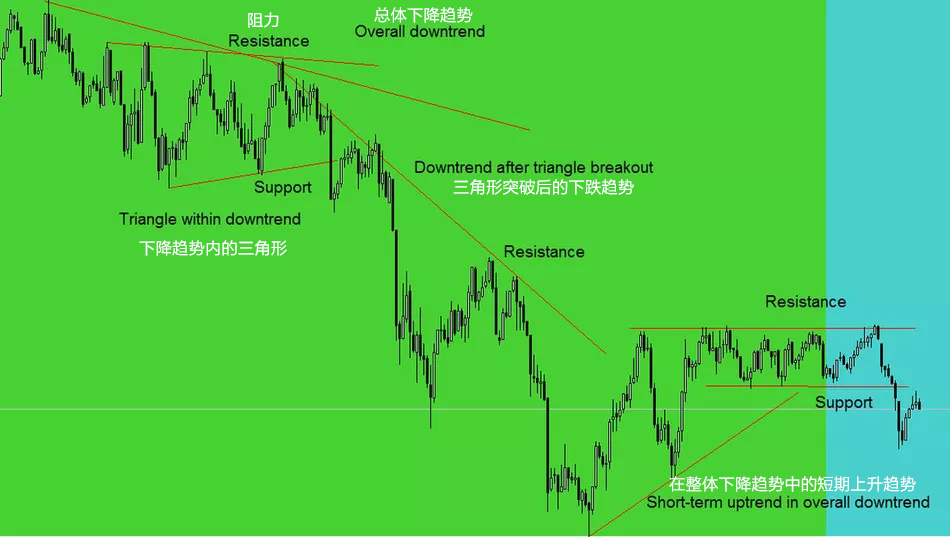
In an uptrend, the price makes higher highs and higher lows. In a downtrend, the price makes lower lows and lower highs. Connect highs and lows during a trend. Then extend that line to the right to see where the price might find support or resistance in the future.
These simple lines highlight trends, ranges and other chart patterns. They allow traders to visualize where the market is currently going and where it will go in the future.
2. Major and minor support and resistance levels
Minor support and resistance levels will not last. For example, if the price is trending lower, it will make a low, bounce back, and start falling again. This low could mark an area of minor support as the price does stall and bounce off this level. But since the trend is down, it is very likely that the price will eventually break below this minor support level.
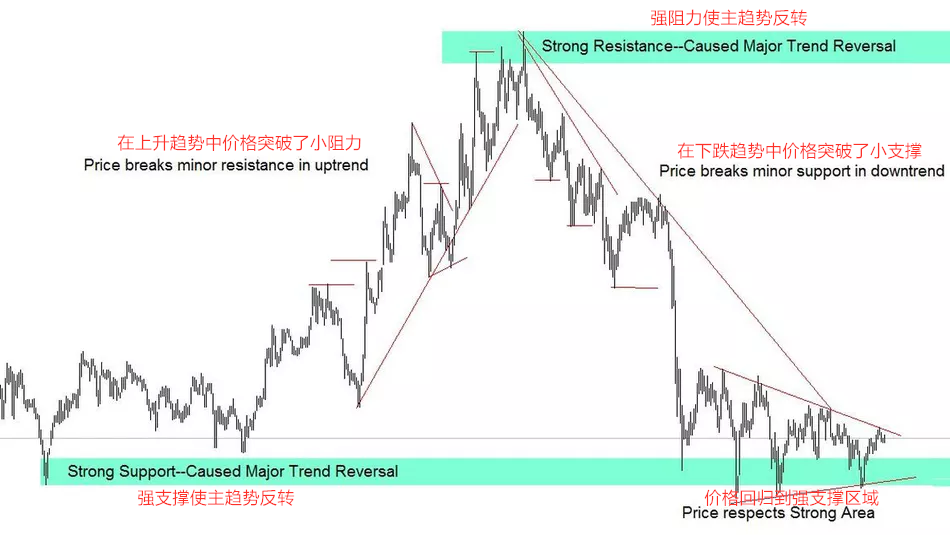
Minor areas of support or resistance provide analytical insight and potential trading opportunities. In the example above, if the price did break below the minor support level, then we know the downtrend is still intact. However, if the price stalls and bounces back to the previous low, a range could be in place. If the price stalls and bounces back above the previous low, we have a higher low, which indicates a possible change in trend.
Major support and resistance areas are price levels that have caused a trend reversal in the near term. If the price is trending up and then reverses to a downtrend, the price where the reversal occurs is a strong resistance level. Where a downtrend ends and an uptrend begins is a strong support level.
When the price returns to a major support or resistance area, it will usually be difficult to break through it and move in the other direction. For example, if the price falls to a strong support level, it will often bounce off the price. The price may eventually break out, but usually the price pulls back from this level several times before then.
3. Trading based on support and resistance
The basic trading method using support and resistance is to buy near support during uptrends or parts of the price range or chart patterns, and sell/sell short-term resistance during downtrends or parts of the price range and chart patterns.
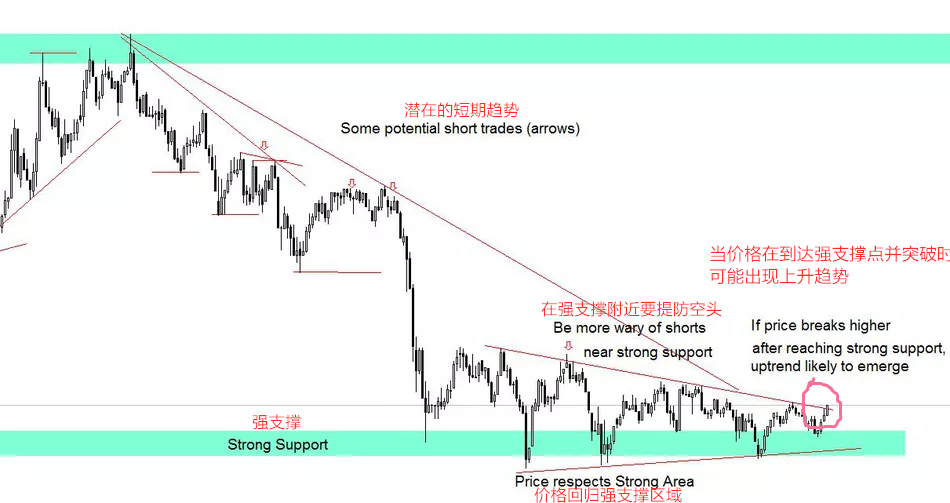
It helps isolate long-term trends even when trading ranges or chart patterns. The trend provides guidance for the direction of the trade. For example, if the trend is down but then forms a range, short selling at range resistance should be prioritized over buying at range support. A downtrend tells us that shorting is more likely to generate profits than buying. If the trend is up and then a triangle is formed, it is advisable to buy near the support of the triangle.
Buying near support or selling near resistance can be rewarding, but there is no guarantee that support or resistance will remain the same, so wait for the market to change.
If buying near support, wait for a consolidation in the support area, then buy when the price breaks above the highs in that small-cap area. When the price is so volatile, it lets us know that the price is still respecting the support area and that the price is starting to move higher from the support. The same concept applies to resistance selling. Wait for a consolidation near resistance, then enter a short trade when the price dips below the low of the minor consolidation. When buying, place your stop a few cents below support), and when shorting, place your stop a few cents above resistance.
In some cases, one may be able to make more profits if a breakout is allowed, rather than selling at minor support/resistance. For example, if you are buying near the support of a triangle in a larger uptrend, you may want to hold the trade until it breaks the triangle resistance and continues the uptrend.
There is also the concept that old support can become new resistance and vice versa. Not always, but it does act as a good support or resistance point under very specific conditions, such as a second breakout.
4. Error breakthrough
Asset prices generally move slightly higher than we expect. This doesn't happen all the time, but when it does, it's called a false breakout.
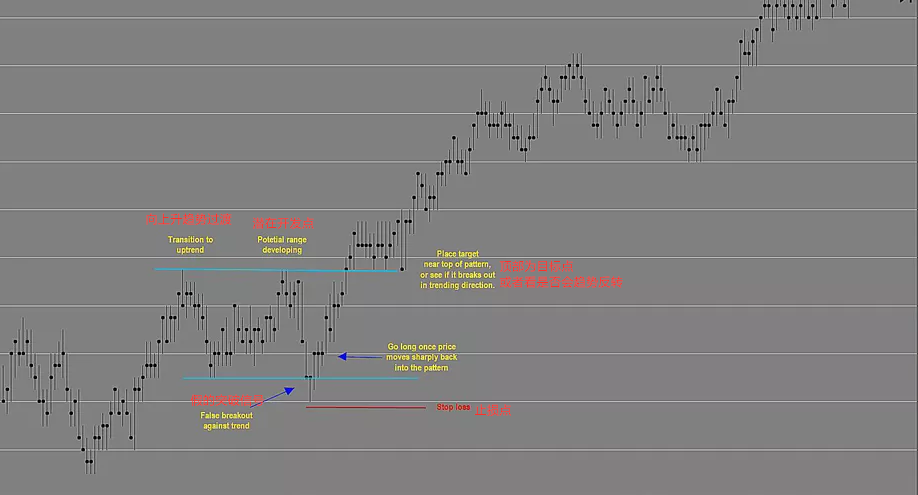
If our analysis shows support at $10, hit $9.97 or $9.95 and start bouncing again. Support and resistance are areas, not exact prices. Expect the price to behave differently around support and resistance. It cannot stop at the exact same price as before.
False breakouts are excellent trading opportunities. One strategy is to actually wait for a false breakout and then enter the market after it does. For example, if the trend is up, and the price falls back to a support level, let the price fall below the support level, then buy when the price starts to rise back above the support level.
Likewise, if the trend is down and the price falls back to the resistance level, let the price break through the resistance level and then go short when the price starts to break below the resistance level.
The downside of this method is that false breakouts will not always occur, one that means good trading opportunities may be missed. Therefore, it is often best to take advantage of upcoming trading opportunities. If you happen to catch the wrong false breakout trade, it will be a good opportunity.
Since false breakouts do occasionally occur, the stop loss should be placed well away from the support or resistance so that the false breakout does not hit the stop before moving in the desired direction.
5. Adapt trading decisions to new support and resistance levels
Support and resistance are dynamic, so trading decisions based on them must also be dynamic. In an uptrend, the last low and the last high are important. If the price makes a lower low, it signals a potential trend change, but if the price makes a new high, it helps confirm an uptrend. Trends often run into trouble in areas of strong support or resistance, and they may end up Will break through, but usually takes time and multiple attempts.
Mark the major support and resistance levels on the chart, because if the price approaches these areas, they may be active again at this point. Remove them once they are no longer relevant - such as if the price breaks out of a strong support or resistance area and continues to move further into the distance.
Also mark current and relevant minor support and resistance levels on the chart. These will help you analyze current trends, ranges and chart patterns. These minor levels quickly lose their relevance as new minor support and resistance areas form.
Copyright reserved to the author
Last updated: 08/14/2023 16:05
 Add
Add

Fibo line, trend line, Bollinger Bands, upper and lower edges of the box, upper and lower rails of the channel, previous high/low, previous transaction-intensive area/the center of the entanglement... 🙀
Copyright reserved to the author
Last updated: 08/01/2023 12:15
Add

First, to determine the effectiveness of the resistance level, you can distinguish the control range of the resistance level, and the deterministic resistance can also be divided into two situations: placing orders after seeing the position and placing orders after verification! Is recognition important?
Copyright reserved to the author
Last updated: 08/10/2023 15:57
Add

0
work
0
subscriber