


Stay in touch!
Subscribe to our newsletter to get the latest updates on live market analysis, trading strategies and more. You can unsubscribe anytime.
By subscribing, you agree to Trading.live Privacy Policy.


Topic, your question is actually a bit paradoxical: since it is a famous trading strategy, you must know it; if you don’t know it, then of course it is not a famous trading strategy, isn’t it?
Since you are asking, let me find a trading strategy that everyone doesn't pay much attention to, but it is really famous, and that is the anti-Martin trading strategy. Usually everyone's focus is on Martin's trading strategy. It is estimated that there are many people who have heard about the anti-Martin trading strategy, but few people really understand it.
The so-called anti-Martingale strategy, as the name suggests, is of course the reverse operation of the Martingale strategy. Here, I think it is necessary to talk about the definition of Martin's trading strategy first.
When it comes to Martin's strategy, I believe most people's first impression is: when the market rises, sell short, and the higher the price, the more you sell; In fact, this is a very wrong idea. The original Martin trading strategy is actually based on such a core point of view: when the market rises to a certain extent, there will inevitably be a certain decline in the market; and after the market falls to a certain depth, there will often be a rebound in the market. In a word, operating against the trend is the core of Martin's strategy.
Since Martin is going against the overall trend, then anti-Martin is of course operating with the trend, because going against the trend is right. In this way, the core of the anti-Martin trading strategy is: increase profits!
With only four words, the anti-Martin trading strategy seems so simple, just keep adding positions. But adding a position is just a performance, what is more critical is where to enter the market, where to add a position, the interval of adding a position, and the size of the position to add, these need to be calculated.
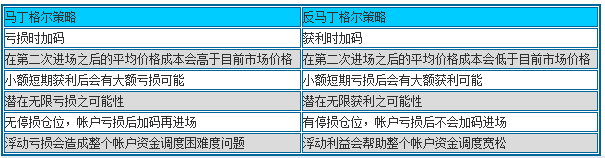
Any trading strategy looks simple, but it is often not simple behind it, so before you want to use this trading strategy, you might as well study it carefully. In order for the subject to better understand how the anti-Martin trading strategy is more advantageous than the Martin trading strategy, I will give an example below.
Suppose you go to the casino to bet on Martin and anti-Martin respectively.
Martin Trading Strategy:
The first time you bet big with 10 yuan, if you win, you will earn 10 yuan, if you lose, continue to the second bet;
The second time you bet big with 20 yuan, if you win, you will earn 10 yuan, if you lose, continue to the third bet;
The third time you bet big with 40 yuan, if you win, you will earn 10 yuan, if you lose, continue to the fourth bet;
By analogy, every time you bet big, start over if you win, and double your bet if you lose. This is the so-called Martin trading method. You will find that according to Martin's trading method, every time you encounter a profitable hand, your total profit is only $10! And with several small openings in a row, you need a huge amount of money to continue betting on the next game.
Let's take a look at the idea of anti-Martin trading strategy:
The first time you bet big with 10 yuan, if you lose, you start to bet big with 10 yuan again, if you win, continue to double the second bet and bet big;
The second time you bet big with 20 yuan, if you lose, start again with 10 yuan to bet big, if you win, continue to double the third bet and bet big;
For the third time, you bet big with 40 yuan. If you lose, start betting big again with 10 yuan. If you win, continue to double the bet for big in the fourth bet;
By analogy, every time you bet big, start over if you lose, and double your bet if you win. This is the so-called anti-Martin trading method. You will find that the profit of the anti-Martin trading method is just opposite to that of the Martin trading method: if you lose a total of 4 times, you will lose a total of 40 yuan, because you will re-bet 10 yuan if you lose. So a total loss of 40 yuan. If you win 4 times in a row, then your total profit is 10+20+40+80=150 yuan! It will be 15 times the profit of the Martin trading method!
The same trading variety, the same initial capital, the results will be very different! This is where the anti-Martin trading strategy is far superior to the Martin trading strategy!
Copyright reserved to the author
Last updated: 08/12/2023 00:15
 Add
Add


Seeing that some friends have answered relatively well, but apart from Martin, Sea Turtle, Larry Williams' gap trading system, etc., the world's well-known trading systems are relatively rare. Because if it is a profitable trading system, it is not so easy to take it out and make it public. The more people who know a set of trading methods, the more likely it will fail. So good strategies are generally kept secret. The author has more research on the turtle trading method, and I will focus on helping you analyze the advantages and disadvantages of the turtle trading method.
We all know that the trading system is not complicated. A trading system is generally composed of three main keys: entry + exit + fund management. However, this is only the appearance rather than the core. The core of a trading system lies in your trading logic consisting of entry and exit and fund management. That is to say, you can't claim that you have a trading system by combining a few entries and exits.
For example: the most famous trading system, Turtle Trading Rules. Its entry is to break through the 20-day high to enter the market, and its exit is to break through the 10-day low to exit. Short the other way around. There are two aspects to money management rules:
1. If the floating profit is 0.5*atr, increase the position once, and add three times in total. If the new open position loses 2*Atr, it will be completely flat.
2. 1% of the total funds are used each time a position is opened.
Simple isn't it? It's very simple, just three steps. But it's this simplicity that makes using it a challenge. Because you have to be able to see why it's simple.
Why break through the 20-day high to enter? Why not look at the fundamentals? Why not look at technical indicators? Why not look at the volume? Is it all done with such a simple algorithm?
Because in the cognition of the founder of Sea Turtle, it is not important to enter the market at all. There is no way to predict the market. The indicators are not good, the fundamentals are not good, and the changes in funds are not good.
He doesn't know how the price will go after the price breaks through the 20th day. He only knows that if the market goes out of trend, the price will definitely break through the 20th day high.

In other words, his admission was just trial and error. I enter the market when it breaks through the 20-day high. What if the direction is wrong? I lost 2*atr and it was over. If there is no loss, I will assume that I am still right and continue to hold. Anyway, I lose 2*atr at most, and the risk is controllable.
If it is right, when he buys, the market will skyrocket? Not only did he not take the initiative to stop profit, but he would not enter the market until the day it fell below the 10-day low.
You know, a break below the 10-day low would mean he would take on a significant pullback for all to see. As such a famous trader, could he not see it? What is he drawing?
Because he wants to let the profit run by bearing the retracement. As long as the market dares to rise, I dare to take it. If you don't fall below the 10-day low, I won't be flat. If it falls below, it touches the exit set by my system. I think the market trend is over, and I will unconditionally close the position.
did you see? His entry is trial and error, and his exit is to cut losses and let profits run. That is to say, if you are wrong, you will stop the loss, and if you are right, you will hold it. He realized a trading logic through such a trading system: he can obtain the correct position in the trend under the premise of controllable risks.
And the increase in his fund management logic allows him to have more correct positions at the right time, which in turn allows him to obtain more profits in trend trading.
And his 1% capital utilization rate, and scattered and multi-variety capital management rules are for better living, and will not lose too much when there is no trend. Accounts can be kept alive to see the trend come.
Therefore, the turtle trading system constitutes a trading system through the three links of entry, exit, and fund management. The output logic of this system is: trend trading.
Copyright reserved to the author
Last updated: 08/07/2023 13:14
Add

The famous trading strategies or trading systems also have the following ten famous trading strategies, and their complete algorithms are as follows:
1. Range breakout
The breakthrough transaction of the fluctuation range triggers the breakthrough transaction of the day according to a certain percentage of yesterday's fluctuation range. If yesterday's fluctuation range is abnormal, necessary adjustments should be made to the fluctuation range to ensure its rationality.
main feature:
intraday trading strategies;
Range breakouts are based on the relationship between yesterday's amplitude and today's opening price;
Yesterday's amplitude = yesterday's highest price - yesterday's lowest price;
Upper track = today’s closing price + N* yesterday’s amplitude;
Lower track = today's closing price - N * yesterday's amplitude;
When the price breaks through the upper track, buy to open a position;
When the price falls below the lower track, sell to open a position.
2. Fiari Quadrivalent
Yesterday's high point, yesterday's low point, yesterday's closing price, and today's opening price can be collectively called the four prices of Fiali. It is the main breakthrough trading frame of reference adopted by the Japanese futures champion Fiari Firm. In addition, because of Ali's subjective mental trading mode, it is determined that it also combines and uses a large number of "spill-stop lines" in actual transactions, that is, resistance lines and support lines.
main feature:
Intraday trading strategy, closing position;
Fiari four prices refer to yesterday's high point, yesterday's low point, yesterday's close, and today's open;
Upper track = yesterday's high point;
Lower track = yesterday's low point;
When the price breaks through the upper track, buy to open a position;
When the price falls below the lower track, sell to open a position.
3. Sky Garden
Opening a breakthrough is the fastest way to enter the market. Of course, the probability of error is also the highest. Whether the first K line at the opening closes positive or negative is the standard for judging the possible movement direction of the intraday trend. It is more effective when the day opens higher or lower.
main feature:
Intraday trading strategy, closing position;
The Sky Garden is used when the day opens high or low, that is, when the opening price >= yesterday’s closing price * 1.01 or the opening price <>
Upper track = the highest price of the first K-line;
Lower track = the lowest price of the first K line;
When the price breaks through the upper track, buy to open a position;
When the price falls below the lower track, sell to open a position.
actually a
Open sharply higher (>1%) on the day, fight high and open low; otherwise,

4. Sideways breakthrough
It is easier to achieve quantitative breakthroughs, including fractals, narrow horizontal breakthroughs, various K-line combinations, double bottoms and double tops, and three buys and three sales; it is more difficult to achieve quantitative breakthroughs, such as trend lines and arc tops Bottom, flag, rhombus, triangle and other classic technical analysis forms, the trend is followed by consolidation, and after consolidation is the trend. The trading strategy of sideways breakthrough fully embodies the price fluctuation law of the volatility cycle. What we need to do is to reasonably quantify the definition of consolidation, such as cycle span and fluctuation range.
main feature:
Intraday trading strategy, closing position;
When the sideways breakthrough occurs when the high and low points of the past 30 K-lines fluctuate within 0.5% of the central axis;
Upper track = the highest price of the past 30 K-lines;
Lower track = the lowest price of the past 30 K-lines;
When the price breaks through the upper track, buy to open a position;
When the price falls below the lower track, sell to open a position.
5. Turn to transactions
Relatively speaking, a breakthrough based on a fixed point may be subject to changes in the price area of the product; while a breakthrough based on a fixed percentage range is less likely to be subject to similar troubles, unless the volatility level of the product changes drastically.
main feature:
Intraday trading strategy, closing position;
Steering trades are based on today's opening price;
Upper track = today's opening price + today's opening price * 0.01;
Lower track = today's opening price - today's opening price * 0.01;
When the price breaks through the upper track, buy to open a position;
When the price falls below the lower track, sell to open a position.
6. HANS123
As a breakthrough trading strategy that is widely popular in the foreign exchange market, HANS123 uses its simple breakthrough of the high and low points of N K lines after the market opening as the criterion for triggering trading signals. This is also a trading mode that enters the market earlier, and with filtering techniques such as price envelope, time confirmation, and fluctuation range, it may increase its chances of winning.
main feature:
Intraday trading strategy, closing position;
HANS123 is ready to enter the market 30 minutes after the opening;
Upper track = the high point 30 minutes after the opening;
Lower track = low point 30 minutes after market opening;
When the price breaks through the upper track, buy to open a position;
When the price falls below the lower track, sell to open a position.
7. Daily average ATR breakthrough
We have reasons to believe that when a certain range of ATR volatility has occurred, we are more willing to bet on the direction of intraday volatility to continue to develop in the direction that has completed a certain ATR range. The benchmark for comparison can be the opening price or the intraday New highs and lows have been set.
You can calculate the ATR in the past 10 days,
main feature:
Intraday trading strategy, closing position;
The daily average ATR breakthrough is based on the relationship between today's opening price and the average ATR of the past N trading days;
Upper track = today’s opening price + N trading day average ATR*M;
Lower track = today's opening price - N trading day average ATR*M;
When the price breaks through the upper track, buy to open a position;
When the price falls below the lower track, sell to open a position.
8. ORB breakthrough
ORB breakthrough trading was first proposed in 1988 by American fund manager Toby. He measures the smaller distance between the opening price, the highest price, and the lowest price as the range of failed breakthroughs. Once the market outlook exceeds this range, it is considered a real breakthrough. In practical applications, breakthroughs in early trading and breakthroughs after narrow fluctuations can be used as effective filtering conditions.
main feature:
Intraday trading strategy, closing position;
ORB failure breakthrough is based on the ORB indicator in the past N trading days;
Upper track = today’s opening price + N-day ORB*M;
Lower track = today's opening price - N days ORB*M;
When the price breaks through the upper track, buy to open a position;
When the price falls below the lower track, sell to open a position.
The more times you have failed in the past, the higher the probability of success next time.
9. Time-sharing average price breakthrough
Because the time-sharing average price yellow line widely appears in the time-sharing average price trend charts of various trading software, its position is particularly prominent and eye-catching in terms of the self-realization language of trading strategies.
main feature:
Intraday trading strategy, closing position;
The time-sharing average price yellow line is based on the average price of today's time-sharing chart;
Upper track = yellow line of time-sharing average price of the day;
Lower track = yellow line of time-sharing average price of the day;
When the price breaks through the upper track, buy to open a position;
When the price falls below the lower track, sell to open a position.
10. Intraday ATR Volatility Breakout
Focuses on the assessment of short-term market volatility changes. Volatility breakthroughs have the ability to adapt to the market to a certain extent, and are more capable of adapting to different market environments in practical applications.
main feature:
Intraday trading strategy, closing position;
The intraday ATR breakthrough is based on the opening price of the current K-line and the ATR of the past N cycles;
Upper track = opening price of the current K-line + N-period ATR*M;
Lower track = opening price of the current K-line - ATR*M for N periods;
When the price breaks through the upper track, buy to open a position;
When the price falls below the lower track, sell to open a position.
Copyright reserved to the author
Last updated: 08/08/2023 07:28
Add

0
work
0
subscriber