

Chapter 4 09/21 USDJPY: BOJ Addresses JPY Decline with Navigating Challenges and Structural Factors Simultaneo
Summary: The real effective exchange rate of the yen has fallen to its lowest level in 53 years. While the market currently expects no policy adjustments from the Bank of Japan this week, swap market indicators currently suggest stronger expectations of lifting the negative interest rate policy before March next year, as compared to an expansion of the 10-year government bond yield target range.
Fundamentals
According to data from the Bank for International Settlements, the real effective exchange rate of the yen has reached its lowest point in 53 years compared to other currencies, underscoring the pressure faced by the Bank of Japan. The decline in the real effective exchange rate implies that Japanese people have to pay more for imported goods and services as wage growth fails to compensate for inflation.
The Bank of Japan, which will announce its latest policy decision on Friday, took into account the impact of the yen when it adjusted its yield curve control settings at the end of July. It is expected that the BOJ will maintain the status quo at this meeting. While the depreciation of the yen has exacerbated inflation, it is not the kind of price growth driven by domestic demand that the central bank is seeking. Besides monetary policy, "clear structural factors" have exacerbated the yen's decline, including trade deficits and service account deficits.
As the USDJPY exchange rate has remained around 150.00 for some time now, some analysts believe this could trigger intervention by the BOJ, and traders remain vigilant to any sharp movements in the yen. Ahead of the Bank of Japan's policy decision on Friday, the market is nervously awaiting more details from Governor Kazuo Ueda on the prospects for negative interest rates and his views on the weakened yen.
In Thursday's trading, the yen appeared to be in a state of uncertainty, with intervention risks providing support while the widening yield differentials with the US put pressure on the yen. Currently, it appears that some yen long positions are being built on expectations of intervention. The unwinding of these positions could accelerate the yen's softening, potentially prompting action. We believe that Japan's forex intervention is aimed at smoothing volatility rather than influencing exchange rate levels, making any intervention to support the yen understandable.
Technical Analysis
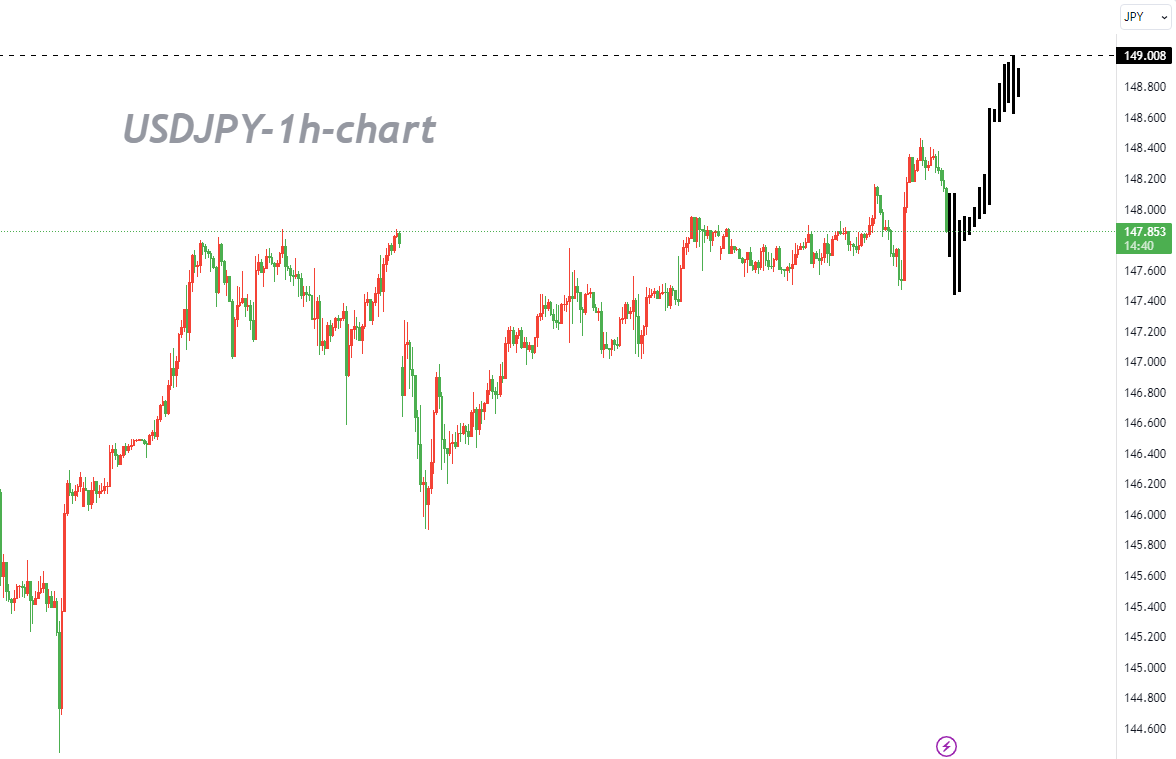
Over the past few weeks, the USDJPY pair has tested the 148.00 psychological level multiple times but without success. However, it made more progress in Thursday's trading, briefly surpassing that level before experiencing a significant retracement due to over-optimistic technical indicators.
Meanwhile, the stochastic oscillator has remained flat within the overbought territory, suggesting that a recent retracement is reasonable. On the other hand, the MACD trending mildly above the zero line indicates potential pressure on further price increases.
If the asset (as shown in the chart) can retrace to the previous starting point of the uptrend, further price gains will target the key 150.00 area, which includes the 161.8% Fibonacci retracement level of the July downtrend at 149.90.
However, the recent high at 148.46 resistance level may hold back the upward momentum. Prices could initially retreat to the 20-day SMA near 146.91 and then drop to the 145.00 level, where prices peaked at the end of June. If there is further decline, the asset could touch the 100-day SMA in the 142.00 range, which is positively correlated with the uptrend line from the March lows.
Overall, the USDJPY still has the potential to break above the previous high at 148.46 to consolidate its long-term uptrend. However, in the face of selling pressure, as long as prices remain above the shallower uptrend line starting from the January lows, the uptrend remains intact. In terms of trading strategy, buying the dips is recommended as the primary strategy.
Trading Recommendations
Trading Direction: Long
Entry Price: 147.40
Target Price: 148.90
Stop Loss: 144.40
Valid Until: 2023-10-05 23:55:00
Support: 146.99, 146.60, 145.69
Resistance: 147.95, 148.20, 148.84


